
You are using an out of date browser. It may not display this or other websites correctly.
You should upgrade or use an alternative browser.
You should upgrade or use an alternative browser.
This new charger lets all EVs plug in without an adapter
- Thread starter JournalBot
- Start date
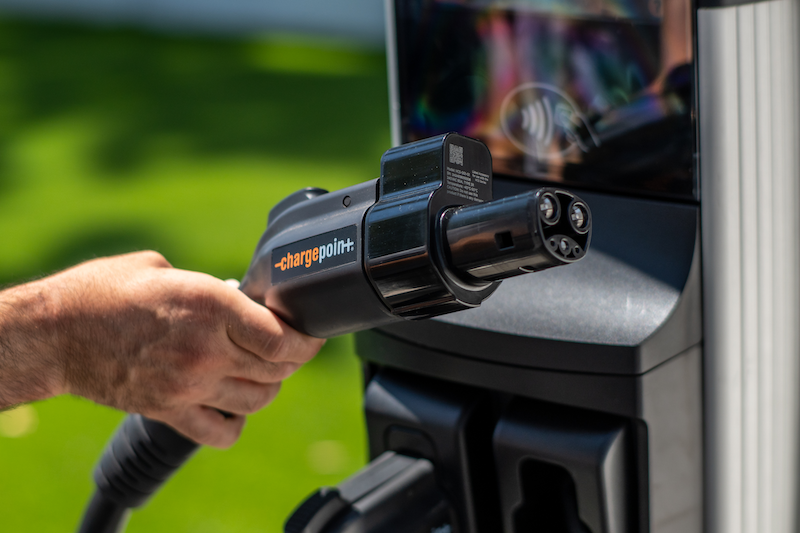
We aren’t moving to J3400 for elegance. We’re moving to J3400 because there are business deals in place for the move.Am I missing something or is that monstrosity in the photo completely missing why we're moving to J3400?!? It's 90% of the bulk of a CCS plug!
Elegance is an optional (and unimportant) side effect to manufacturers.
Upvote
5
(11
/
-6)

Statistical
Ars Legatus Legionis
My bad. Yeah confusing they are doing it for both L2 (AC charging) and Fast DC and using the name for both. More confusing the article is talking about Fast DC charging and then showing L2 photo.They're actually doing it to both types. The one in the photo is a L2 charger, and is a retrofit to a model that I use on a regular basis.
https://www.chargepoint.com/businesses/stations/cp6000
They are also doing this for CCS1 as well on the other model.
But the photo is for an L2 station. I have no idea why Ars choose to feature the L2 plug on their article's headline image. Its also in the file name: ChargePoint_Omni_AC-copy.png
Given how ubiquitous and cheap AC (L2) NACS to CCS adapters are I think the Fast DC will be more important. I have had a J1772 to NACS adapter in my glove box for almost a decade now. I never really use it because I rarely charge at public L2 chargers.
Upvote
2
(2
/
0)
It's ChargePoint's version of the Tesla's 'Magic Dock', but in reverse. The cable itself has a CCS connector on it. Then there's an adapter to NACS that the receptacle holds. Depending on which connector you select on the screen, it either dispenses only the cable or the cable with the adapter attached. Presumably you can't manually disconnect the adapter from the cable.
Seems like a reasonably elegant solution. Certainly compared to their existing solution of having a dedicated connector for each protocol on each station (CCS, CHAdeMO and Tesla/NACS)
The headline is also a bit misleading ('This new charger lets all EVs plug in without an adapter') - this solution doesn't work for CHAdeMO.
Would have been helpful for the article to show those photos (or a clip from the video) to make it clearer.
(Also, the reference to J1776 should probably read J1772).
Seems like a reasonably elegant solution. Certainly compared to their existing solution of having a dedicated connector for each protocol on each station (CCS, CHAdeMO and Tesla/NACS)
The headline is also a bit misleading ('This new charger lets all EVs plug in without an adapter') - this solution doesn't work for CHAdeMO.
Would have been helpful for the article to show those photos (or a clip from the video) to make it clearer.
(Also, the reference to J1776 should probably read J1772).
Upvote
12
(12
/
0)
I’m also in BC, and I don’t think I’ve ever encountered a dual charger. Lots of Tesla superchargers, though.Because we’ve had chargers with both connections and a pair of cables here just across the border in BC for years. Not every charger, but most that I’ve had to use are either the dual type, or Tesla superchargers.
Upvote
1
(1
/
0)
Statistical
Ars Legatus Legionis
We aren’t moving to J3400 for elegance. We’re moving to J3400 because there are business deals in place for the move.
Elegance is an optional (and unimportant) side effect to manufacturers.
But a better nicer plug is a nice bonus for consumers well for consumers not using the omni plug which looks like a portable heavy pulse rifle from a scifi movie.
Pew pew pew. The guy is looking at it confused like I am not sure I am licensed to operate high output energy weapons am I?
Last edited:
Upvote
26
(27
/
-1)

It will likely ironically be far more important for chademo users, as the pressure to remove the chademo cable on existing chargers to add an NACS one would likely be pretty big.My bad. Yeah confusing they are doing it for both L2 (AC charging) and Fast DC and using the name for both. More confusing the article is talking about Fast DC charging and then showing L2 photo.
Given how ubiquitous and cheap AC (L2) NACS to CCS adapters are I think the Fast DC will be more important. I have had a J1772 to NACS adapter in my glove box for almost a decade now. I never really use it because I rarely charge at public L2 chargers.
Built in adaptors are just more convient for both types of chargers. Most people for a while will be carrying around both most likely.
Upvote
1
(1
/
0)
Statistical
Ars Legatus Legionis
It will likely ironically be far more important for chademo users, as the pressure to remove the chademo cable on existing chargers to add an NACS one would likely be pretty big.
Built in adaptors are just more convient for both types of chargers. Most people for a while will be carrying around both most likely.
One more nail in the coffin for Chademo. I will use this a reminder for how sleazy it is that Nissan continues to sell the Leaf in 2024 with Chademo port.
Upvote
16
(16
/
0)
You had dual Tesla and CCS1 chargers? Tesla and J1772 dual/combo chargers existed here, but I can't think of any combo DCFCers.Wait, is this “new” new, or like its 2020 and America is kinda embracing chip and pin cards “new”?
Because we’ve had chargers with both connections and a pair of cables here just across the border in BC for years. Not every charger, but most that I’ve had to use are either the dual type, or Tesla superchargers.
So unless I’m missing something due to lack of caffeine this morning, I’m not seeing anything revolutionary here
Upvote
0
(0
/
0)
"Omni" actually made me thin they support every standard out there (for example also CHAdeMO), and the "new charger works without an adapted" made me think of some fancy morphing plug that somehow works in all connectors. The innovation seems to be they automatically give you the adapter as needed. I like simple, old school solutions but somehow the title and message of the article oversell the importance and innovation of the charger.
Upvote
6
(6
/
0)
Leaf owners who need ubiquitous quick charging now have a couple CCS->ChaDeMo adapter options on the market. They are around $1,000 since they require active electronics and expect relatively low-volume sales, but they are available and found to work with many current networks.One more nail in the coffin for Chademo. I will use this a reminder for how sleazy it is that Nissan continues to sell the Leaf in 2024 with Chademo port.
https://www.autoblog.com/2024/02/06/chademo-ccs-charging-adapter-nissan-leaf/
Upvote
6
(7
/
-1)
This article reminded me, GM was supposed to offer me a NACS adapter I thought as early as May. It's well in to August now. Not a shock, GM has had about as good a track record as Boeing in recent years, and breaking promises to Bolt owners just seems to be what their corporate team does to pass the time.
Upvote
3
(4
/
-1)
Okay now THAT makes good sense.Nope, you pull up, open the chargepoint app, say I'm using a CCS or J3400 and when you remove the charging cable it has the right end on it.
So the adapter returns to "inside" the charging machine and it basically rotates or attaches the proper adapter already attached to a single cable.
Upvote
2
(2
/
0)
Apple certainly agrees with you.Honestly, Lightning would be an awesome name for a charging connection.
Upvote
5
(5
/
0)
Might be able to place the blame on that at Tesla's door. The Ford adapter has seen some delays, though they are making it out to owners, because of lower production than anticipated. It's supposed to be sources from Tesla.This article reminded me, GM was supposed to offer me a NACS adapter I thought as early as May. It's well in to August now. Not a shock, GM has had about as good a track record as Boeing in recent years, and breaking promises to Bolt owners just seems to be what their corporate team does to pass the time.
Not sure if GM is getting theirs from Tesla or someone else.
Upvote
3
(4
/
-1)
Even Nissan recognizes the port is dead. But from a public good standpoint we need to keep those ports around for a long while. Especially without any sort of vendor approved adaptors. I don't think we should leave people behind in the transition.One more nail in the coffin for Chademo. I will use this a reminder for how sleazy it is that Nissan continues to sell the Leaf in 2024 with Chademo port.
I would really hope Nissan at some point will release a first party adaptor for them.
Upvote
2
(2
/
0)
But not quite as innovative as a pump with three buttons for 89, 91, and 95, and just a single hose.It's about as innovative as a pump with three hoses, for 95, 98 and Diesel.
Upvote
2
(4
/
-2)
Post content hidden for low score.
Show…
This is likely a problem is with Tesla, which is far less reliable. The delays occurred immediately after they fired the entire fucking supercharger division of the company.This article reminded me, GM was supposed to offer me a NACS adapter I thought as early as May. It's well in to August now. Not a shock, GM has had about as good a track record as Boeing in recent years, and breaking promises to Bolt owners just seems to be what their corporate team does to pass the time.
Without access to super chargers right now there is no reason to have an adaptor.
Upvote
1
(4
/
-3)
It really isn't that complicated.Any more complicated than this:
View attachment 87346
Then I'm out!
Kinda funny watching the cable/dongle wars happening outside the tech space.
Can you handle this?

Congrats, you can handle plugging in your car. If you can't, then you should not be driving a car.
Upvote
20
(20
/
0)
Wrong. Not a pair of cables, it is exactly the opposite of this sentence. They created a nesting plug interface that is "chosen" upon starting the charge process.ChargePoint didn't create a new plug that fits into J1772, CCS1, and J3400 (originally NACS) sockets. Instead, like Tesla's Magic Dock Superchargers, the Omni Port features a pair of cables.
Upvote
8
(8
/
0)
magnetic latch relays for high current charge applications are mature and cheap technology (pretty standard in marine battery charging solutions). it would be simple to engineer a reliable solution that connects / disconnects the appropriate connector off a simple 12v signal wire using nothing but off the shelf retail parts.There is slightly more to that. Designing a connector to handle the power levels of DC fast charging while also automatically selecting the correct adapter and making it seamless to the user is a pretty big accomplishment.
Not everything has to be the biggest technological achievement, making something boring, reliable, and intuitive is really what we need to be striving for with charging at the moment.
Here is a marine version intended for 12-24v 500A applications, but rated for up to 700V. It retails for around $300
https://www.bluesea.com/products/76...rging_Relay_with_Manual_Control_-_12V_DC_500A
this would be a drop in ready off the shelf part for $300 (retail) that could be used to turn on & off the different cables coming out of the charger. I'm sure you could buy them in bulk for a LOT cheaper
Upvote
-2
(0
/
-2)
I think the key is the ability to retrofit existing chargers with it.. I would hope any future solutions designed from the ground up would be NACS first."Legally distinct Magic Dock"
Good to see someone else making it happen, but they did it the wrong way around IMO. One of the perks of NACS is the smaller, more elegant handle/plug. This combines all of the bulky negatives of CCS with the added bulk of the adapter.
Upvote
2
(2
/
0)
The point is these units are already in the field. They can be retrofitted with this rather than replaced and serve more cars easily.magnetic latch relays for high current charge applications are mature and cheap technology (pretty standard in marine battery charging solutions). it would be simple to engineer a reliable solution that connects / disconnects the appropriate connector off a simple 12v signal wire using nothing but off the shelf retail parts.
Here is a marine version intended for 12-24v 500A applications, but rated for up to 700V. It retails for around $300
https://www.bluesea.com/products/76...rging_Relay_with_Manual_Control_-_12V_DC_500A
this would be a drop in ready off the shelf part for $300 (retail) that could be used to turn on & off the different cables coming out of the charger. I'm sure you could buy them in bulk for a LOT cheaper
Upvote
2
(2
/
0)
J3400 is an open standard.. the business deals you're mentioning are for access to the Tesla supercharger network and plug-and-charge billing.We aren’t moving to J3400 for elegance. We’re moving to J3400 because there are business deals in place for the move.
Elegance is an optional (and unimportant) side effect to manufacturers.
Access to superchargers is a huge consumer win regardless.
Upvote
6
(6
/
0)
Post content hidden for low score.
Show…
The article text is quite misleading IMO. It talks about 2 connectors, a pair of cables, and a selection process that releases the correct one. It never explicitly mentions there being an adaptor on the end.
Maybe the 'like magic dock ... Pair of cables' sentence is a typo? Because magic dock Tesla stations don't have a pair of cables.
Maybe the 'like magic dock ... Pair of cables' sentence is a typo? Because magic dock Tesla stations don't have a pair of cables.
Upvote
6
(6
/
0)
Leaf owners who need ubiquitous quick charging now have a couple CCS->ChaDeMo adapter options on the market. They are around $1,000 since they require active electronics and expect relatively low-volume sales, but they are available and found to work with many current networks.
https://www.autoblog.com/2024/02/06/chademo-ccs-charging-adapter-nissan-leaf/
I know some people won't agree but I really don't think much is being lost for CHAdeMO users. Gen 1 Leafs are almost pointless to quick charge. Relatively slow quick charging and limited range make quick charging really unpractical even if you do actually have the charging port, which was optional for the entire life of the Gen 1. Even the Gen 2 Leaf + just make it up to the passable level in good situations. 200+ nominal range so 150+ mile quick charge stops are possible but topping out at ~70kW it's still going to be 30 -45 minute stop for that charging.
Leafs have a lot more limitations in quick charging than just the availability of chargers and an adapter doesn't solve any of those. Low max charging rate makes for a pretty slow, quick charging experience and the ratio of drive time to charge time pretty poor. It's pretty much the road trips sucks example, along with the Bolt, that EV haters use. Add on top of that the lack of thermal management for the battery and you are both risking battery damage long term from the heat of quick charging and potentially even pushing the car into turtle mode (limited power) while driving and/or ending up with your second or third quick charge stop for the day maxing out at 20kW or something low like that to keep battery temperature happy. The slow quick charge stops are bad enough but when they get even slower because of battery temperature it's even worse.
IMO if you are even considering the 1k adapter you have vehicle really poorly suited for your needs. You don't spend 1k on something you might use at some point or just in case you need it. You spend 1k because you know you will need it and use it with some regularity which means somewhat regular fast charging and the Leaf just isn't a great car for that. We love ours. It's a great little car and perfect for our local needs but it is a local only car.
Upvote
5
(7
/
-2)
Poe's law. People seriously say shit as stupid as what you said, even if you meant it in jest.Jokes don't work for you do they?
May want to take stuff a bit less seriously.
Speaking of taking a joke, I literally posted a picture of a baby playing with a toy to demonstrate how simple plugging in an EV is.
Upvote
11
(12
/
-1)
Imagine that the somewhat clickbaity nature of the title "now without an adapter!!!" accompanied the understanding that... "it comes with 2 cables", which is probably the least innovative way to solve this problem. At least the fancier "attached adapter as needed" is a bit more interesting.Wrong. Not a pair of cables, it is exactly the opposite of this sentence. They created a nesting plug interface that is "chosen" upon starting the charge process.
Upvote
-1
(0
/
-1)
“I select what I want and it releases the cable I need” sounds like exactly the sort of solution that works great on installation and then breaks a couple years later and never gets fully fixed.
Upvote
4
(5
/
-1)

One complaint regarding the CCS Combo 1 plug and socket was that the weight of the cable could cause poor connectivity with the control pins, resulting in various errors. Both the Tesla and CCS Combo 2 plugs and sockets use a better locking mechanism, so they have fewer connectivity problems.I don't understand why people are so against the bulk of the CCS plug. Sure the Tesla is sexier but it's not like I'm carrying the thing around with me all day-- it's attached to the charger.
Given how common Tesla chargers are in Canada, Mexico, and the US and how rare residential three-phase AC power is in much of North America, that was a big factor driving the change to NACS instead of Combo 2.
edit: clarification
Last edited:
Upvote
6
(7
/
-1)

Nope, I don’t think you are missing anything. The state of the EV ecosystem in America has been hamstrung by a weak federal government (by slave-state founder design!) Thanks to Musk and the Japanese refusing to adhere to the standard here the way they did in Europe we have a mishmash of crap payment systems and three charging plugs. Charging stations have been allowed to get away with malicious compliance, minimal viable product, and zero maintenance.Wait, is this “new” new, or like its 2020 and America is kinda embracing chip and pin cards “new”?
Because we’ve had chargers with both connections and a pair of cables here just across the border in BC for years. Not every charger, but most that I’ve had to use are either the dual type, or Tesla superchargers.
So unless I’m missing something due to lack of caffeine this morning, I’m not seeing anything revolutionary here
Notice it’s also news that the chargers have cables long enough to reach the cars’ plugs.

Talking about malicious compliance, all the car makers have been sabotaging their own EV sales by producing ugly overpriced econoboxes, selling only in certain states, removing stalks and buttons and handles, even reinventing the wheel.
Upvote
-7
(2
/
-9)

Poe's law. People seriously say shit as stupid as what you said, even if you meant it in jest.
Speaking of taking a joke, I literally posted a picture of a baby playing with a toy to demonstrate how simple plugging in an EV is.
ok.
Upvote
-14
(0
/
-14)
What about the other CCS charging standard in Europe that Tesla uses there?One complaint regarding the CCS Combo 1 plug and socket was that the weight of the cable could cause poor connectivity with the control pins, resulting in various errors. Both the Tesla and CCS Combo 2 plugs and sockets use a better locking mechanism, so they have fewer connectivity problems.
Given how common Tesla chargers are in Canada, Mexico, and the US and how rare residential three-phase AC power is in much of North America, that was a big factor driving the change.
Upvote
-4
(0
/
-4)
The "road trips suck" is FUD for vehicles like the Bolt. While I don't think you'd want to take it for a coast-to-coast trip, most trips aren't that. I took mine to see the eclipse and to a wedding. Both trips didn't involve that much charging time, outside not having a hotel with a L2 charger for the eclipse.I know some people won't agree but I really don't think much is being lost for CHAdeMO users. Gen 1 Leafs are almost pointless to quick charge. Relatively slow quick charging and limited range make quick charging really unpractical even if you do actually have the charging port, which was optional for the entire life of the Gen 1. Even the Gen 2 Leaf + just make it up to the passable level in good situations. 200+ nominal range so 150+ mile quick charge stops are possible but topping out at ~70kW it's still going to be 30 -45 minute stop for that charging.
Leafs have a lot more limitations in quick charging than just the availability of chargers and an adapter doesn't solve any of those. Low max charging rate makes for a pretty slow, quick charging experience and the ratio of drive time to charge time pretty poor. It's pretty much the road trips sucks example, along with the Bolt, that EV haters use. Add on top of that the lack of thermal management for the battery and you are both risking battery damage long term from the heat of quick charging and potentially even pushing the car into turtle mode (limited power) while driving and/or ending up with your second or third quick charge stop for the day maxing out at 20kW or something low like that to keep battery temperature happy. The slow quick charge stops are bad enough but when they get even slower because of battery temperature it's even worse.
IMO if you are even considering the 1k adapter you have vehicle really poorly suited for your needs. You don't spend 1k on something you might use at some point or just in case you need it. You spend 1k because you know you will need it and use it with some regularity which means somewhat regular fast charging and the Leaf just isn't a great car for that. We love ours. It's a great little car and perfect for our local needs but it is a local only car.
I know it adds about 20 minutes on a trip to my parents, where I start full, and end with 10% left. I have one charging stop in the middle, which replaced a refueling and bathroom stop. Sometimes more coming back, but that is because I only have L1 charging at my parents, so I can't always get a 100% charge on a weekend trip. So for something like this a Leaf I'm sure does fine.
Now, the lack of better thermal management is a problem for the Leaf. But if it is good enough for someone's long distance needs, then it is good enough for their long distance needs. Not everyone can afford multiple vehicles.
There is nothing else new right now in that price range, at least until the generation 2 Bolts come out.
Upvote
10
(10
/
0)
What about the other CCS charging standard in Europe that Tesla uses there?
CCS2 is the "other CCS charging standard". Both CCS1 and CCS2 are 2 DC Fast charging pins added to the local fast AC charging standard. Europe's AC charging standard is different because 3 phase power is common and AC charging needed to support that which means more pins for AC charging.
Upvote
6
(6
/
0)
That is probably going to be a problem with NACS cables once they get longer. A lot of the weight issues with CCS1 cables comes from the fact they're significantly longer than the Tesla cables. Sadly EV's don't have a standard charging port location.One complaint regarding the CCS Combo 1 plug and socket was that the weight of the cable could cause poor connectivity with the control pins, resulting in various errors. Both the Tesla and CCS Combo 2 plugs and sockets use a better locking mechanism, so they have fewer connectivity problems.
Given how common Tesla chargers are in Canada, Mexico, and the US and how rare residential three-phase AC power is in much of North America, that was a big factor driving the change.
Really I wish this is something the industry could have standardized.
Upvote
6
(6
/
0)
I don’t really see the innovation. We’ve had the Tesla universal wall connector https://shop.tesla.com/product/universal-wall-connector and it’s less bulky.
Upvote
-4
(0
/
-4)
Magic dock doesn't have a seperate CCS cable hence the "dock" and "magic". This is essentially a reversed magic dock. I do agree though the article either missed the point or it was worded terribly.
The idea is both NACS and CCS1 charging using a SINGLE cable. The photos show multiple cables because the are chargers to support two cars at the same time.
View attachment 87338
The charger on the left can be either CCS1 or NACS. The charger on the right can also be CCS1 or NACS.
That point is escaping a lot of posters.
Upvote
3
(3
/
0)