
You are using an out of date browser. It may not display this or other websites correctly.
You should upgrade or use an alternative browser.
You should upgrade or use an alternative browser.
General Motors drops entry-level Blazer EV as deliveries begin
- Thread starter JournalBot
- Start date
They did it with the Bolt, but then couldn't deliver to meet the demand. Partly, at least, because they at best broke even on the car. It was, as small cars usually are, a loss-leader to get traffic into the dealers where people could be upsold into a more profitable truck. That fact that many Bolt buyers actually wanted a smallish, affordable EV, not a truck, seems to have escaped the marketers, but definitely impacted the supply chain.GM pulls a Tesla, and drops the price to take advantage of the EV tax credit?
Upvote
1
(1
/
0)
HoneyMustard
Seniorius Lurkius
The news of a higher starting price might have bothered me as I think it's a slick looking vehicle and I was looking forward to considering it for a future purchase. The announcement to remove CarPlay completely killed that. I am not interested in the slightest.
Upvote
5
(5
/
0)

Statistical
Ars Legatus Legionis
More likely, GM lobbyists ram through a change in the law raising the threshold for the tax credit so all $65K EVs (not just pickup trucks) qualify. Tesla raises prices overnight and profits. The rest, finally, break even.
The Blazer is a truck (at least for tax credit purposes) it already qualifies for the tax credit. When people say there is a lower max price for cars it is litterally cars as in sedans and hatchbacks. CUV, SUV, Trucks, Minivans, Land Dreadnaughts, etc all qualify for the higher "truck" price limit.
Realistically there should only be one limit. If someone wants to buy a luxury car instead of a luxury truck shouldn't we encourage that. Currently they would not qualify unless they upgrade to a larger vehicle which is just a painfully stupid scenario to create.
Upvote
5
(5
/
0)

Timtheenchanter
Ars Tribunus Militum
Sure, it is as simple as stacking blocks in a box, good luck to them! I’m sure it will go as well as the Bolt did.GM is not new to EVs, though, and it has a pretty deep bench with lots of institutional knowledge.
Upvote
-8
(2
/
-10)
How did the Bolt go badly? Yes, there was an issue with the batteries, which is irrelevant because they're transitioning to the Ultium component set; do you assume they somehow are incapable of incorporating lessons learned? Otherwise the Bolt is a popular, affordable, well-thought-of car.Sure, it is as simple as stacking blocks in a box, good luck to them! I’m sure it will go as well as the Bolt did.
Upvote
8
(9
/
-1)
Statistical
Ars Legatus Legionis
How did the Bolt go badly? Yes, there was an issue with the batteries, which is irrelevant because they're transitioning to the Ultium component set; do you assume they somehow are incapable of incorporating lessons learned? Otherwise the Bolt is a popular, affordable, well-thought-of car.
Also I would add the issue with the batteries was not the fault of GM. It was a manufacturing defect by the battery supplier. If Panasonic had a similar defect in the cells supplied to Tesla then Tesla would have suffered a similar recall.
I give GM flack for being dysfunctional in killing the Volt and then Bolt without a suitable replacement ready but the cell failures were not their fault. They partnered with a believed to be reliable battery cell supplier who supplied them defective product. It caused catastrophic damage to their production just at a time they were trying to ramp up volumes. They handled it about as well as can be expected.
Last edited:
Upvote
11
(11
/
0)
One can only hope it will go as "badly" as the Bolt did. The most popular BEV in the United States behind Tesla, and also the most affordable BEV on the market.Sure, it is as simple as stacking blocks in a box, good luck to them! I’m sure it will go as well as the Bolt did.
Upvote
8
(8
/
0)
GM was also not the only manufacturer affected. The bad cells were put into packs for other automakers as well.Also I would add the issue with the batteries was not the fault of GM. It was a manufacturing defect by the battery supplier. If Panasonic had a similar defect in the cells supplied to Tesla then Tesla would have suffered a similar recall.
I give GM flack for being dysfunctional in killing the Volt and then Bolt without a suitable replacement ready but the cell failures were not their fault. They partnered with a believed to be reliable battery cell supplier who supplied them defective product. They handled it about as well as can be expected.
Upvote
4
(4
/
0)
True. Another one affected was Hyundai, with most Konas built in a similar timeframe as the early Bolts needing a similar recall. Difference is that GM's production volume was considerably higher than Hyundai's (at least for the US), so the recall had a larger impact in the market, and Hyundai was able to shift to a different supplier to keep the production line running while GM had to shut everything down for an extended time.GM was also not the only manufacturer affected. The bad cells were put into packs for other automakers as well.
LG is also the battery supplier for Ultium, at least so far. There seem to be some production issues happening there, too, though hopefully nothing fire-provoking. Hand-building batteries is not going to scale well...
Upvote
2
(2
/
0)
Timtheenchanter
Ars Tribunus Militum
As I recall, it was an amazing success story when GM had to tell their customers not to park their bolts near their homes because their car might burst into flames. Then they had lots of happy customers calling them to get their battery packs replaced over a year or so. Even though LG took the blame and shouldered most of the $2B costs for replacement - because remember that was an LG designed and manufactured battery pack - it was not exactly great story for GM and it totally haulted production for like a year.How did the Bolt go badly? Yes, there was an issue with the batteries, which is irrelevant because they're transitioning to the Ultium component set; do you assume they somehow are incapable of incorporating lessons learned? Otherwise the Bolt is a popular, affordable, well-thought-of car.
So if they have a similar fuckup with Ultium, it is going to be GM footing the bill most likely.
Upvote
-9
(1
/
-10)
In fairness, Tesla is now just over 10% of global EV sales. So the big OEMs are together selling way more EVs, just not each one individually.I don't disagree it is just disappointing. Tesla has the battery production capacity to produce 2M+ vehicles a year. Nothing they did over the last decade would have been impossible for the big OEMs to do as well.
Building those supply chains could definitely have been accelerated, but I think it's dubious to say others could have followed the same path as Tesla, given the limited demand for vehicles that cost anywhere near Tesla's average ASP over the last 10 years.
Realistically, if the big OEMs had jumped in, I expect that the total volume of EVs sold in that time period would only have been marginally more, they would mainly be branded as luxury marques, and Tesla would likely have been strangled in the crib as a result.
Upvote
3
(5
/
-2)
Jeffro-Tull
Ars Scholae Palatinae
Or, phrased slightly differently, because “fuck you,” that’s why.So far, the evidence points to capitalism.
Upvote
4
(4
/
0)
If you're in the US, you'll first need to convince the federal regulators to increase the Low-Speed Vehicle (LSV) top speed of "about 25 mph".if only it did 40mph I'd be very interested in this for exactly what it is. 28mph is just a little too slow to my mind.
Upvote
3
(3
/
0)
This is a ridiculous comparison, because the price of an average new car has skyrocketed over the past 4 years. It's not that EVs are becoming much more affordable, it's that the entire market is becoming less affordable.This is GM bullshit passed on without criticism by the author. EVs have been getting less expensive this year, as evident in Tesla pricing but also at Ford and VW.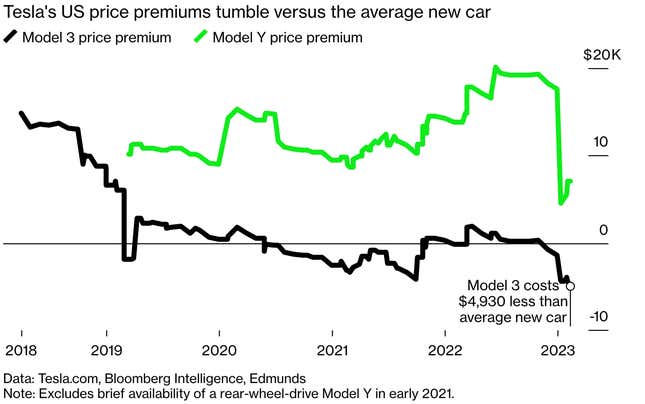
What do you want to bet that the “Equinox EV (which is meant to start around $30,000)” turns out to be $50,000 when they actually start delivering?
This news is more evidence that things are not going well with the Ultium platform.
Upvote
4
(5
/
-1)
Edit: the OP's graph could probably be used in an elementary statistics (or, better, marketing) class as an example of how to lie with pretty lines - make it look good, but leave out necessary context.This is a ridiculous comparison, because the price of an average new car has skyrocketed over the past 4 years. It's not that EVs are becoming much more affordable, it's that the entire market is becoming less affordable.
The price of the average GM EV will skyrocket after this fall, to well above the average new vehicle price. Until then, selling mostly Bolts and SUVs, it's going to be way below the average price. So there should be a significant unconformity in the graph for GM. Until the lower-trim Equinox EVs arrive (likely late next year, at the rate battery production is not ramping up), GM won't have a EV below $45-50K.
Rereading the comments here and in other publications, and given the conspicuous lack of clarity in GM's pronouncements, I don't expect a Bolt replacement (i.e. something affordable, usable as an only car or nearly so, and smaller/more efficient than an Equinox) before 2025 or 2026. More likely 27-28 with Honda. I'd love to be wrong on the sooner and more Boltish side.
Edit: do you suppose that Mary could be talking about taking all those buybacks, finishing the battery replacements, and flooding the CPO market with them?
Dropping Tesla bare-bones Model 3 prices below $40K finely sands the lower edge of the price range, but nobody else is picking up where the Bolt left off (below $30K), at least in volume production (sorry, nothing from Fisker is arriving soon or in any realistic quantity, even if you would dare buy one of their launch-month vehicles considering the old Karma's problems). Hyundai still isn't producing EVs in enough quantity to satisfy demand in any price range, especially the Kona in the mid-upper $30Ks. All that's left at the very low end after the Bolt departs is the Leaf, which in the extended range version is over $30K and is not long for this world either. Or maybe a compliance car like the Mini, though as a low-end BMW I don't expect any fantastic deals there.
Upvote
8
(8
/
0)
It's classic GM. They have maybe the most impressive engineering group in the world, widely recognized as such. The Volt was a mature, well-sorted product a decade before its time. The Bolt was affordable, had 250 miles of real-world range, and again delivered a good car with good specs and good range ahead of the rest of the market. But they freak out and kill models when they don't beat sales expectations, particularly when they fail to effectively market those products to begin with. And they also commit unforced errors like making the Bolt kind of practical and dowdy and not making the second gen Volt a crossover.Also I would add the issue with the batteries was not the fault of GM. It was a manufacturing defect by the battery supplier. If Panasonic had a similar defect in the cells supplied to Tesla then Tesla would have suffered a similar recall.
I give GM flack for being dysfunctional in killing the Volt and then Bolt without a suitable replacement ready but the cell failures were not their fault. They partnered with a believed to be reliable battery cell supplier who supplied them defective product. It caused catastrophic damage to their production just at a time they were trying to ramp up volumes. They handled it about as well as can be expected.
So they get great product designed breathtakingly well, but the marketers and product planners couldn't sell water to a dying man crawling across a desert, and when they luck into a couple drums of Gatorade, they pour the shit out in the sand because they can't see any more dying guys. It's fucking frustrating.
Last edited:
Upvote
8
(8
/
0)
Timtheenchanter
Ars Tribunus Militum
The entire market became more expensive because automakers reduced the number of inexpensive vehicles they were selling, and we had inflation.This is a ridiculous comparison, because the price of an average new car has skyrocketed over the past 4 years. It's not that EVs are becoming much more affordable, it's that the entire market is becoming less affordable.
The EV situation is very different, average cost of EVs declined this year. Commodity prices for things in EV batteries dropped a lot. Tesla is no longer just competing for EV market share, they are trying for market share from Toyota and other ICE manufacturers, so they had to drop prices so that people shopping for RAV4s or CRVs might instead buy a Y. Most of the rest also dropped prices on EVs.
So GM’s explanation “The loss of the cheapest Blazer EV is more evidence of the ever-increasing cost of EVs…” is bullshit. They are not increasing at Tesla, VW and Ford. No one is going to buy these blazers when they can buy an excellent Mach E or id4 for over $10k less. This will be a disaster at these prices.
Upvote
2
(6
/
-4)
I can tell you that $300K is not top 5% in markets like Seattle. It may be on the high end of middle class but still not wealthy. houses are around $800K and up.Only in America, can you have a household income of $300k, putting you in the top 5%, and still call yourself middle class.
Upvote
-1
(2
/
-3)
New cars in general are not affordable for poor people and never have been. That is where the used market comes in. The $4K used EV credit helps for some people.In 10 years there will be millions of old BEV's for those on lower incomes to buy. BEV's were never going to be affordable for the poor when new anyway.
Upvote
2
(2
/
0)
Upvote
-1
(2
/
-3)
GM's task is not a bigger scale than Tesla unless you count figuring out how to wind down all existing non-electric production. Tesla has laid out their plans for expansion that will have them selling 20 million EVs by 2030, and they've been executing quite well on their 50% year-over-year growth targets for several years now.Again, GM's task is much bigger scale than Tesla. These things take time. Tesla's entire global production (of all 4 models combined) is merely double the number of Silverados and Sierras GM produces for North America alone. That's not including any other sedans, SUVs, crossovers, or smaller trucks. GM is scaling up to electrify their entire lineup by 2035.
Those 36k EVs you mentioned do not include all of the Ultium EVs being produced inside China for the Chinese market. This is a common and annoying mistake commenters always make defending Tesla, comparing Tesla globally to other automakers only in one market.
The Model 3 launch was rightly derided as a disaster. Elon Musk himself has stated on multiple occasions that the botched Model 3 launch nearly bankrupted the company, and they still haven't fully fixed the mistakes made back in 2018. If they had, they wouldn't still be building cars in a "temporary" structure in the parking lot of Fremont.
Upvote
0
(3
/
-3)
TimeToTilt
Ars Tribunus Militum
3k ultium delivered on sis months is bad and you don't have to compare it to anyone to recognize that.Again, GM's task is much bigger scale than Tesla. These things take time. Tesla's entire global production (of all 4 models combined) is merely double the number of Silverados and Sierras GM produces for North America alone. That's not including any other sedans, SUVs, crossovers, or smaller trucks. GM is scaling up to electrify their entire lineup by 2035.
Those 36k EVs you mentioned do not include all of the Ultium EVs being produced inside China for the Chinese market. This is a common and annoying mistake commenters always make defending Tesla, comparing Tesla globally to other automakers only in one market.
The Model 3 launch was rightly derided as a disaster. Elon Musk himself has stated on multiple occasions that the botched Model 3 launch nearly bankrupted the company, and they still haven't fully fixed the mistakes made back in 2018. If they had, they wouldn't still be building cars in a "temporary" structure in the parking lot of Fremont.
And June was the first month GM delivered any Ultium power trains in China from what I can see. 3500 buick SUVs... So again barely above vaporware.
IDK why you feel the need to defend GM on this. What I'm saying about Ultium being massively behind and almost non-existent isn't particularly offensive, it's factual.
Upvote
-2
(2
/
-4)

Really? Is a Japanese thing to like seat warmers maybe? I'm around a lot of Acura, Mazdas and Subarus and they all have seat warmers (and some steering wheel) and they aren't even the top trims. Being in TN I initally scoffed but seat warmers are also good for dad-back after-playing-in-the-floor-for-an-hour.
Again, I am talking about REAR seat heaters.
Upvote
5
(5
/
0)
TimeToTilt
Ars Tribunus Militum
Tesla was 13% if you look at bev and phev. In bev only though they were 18% and BYD plus SAIC were 22%. Combined that puts the BEV market at 40~% in just the 3 upstarts in the top 3 positions. I don't think that implies the big oems are doing well at all especially because that remaining sixty percent is not all what we call big oems.In fairness, Tesla is now just over 10% of global EV sales. So the big OEMs are together selling way more EVs, just not each one individually.
Building those supply chains could definitely have been accelerated, but I think it's dubious to say others could have followed the same path as Tesla, given the limited demand for vehicles that cost anywhere near Tesla's average ASP over the last 10 years.
Realistically, if the big OEMs had jumped in, I expect that the total volume of EVs sold in that time period would only have been marginally more, they would mainly be branded as luxury marques, and Tesla would likely have been strangled in the crib as a result.
If BEVs are the future of cars then the big oems are in bad shape. I'm curious when we will see someone like byd expand to America. We seem overdue for an emerging market auto upstart to show up.
Upvote
-3
(1
/
-4)
Dyskresiac
Ars Tribunus Militum
Weird article. They're keeping the bolt. So what is the point of this car if it is redundant with the Bolt, a car people actually want?
Upvote
-7
(0
/
-7)
Deathmonkey
Ars Tribunus Militum
Again, I am talking about REAR seat heaters.
Any idea if the lack of heated rear seats is just a US only feature removal? For instance the 2024 Kia Seltos can be spec'd to have heated rear seats in Canada but not the US.
Upvote
1
(1
/
0)
TimeToTilt
Ars Tribunus Militum
Pretty sure what started this off was someone saying rear seats should be standard equipment? Could be wrong though it's been a long thread.Any idea if the lack of heated rear seats is just a US only feature removal? For instance the 2024 Kia Seltos can be spec'd to have heated rear seats in Canada but not the US.
Upvote
0
(0
/
0)
Because the Bolt is still going away at the end of this year. GM has said they will bring the Bolt back, at some yet unannounced date. Could be next year, could be 2030, for all they've said.Weird article. They're keeping the bolt. So what is the point of this car if it is redundant with the Bolt, a car people actually want?
Upvote
2
(2
/
0)
Tesla's "laid out plans" are essentially exponential growth for the foreseeable future and have been since the first vehicle produced. That's not realistic or sustainable. Eventually they will hit a ceiling, whether due to uncompetitive features, pricing, or simply brand loyalty by consumers.GM's task is not a bigger scale than Tesla unless you count figuring out how to wind down all existing non-electric production. Tesla has laid out their plans for expansion that will have them selling 20 million EVs by 2030, and they've been executing quite well on their 50% year-over-year growth targets for several years now.
How do I know it's unrealistic? Because 20 million EVs annually is double the 2022 global sales of Toyota, the world's largest automaker. And total vehicle sales have been slowing or declining for the last 10 years, as wealthy countries hit saturation and vehicles are of better quality so they last longer. Barring quality falling off a cliff at every automaker in the world, the market for Tesla alone is not going to expand to 20 million.
Last edited:
Upvote
1
(4
/
-3)

AmanoJyaku
Ars Tribunus Angusticlavius
Weird article. They're keeping the bolt. So what is the point of this car if it is redundant with the Bolt, a car people actually want?
Why should GM sell only one low-cost BEV? They have at least 4 ICEs at similar prices as the Bolt.
Upvote
2
(2
/
0)
I know why the entire market became more expensive, thanks. I'm just saying that your chart is wildly misleading without taking that into account. If the prices of EVs have dropped in inflation adjusted dollars, post a chart showing that. Keep in mind that the most affordable, decent EV on the market is about to go away for an indeterminate amount of time and that's going to significantly affect that chart in a few months.The entire market became more expensive because automakers reduced the number of inexpensive vehicles they were selling, and we had inflation.
The EV situation is very different, average cost of EVs declined this year. Commodity prices for things in EV batteries dropped a lot. Tesla is no longer just competing for EV market share, they are trying for market share from Toyota and other ICE manufacturers, so they had to drop prices so that people shopping for RAV4s or CRVs might instead buy a Y. Most of the rest also dropped prices on EVs.
Also, the current Model 3 starts at an inflation-adjusted price that is equivalent to the $35k Model 3 that they promised and barely delivered years ago. Except that people's wages haven't kept pace with inflation. So $40k plus now is generally less affordable than $35k then.
Upvote
3
(3
/
0)
Timtheenchanter
Ars Tribunus Militum
“Keeping the bolt” in that a vehicle with that name is to appear in the future (1 year, 2 years?), maybe at a different price point. Bolt was a compact hatch, and Bolt euv was a tiny compact suv like a Niro or Kona, this blazer is more like a mach-e or model y size I believe.Weird article. They're keeping the bolt. So what is the point of this car if it is redundant with the Bolt, a car people actually want?
Upvote
-2
(0
/
-2)
Timtheenchanter
Ars Tribunus Militum
Did you look at that chart? Tesla prices declined in real dollars costs. Plotted against average vehicle costs, you can see that teslas “premium“ over average car price dropped. So you are not challenging that that is accurate, or that something distorting is going on like average vehicle costs skyrocketed while teslas stayed the same? So why then is that chart misleading? Why am I wrong in disagreeing with the line in the article, that EV costs are ever increasing?I know why the entire market became more expensive, thanks. I'm just saying that your chart is wildly misleading without taking that into account. If the prices of EVs have dropped in inflation adjusted dollars, post a chart showing that. Keep in mind that the most affordable, decent EV on the market is about to go away for an indeterminate amount of time and that's going to significantly affect that chart in a few months.
Also, the current Model 3 starts at an inflation-adjusted price that is equivalent to the $35k Model 3 that they promised and barely delivered years ago. Except that people's wages haven't kept pace with inflation. So $40k plus now is generally less affordable than $35k then.
Upvote
-5
(0
/
-5)
If the average car price increased (which it did), and Tesla's prices stayed the same, that line on your graph would still drop. It doesn't convey whether Tesla prices have dropped or not. I know that they have, but the chart doesn't say what you said it does. The drop versus the average car price is a much steeper line than the drop in absolute dollars and is misleading if you're talking about how EVs are becoming cheaper.Did you look at that chart? Tesla prices declined in real dollars costs. Plotted against average vehicle costs, you can see that teslas “premium“ over average car price dropped. So you are not challenging that that is accurate, or that something distorting is going on like average vehicle costs skyrocketed while teslas stayed the same? So why then is that chart misleading? Why am I wrong in disagreeing with the line in the article, that EV costs are ever increasing?
Also, when GM talks about cost, they're not talking about the MSRP, they're talking about how much it costs to build them. Tesla's margins have dropped because of their price drops, and Ford is losing money.
Upvote
4
(4
/
0)
Again: if you think that's relevant, you're choosing to ignore context and facts in order to throw a Tesla competitor against the wall, as you nearly always choose to do. LG took the blame because it was to blame. That could have happened to any manufacturer or any battery supplier, including Tesla.As I recall, it was an amazing success story when GM had to tell their customers not to park their bolts near their homes because their car might burst into flames. Then they had lots of happy customers calling them to get their battery packs replaced over a year or so. Even though LG took the blame and shouldered most of the $2B costs for replacement - because remember that was an LG designed and manufactured battery pack - it was not exactly great story for GM and it totally haulted production for like a year.
So if they have a similar fuckup with Ultium, it is going to be GM footing the bill most likely.
Upvote
7
(7
/
0)
Just to be clear, the Blazer was never going to compete with the "Select" level in the image. It was upmarket from there, starting around the "Premium" level. Now it's going to start in-between "Premium" and "Route 1" and the higher-trim Equinox will cover the basic "Premium" level as well as "Select." The Equinox base (1LT) will likely end up higher than the original "around $30K" target - I'm guessing about $35K for a loss-leader.The entire market became more expensive because automakers reduced the number of inexpensive vehicles they were selling, and we had inflation.
The EV situation is very different, average cost of EVs declined this year. Commodity prices for things in EV batteries dropped a lot. Tesla is no longer just competing for EV market share, they are trying for market share from Toyota and other ICE manufacturers, so they had to drop prices so that people shopping for RAV4s or CRVs might instead buy a Y. Most of the rest also dropped prices on EVs.
So GM’s explanation “The loss of the cheapest Blazer EV is more evidence of the ever-increasing cost of EVs…” is bullshit. They are not increasing at Tesla, VW and Ford. No one is going to buy these blazers when they can buy an excellent Mach E or id4 for over $10k less. This will be a disaster at these prices.
View attachment 60395
The Really Affordable EV will almost certainly end up as something with the resurrected Bolt name, at around $30K as commonly equipped (stripped base likely in the high $20Ks), but we don't really know when it will arrive or what it will look like. I'd love to see a Boltamino!
GM clearly is trying to make sure that there's not much, if any, overlap between EV product lines. The old days of the top trips of one line overlapping base trims of the next higher one appear to be over. With the pickup trucks off in a parallel space.
Unless Ford has something up its sleeve like a EV Focus or Escape that can cover 200-250 miles/full charge and has actual fast DC charging, they won't be competing at the Bolt pricing level. Delivering a bunch of high-priced pickup trucks is a good way to improve the prospects for a per-unit profit, but the market is bigger than that and ultimately all vehicle types and sizes need to be electrified including a full-EV option.
Upvote
4
(4
/
0)
The Blazer does not really compete with the entry-level ID.4 and Mach E, though I'd argue the Ford punches above its weight. That's what the Equinox EV is for, and it's starting at the same price they are. The Blazer is going to come standard with AWD and I expect it will directly compete more with the GV60, Polestar 2, ID.6, XC40/C40, and maybe the Q4 e-tron.So GM’s explanation “The loss of the cheapest Blazer EV is more evidence of the ever-increasing cost of EVs…” is bullshit. They are not increasing at Tesla, VW and Ford. No one is going to buy these blazers when they can buy an excellent Mach E or id4 for over $10k less. This will be a disaster at these prices.
Upvote
5
(5
/
0)
I heard a rumor yesterday that the Maverick is going spawn sort of a sub-family of cheapish efficient utility vehicles - the hybrid pickup will gain an EV variant, and the Escape will become a Maverick SUV with both hybrid and EV options. That may be car nerds talking story, but it makes sense to me, aside from the idiotic notion of killing the Escape name. That would also have the effect of clearing some space between the Escape and the Bronco Sport, which is killing it in sales.Unless Ford has something up its sleeve like a EV Focus or Escape that can cover 200-250 miles/full charge and has actual fast DC charging, they won't be competing at the Bolt pricing level. Delivering a bunch of high-priced pickup trucks is a good way to improve the prospects for a per-unit profit, but the market is bigger than that and ultimately all vehicle types and sizes need to be electrified including a full-EV option.
Upvote
2
(2
/
0)
Timtheenchanter
Ars Tribunus Militum
I have said exactly that but here is another chart. GM seems to have problems that the rest of the industry do not, or they are demanding higher profits than the rest of the companies making EVs. I highlighted Tesla in particular since they remain over half the the US market. The method used here is looking at the 10 best selling vehicles.If the average car price increased (which it did), and Tesla's prices stayed the same, that line on your graph would still drop. It doesn't convey whether Tesla prices have dropped or not. I know that they have, but the chart doesn't say what you said it does. The drop versus the average car price is a much steeper line than the drop in absolute dollars and is misleading if you're talking about how EVs are becoming cheaper.
Also, when GM talks about cost, they're not talking about the MSRP, they're talking about how much it costs to build them. Tesla's margins have dropped because of their price drops, and Ford is losing money.

https://caredge.com/guides/average-price-of-an-electric-car
Upvote
-4
(0
/
-4)
Timtheenchanter
Ars Tribunus Militum
My nephew has an ICE model, it isn’t very large, only 2 rows of seats. I’m surprised anyone would compare it with the larger SUVs, but maybe I’m not the intended market.The Blazer does not really compete with the entry-level ID.4 and Mach E, though I'd argue the Ford punches above its weight. That's what the Equinox EV is for, and it's starting at the same price they are. The Blazer is going to come standard with AWD and I expect it will directly compete more with the GV60, Polestar 2, ID.6, XC40/C40, and maybe the Q4 e-tron.
Upvote
-1
(0
/
-1)