
You are using an out of date browser. It may not display this or other websites correctly.
You should upgrade or use an alternative browser.
You should upgrade or use an alternative browser.
General Motors drops entry-level Blazer EV as deliveries begin
- Thread starter JournalBot
- Start date
https://www.topgear.com/car-reviews/citroen/ami
if only it did 40mph I'd be very interested in this for exactly what it is. 28mph is just a little too slow to my mind.
I do sort of want to see someone in one of these fined for breaking the speed limit in a school zone though.
if only it did 40mph I'd be very interested in this for exactly what it is. 28mph is just a little too slow to my mind.
I do sort of want to see someone in one of these fined for breaking the speed limit in a school zone though.
Upvote
2
(2
/
0)
The problem is that you can't make sensible walking, cycling or transit work in the sprawl. And you can't change the sprawl because people will freak out that you're taking their lawns and white picket fences. I dunno what's the most politically feasible solution is. Probably upzoning and just building some tram/subway lines that will encourage denser developments near the stops.Climbing car prices make an even stronger case for better walking, cycling, and transit options. Plus they're by far the better experience: not being a driver stuck in traffic or worried about what reckless drivers around you are doing. (I'm assuming protected walking/cycling infrastructure, because any less is close to pointless.) Feeling the power of your own muscles, or relaxing in a train car and having the time free to text, read, or do as you may? Those are good feelings.
Are automobile prices projected to decrease anytime soon?
Upvote
6
(7
/
-1)
TimeToTilt
Ars Tribunus Militum
Don't conflate rural with poor. Yes there are a lot of rural people who are poor, they aren't the ones with lift kits on five year old trucks.Or maybe it's preferable because of the abysmal charging network in rural America or the lack of aftermarket upgrades, like lift kits....
And there are a lot of poor people in the city.
Upvote
12
(12
/
0)
TimeToTilt
Ars Tribunus Militum
At this point ultium feels not much better than vaporware to the point of where all these timelines seem extremely irrelevant. Even if they do start production this year or next there is unlikely to be any real scale to it given how things have gone.
And Tesla caught hell for their scaling challenges despite having never really done so. Feels like the media is giving GM a pass after a decade of everyone saying how "the big automakers know how to scale so once they start Tesla is dead".
I wish they would, I really want my next vehicle to be an EV and to have even comparable non Tesla options, but so far for what feels like the tenth year in a row nobody is putting Bev's out in America at scale other than Tesla and certainly not at a price point the middle class can afford.
And Tesla caught hell for their scaling challenges despite having never really done so. Feels like the media is giving GM a pass after a decade of everyone saying how "the big automakers know how to scale so once they start Tesla is dead".
I wish they would, I really want my next vehicle to be an EV and to have even comparable non Tesla options, but so far for what feels like the tenth year in a row nobody is putting Bev's out in America at scale other than Tesla and certainly not at a price point the middle class can afford.
Upvote
6
(8
/
-2)
By 2025/2026 GM will have the scale needed. They currently have 5 battery plants in North America alone, either in operation or currently under construction.At this point ultium feels not much better than vaporware to the point of where all these timelines seem extremely irrelevant. Even if they do start production this year or next there is unlikely to be any real scale to it given how things have gone.
And Tesla caught hell for their scaling challenges despite having never really done so. Feels like the media is giving GM a pass after a decade of everyone saying how "the big automakers know how to scale so once they start Tesla is dead".
I wish they would, I really want my next vehicle to be an EV and to have even comparable non Tesla options, but so far for what feels like the tenth year in a row nobody is putting Bev's out in America at scale other than Tesla and certainly not at a price point the middle class can afford.
Brownstown, MI is being converted to Ultium from the BEV2 generation batteries (Bolt, Bolt EUV), while Lordstown, OH is delivering batteries for the BrightDrop, Hummer and Lyriq at a reduced rate as they add more assembly lines to fill the building. Spring Hill, TN has the shell of the building complete and is currently installing battery production equipment. Lansing, MI broke ground in September of last year, and is expected to begin production in late 2024. GM also recently announced a plant in New Carlisle, IN in partnership with Samsung, diversifying the battery partners. Construction in Indiana is expected to begin in the Spring.
Compared to what Tesla did (or rather paid Panasonic to do for them), GM is a much more ambitious undertaking in scale and speed.
Upvote
-2
(1
/
-3)
The legacy automakers are a lot like gigantic ocean liners whose sole purpose is to go as fast as possible while not hitting continents. They've spent decades engineering the hell out of their structures to suite that purpose, and they're fairly good at it. They can steer of course, but only just enough to avoid things they can see coming for thousands of miles. They can also slow down or speed up, but not easily or without cost, because who slows down or goes anything less than maximum speed when the nearest obstacle is so far beyond the horizon?It would have been great if they took BEV seriously that long ago but Tesla has been profitable for a number of years now. Had the OEMs gotten aggressive even five years ago while they wouldn't have capacity for 2M+ vehicles they should certainly be able to do 250k+. It feels like pulling teeth to get OEMs to ramp up production. It is 2024+ and we are talking about production runs in the tens of thousands. It is disappointing.
Tesla came along and said that they think it's possible for a gigantic ocean liner to go just as fast while being able to navigate a sea that's filled with icebergs.
Everyone laughed, and a lot of people bet billions of dollars against them. What did Tesla know about ocean liners? All they'd built was a dinky little speed boat that barely worked! For a time, those bets were paying quite handsomely.
Then Tesla pulled it off, and people mostly stopped laughing. Whispered discussions began at the legacy automakers, trying to figure out what it was actually going to take to navigate something as narrow as a sea and be nimble enough to dodge those floating chunks of ice.
One by one, they asked questions that had never even occured to them, because they'd literally never had to engineer anything like an EV. Sure, most had built hybrids, but those aren't all that much like an EV when you get down to brass tacks. Not only because of different design constraints, but because of the supply chains involved. Not just raw materials and components for batteries and electric motors, but things like the electronics, wiring, user interface and control elements, safety engineering, noise-vibration-harshness considerations, etc.
Then there's the differences in factory design borne of all those core engineering and design differences, and we haven't even touched on what happens to the distribution channels (dealerships). Those relationships were all built on the premise that combustion engines require a lot of maintenance, and because owners often don't maintain them well enough, they also require a lot of repairs, and all that maintenance and repair presents an opportunity for dealerships to make money on selling vehicles for very narrow profit margins. EVs don't require nearly as much maintenance or repair work, and so the foundational design of the distribution network had to be entirely reconsidered.
Ford restructured in a way that is almost certainly going to end in the legacy half the company being spun off into an entity destined for bankruptcy, messily side-stepping many of the contractual relationships that would otherwise restrain them. Volkswagen tried restructuring, but labor pressure is complicating the effort. GM threw a lot at the wall to see what sticks, and started on a massive effort to build entire platforms suitable for the badge engineering they've always known. Toyota insisted that the future was still hydrogen, or maybe solid state batteries, and has largely bet the company on breakthroughs in both. Some are trying to turn their dealerships into charging destinations, and others are making similar bets as Toyota or trying to partner with companies that have more coherent plans.
Simply put, what we're seeing today is the result of (most) OEMs going as hard as they believed they could without crashing the ship.
Upvote
6
(8
/
-2)
TimeToTilt
Ars Tribunus Militum
But that's what everybody's been saying about every major automaker for the past decade. Next year will be different. Meanwhile in the real world GM has only delivered 36k BEVs in the first six months. And 33k of those were the now cancelled bolt. Ultium is barely above vaporware.By 2025/2026 GM will have the scale needed. They currently have 5 battery plants in North America alone, either in operation or currently under construction.
Brownstown, MI is being converted to Ultium from the BEV2 generation batteries (Bolt, Bolt EUV), while Lordstown, OH is delivering batteries for the BrightDrop, Hummer and Lyriq at a reduced rate as they add more assembly lines to fill the building. Spring Hill, TN has the shell of the building complete and is currently installing battery production equipment. Lansing, MI broke ground in September of last year, and is expected to begin production in late 2024. GM also recently announced a plant in New Carlisle, IN in partnership with Samsung, diversifying the battery partners. Construction in Indiana is expected to begin in the Spring.
Compared to what Tesla did (or rather paid Panasonic to do for them), GM is a much more ambitious undertaking in scale and speed.
Also I was talking about Teslas model 3 scale up which was derided in the media constantly. But comparison ultium has been an absolute disaster.
Upvote
6
(8
/
-2)

This is absolutely insane. I’ve got a 2021 Blazer and was looking to lease the equivalent EV version, but at the above numbers - it will likely be over $20,000 more than my gas version. And that’s just for a base model with no luxuries. I’m all for saving the environment and decreasing my carbon footprint, but I can’t afford that. So, I’ll be sticking to ICE cars for the foreseeable future. Especially since GM has dumped Apple CarPlay in all BEV’s. Screw them.
Upvote
10
(10
/
0)
Again, GM's task is much bigger scale than Tesla. These things take time. Tesla's entire global production (of all 4 models combined) is merely double the number of Silverados and Sierras GM produces for North America alone. That's not including any other sedans, SUVs, crossovers, or smaller trucks. GM is scaling up to electrify their entire lineup by 2035.But that's what everybody's been saying about every major automaker for the past decade. Next year will be different. Meanwhile in the real world GM has only delivered 36k BEVs in the first six months. And 33k of those were the now cancelled bolt. Ultium is barely above vaporware.
Also I was talking about Teslas model 3 scale up which was derided in the media constantly. But comparison ultium has been an absolute disaster.
Those 36k EVs you mentioned do not include all of the Ultium EVs being produced inside China for the Chinese market. This is a common and annoying mistake commenters always make defending Tesla, comparing Tesla globally to other automakers only in one market.
The Model 3 launch was rightly derided as a disaster. Elon Musk himself has stated on multiple occasions that the botched Model 3 launch nearly bankrupted the company, and they still haven't fully fixed the mistakes made back in 2018. If they had, they wouldn't still be building cars in a "temporary" structure in the parking lot of Fremont.
Last edited:
Upvote
3
(6
/
-3)
I'm sort of surprised we never saw more hybrids where a small combustion engine runs almost constantly at peak efficiency to charge a relatively small battery. This would seem to give the designer slots of capacity to scale up the motor and wiring manufacturing side whilst avoiding the huge battery supply limitations. I guess a potential concern here is choosing a battery chemistry that can handle the discharge cycles.One by one, they asked questions that had never even occured to them, because they'd literally never had to engineer anything like an EV. Sure, most had built hybrids, but those aren't all that much like an EV when you get down to brass tacks. Not only because of different design constraints, but because of the supply chains involved. Not just raw materials and components for batteries and electric motors, but things like the electronics, wiring, user interface and control elements, safety engineering, noise-vibration-harshness considerations, etc.
Upvote
2
(3
/
-1)
There were a few of these, mainly the i3 comes to mind and I guess the Volt could run like that(?) and Mazda seems to be close to launching one with a rotary ranger extender.I'm sort of surprised we never saw more hybrids where a small combustion engine runs almost constantly at peak efficiency to charge a relatively small battery. This would seem to give the designer slots of capacity to scale up the motor and wiring manufacturing side whilst avoiding the huge battery supply limitations. I guess a potential concern here is choosing a battery chemistry that can handle the discharge cycles.
I'm not sure why these haven't taken off, it does make sense intuitively. Large batteries are expensive but maybe by the time you add the ICE engine, maybe you get close enough that you might as well go 100% ev?
Upvote
5
(5
/
0)

There were a few of these, mainly the i3 comes to mind and I guess the Volt could run like that(?) and Mazda seems to be close to launching one with a rotary ranger extender.
I'm not sure why these haven't taken off, it does make sense intuitively. Large batteries are expensive but maybe by the time you add the ICE engine, maybe you get close enough that you might as well go 100% ev?
Same. Isn't that how a diesel train works? Diesel generator that powers the electric motors to make the train go?
I forgot what the arguments against it was. Probably something generally in the 'too complicated just go full EV' type argument? I forget.
Upvote
0
(1
/
-1)
Jeffro-Tull
Ars Scholae Palatinae
The Volt was originally going to be like that, but it became much more conventional (Prius-like) between announcement and release. I think NVH was one of the primary concerns, but it’s been a while.There were a few of these, mainly the i3 comes to mind and I guess the Volt could run like that(?) and Mazda seems to be close to launching one with a rotary ranger extender.
I'm not sure why these haven't taken off, it does make sense intuitively. Large batteries are expensive but maybe by the time you add the ICE engine, maybe you get close enough that you might as well go 100% ev?
Upvote
1
(1
/
0)
Especially subsidies that are designed so only well to do people can qualify. Those people want heated seats etc...by and large, it they might want a bolt or similar econobox. Less likely to want a big crossover unless they want it fancy.This is the sort of behavior you’d expect with large subsidies.
Last edited:
Upvote
-3
(0
/
-3)
UhtredsonofUhtred
Ars Scholae Palatinae
$60K for a Chevy!? The most I ever paid for a Chevy was $2K for used 1980 Chevette back in '84. The little 4 banger engine wouldn't die but the rest of the car was the definition of "shit box".
I never owned another Chevy but every GM car I have been in since the 80's has had that same cut-rate build and vibe.
Who actually buys the crap they produce other than the rental fleets?
I never owned another Chevy but every GM car I have been in since the 80's has had that same cut-rate build and vibe.
Who actually buys the crap they produce other than the rental fleets?
Upvote
-6
(3
/
-9)
Evil Overlord
Ars Centurion
When people say EV sales are stalling, this is why. My last car cost $24,000 (which seemed a lot at the time) and still runs great. I'd love to buy an EV, but not at these prices. Now waiting to see the new Volvo - but how can it be that Volvo is the cheap car?
Upvote
9
(10
/
-1)

Timtheenchanter
Ars Tribunus Militum
This is GM bullshit passed on without criticism by the author. EVs have been getting less expensive this year, as evident in Tesla pricing but also at Ford and VW.The loss of the cheapest Blazer EV is more evidence of the ever-increasing cost of EVs, something that has the potential to slow adoption if left unabated. GM told Automotive News that the more expensive versions of the Equinox EV (which is meant to start around $30,000) should fill the gap left by the removal of the Blazer EV 1LT.
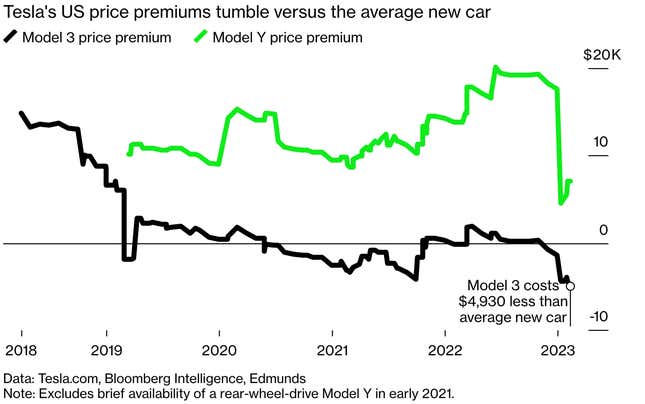
What do you want to bet that the “Equinox EV (which is meant to start around $30,000)” turns out to be $50,000 when they actually start delivering?
This news is more evidence that things are not going well with the Ultium platform.
Upvote
2
(6
/
-4)

Statistical
Ars Legatus Legionis
Same. Isn't that how a diesel train works? Diesel generator that powers the electric motors to make the train go?
I forgot what the arguments against it was. Probably something generally in the 'too complicated just go full EV' type argument? I forget.
The conversion from mechanical energy to electrical back to mechanical is worse. It is actually significantly simpler than a parallel hybrid especially modern multi-mode parallel hybrids.
The lower efficiency when the engine is running may not be a deal breaker if you couple it with a large enough battery for very high all-electric range. BMW tried it with the i3 Rex but it didn't really take off probably too early. If batteries get cheap enough for a 50 to 100 mile PHEV then a range extender type design (series hybrid) might make sense.
Upvote
5
(5
/
0)
icwhatudidthere
Ars Tribunus Militum
It'll be built in China. And there are a lot of design choices that minimize assembly costs.When people say EV sales are stalling, this is why. My last car cost $24,000 (which seemed a lot at the time) and still runs great. I'd love to buy an EV, but not at these prices. Now waiting to see the new Volvo - but how can it be that Volvo is the cheap car?
Upvote
1
(1
/
0)
Statistical
Ars Legatus Legionis
There were a few of these, mainly the i3 comes to mind and I guess the Volt could run like that(?) and Mazda seems to be close to launching one with a rotary ranger extender.
I'm not sure why these haven't taken off, it does make sense intuitively. Large batteries are expensive but maybe by the time you add the ICE engine, maybe you get close enough that you might as well go 100% ev?
The big factor is when running on the engine it will have worse fuel economy than a parallel hybrid. So it only really makes sense if the battery is large enough so most (60%+ ideally 80%+) of driving is all electric. Until recently batteries were just too expensive for that.
We might see a comeback to meet BEV/PHEV requirements in the future. Many people would just take a BEV but those who need "training wheels" might take a range extender PHEV. Hard to say. CA 50 mile all-electric requirement for PHEV might be a push in the right direction.
Upvote
5
(5
/
0)
Timtheenchanter
Ars Tribunus Militum
The big OEMs were all marginally successful with their business models prior to the Great Recession and again after recovery. It is not easy for a company like that to disrupt themselves, essentially making their current profitable products less valuable by creating better or more valuable products.Yes, if the big OEMs had started on EV production as a condition of the 2009 restructuring/bailout, instead of waiting until Tesla started pinging the possibility of consistent profitability a decade later, it's entirely possible that battery production constraints wouldn't be the biggest impediment to mass market EV production. But structurally and culturally, it was impossible for them to acknowledge that such a fundamentally different approach to the design of automobiles was necessary. It took someone else proving that it was possible to build and profitably sell a mass market EV for them to change their tune, just like it took SpaceX proving that it was profitable to land and reuse rocket boosters for other companies to (begrudgingly) start to change.
Making “EV production a condition of restructuring/ bailout“ would have been a failure in my opinion, they would have produced crap compliance EVs. The Obama administration would get blamed for causing the failure and probably it would have set things back.
But the Obama administration awarded $8 billion in low-interest loans to make EVs, including $465 million to Tesla Motors, $1.6 billion to Nissan, and $5.9 billion to Ford.
Upvote
-3
(0
/
-3)

AmanoJyaku
Ars Tribunus Angusticlavius
Any guesses on how this plays out?
GM pulls a Tesla, and drops the price to take advantage of the EV tax credit?
Upvote
3
(3
/
0)
I hate to admit it, given how much interest I’ve expressed in switching to an EV truck to my friends, but that’s me. I don’t see a reason to buy a 23 or 24 MY when I can ride out the next year or so.Or because they're not ramping up production as fast as they'd like and they (and most EV makers) basically Osborned the 2024 model year by announcing a switch to NACS either in 2025 or for the 2025 model year.
Upvote
3
(3
/
0)
This is absolutely not true. There is nothing locking us into those decisions that were made in the early to mid 20th century. The problem is that you can't shift that infrastructure that has been built up fast enough to deal with climate change.
You can't reverse a century's worth of bad development decisions in a decade. If you build out good mass transit, and allow for higher density building and mixed commercial/residential near routes we can start to reverse that. But we're talking about efforts that have a 50 to 100 year horizon.
I agree with your larger point but not about the specific reasons why increasing mass transit has been so slow. From my perspective living in Chicago, a city with at least a subway/El system, but not a great one compared to other major global cities or even NYC, our problem isn't that existing infrastructure is in the way or that zoning is the issue. It's that for whatever reason it's insanely expensive to build new subway tunnels (I'll blame this mostly on contractor grift and union contract costs but have not looked at the analysis closely), and even existing unused over-ground rail corridors are not mandated to be resurrected for expanded service. These can both be overcome by a strong political will to prioritize mass transit, but it just doesn't exist, which comes down to apathy in voters. Where I've seen success is in areas like DC and surrounding suburbs where new lines are built in coordination with private investors who are lined up to build the commercial/residential spaces near new stops like you're suggesting -- in other words, it took more than just building the train line, but a more concerted effort to bring investment to the table when doing so. Chicago builds new train stops but doesn't do diddly to encourage growth to make use of that enormous investment. For example, the CTA spent $280M to rebuild the southern endpoint of the red line, one of the most heavily used lines, and while that project completed in 2019, today all that exists around it are: a massive (several blocks) empty paved area, a McDonalds, a Dollar Store, a check-cashing place, a couple churches, a giant park, and several single-floor low-density homes or empty lots. When DC built the silver line out to Dulles, the area around Tysons Square that was on that route almost literally exploded with growth, including the relocation of Capital One's HQ and at least a dozen other high rise apartments and office buildings. These aren't comparable neighborhoods, to be sure, but it points to the complete disconnect many politicians have when it comes to what investment in mass transit actually means -- it's absolutely not enough to simply build the train line and do nothing else to foster the use of that train.
Upvote
5
(5
/
0)
Or perhaps not - I’d suggest CA is definitely one place where range anxiety with a BEV isn’t a big factor, which would mean there is little desire for a PHEV there. If so, sales might be predicted low enough to not bother just for CA.CA 50 mile all-electric requirement for PHEV might be a push in the right direction.
Upvote
2
(2
/
0)
Statistical
Ars Legatus Legionis
Or perhaps not - I’d suggest CA is definitely one place where range anxiety with a BEV isn’t a big factor, which would mean there is little desire for a PHEV there. If so, sales might be predicted low enough to not bother just for CA.
They are selling PHEV now. CA is more than Los Angeles. It has thousands of miles of semi-rural and rural areas. I don't ever think PHEV are going to outsell BEVs but I don't think they are going to go away overnight. For many people a BEV is especially first BEV is scary. A PHEV lets them hedge that a bit. Get use to the idea of driving on electrons and still have easy to extend range via a fuel tank.
If I had to hazard to guess PHEV will be sold in small but significant numbers for at least the next decade. By then BEVs should be mainstream enough to not be scary and there numbers may dwindle.
Upvote
2
(3
/
-1)
JustAnotherNobody
Ars Praetorian
EVs for the rich, pollution for the poor.
Poor people buy used cars. What will happen is the rich will eventually drive EVs, then the government will tax the shit out of gasoline as yet another way to punish the poor for being poor.
Upvote
7
(7
/
0)
I think it is debatable that Tesla has in fact pulled it off, if we define "it" as having the same operational and product planning tempo as other carmakers. Like many organisms that are opportunistic and fast-growing, it's shallowly rooted and optimized for rapid expansion rather than sustained, steady-state operations - Tesla is like aspen trees expanding into an avalanche scar, GM and Ford and VW are like stolid old oaks that can withstand a gale but have a few rotten branches.Then Tesla pulled it off, and people mostly stopped laughing. Whispered discussions began at the legacy automakers, trying to figure out what it was actually going to take to navigate something as narrow as a sea and be nimble enough to dodge those floating chunks of ice.
Yes, Tesla can scale production steeply and they can produce vehicles cheaply. That's not nothing. But other OEMs surpass their QA/QC in their sleep. Other OEMs have modular platforms that dramatically drop the gestation time of new vehicles, where Tesla only shares substantial engineering between the 3 and Y. Tesla has only managed to refresh its existing vehicles incrementally, not establish an engineering pipeline for the 8-year model cycles other OEMs are capable of as a matter of course. One doesn't get the sense there's a great deal of planning for the long-term future there, just frantically getting the next promised product to market.
Upvote
5
(6
/
-1)
Statistical
Ars Legatus Legionis
Poor people buy used cars. What will happen is the rich will eventually drive EVs, then the government will tax the shit out of gasoline as yet another way to punish the poor for being poor.
Lower income households buying used still requires reasonably priced new BEVs. Used prices are a factor of new sale prices. Look up price of a used Porsche 911. If average new BEV prices keep going up then average used BEV prices will keep going up too. That doesn't bode well for affordability of BEVs among lower income households even buying used.
$60k+ BEVs are cool but we really need $40k and ideally $30k ones. Not because poor people will buy them new (they won't) but because you might then have a nice fleet of decent used BEVs <$10k in 7-10 years.
Last edited:
Upvote
10
(10
/
0)
Which is why GM is also bringing back the Bolt and an Equinox that will slot under the Blazer. The Blazer was always a mid-range product and performance-oriented, so it was never reasonable to expect it to be truly entry-level.Why poor people buy used cars the price of used cars depends on the price of new cars. If BEV prices keep going up then used BEV prices will keep going up too. That doesn't bode well for affordability of BEVs among lower income households even buying used.
$60k+ BEVs are cool but we really need $40k and ideally $30k ones. Not because poor people will buy them new but because you might then have a nice fleet of used BEVs <$10k in 7-10 years.
Upvote
0
(1
/
-1)
johnt007871
Ars Praefectus
Really? Is a Japanese thing to like seat warmers maybe? I'm around a lot of Acura, Mazdas and Subarus and they all have seat warmers (and some steering wheel) and they aren't even the top trims. Being in TN I initally scoffed but seat warmers are also good for dad-back after-playing-in-the-floor-for-an-hour.And how many cars have heated rear seats as standard equipment? I almost never encounter them and I drive 50-60 new cars a year. Most of them fully specced press cars.
Upvote
0
(1
/
-1)
Timtheenchanter
Ars Tribunus Militum
By 2025/2026 GM will have the scale needed. They currently have 5 battery plants in North America alone, either in operation or currently under construction.
Brownstown, MI is being converted to Ultium from the BEV2 generation batteries (Bolt, Bolt EUV), while Lordstown, OH is delivering batteries for the BrightDrop, Hummer and Lyriq at a reduced rate as they add more assembly lines to fill the building. Spring Hill, TN has the shell of the building complete and is currently installing battery production equipment. Lansing, MI broke ground in September of last year, and is expected to begin production in late 2024. GM also recently announced a plant in New Carlisle, IN in partnership with Samsung, diversifying the battery partners. Construction in Indiana is expected to begin in the Spring.
Seems like GM is making a huge bet that Ultium will be successful before they have a chance to know if it will be. To wit, how many Ultium vehicles are on the road allowing GM to improve or evolve design and manufacturing? Not many.
Funny that when GM copies Tesla’s approach (from 2016) of joint ventures with battery manufacturers, you view it as somehow different. GM are going to have 130GWh of capacity when all 4 of these pants are ramped up. Tesla already has 35GWh capacity at Nevada in the Panasonic joint venture, and they recently announced adding 100GWh of Tesla owned and operated capacity.Compared to what Tesla did (or rather paid Panasonic to do for them), GM is a much more ambitious undertaking in scale and speed.
https://www.tesla.com/giga-nevadaThen there are other battery manufacturing investments at Giga Texas (said to be the largest capacity), Germany and in California. The total is going to be in multiples of 130GWh.
https://cleantechnica.com/2022/04/1...the-worlds-largest-battery-cell-manufacturer/https://insideevs.com/news/671390/tesla-readies-4680-battery-cell-production-fremont/
Upvote
-1
(2
/
-3)
Timtheenchanter
Ars Tribunus Militum
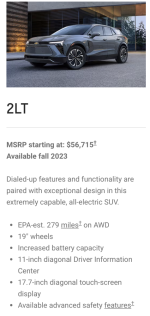
That would be a fascinating twist, hope that is what happens. At $57,000 of course they already are under the SUV/truck limit which is at $80,000.GM pulls a Tesla, and drops the price to take advantage of the EV tax credit?
Upvote
1
(1
/
0)
Why wouldn't it be?Seems like GM is making a huge bet that Ultium will be successful before they have a chance to know if it will be.
Upvote
4
(5
/
-1)
AmanoJyaku
Ars Tribunus Angusticlavius
It's that for whatever reason it's insanely expensive to build new subway tunnels (I'll blame this mostly on contractor grift and union contract costs but have not looked at the analysis closely)
So far, the evidence points to capitalism. The money isn't going to labor or materials. For highways, but the pattern is the same:
Upvote
4
(5
/
-1)
Tesla's approach is NOT a joint venture. GM is not copying Tesla.Seems like GM is making a huge bet that Ultium will be successful before they have a chance to know if it will be. To wit, how many Ultium vehicles are on the road allowing GM to improve or evolve design and manufacturing? Not many.
Funny that when GM copies Tesla’s approach (from 2016) of joint ventures with battery manufacturers, you view it as somehow different. GM are going to have 130GWh of capacity when all 4 of these pants are ramped up. Tesla already has 35GWh capacity at Nevada in the Panasonic joint venture, and they recently announced adding 100GWh of Tesla owned and operated capacity.
https://www.tesla.com/giga-nevadaThen there are other battery manufacturing investments at Giga Texas (said to be the largest capacity), Germany and in California. The total is going to be in multiples of 130GWh.
https://cleantechnica.com/2022/04/1...the-worlds-largest-battery-cell-manufacturer/https://insideevs.com/news/671390/tesla-readies-4680-battery-cell-production-fremont/
Panasonic's cell manufacturing is distinct from Tesla's pack assembly. No employees are in common between the two. Panasonic's facility happens to be co-located in the same building, but GM has suppliers co-located in certain ICE assembly plants as well. That does not mean they are somehow GM employees or doing work for GM. They are still separate companies.
Upvote
0
(2
/
-2)
Timtheenchanter
Ars Tribunus Militum
Seems like almost everyone has had problems to work out with new EVs, and these are very new.Why wouldn't it be?
Upvote
-5
(1
/
-6)
GM is not new to EVs, though, and it has a pretty deep bench with lots of institutional knowledge.Seems like almost everyone has had problems to work out with new EVs, and these are very new.
Upvote
6
(7
/
-1)
More likely, GM lobbyists ram through a change in the law raising the threshold for the tax credit so all $65K EVs (not just pickup trucks) qualify. Tesla raises prices overnight and profits. The rest, finally, break even.GM pulls a Tesla, and drops the price to take advantage of the EV tax credit?
Upvote
-4
(0
/
-4)