
Renewables, environmental, and efficiency industries grew 3x faster than fossil fuels.
Read the whole story
Read the whole story
Not a whole lot of work for mining, outside of mining, but a competent millwright can find work anywhere.As someone else said a 2-year cert is enough to land you a job as a glorified bug tester or call center drone for $13 an hour. That's a far cry from the wages of a union mining or millwright job.
And we all know that the sled won out in the end. Or what is the point you are making here?Renewables, environmental, and efficiency industries grew 3x faster than fossil fuels.
This is the dumbest thing I've seen from Ars lately. Of course an industry which barely exists is growing faster than a well establish industry. It's like during the "revolution" of the wheel replacing sleds commenting on how much faster the wheel is being adopted that the already established sled.

In the US, the Bureau of Labor Statistics stopped measuring jobs in the green economy in March 2013 due to budget cuts.
Well, that's very convenient. A Republican congress refused to allocate a relatively minor amount of money to enable BLS to track green jobs. . . just as the green economy started really growing. I'm sure it's totally coincidence. Also, totally driven by budgetary concerns. I'm sure that part of the BLS budget was definitely bankrupting the country and fleecing the taxpayer.
And a Democratic Congress has had 6 years to fix it...
The fact remains, it takes a LOT more man hours for the green energy, correct? Or perhaps you dispute that fact? Please show where it takes less man hours (your original show me the numbers knee jerk reaction).
Are you basing your man hours estimate solely upon how often the machinery has to be maintained and replaced?
The fact remains, it takes a LOT more man hours for the green energy, correct? Or perhaps you dispute that fact? Please show where it takes less man hours (your original show me the numbers knee jerk reaction).
Are you basing your man hours estimate solely upon how often the machinery has to be maintained and replaced?
I'll quote from the article we are discussing:
"Our analysis also suggests that in the US, nearly ten times more people were employed in the green economy and its supply chains (9.5 million) than employed directly in the fossil fuel industry (roughly 1 million)—that is, miners, electricity grid workers, infrastructure manufacturers, and construction workers."
So, 11% of power generation takes 10X more people than 80% of power generation. You say infrastructure is why, but ALL forms of power generation require infrastructure.
And I bet there's 10x the owners in the companies too, distributing the wealth a bit more. Which is why they're so against it.Our analysis also suggests that in the US, nearly ten times more people were employed in the green economy and its supply chains (9.5 million) than employed directly in the fossil fuel industry (roughly 1 million)
I’m in favor of clean energy, but all this language is misleading.
The correct way to view it that it costs nearly ten times as much manpower to generate our clean energy as our traditional energy requires.
This language of referring to the $1.3 trillion as a benefit and not a cost is straight out of pork barrel politics. “My projects (diversions of resources) generated thousands of jobs (unnecessary politically appointed work)”
We need clean energy, but let’s not fool ourselves about the costs by using misleading language. The costs are worth because they slow glisbal warming and provide a clean environment.
Why does it cost 10 times more? Citation please.
https://www.eia.gov/energyexplained/us-energy-facts/
80% of US energy is generated by fossil fuels (petroleum, natural gas, and coal).
Of the 11% generated by renewable energy, 23% of that is hydro power (not exactly a growth industry there).
Seems like it takes a LOT more workers to generate that 11% than it does to generate the 80%.
More jobs isn't necessarily a bad thing, in fact it is even good as long as they aren't subsidized by the taxpayer (like both fossil fuel and renewable energy).
Apparently you have to be of a certain age in order to truly appreciate the impact that various environmental regulations have made to our quality of life. A trip in 1998 to the former soviet union made it very clear to me, breathing the air near a main road gave me a deja vue experience, this is what the USA smelled like in the 1960s and 1970s. It made an impression on me, since the introduction of catalytic converters made the changes in the USA slow, and hard to notice.
That said, renewable energy sources are also limited in their impact and application due to problems with storing the energy for use WHEN it is needed. Solar power is cost effective currently due to government investment in the past. The problem is, it doesn't work at night. Before investing trillions of dollars in what is currently 11% of our energy supply, we might want to invest in technologies that allow us to use that energy when we need it. We need realistic investment, not knee jerk "it's green, must be good".
This entire discussion boils down to "lets use statistics to bash Trump". Guess what, some of know all about statistics (lies, damn lies, and statistics). Some of us would rather invest wisely, and not use politics as a deciding factor.
Courting "green power" doesn't endear Trump to disenfranchised middle-class white men in rust belt and coal-producing states. Higher growth in renewables is of no political advantage for him.
But it should. Unlike "teaching coal miners to code" retraining those disenfranchised blue-collar workers for jobs in the green energy industry would be more viable due to; greater availability of jobs in this sector across the nation (everyone needs electricity whereas tech hubs tend to be in coastal blue states), skills are more translatable/equivalent than coding, (you're already working with your hands), not to mention, being energy independent is good for national security. Also, as mentioned in the article, it's great for the economy, along with the world at large.
That being said, I do realize that the reason many of these environmental initiatives were rolled back is due to lobbying money. Also not naive enough to think that the current administration would do an about-face regarding green policy v fossil fuel policy.
The above is the messaging future candidates of both parties should adopt. This is why the green-new-deal is so appealing. Democrats are finally tweaking their marketing in the right direction, although they do have some more work to do to appeal to a wider base of swing voters.
Edit: typo
The fact remains, it takes a LOT more man hours for the green energy, correct? Or perhaps you dispute that fact? Please show where it takes less man hours (your original show me the numbers knee jerk reaction).
Are you basing your man hours estimate solely upon how often the machinery has to be maintained and replaced?
I'll quote from the article we are discussing:
"Our analysis also suggests that in the US, nearly ten times more people were employed in the green economy and its supply chains (9.5 million) than employed directly in the fossil fuel industry (roughly 1 million)—that is, miners, electricity grid workers, infrastructure manufacturers, and construction workers."
So, 11% of power generation takes 10X more people than 80% of power generation. You say infrastructure is why, but ALL forms of power generation require infrastructure.
Incorrect. 11% of energy CONSUMED is green. Percentage GENERATED is 17%. Not sure why the disparity exists but you are quoting the wrong number.
And I bet there's 10x the owners in the companies too, distributing the wealth a bit more. Which is why they're so against it.Our analysis also suggests that in the US, nearly ten times more people were employed in the green economy and its supply chains (9.5 million) than employed directly in the fossil fuel industry (roughly 1 million)
I’m in favor of clean energy, but all this language is misleading.
The correct way to view it that it costs nearly ten times as much manpower to generate our clean energy as our traditional energy requires.
This language of referring to the $1.3 trillion as a benefit and not a cost is straight out of pork barrel politics. “My projects (diversions of resources) generated thousands of jobs (unnecessary politically appointed work)”
We need clean energy, but let’s not fool ourselves about the costs by using misleading language. The costs are worth because they slow glisbal warming and provide a clean environment.
Why does it cost 10 times more? Citation please.
https://www.eia.gov/energyexplained/us-energy-facts/
80% of US energy is generated by fossil fuels (petroleum, natural gas, and coal).
Of the 11% generated by renewable energy, 23% of that is hydro power (not exactly a growth industry there).
Seems like it takes a LOT more workers to generate that 11% than it does to generate the 80%.
More jobs isn't necessarily a bad thing, in fact it is even good as long as they aren't subsidized by the taxpayer (like both fossil fuel and renewable energy).
Apparently you have to be of a certain age in order to truly appreciate the impact that various environmental regulations have made to our quality of life. A trip in 1998 to the former soviet union made it very clear to me, breathing the air near a main road gave me a deja vue experience, this is what the USA smelled like in the 1960s and 1970s. It made an impression on me, since the introduction of catalytic converters made the changes in the USA slow, and hard to notice.
That said, renewable energy sources are also limited in their impact and application due to problems with storing the energy for use WHEN it is needed. Solar power is cost effective currently due to government investment in the past. The problem is, it doesn't work at night. Before investing trillions of dollars in what is currently 11% of our energy supply, we might want to invest in technologies that allow us to use that energy when we need it. We need realistic investment, not knee jerk "it's green, must be good".
This entire discussion boils down to "lets use statistics to bash Trump". Guess what, some of know all about statistics (lies, damn lies, and statistics). Some of us would rather invest wisely, and not use politics as a deciding factor.
People keep quoting the wrong number. It's not 11%. It's 17%. 11% of CONSUMED power is renewable. CONSUMED CONSUMED CONSUMED CONSUMED CONSUMED CONSUMED CONSUMED CONSUMED!!!!!!!!!!!!!!!!!!!!!!!!!!!!!!!!!!!!!!!!!!!!!!!!!!!!!!!!!!!!!!!!!!!!!!!!!!!!!!!!!!!!!!
NOT GENERATED!!!!!!!!!!!!!!!!!!!!!!!!!!!!!!!!!!!!!!!!!!!!!!!!!!!!!!!!!!!!!!!!!!!!!!!!!!!!!!!!!!!!!!!!!!!!!!!!!!!!!!!!!!!!!!!!!!!!!!!!!
Courting "green power" doesn't endear Trump to disenfranchised middle-class white men in rust belt and coal-producing states. Higher growth in renewables is of no political advantage for him.
But it should. Unlike "teaching coal miners to code" retraining those disenfranchised blue-collar workers for jobs in the green energy industry would be more viable due to; greater availability of jobs in this sector across the nation (everyone needs electricity whereas tech hubs tend to be in coastal blue states), skills are more translatable/equivalent than coding, (you're already working with your hands), not to mention, being energy independent is good for national security. Also, as mentioned in the article, it's great for the economy, along with the world at large.
That being said, I do realize that the reason many of these environmental initiatives were rolled back is due to lobbying money. Also not naive enough to think that the current administration would do an about-face regarding green policy v fossil fuel policy.
The above is the messaging future candidates of both parties should adopt. This is why the green-new-deal is so appealing. Democrats are finally tweaking their marketing in the right direction, although they do have some more work to do to appeal to a wider base of swing voters.
Edit: typo
Part of the issue though is the actual workers themselves. Many of them do NOT want to be retrained. Even if their job is disappearing. Many of them do NOT want to move.
When you combine it, I'd wager its a minority (maybe a large one, but a minority) who'd actually be willing to take retraining and possible relocation. The bit I have seen on retraining programs most won't bite and most won't relocate. Its hoping and praying and harassing their politicians to reopen the mine that closed. It isn't getting job retraining and moving out of their small town to where the new job is.
That doesn't mean we shouldn't have the option out there. Just that I think there will be sadly fewer takers than you'd hope for.
I live in a state (Nevada) that's littered with the remains of towns that used to be thriving mining towns and are now just shells of old buildings. I myself grew up in coal country, and left my dirt-poor family behind 30 years ago to build a life elsewhere. Meanwhile my family that remains *still* complains about how they're not getting enough government help. The coal mining towns are never going to be anything but welfare magnets.
An honest politician would tell these people the truth: Their towns are dead, and they need to GTFO if they ever want to be happy. This is how it's always been; it's how it will always be.
Very similar here, UT/CO border area.
Unfortunately, getting people to uproot their families and move is extremely difficult. Especially in lesser educated/manual labor fields. Living paycheck to paycheck, advancing your career and income in a field with few transferable skills, constantly worrying about whether or not you'll have a job tomorrow, and working yourself to exhaustion every day are prime conditions for staying stuck where you are.
Not to mention the cost of relocating an entire family. I like to move around a lot for the sake of advancing my career, and I'm pretty sure that I've solo financed the local UHaul branches by myself. Having to set aside 5-6k for a move isn't out of the ordinary for my family of 4 (Moving costs, Deposit+First+Last month rent, moving supplies, etc), but is probably literally impossible for lots of families.
My current position is in a fracking town, and when that eventually goes the way of coal, basically everyone I know will be unemployed, and I'm pretty sure a good number of them won't be able to handle it. I'll be fine since I'm in IT and can go anywhere, some of the management types and engineers will be fine, but most of them will have their entire resumes nullified overnight. Even ye olde Walmart worker will have to look into relocating, since there will no longer be an economy to support retail purchases.
I mean, I'm not here to support the continuation of fields that we know should be phased out, but it's a hard pill to swallow when the human cost is so high to people you know and love. Moving away from fossil fuels is the right thing to do, but it's gonna hurt some people a lot more than others.
This many sound strange, but shouldn't the amount consumed roughly equal what is generated. How much is lost in distribution?And I bet there's 10x the owners in the companies too, distributing the wealth a bit more. Which is why they're so against it.Our analysis also suggests that in the US, nearly ten times more people were employed in the green economy and its supply chains (9.5 million) than employed directly in the fossil fuel industry (roughly 1 million)
I’m in favor of clean energy, but all this language is misleading.
The correct way to view it that it costs nearly ten times as much manpower to generate our clean energy as our traditional energy requires.
This language of referring to the $1.3 trillion as a benefit and not a cost is straight out of pork barrel politics. “My projects (diversions of resources) generated thousands of jobs (unnecessary politically appointed work)”
We need clean energy, but let’s not fool ourselves about the costs by using misleading language. The costs are worth because they slow glisbal warming and provide a clean environment.
Why does it cost 10 times more? Citation please.
https://www.eia.gov/energyexplained/us-energy-facts/
80% of US energy is generated by fossil fuels (petroleum, natural gas, and coal).
Of the 11% generated by renewable energy, 23% of that is hydro power (not exactly a growth industry there).
Seems like it takes a LOT more workers to generate that 11% than it does to generate the 80%.
More jobs isn't necessarily a bad thing, in fact it is even good as long as they aren't subsidized by the taxpayer (like both fossil fuel and renewable energy).
Apparently you have to be of a certain age in order to truly appreciate the impact that various environmental regulations have made to our quality of life. A trip in 1998 to the former soviet union made it very clear to me, breathing the air near a main road gave me a deja vue experience, this is what the USA smelled like in the 1960s and 1970s. It made an impression on me, since the introduction of catalytic converters made the changes in the USA slow, and hard to notice.
That said, renewable energy sources are also limited in their impact and application due to problems with storing the energy for use WHEN it is needed. Solar power is cost effective currently due to government investment in the past. The problem is, it doesn't work at night. Before investing trillions of dollars in what is currently 11% of our energy supply, we might want to invest in technologies that allow us to use that energy when we need it. We need realistic investment, not knee jerk "it's green, must be good".
This entire discussion boils down to "lets use statistics to bash Trump". Guess what, some of know all about statistics (lies, damn lies, and statistics). Some of us would rather invest wisely, and not use politics as a deciding factor.
People keep quoting the wrong number. It's not 11%. It's 17%. 11% of CONSUMED power is renewable. CONSUMED CONSUMED CONSUMED CONSUMED CONSUMED CONSUMED CONSUMED CONSUMED!!!!!!!!!!!!!!!!!!!!!!!!!!!!!!!!!!!!!!!!!!!!!!!!!!!!!!!!!!!!!!!!!!!!!!!!!!!!!!!!!!!!!!
NOT GENERATED!!!!!!!!!!!!!!!!!!!!!!!!!!!!!!!!!!!!!!!!!!!!!!!!!!!!!!!!!!!!!!!!!!!!!!!!!!!!!!!!!!!!!!!!!!!!!!!!!!!!!!!!!!!!!!!!!!!!!!!!!
I agree with both of you - it must suck for these people. I’m just always reminded of the fishing quota debacle in my country in the eighties - fish stocks were dwindling so the fishermen were told - by law - to only fish a fraction of what they were used to. And they complained wildly. “How are we supposed to make a living like this?!” And it’s tough - but what do you want to do, keep fishing and then in 10 years we all starve cause all the fish are gone?I live in a state (Nevada) that's littered with the remains of towns that used to be thriving mining towns and are now just shells of old buildings. I myself grew up in coal country, and left my dirt-poor family behind 30 years ago to build a life elsewhere. Meanwhile my family that remains *still* complains about how they're not getting enough government help. The coal mining towns are never going to be anything but welfare magnets.
An honest politician would tell these people the truth: Their towns are dead, and they need to GTFO if they ever want to be happy. This is how it's always been; it's how it will always be.
Very similar here, UT/CO border area.
Unfortunately, getting people to uproot their families and move is extremely difficult. Especially in lesser educated/manual labor fields. Living paycheck to paycheck, advancing your career and income in a field with few transferable skills, constantly worrying about whether or not you'll have a job tomorrow, and working yourself to exhaustion every day are prime conditions for staying stuck where you are.
Not to mention the cost of relocating an entire family. I like to move around a lot for the sake of advancing my career, and I'm pretty sure that I've solo financed the local UHaul branches by myself. Having to set aside 5-6k for a move isn't out of the ordinary for my family of 4 (Moving costs, Deposit+First+Last month rent, moving supplies, etc), but is probably literally impossible for lots of families.
My current position is in a fracking town, and when that eventually goes the way of coal, basically everyone I know will be unemployed, and I'm pretty sure a good number of them won't be able to handle it. I'll be fine since I'm in IT and can go anywhere, some of the management types and engineers will be fine, but most of them will have their entire resumes nullified overnight. Even ye olde Walmart worker will have to look into relocating, since there will no longer be an economy to support retail purchases.
I mean, I'm not here to support the continuation of fields that we know should be phased out, but it's a hard pill to swallow when the human cost is so high to people you know and love. Moving away from fossil fuels is the right thing to do, but it's gonna hurt some people a lot more than others.
Add to that the difficulty of leaving behind a potentially paid off house that you can't sell to pick up a mortgage or rental payment somewhere else. (hopefully I didn't screw up the quotes.)
The fact remains, it takes a LOT more man hours for the green energy, correct? Or perhaps you dispute that fact? Please show where it takes less man hours (your original show me the numbers knee jerk reaction).
Are you basing your man hours estimate solely upon how often the machinery has to be maintained and replaced?
I'll quote from the article we are discussing:
"Our analysis also suggests that in the US, nearly ten times more people were employed in the green economy and its supply chains (9.5 million) than employed directly in the fossil fuel industry (roughly 1 million)—that is, miners, electricity grid workers, infrastructure manufacturers, and construction workers."
So, 11% of power generation takes 10X more people than 80% of power generation. You say infrastructure is why, but ALL forms of power generation require infrastructure.
Incorrect. 11% of energy CONSUMED is green. Percentage GENERATED is 17%. Not sure why the disparity exists but you are quoting the wrong number.
Lucky for you the US is a huge country spanning a continent - the sun is always shining somewhere in the US, and the wind is always blowing. In the UK last quarter green energy outpaced fossil fuel, and guess what - no power cuts. It’s perfectly doable.The fact remains, it takes a LOT more man hours for the green energy, correct? Or perhaps you dispute that fact? Please show where it takes less man hours (your original show me the numbers knee jerk reaction).
Are you basing your man hours estimate solely upon how often the machinery has to be maintained and replaced?
I'll quote from the article we are discussing:
"Our analysis also suggests that in the US, nearly ten times more people were employed in the green economy and its supply chains (9.5 million) than employed directly in the fossil fuel industry (roughly 1 million)—that is, miners, electricity grid workers, infrastructure manufacturers, and construction workers."
So, 11% of power generation takes 10X more people than 80% of power generation. You say infrastructure is why, but ALL forms of power generation require infrastructure.
Incorrect. 11% of energy CONSUMED is green. Percentage GENERATED is 17%. Not sure why the disparity exists but you are quoting the wrong number.
OK, wow that makes a difference. 17% of energy generated takes 10X the number of man hours that 80% does, better now? You asked for facts about how it takes 10X the man hours for green energy, they are in the article, now we see it has changed to semantics. (generated vs consumed)
We could also subtract the energy generated by hydro power and say that 14% of energy CONSUMED requires 10X the manpower of 80%.
1. Nobody is arguing we shouldn't continue with generating renewable energy.
2. You said "show me where it says it takes 10X the manpower", I did. Now it's "consumed vs generated", big whoop.
I do say that we should show some brains and invest in energy shifting or storage technology to enable us to make renewable energy more effective. Currently there is a plateau where more UNRELIABLE sources of energy (primarily green) are simply throwing money away. Nobody wants to be told that on the coldest day of the year you can't heat your home because it is cloudy. Are we at that point in the USA? No, but we're not that far off. If you really want green energy, invest in nuclear (China is). There are no easy solutions, and the "green new deal" is really not well thought out.
We are looking at a future where so many jobs will disappear as robots and those mythical self driving cars take over. Seems to me that having 10 times as many people working in energy production would be a blessing?The fact remains, it takes a LOT more man hours for the green energy, correct? Or perhaps you dispute that fact? Please show where it takes less man hours (your original show me the numbers knee jerk reaction).
Are you basing your man hours estimate solely upon how often the machinery has to be maintained and replaced?
I'll quote from the article we are discussing:
"Our analysis also suggests that in the US, nearly ten times more people were employed in the green economy and its supply chains (9.5 million) than employed directly in the fossil fuel industry (roughly 1 million)—that is, miners, electricity grid workers, infrastructure manufacturers, and construction workers."
So, 11% of power generation takes 10X more people than 80% of power generation. You say infrastructure is why, but ALL forms of power generation require infrastructure.
Incorrect. 11% of energy CONSUMED is green. Percentage GENERATED is 17%. Not sure why the disparity exists but you are quoting the wrong number.
OK, wow that makes a difference. 17% of energy generated takes 10X the number of man hours that 80% does, better now? You asked for facts about how it takes 10X the man hours for green energy, they are in the article, now we see it has changed to semantics. (generated vs consumed)
We could also subtract the energy generated by hydro power and say that 14% of energy CONSUMED requires 10X the manpower of 80%.
1. Nobody is arguing we shouldn't continue with generating renewable energy.
2. You said "show me where it says it takes 10X the manpower", I did. Now it's "consumed vs generated", big whoop.
I do say that we should show some brains and invest in energy shifting or storage technology to enable us to make renewable energy more effective. Currently there is a plateau where more UNRELIABLE sources of energy (primarily green) are simply throwing money away. Nobody wants to be told that on the coldest day of the year you can't heat your home because it is cloudy. Are we at that point in the USA? No, but we're not that far off. If you really want green energy, invest in nuclear (China is). There are no easy solutions, and the "green new deal" is really not well thought out.

The fact remains, it takes a LOT more man hours for the green energy, correct? Or perhaps you dispute that fact? Please show where it takes less man hours (your original show me the numbers knee jerk reaction).
Are you basing your man hours estimate solely upon how often the machinery has to be maintained and replaced?
I'll quote from the article we are discussing:
"Our analysis also suggests that in the US, nearly ten times more people were employed in the green economy and its supply chains (9.5 million) than employed directly in the fossil fuel industry (roughly 1 million)—that is, miners, electricity grid workers, infrastructure manufacturers, and construction workers."
So, 11% of power generation takes 10X more people than 80% of power generation. You say infrastructure is why, but ALL forms of power generation require infrastructure.
Incorrect. 11% of energy CONSUMED is green. Percentage GENERATED is 17%. Not sure why the disparity exists but you are quoting the wrong number.
OK, wow that makes a difference. 17% of energy generated takes 10X the number of man hours that 80% does, better now? You asked for facts about how it takes 10X the man hours for green energy, they are in the article, now we see it has changed to semantics. (generated vs consumed)
...
If manpower is much higher AND the power is much less expensive, what is the objection? Is your position that you would want fewer people to be employed and to use more expensive power? I'm perplexed.The fact remains, it takes a LOT more man hours for the green energy, correct? Or perhaps you dispute that fact? Please show where it takes less man hours (your original show me the numbers knee jerk reaction).
Are you basing your man hours estimate solely upon how often the machinery has to be maintained and replaced?
I'll quote from the article we are discussing:
"Our analysis also suggests that in the US, nearly ten times more people were employed in the green economy and its supply chains (9.5 million) than employed directly in the fossil fuel industry (roughly 1 million)—that is, miners, electricity grid workers, infrastructure manufacturers, and construction workers."
So, 11% of power generation takes 10X more people than 80% of power generation. You say infrastructure is why, but ALL forms of power generation require infrastructure.
Incorrect. 11% of energy CONSUMED is green. Percentage GENERATED is 17%. Not sure why the disparity exists but you are quoting the wrong number.
OK, wow that makes a difference. 17% of energy generated takes 10X the number of man hours that 80% does, better now? You asked for facts about how it takes 10X the man hours for green energy, they are in the article, now we see it has changed to semantics. (generated vs consumed)
We could also subtract the energy generated by hydro power and say that 14% of energy CONSUMED requires 10X the manpower of 80%.
1. Nobody is arguing we shouldn't continue with generating renewable energy.
2. You said "show me where it says it takes 10X the manpower", I did. Now it's "consumed vs generated", big whoop.
I do say that we should show some brains and invest in energy shifting or storage technology to enable us to make renewable energy more effective. Currently there is a plateau where more UNRELIABLE sources of energy (primarily green) are simply throwing money away. Nobody wants to be told that on the coldest day of the year you can't heat your home because it is cloudy. Are we at that point in the USA? No, but we're not that far off. If you really want green energy, invest in nuclear (China is). There are no easy solutions, and the "green new deal" is really not well thought out.

Wind and Solar require a lot of new infrastructure.The fact remains, it takes a LOT more man hours for the green energy, correct? Or perhaps you dispute that fact? Please show where it takes less man hours (your original show me the numbers knee jerk reaction).
Are you basing your man hours estimate solely upon how often the machinery has to be maintained and replaced?
I'll quote from the article we are discussing:
"Our analysis also suggests that in the US, nearly ten times more people were employed in the green economy and its supply chains (9.5 million) than employed directly in the fossil fuel industry (roughly 1 million)—that is, miners, electricity grid workers, infrastructure manufacturers, and construction workers."
So, 11% of power generation takes 10X more people than 80% of power generation. You say infrastructure is why, but ALL forms of power generation require infrastructure.

My older sister made a strong point to me the other day:
EPCOT (Experimental Prototype City Of Tomorrow) was Walt Disney's showcase of environmentally-sustainable planned communities that would be healthy, happy, efficient places for people to live and work free of stress and (hopefully) free of strife. He might have actually built a REAL cities of the future had he not died before the project was completed.
The fact that EPCOT center in Disneyworld EXISTS is a damning condemnation of the failure of government to act in the interests of it's people.
As my sister pointed out to me, it was UNTHINKABLE in the 1960's that the new tech being developed (efficient mass-transit, hydroponic gardens, efficient lighting) and the revolution of understanding in planned communities (mass transit to move large crowds of people instead of large gatherings to cars to move small crowds of people) could possibly NOT BE DEPLOYED FOR THE PUBLIC GOOD BY THE GOVERNMENT.
In other words, the government has COMPLETELY FAILED to deploy the modern innovations in city planning and infrastructure that have been developed. It has done nothing but PERPETUATE THE MISTAKES THAT HAD ALREADY BEEN DEPLOYED AS INFRASTRUCTURE, and there is only one reason for this, to ensure the profits and prosperity of the supplies of the existing broken infrastructure.
Had you told Walt Disney that in 60 YEARS cars would STILL be burning gasoline, only there would be many, many MANY times more of them, transportation EVERYWHERE would STILL be cars that only carry a few people, we would still be using the same roads, tunnels, bridges, planes, that they were using in the 1960's a full SIXTY YEARS LATER he would never have believed you.
And now people talk about a Green New Deal to make up SIXTY YEARS of lost time, and people call it too expensive!!! Well guess what? YOU VOTED IT DOWN WHEN IT WOULD HAVE BEEN CHEAP. You CANNOT put the future off forever! One day it bites you in the behind.
Fun fact: The number of coal miners in the US is miniscule. 50,000.
And yet, they have been a significant enough lobby to drive about 3 or 4 states voter loyalty.
At least the good news here is that the coal industry has contracted so much, I think they'll soon lose their political power - not enough money for bribes, not enough employees left to be a significant player in state or national politics, eventually. I'm sure they're still powerful in WV and KY, but even there, I don't think they will remain a power much longer, simply because of the contraction caused by natural gas and renewable energy.
"Just a flesh wound!"
By the way, citing WUWT is an endorsement of climate denialism.[url=https://meincmagazine.com/civis/viewtopic.php?p=38120363:14hiyfxp said:mikus42[/url]":14hiyfxp] China's actions speak louder than words. They are literally blowing smoke! The US has actually reduced carbon emissions. By the way, critizing China's record is not an endorsement of the US position.
https:// wattsupwiththat.com/blah/blah/blah
It has: Before the recent tariffs on Chinese imports, there was a strong but degressive tariff on solar panels. Thankfully it did not change the trend much, there were even massive imports before the tariff took place.Up to now, Trump’s campaign rhetoric has not been backed up by major policy changes
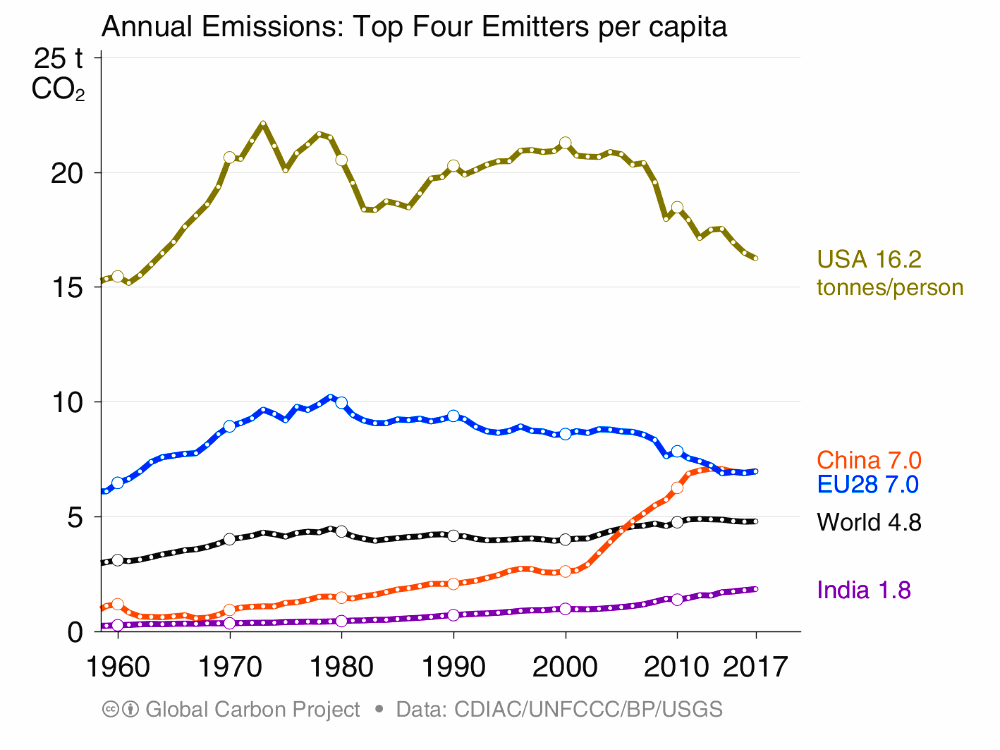
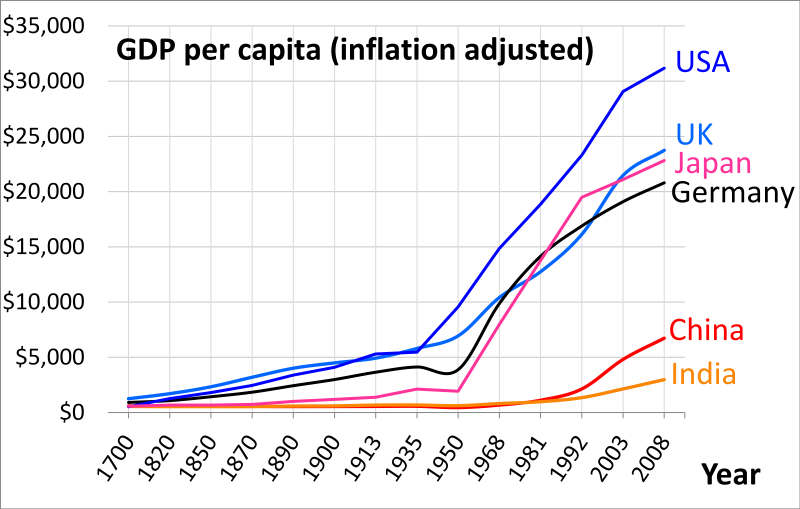
Interestingly, one might argue that how efficiently that each ton of CO2 is used might be important. I can't quickly find a graph that includes all these countries that's more up-to-date but take a look at per-capita GDP divided by your per-capita emissions above. It seems the US has a higher ratio than China or India but below Germany and probably pretty close to the EU in general. The decoupling of emissions with GDP growth in the US was big news. I'm curious if someone's got the last decade of these data for evaluation.By the way, citing WUWT is an endorsement of climate denialism.[url=https://meincmagazine.com/civis/viewtopic.php?p=38120363:200fmhay said:mikus42[/url]":200fmhay] China's actions speak louder than words. They are literally blowing smoke! The US has actually reduced carbon emissions. By the way, critizing China's record is not an endorsement of the US position.
https:// wattsupwiththat.com/blah/blah/blah
The graph that matters is actually:
No. The amount consumed is going to be 2-3x the amount generated. Standard heat engine loss. It's like saying a standard solar panel produces 1kW/m2, and ignoring the fact that it only converts 20% of that incident radiation to electricity.This many sound strange, but shouldn't the amount consumed roughly equal what is generated. How much is lost in distribution?
Fun fact: The number of coal miners in the US is miniscule. 50,000.
They're pretty densely packed where they are though. Almost made the mistake of buying a house in a town with a coal economy. Would have been very very bad, as that house is now worth about 1/5th what they were asking 3 years ago.
As understandable as the move away from coal is, it's kinda sad to see an entire town shuttered basically overnight.
OK, wow that makes a difference. 17% of energy generated takes 10X the number of man hours that 80% does, better now? You asked for facts about how it takes 10X the man hours for green energy, they are in the article, now we see it has changed to semantics. (generated vs consumed)
We could also subtract the energy generated by hydro power and say that 14% of energy CONSUMED requires 10X the manpower of 80%.

By the way, citing WUWT is an endorsement of climate denialism.[url=https://meincmagazine.com/civis/viewtopic.php?p=38120363:1wbmw23p said:mikus42[/url]":1wbmw23p] China's actions speak louder than words. They are literally blowing smoke! The US has actually reduced carbon emissions. By the way, critizing China's record is not an endorsement of the US position.
https:// wattsupwiththat.com/blah/blah/blah
The graph that matters is actually:
Disenfranchised steel or coal worker doesn't want to learn to code. That's for them odd folks in California. He wants to do what he used to do and feel proud about continuing to do so.
That's not entirely fair. That disenfranchised steel or coal worker might be smart enough to know that a 40yo with a two year 'certificate' behind them is not going to land a job in Software Engineering, and even if it could, they'd likely need to uproot their entire family, and get crushed on property value differentials.
And I bet there's 10x the owners in the companies too, distributing the wealth a bit more. Which is why they're so against it.Our analysis also suggests that in the US, nearly ten times more people were employed in the green economy and its supply chains (9.5 million) than employed directly in the fossil fuel industry (roughly 1 million)
I’m in favor of clean energy, but all this language is misleading.
The correct way to view it that it costs nearly ten times as much manpower to generate our clean energy as our traditional energy requires.
This language of referring to the $1.3 trillion as a benefit and not a cost is straight out of pork barrel politics. “My projects (diversions of resources) generated thousands of jobs (unnecessary politically appointed work)”
We need clean energy, but let’s not fool ourselves about the costs by using misleading language. The costs are worth because they slow glisbal warming and provide a clean environment.
Why does it cost 10 times more? Citation please.
https://www.eia.gov/energyexplained/us-energy-facts/
80% of US energy is generated by fossil fuels (petroleum, natural gas, and coal).
Of the 11% generated by renewable energy, 23% of that is hydro power (not exactly a growth industry there).
Seems like it takes a LOT more workers to generate that 11% than it does to generate the 80%.
More jobs isn't necessarily a bad thing, in fact it is even good as long as they aren't subsidized by the taxpayer (like both fossil fuel and renewable energy).
Apparently you have to be of a certain age in order to truly appreciate the impact that various environmental regulations have made to our quality of life. A trip in 1998 to the former soviet union made it very clear to me, breathing the air near a main road gave me a deja vue experience, this is what the USA smelled like in the 1960s and 1970s. It made an impression on me, since the introduction of catalytic converters made the changes in the USA slow, and hard to notice.
That said, renewable energy sources are also limited in their impact and application due to problems with storing the energy for use WHEN it is needed. Solar power is cost effective currently due to government investment in the past. The problem is, it doesn't work at night. Before investing trillions of dollars in what is currently 11% of our energy supply, we might want to invest in technologies that allow us to use that energy when we need it. We need realistic investment, not knee jerk "it's green, must be good".
This entire discussion boils down to "lets use statistics to bash Trump". Guess what, some of know all about statistics (lies, damn lies, and statistics). Some of us would rather invest wisely, and not use politics as a deciding factor.
They both matter.By the way, citing WUWT is an endorsement of climate denialism.[url=https://meincmagazine.com/civis/viewtopic.php?p=38120363:2acybrmy said:mikus42[/url]":2acybrmy] China's actions speak louder than words. They are literally blowing smoke! The US has actually reduced carbon emissions. By the way, critizing China's record is not an endorsement of the US position.
https:// wattsupwiththat.com/blah/blah/blah
The graph that matters is actually:
)
I think you might have that phrased reversed. The amount consumed can not be greater than the amount generated. If 100Q Btu are generated then you can't consume 200-300Q Btu.No. The amount consumed is going to be 2-3x the amount generated. Standard heat engine loss. It's like saying a standard solar panel produces 1kW/m2, and ignoring the fact that it only converts 20% of that incident radiation to electricity.This many sound strange, but shouldn't the amount consumed roughly equal what is generated. How much is lost in distribution?
Courting "green power" doesn't endear Trump to disenfranchised middle-class white men in rust belt and coal-producing states. Higher growth in renewables is of no political advantage for him.
But it should. Unlike "teaching coal miners to code" retraining those disenfranchised blue-collar workers for jobs in the green energy industry would be more viable due to; greater availability of jobs in this sector across the nation (everyone needs electricity whereas tech hubs tend to be in coastal blue states), skills are more translatable/equivalent than coding, (you're already working with your hands), not to mention, being energy independent is good for national security. Also, as mentioned in the article, it's great for the economy, along with the world at large.
That being said, I do realize that the reason many of these environmental initiatives were rolled back is due to lobbying money. Also not naive enough to think that the current administration would do an about-face regarding green policy v fossil fuel policy.
The above is the messaging future candidates of both parties should adopt. This is why the green-new-deal is so appealing. Democrats are finally tweaking their marketing in the right direction, although they do have some more work to do to appeal to a wider base of swing voters.
Edit: typo
Part of the issue though is the actual workers themselves. Many of them do NOT want to be retrained. Even if their job is disappearing. Many of them do NOT want to move.
When you combine it, I'd wager its a minority (maybe a large one, but a minority) who'd actually be willing to take retraining and possible relocation. The bit I have seen on retraining programs most won't bite and most won't relocate. Its hoping and praying and harassing their politicians to reopen the mine that closed. It isn't getting job retraining and moving out of their small town to where the new job is.
That doesn't mean we shouldn't have the option out there. Just that I think there will be sadly fewer takers than you'd hope for.
Easy to blame them without examining the retraining options. The few that I've seen actually go live in public provide abysmal outcomes on the whole. The very idea of training a lifelong skilled laborer to code is laughable, in my opinion. It's like expecting a typical programmer to be able to accurately guess the size of a socket needed for a bolt by sight or use a mag drill. These skills take years to develop and take up a lot of headspace that won't easily yield to learning about if, for, and while loops.
There are, of course, members of that community that could perhaps manage it. Younger folks. Unfortunately, the idea that a 2-year unaccredited cert program somehow makes a high school grad (or dropout) suitable to work in an industry that has no interest opening up shop where they live is just as absurd as turning a coal miner into a unit tester.
Disenfranchised steel or coal worker doesn't want to learn to code. That's for them odd folks in California. He wants to do what he used to do and feel proud about continuing to do so.
That's not entirely fair. That disenfranchised steel or coal worker might be smart enough to know that a 40yo with a two year 'certificate' behind them is not going to land a job in Software Engineering, and even if it could, they'd likely need to uproot their entire family, and get crushed on property value differentials.
That is a good way to look at it.
Here Chrysler is closing 3rd shift. That’s 1500 jobs.
Even if all of those people have the aptitude for computer careers there are 700 IT jobs in the entire county… At any given time are a few dozen positions advertised (that’s all IT not just developers).
A 50 year old factory worker with a new degree in Computer Science is going to be looked over. Ageism is rampant in the industry.
There are plenty of people with experience they would be competing with too.
Citation – I am an old software developer.


