
Renewables, environmental, and efficiency industries grew 3x faster than fossil fuels.
Read the whole story
Read the whole story
There are lots of things that displaced workers can do to get ahead. But politically, it's all too easy to promise those people that they don't need to make any changes - just sit tight and those jobs will return. For your re-election you just blame the other party for blocking your agenda while still pushing the same rhetoric.Disenfranchised steel or coal worker doesn't want to learn to code. That's for them odd folks in California. He wants to do what he used to do and feel proud about continuing to do so.
That's not entirely fair. That disenfranchised steel or coal worker might be smart enough to know that a 40yo with a two year 'certificate' behind them is not going to land a job in Software Engineering, and even if it could, they'd likely need to uproot their entire family, and get crushed on property value differentials.
That is a good way to look at it.
Here Chrysler is closing 3rd shift. That’s 1500 jobs.
Even if all of those people have the aptitude for computer careers there are 700 IT jobs in the entire county… At any given time are a few dozen positions advertised (that’s all IT not just developers).
A 50 year old factory worker with a new degree in Computer Science is going to be looked over. Ageism is rampant in the industry.
There are plenty of people with experience they would be competing with too.
Citation – I am an old software developer.
But there is also plenty of job retraining programs for things like learning to become an auto mechanic (who are always in demand, just might still need to move out of your town of 3000 people to a city or near a city to get a job). Plumbing and electrical unions will often pay for training to become certified and happy to find you a job as an apprentice while you train. Probably does mean moving to where more jobs are.
Those are just a couple of examples. There are many, many retraining programs offered in and around Appalachia.
https://www.reuters.com/article/us-trum ... SKBN1D14G0
https://wfpl.org/rethinking-retraining- ... l-country/
As that WFPL article mentions someone retraining as a truck driver. Those are always in demand. Might or might not mean moving. Pay isn't that bad, though not as good as a coal miner in general.
But that isn't a route many would be willing to go with.
Courting "green power" doesn't endear Trump to disenfranchised middle-class white men in rust belt and coal-producing states. Higher growth in renewables is of no political advantage for him.
But it should. Unlike "teaching coal miners to code" retraining those disenfranchised blue-collar workers for jobs in the green energy industry would be more viable due to; greater availability of jobs in this sector across the nation (everyone needs electricity whereas tech hubs tend to be in coastal blue states), skills are more translatable/equivalent than coding, (you're already working with your hands), not to mention, being energy independent is good for national security. Also, as mentioned in the article, it's great for the economy, along with the world at large.
That being said, I do realize that the reason many of these environmental initiatives were rolled back is due to lobbying money. Also not naive enough to think that the current administration would do an about-face regarding green policy v fossil fuel policy.
The above is the messaging future candidates of both parties should adopt. This is why the green-new-deal is so appealing. Democrats are finally tweaking their marketing in the right direction, although they do have some more work to do to appeal to a wider base of swing voters.
Edit: typo
Part of the issue though is the actual workers themselves. Many of them do NOT want to be retrained. Even if their job is disappearing. Many of them do NOT want to move.
When you combine it, I'd wager its a minority (maybe a large one, but a minority) who'd actually be willing to take retraining and possible relocation. The bit I have seen on retraining programs most won't bite and most won't relocate. Its hoping and praying and harassing their politicians to reopen the mine that closed. It isn't getting job retraining and moving out of their small town to where the new job is.
That doesn't mean we shouldn't have the option out there. Just that I think there will be sadly fewer takers than you'd hope for.
Easy to blame them without examining the retraining options. The few that I've seen actually go live in public provide abysmal outcomes on the whole. The very idea of training a lifelong skilled laborer to code is laughable, in my opinion. It's like expecting a typical programmer to be able to accurately guess the size of a socket needed for a bolt by sight or use a mag drill. These skills take years to develop and take up a lot of headspace that won't easily yield to learning about if, for, and while loops.
There are, of course, members of that community that could perhaps manage it. Younger folks. Unfortunately, the idea that a 2-year unaccredited cert program somehow makes a high school grad (or dropout) suitable to work in an industry that has no interest opening up shop where they live is just as absurd as turning a coal miner into a unit tester.
I meant general job retraining. I don't mean coding training.
There are programs for general job retraining in various skilled professions as well as support for relocation and the number of takers is well below what the programs can fund.
Speaking in a general sense on communities like these, the number of people on disability is also extremely high even though there are job retraining programs for that too. In some cases you are talking someone with a high school education who's job prospects are a cashier or working in a mine. They've got a bad back after years in the mine, so they can't stand on their feet to be a cashier.
So they are effectively on disability till they can collect retirement. But they could be retrained, or heck even move. But they aren't willing (sometimes able) to move where there would be a blue collar or unskilled job where they can actually sit for it. Their local job market is too limited.
So they qualify for disability payments instead because they can't work anymore. Where they live.
It is a complex problem and a limited amount of the blame is on the people themselves. More of it is on the local/state/federal government and politicians. Why would you move if all your pols are promising they'll reopen the mine? That more jobs are coming back from overseas? The factory is going to reopen?
I mean, you can survive on unemployment a couple of years if you put in some limited effort looking for a job. That runs out, if you can prove some kind of long term injury, you might manage to get on disability that'll last a decade (or find a doctor willing to help you fake the medical evidence). Maybe your mine job or factory job will come back in that time.
But it is chiefly the responsibility of the elected politicians (now granted, many of those elected, were elected by the people not trying to find a way out. Though plenty of them DO try to find a way out) not doing things like seeing the writing on the wall and trying to generate non-mine/factory jobs for their constituents. Promising things that won't happen. Etc.
A steam power plant may produce 1GW (3.4GBTU/hr) but consume 8.5GBTU/hr (40% eff) of coal to do so. The EIA report uses the 8.5 value when calculating consumption. Where the transportation sector currently reports some 28.3 quads consumed, that might only be 10 quads were that whole sector electrified. This is readily apparent in the electric power sector where only 34% of consumption is actually sold to customers. Transmission losses are nowhere near 66%.I think you might have that phrased reversed. The amount consumed can not be greater than the amount generated. If 100Q Btu are generated then you can't consume 200-300Q Btu.No. The amount consumed is going to be 2-3x the amount generated. Standard heat engine loss. It's like saying a standard solar panel produces 1kW/m2, and ignoring the fact that it only converts 20% of that incident radiation to electricity.This many sound strange, but shouldn't the amount consumed roughly equal what is generated. How much is lost in distribution?

we might want to invest in technologies that allow us to use that energy when we need it.

Far, far less than the subsidies to the Fossil Economy.What is the subsidy size of the Green Economy? Serious question, seems like something a thorough analysis would cover.
Other people have already pointed out that job training programs include more than IT, so I will just deal with this bizarre statement.Even if all of those people have the aptitude for computer careers there are 700 IT jobs in the entire county… At any given time are a few dozen positions advertised (that’s all IT not just developers).
Or the cost of overseas adventures in places that coincidentally have lots of oil...Far, far less than the subsidies to the Fossil Economy.What is the subsidy size of the Green Economy? Serious question, seems like something a thorough analysis would cover.
Plus we no longer will shoulder the massive externalized costs of their pollution (thousands of Americans die every year from fossil particulate pollution, hundreds of thousands to millions have illness because of it)
You can potentially add military costs to the externalized costs related to fossil fuels. If energy security weren't a concern, the US interests in the Mideast would be far less of a drain on the DoD.Far, far less than the subsidies to the Fossil Economy.What is the subsidy size of the Green Economy? Serious question, seems like something a thorough analysis would cover.
Plus we no longer will shoulder the massive externalized costs of their pollution (thousands of Americans die every year from fossil particulate pollution, hundreds of thousands to millions have illness because of it)
A friend of mine places temps at Google. She places more than 700 programmers there per year.Other people have already pointed out that job training programs include more than IT, so I will just deal with this bizarre statement.Even if all of those people have the aptitude for computer careers there are 700 IT jobs in the entire county… At any given time are a few dozen positions advertised (that’s all IT not just developers).
Either you are using an insanely narrow definition of "IT jobs", or several percent of the IT workers in the country work in my building. I should point out that our primary product isn't even software. IT jobs include tech support, programmers, web developers, systems analysts, IT security and network admins. The only way there are only 700 of these jobs in the country is if the country you are talking about is Luxembourg.
Edit: Stanford claims that it had 273 Computer Science graduates in 2018 alone. How does that make any sense if your number is correct?
Renewables, environmental, and efficiency industries grew 3x faster than fossil fuels.
This is the dumbest thing I've seen from Ars lately. Of course an industry which barely exists is growing faster than a well establish industry. It's like during the "revolution" of the wheel replacing sleds commenting on how much faster the wheel is being adopted that the already established sled.
It appears that we are not talking the same. You are talking about what is going in the front of the powerplant (coal, oil, etc) as consuming and out the back as generated. I am talking what goes out the back of the powerplant (generated electricity) and what get consumed by the market. I think the latter is what they were discussing because a difference of 11% vs 17% doesn't make sense with the former.A steam power plant may produce 1GW (3.4GBTU/hr) but consume 8.5GBTU/hr (40% eff) of coal to do so. The EIA report uses the 8.5 value when calculating consumption. Where the transportation sector currently reports some 28.3 quads consumed, that might only be 10 quads were that whole sector electrified. This is readily apparent in the electric power sector where only 34% of consumption is actually sold to customers. Transmission losses are nowhere near 66%.I think you might have that phrased reversed. The amount consumed can not be greater than the amount generated. If 100Q Btu are generated then you can't consume 200-300Q Btu.No. The amount consumed is going to be 2-3x the amount generated. Standard heat engine loss. It's like saying a standard solar panel produces 1kW/m2, and ignoring the fact that it only converts 20% of that incident radiation to electricity.This many sound strange, but shouldn't the amount consumed roughly equal what is generated. How much is lost in distribution?
This many sound strange, but shouldn't the amount [of energy] consumed roughly equal what is generated. How much is lost in distribution?
If manpower is much higher AND the power is much less expensive, what is the objection? Is your position that you would want fewer people to be employed and to use more expensive power? I'm perplexed.[babble]
Just a reading comprehension fail. There was no typo.Either you are using an insanely narrow definition of "IT jobs", or several percent of the IT workers in the country work in my building.Even if all of those people have the aptitude for computer careers there are 700 IT jobs in the entire county… At any given time are a few dozen positions advertised (that’s all IT not just developers).
A county is a part of a country that’s ruled by a count.Other people have already pointed out that job training programs include more than IT, so I will just deal with this bizarre statement.Even if all of those people have the aptitude for computer careers there are 700 IT jobs in the entire county… At any given time are a few dozen positions advertised (that’s all IT not just developers).
Either you are using an insanely narrow definition of "IT jobs", or several percent of the IT workers in the country work in my building. I should point out that our primary product isn't even software. IT jobs include tech support, programmers, web developers, systems analysts, IT security and network admins. The only way there are only 700 of these jobs in the country is if the country you are talking about is Luxembourg.
Edit: Stanford claims that it had 273 Computer Science graduates in 2018 alone. How does that make any sense if your number is correct?
Strictly from a numbers standpoint the babbler is correct. Once any company or economic sector gets very big, it's extremely difficult to have growth that exceeds inflation. The stock market likes earnings and capital growth that exceeds inflation - in fact, with a few exceptions, it demands it.Renewables, environmental, and efficiency industries grew 3x faster than fossil fuels.
This is the dumbest thing I've seen from Ars lately. Of course an industry which barely exists is growing faster than a well establish industry. It's like during the "revolution" of the wheel replacing sleds commenting on how much faster the wheel is being adopted that the already established sled.
The swarm of ignorant posters babbling is impressive.
Dig deeper, grasshopper.
Fun fact: The number of coal miners in the US is miniscule. 50,000.
But the number of people whose family were coal miners and developed their whole identity around being coal miners is much, much larger.
We need clean energy, but let’s not fool ourselves about the costs by using misleading language. The costs are worth because they slow glisbal warming and provide a clean environment.
“County”. Not “country”.Other people have already pointed out that job training programs include more than IT, so I will just deal with this bizarre statement.Even if all of those people have the aptitude for computer careers there are 700 IT jobs in the entire county… At any given time are a few dozen positions advertised (that’s all IT not just developers).
Either you are using an insanely narrow definition of "IT jobs", or several percent of the IT workers in the country work in my building. I should point out that our primary product isn't even software. IT jobs include tech support, programmers, web developers, systems analysts, IT security and network admins. The only way there are only 700 of these jobs in the country is if the country you are talking about is Luxembourg.
Edit: Stanford claims that it had 273 Computer Science graduates in 2018 alone. How does that make any sense if your number is correct?
“Of course it’s easier to have fast growth if you’re tiny” is true, but renewables are not tiny, haven’t been in years — they had fast growth for a long time.Strictly from a numbers standpoint the babbler is correct. Once any company or economic sector gets very big, it's extremely difficult to have growth that exceeds inflation. The stock market likes earnings and capital growth that exceeds inflation - in fact, with a few exceptions, it demands it.Renewables, environmental, and efficiency industries grew 3x faster than fossil fuels.
This is the dumbest thing I've seen from Ars lately. Of course an industry which barely exists is growing faster than a well establish industry. It's like during the "revolution" of the wheel replacing sleds commenting on how much faster the wheel is being adopted that the already established sled.
The swarm of ignorant posters babbling is impressive.
Dig deeper, grasshopper.
Certainly, the (relative) newcomer will have fantastic percentage growth at the beginning. But that tells me that the Green energy companies are the places to invest for return rather than dividends, which is a good thing for both the bottom line and the environment. I should also disinvest (hard to do with mutual funds, but not impossible) in the fossil-fuel and related sectors, since the only way the established fossil fuel-based operations can make higher profits is to reduce cost - hence demand for fewer regs, more subsidies, less staff/more automation, disposal of non-performing assets (those coal plants and their supporting industries); the smart ones are doing that and reinvesting the proceeds in Green industry (companies that aren't totally dysfunctional like to survive).

Vlad? Is that you?A county is a part of a country that’s ruled by a count.Other people have already pointed out that job training programs include more than IT, so I will just deal with this bizarre statement.Even if all of those people have the aptitude for computer careers there are 700 IT jobs in the entire county… At any given time are a few dozen positions advertised (that’s all IT not just developers).
Either you are using an insanely narrow definition of "IT jobs", or several percent of the IT workers in the country work in my building. I should point out that our primary product isn't even software. IT jobs include tech support, programmers, web developers, systems analysts, IT security and network admins. The only way there are only 700 of these jobs in the country is if the country you are talking about is Luxembourg.
Edit: Stanford claims that it had 273 Computer Science graduates in 2018 alone. How does that make any sense if your number is correct?
The EIA report claims 11.5% of energy consumption in the US comes from renewable sources, but for sources that don't have a "fuel", the EIA is only claiming the useful output of the system. For fuel-consuming sources, they're claiming the fuel consumed.It appears that we are not talking the same. You are talking about what is going in the front of the powerplant (coal, oil, etc) as consuming and out the back as generated. I am talking what goes out the back of the powerplant (generated electricity) and what get consumed by the market. I think the latter is what they were discussing because a difference of 11% vs 17% doesn't make sense with the former.A steam power plant may produce 1GW (3.4GBTU/hr) but consume 8.5GBTU/hr (40% eff) of coal to do so. The EIA report uses the 8.5 value when calculating consumption. Where the transportation sector currently reports some 28.3 quads consumed, that might only be 10 quads were that whole sector electrified. This is readily apparent in the electric power sector where only 34% of consumption is actually sold to customers. Transmission losses are nowhere near 66%.I think you might have that phrased reversed. The amount consumed can not be greater than the amount generated. If 100Q Btu are generated then you can't consume 200-300Q Btu.No. The amount consumed is going to be 2-3x the amount generated. Standard heat engine loss. It's like saying a standard solar panel produces 1kW/m2, and ignoring the fact that it only converts 20% of that incident radiation to electricity.This many sound strange, but shouldn't the amount consumed roughly equal what is generated. How much is lost in distribution?
That's true, and it means that some of the more poorly-run operations are probably gone by now. They're still tiny in terms of total revenue compared to the fossil folks, but with the really bad operators out of the way it's still a good place to invest. I do see a probable m&a market soon, with the smarter Big Fossil Boys starting to buy up the renewable operators that have good returns and prospects - not to extinguish them, but to add them to the portfolio.“Of course it’s easier to have fast growth if you’re tiny” is true, but renewables are not tiny, haven’t been in years — they had fast growth for a long time.Strictly from a numbers standpoint the babbler is correct. Once any company or economic sector gets very big, it's extremely difficult to have growth that exceeds inflation. The stock market likes earnings and capital growth that exceeds inflation - in fact, with a few exceptions, it demands it.Renewables, environmental, and efficiency industries grew 3x faster than fossil fuels.
This is the dumbest thing I've seen from Ars lately. Of course an industry which barely exists is growing faster than a well establish industry. It's like during the "revolution" of the wheel replacing sleds commenting on how much faster the wheel is being adopted that the already established sled.
The swarm of ignorant posters babbling is impressive.
Dig deeper, grasshopper.
Certainly, the (relative) newcomer will have fantastic percentage growth at the beginning. But that tells me that the Green energy companies are the places to invest for return rather than dividends, which is a good thing for both the bottom line and the environment. I should also disinvest (hard to do with mutual funds, but not impossible) in the fossil-fuel and related sectors, since the only way the established fossil fuel-based operations can make higher profits is to reduce cost - hence demand for fewer regs, more subsidies, less staff/more automation, disposal of non-performing assets (those coal plants and their supporting industries); the smart ones are doing that and reinvesting the proceeds in Green industry (companies that aren't totally dysfunctional like to survive).
Strictly from a numbers standpoint the babbler isRenewables, environmental, and efficiency industries grew 3x faster than fossil fuels.
This is the dumbest thing I've seen from Ars lately. Of course an industry which barely exists is growing faster than a well establish industry. It's like during the "revolution" of the wheel replacing sleds commenting on how much faster the wheel is being adopted that the already established sled.
The swarm of ignorant posters babbling is impressive.
Dig deeper, grasshopper.correct.incorrect
Oops.“County”. Not “country”.Other people have already pointed out that job training programs include more than IT, so I will just deal with this bizarre statement.Even if all of those people have the aptitude for computer careers there are 700 IT jobs in the entire county… At any given time are a few dozen positions advertised (that’s all IT not just developers).
Either you are using an insanely narrow definition of "IT jobs", or several percent of the IT workers in the country work in my building. I should point out that our primary product isn't even software. IT jobs include tech support, programmers, web developers, systems analysts, IT security and network admins. The only way there are only 700 of these jobs in the country is if the country you are talking about is Luxembourg.
Edit: Stanford claims that it had 273 Computer Science graduates in 2018 alone. How does that make any sense if your number is correct?
Courting "green power" doesn't endear Trump to disenfranchised middle-class white men in rust belt and coal-producing states. Higher growth in renewables is of no political advantage for him.
But it should. Unlike "teaching coal miners to code" retraining those disenfranchised blue-collar workers for jobs in the green energy industry would be more viable due to; greater availability of jobs in this sector across the nation (everyone needs electricity whereas tech hubs tend to be in coastal blue states), skills are more translatable/equivalent than coding, (you're already working with your hands), not to mention, being energy independent is good for national security. Also, as mentioned in the article, it's great for the economy, along with the world at large.
That being said, I do realize that the reason many of these environmental initiatives were rolled back is due to lobbying money. Also not naive enough to think that the current administration would do an about-face regarding green policy v fossil fuel policy.
The above is the messaging future candidates of both parties should adopt. This is why the green-new-deal is so appealing. Democrats are finally tweaking their marketing in the right direction, although they do have some more work to do to appeal to a wider base of swing voters.
Edit: typo
Part of the issue though is the actual workers themselves. Many of them do NOT want to be retrained. Even if their job is disappearing. Many of them do NOT want to move.
When you combine it, I'd wager its a minority (maybe a large one, but a minority) who'd actually be willing to take retraining and possible relocation. The bit I have seen on retraining programs most won't bite and most won't relocate. Its hoping and praying and harassing their politicians to reopen the mine that closed. It isn't getting job retraining and moving out of their small town to where the new job is.
That doesn't mean we shouldn't have the option out there. Just that I think there will be sadly fewer takers than you'd hope for.
Easy to blame them without examining the retraining options. The few that I've seen actually go live in public provide abysmal outcomes on the whole. The very idea of training a lifelong skilled laborer to code is laughable, in my opinion. It's like expecting a typical programmer to be able to accurately guess the size of a socket needed for a bolt by sight or use a mag drill. These skills take years to develop and take up a lot of headspace that won't easily yield to learning about if, for, and while loops.
There are, of course, members of that community that could perhaps manage it. Younger folks. Unfortunately, the idea that a 2-year unaccredited cert program somehow makes a high school grad (or dropout) suitable to work in an industry that has no interest opening up shop where they live is just as absurd as turning a coal miner into a unit tester.
What is the subsidy size of the Green Economy? Serious question, seems like something a thorough analysis would cover.
What is the subsidy size of the Green Economy? Serious question, seems like something a thorough analysis would cover.
I think the real point is that subsidizing emerging industries, that are very much needed, makes sense.
Subsiding completely dominant, profitable, mature, incumbent industries like oil and coal makes ZERO sense.
Oil has been subsidized nonstop in the U.S. since 1918 and Coal since 1932.
The EIA report claims 11.5% of energy consumption in the US comes from renewable sources, but for sources that don't have a "fuel", the EIA is only claiming the useful output of the system. For fuel-consuming sources, they're claiming the fuel consumed.It appears that we are not talking the same. You are talking about what is going in the front of the powerplant (coal, oil, etc) as consuming and out the back as generated. I am talking what goes out the back of the powerplant (generated electricity) and what get consumed by the market. I think the latter is what they were discussing because a difference of 11% vs 17% doesn't make sense with the former.A steam power plant may produce 1GW (3.4GBTU/hr) but consume 8.5GBTU/hr (40% eff) of coal to do so. The EIA report uses the 8.5 value when calculating consumption. Where the transportation sector currently reports some 28.3 quads consumed, that might only be 10 quads were that whole sector electrified. This is readily apparent in the electric power sector where only 34% of consumption is actually sold to customers. Transmission losses are nowhere near 66%.I think you might have that phrased reversed. The amount consumed can not be greater than the amount generated. If 100Q Btu are generated then you can't consume 200-300Q Btu.No. The amount consumed is going to be 2-3x the amount generated. Standard heat engine loss. It's like saying a standard solar panel produces 1kW/m2, and ignoring the fact that it only converts 20% of that incident radiation to electricity.This many sound strange, but shouldn't the amount consumed roughly equal what is generated. How much is lost in distribution?
So let's consider that of the petroleum, natural gas, coal, and nuclear that account for the other 88.5%, you're only getting about 50% useful work. Just spitballing here, since I don't know what the breakdown is for direct heating. Those 89.7 quads are now only 44.8, and renewables now account for 20.3% of all energy consumption in the US. See how it's misleading?
Renewables only account for 11% of the 101 quads of energy we consume, but if all the energy we consume came from renewables, we would only actually consume half as much.

You are looking at this from entirely the wrong POV. Big coal and big oil "contribute" X billion to political coffers, largely Republican. So called green industries contribute a few million, and even if it were 100% to Republicans it would still be pocket lint. QED.
Courting "green power" doesn't endear Trump to disenfranchised middle-class white men in rust belt and coal-producing states. Higher growth in renewables is of no political advantage for him.
But it should. Unlike "teaching coal miners to code" retraining those disenfranchised blue-collar workers for jobs in the green energy industry would be more viable due to; greater availability of jobs in this sector across the nation (everyone needs electricity whereas tech hubs tend to be in coastal blue states), skills are more translatable/equivalent than coding, (you're already working with your hands), not to mention, being energy independent is good for national security. Also, as mentioned in the article, it's great for the economy, along with the world at large.
That being said, I do realize that the reason many of these environmental initiatives were rolled back is due to lobbying money. Also not naive enough to think that the current administration would do an about-face regarding green policy v fossil fuel policy.
The above is the messaging future candidates of both parties should adopt. This is why the green-new-deal is so appealing. Democrats are finally tweaking their marketing in the right direction, although they do have some more work to do to appeal to a wider base of swing voters.
Edit: typo
Part of the issue though is the actual workers themselves. Many of them do NOT want to be retrained. Even if their job is disappearing. Many of them do NOT want to move.
When you combine it, I'd wager its a minority (maybe a large one, but a minority) who'd actually be willing to take retraining and possible relocation. The bit I have seen on retraining programs most won't bite and most won't relocate. Its hoping and praying and harassing their politicians to reopen the mine that closed. It isn't getting job retraining and moving out of their small town to where the new job is.
That doesn't mean we shouldn't have the option out there. Just that I think there will be sadly fewer takers than you'd hope for.
Easy to blame them without examining the retraining options. The few that I've seen actually go live in public provide abysmal outcomes on the whole. The very idea of training a lifelong skilled laborer to code is laughable, in my opinion. It's like expecting a typical programmer to be able to accurately guess the size of a socket needed for a bolt by sight or use a mag drill. These skills take years to develop and take up a lot of headspace that won't easily yield to learning about if, for, and while loops.
There are, of course, members of that community that could perhaps manage it. Younger folks. Unfortunately, the idea that a 2-year unaccredited cert program somehow makes a high school grad (or dropout) suitable to work in an industry that has no interest opening up shop where they live is just as absurd as turning a coal miner into a unit tester.
Ironically, I've found that people with experience in machine shops or just about anywhere else that breaking down tasks into self contained operations, each consisting of a logical sequence of steps is fundamental to the work are often quite adept at a wide variety of programming tasks.
Procedural programming requires a surprisingly similar set of analytical and deductive skills. High level architecture or large object oriented projects might not be the best fit for many, but I've seen them take to programming tools and machines they can use in their work comes very naturally to a lot more people than many of us nerds would like to believe.
Attitudes adopted due to prior negative learning experience are often a much bigger obstacle than anything else.
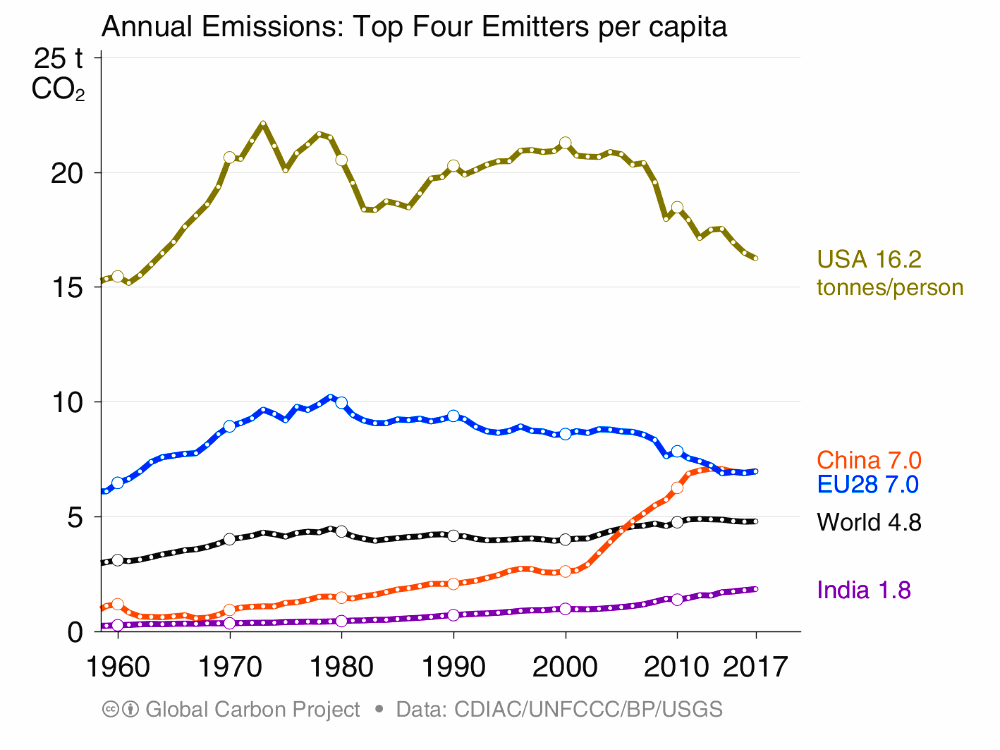
By the way, citing WUWT is an endorsement of climate denialism.[url=https://meincmagazine.com/civis/viewtopic.php?p=38120363:3otg4p7r said:mikus42[/url]":3otg4p7r] China's actions speak louder than words. They are literally blowing smoke! The US has actually reduced carbon emissions. By the way, critizing China's record is not an endorsement of the US position.
https:// wattsupwiththat.com/blah/blah/blah
The graph that matters is actually:
What is the subsidy size of the Green Economy? Serious question, seems like something a thorough analysis would cover.
Ahh, fair enough. But would you not agree that being retrained in jobs that they are more used to makes more sense than telling them to learn to write software? Also, i am not sure if people realise but coal mining is not going into a shaft with a pick axe these days.No, I did but perhaps I didn't frame my reaction properly. Trump is banking on the dissatisfaction that former coal workers have in being told to "retrain" for a new job. Rather than push sound economic policy, Trump pushes the narrative that ingratiates him to target constituencies. Nobody likes to hear that the career they've spent their life doing is obsolete. Instead, Trump offers the promise that they can go right back to that same life.We seem to be veering off topic. The post wick wick quoted mentioned that it would make far more sense for “coal workers” to be retrained in green energy stuff. I think we can all agree to that, apart from wickwick who appears to have not fully read the post he quoted.Disenfranchised steel or coal worker doesn't want to learn to code. That's for them odd folks in California. He wants to do what he used to do and feel proud about continuing to do so.
That's not entirely fair. That disenfranchised steel or coal worker might be smart enough to know that a 40yo with a two year 'certificate' behind them is not going to land a job in Software Engineering, and even if it could, they'd likely need to uproot their entire family, and get crushed on property value differentials.

Other people have already pointed out that job training programs include more than IT, so I will just deal with this bizarre statement.Even if all of those people have the aptitude for computer careers there are 700 IT jobs in the entire county… At any given time are a few dozen positions advertised (that’s all IT not just developers).
Either you are using an insanely narrow definition of "IT jobs", or several percent of the IT workers in the country work in my building. I should point out that our primary product isn't even software. IT jobs include tech support, programmers, web developers, systems analysts, IT security and network admins. The only way there are only 700 of these jobs in the country is if the country you are talking about is Luxembourg.
Edit: Stanford claims that it had 273 Computer Science graduates in 2018 alone. How does that make any sense if your number is correct?

