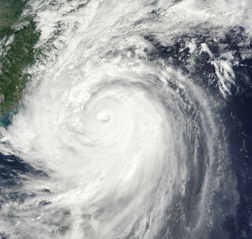
Typhoon Jangmi a few hours before
hitting Taiwan. Image: Jeff Schmaltz
MODIS Land Rapid Response Team,
NASA GSFC
Typhoon Jangmi struck Taiwan on September 28th, 2008. This was the strongest storm to hit Taiwan in 2008, and it killed two people and injured 30 more. Along with the devastation, the storm did something else: Jangmi was responsible for burying many tons of carbon on the ocean floor.
Geologic processes are often perceived as occurring very slowly, over decades to eons. However, more and more often, we are recognizing that short and intense events, such as typhoon Jangmi, may really drive geologic systems. A recent study in Nature Geosciences showed that the carbon eroded during a typhoon may be 100 times greater than the norm. This is important, in part because predictions for future climate change include an increase in these carbon-burying storms.
Let's look at the process as a whole first. The primary geologic mechanism of long term carbon storage involves burying that carbon in deep ocean sediments, where it will likely stay for millions of years (at least until it turns into oil). This carbon typically comes from one of three places: organisms living in the ocean that died and dropped to the sea floor, carbon that has bonded to minerals as part of natural weathering, and organic carbon eroded from the land surface and carried out to sea. Typhoons cause massive erosion on land, and this eroded material is carried far out to sea.
In the past, we have thought that, in large storms, the eroded material is primarily sediment. Even though carbon is part of that sediment, it was believed to be old carbon that came from the rocks themselves, thus it was not considered a net carbon sink. The thinking was as follows: in small rainstorms, water carried organic material from the hillsides and river banks to the ocean. But, in large storms, erosion is dominated by landslides which primarily carry rocky material.