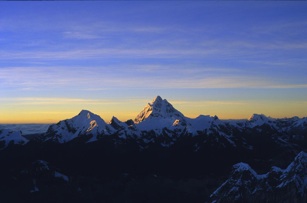
Sunrise in the Andes Image: Ethan Gutmann
Mountain ranges are so big, and continental plates move so slowly, that common wisdom suggests they must take millions of years to form. This seems to have been confirmed in the past with limited data sets that show the timing of their uplift; however, a recent paper in Science and another in Earth and Planetary Science Letters have suggested that uplift may occur much more rapidly in some cases.
Mountain ranges typically form where two plates collide. As the plates converge, the crust gets thicker. Because continental crust is essentially floating on the mantle, the thicker it is, the higher its top will be. This is just like an iceberg, or even an ice cube, floating in water. From simple estimates of plate convergence, we can calculate how rapidly the crust must thicken, and thus how fast the mountains can rise. These estimates tend to be on the order of tens of millions of years.
An article published in Science last week looked in more detail at the rise of the central Andean plateau. The authors analyzed δ18O, Deuterium, and δ13C isotopic data from volcanic clays and carbonate deposits in the area. They used the isotopic data to estimate changes in rainfall isotopic composition that can be used in turn to estimate paleoelevation.
The picture painted by their isotopic data stands in stark contrast to the generally accepted notion that the Andes rose slowly over tens of millions of years. Instead, the isotopic data suggest that the elevation of the central Andean plateau was stable for tens of millions of years at a time, with sharp increases approximately 26 million years ago and again six million years ago. While they have very little data to support the 26Ma rise, the 6Ma rise is supported by landscape features, paleobotanical data, and multiple isotopic records.
Of course, isotopic data from precipitation could also be indicative of a changing climate. In particular, the changes in the δ18O composition they see could be indicative of enrichment of heavier isotopes by evaporation. This is where the carbonate δ18O data come in. These data indicate that, despite evidence for increased aridity, the trends in carbonate δ18O are opposite what one would expect if there was an increase in evaporation. They conclude that the central Andean plateau may have risen 1500m in as little as one million years.