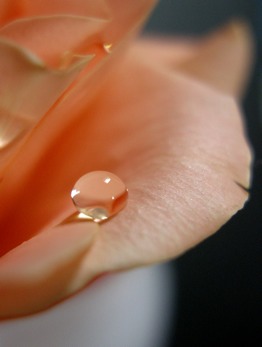
A water droplet stuck to a rose petal
While Geckos have been a very popular source of inspiration for new materials, a recent study in Langmuir suggests that we should not overlook the humble rose petal. Rose petals, like many plant surfaces, exhibit a curious property known as superhydrophobicity.
Superhydrophobicity is defined by the contact angle between a water droplet and the surface of another material. A superhydrophobic material will have a contact angle that is greater than 150 degrees. This means that a water droplet will ball up on the surface instead of spreading out. On a molecular level, this is a product of the fact that individual water molecules would rather bond to another water molecule than to the material in question.
Many plants exhibit superhydrophobicity; the lotus leaf is a classic example. On a lotus leaf, water will ball up on the surface and, when the leaf is tilted as little as five degrees, the droplet will readily slide off. This process cleans the leaf of dust that might otherwise build up on the surface. But a drop of water on a rose petal doesn't act quite the same way. When a drop of water is placed on a rose petal, it balls up, but it does not readily slide off. In fact, a rose with a small drop of water on it can be turned completely upside down and the droplet will stick tightly to the petal.