Geckos always seem to be a popular topic when covered on NI, so we always try to bring the latest in cutting-edge gecko related research. The mechanics of exploiting van der Waals forces that geckos rely on has inspired engineers to create new kinds of tape and wall climbing robots. Some new research by the team that originally uncovered the gecko wall walking mechanism has shown that the hairs on their feet are not the whole story.
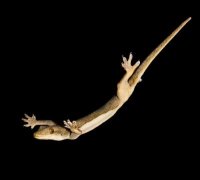 In an open access article in this week's Early Edition of the Proceeding of the National Academy of Sciences, integrated biology professor Robert J. Full reports on the gecko's reliance on its tail while climbing. In a series of experiments, the researchers looked at the role the gecko's unusually large tail played in its incredible mobility. Using a flat-tailed house gecko—cosymbotus platyurus—they observed that when the gecko ran up a vertical surface with good grip, its tail was held above the surface. When a slippery patch was introduced to the otherwise high-traction surface, the team noted that geckos began to drop their tail about 30 ms after slipping, and the tail touched the surface after a mere 50 ms. This motion, putting the tail down against the surface, prevented the animal from pitching backwards and falling off the wall.
To discern whether this was a "one movement fits all" type of balancing act, the researchers created a device that was capable of measuring the force of a gecko's tail against the surface. Using a surface that resulted in "moderate foot slippage" with each step, the animals kept their tails down at all times. They found two tail actions: a stabilizing impulse moment, and a "natural pitch-back" impulse moment. Through some basic physics, the researchers found that the stabilizing impulse changed in response to the distance and time that the fore feet slipped, suggesting an active level of tail control. They also found that when the animals pitched back too far—greater than 60o—they would drop the last two-thirds of their tail against the wall to prevent themselves from falling, the tail acting much like a bicycle's kick stand.