Skip to content
New stuff to kill

Vampire Survivors’ first DLC offers some enjoyable (but diminishing) returns

Legacy of the Moonspell‘s new unlockables are interesting… for a while, at least.

Kyle Orland | 34
Welcome back my friends, to the horde that never ends.
Story text

In our review of Vampire Survivors, we noted how it seems like “you’re always unlocking some cool new toy or character to play around with.” Unfortunately, that’s not literally true. After dozens of hours, most players will be able to find every secret and unlock every one of the game’s numerous unlockable characters, maps, and weapons.

The game doesn’t instantly lose its hypnotic, epilepsy-inducing appeal at that point, of course. But once you’ve finally met all of the game’s many “official” goals, it becomes a bit more difficult to come up with new self-imposed challenges.

Enter Legacy of the Moonspell, the first piece of official paid DLC for Vampire Survivors. While we welcome any new content for one of our favorite games of the year (especially when it’s offered for just $2), this addition feels a little limited, especially for a game that has seen dozens of free updates since its 2021 launch in Early Access.

Mountains of madness

As the name implies, a main highlight of this DLC is its new stage, Mt. Moonspell. The developers at Poncle boast that this map is “25 times bigger than other maps in Vampire Survivors, but it doesn’t feel that way in practice. That said, Mt. Moonspell feels much more intricately designed than most previous Vampire Survivors maps.

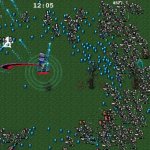
Wide open areas like these are rarer than ever on the DLC’s new Mt. Moonspell map.

On other Vampire Survivors maps, getting to a specific item on your map is usually just a matter of walking in the correct cardinal direction for a while. That’s not necessarily true on Mt. Moonspell, where you’re likely to run into a cliff edge or impassable walls that force you to double back and find a new way through maze-like corridors. There are plenty of dead ends to get trapped in (or to trap encroaching enemies), as well as several new “indoor” areas, where entering a door causes the roof to fade away to let you see the chambers inside.

While there are a few new enemy types in Mt. Moonspell, most of them amount to fodder that’s difficult, if not impossible, to differentiate from existing enemies. That doesn’t apply to the stage’s handful of mini-bosses, though; giant beasts with fast, ranged attacks require all of your deft dodging and positioning skill.

Wild weapons

The Moonspell DLC’s new weapons are a mixed bag. I especially liked the “108 Bocce,” a set of eight brown balls that rotate around your character in a hypnotic semi-spiral, whipping into any foe that dares to get too close. The Silver Wind similarly sends tiny white particles whizzing just above your character in an especially satisfying pattern that I never tire of gazing at. I also enjoyed the Four Seasons, a weapon that sends particularly flashy fireworks explosions to the four corners of the screen, forcing you to position enemies carefully at a distance.

Summon Night is a powerful new weapon that tears multiple vertical gashes down the screen slightly above your character’s position, scorching any enemy that wanders into their persistent burning. I found it a little frustrating to position, though, especially in situations where the environment made it difficult to lure enemies above me. The Night Sword is much less interesting, performing seemingly automatic slashes on any enemy that gets too close (and possibly stealing some health in the process).

Taking Wolverine claws to the entire screen is incredibly satisfying.

My least favorite new weapon was the Mirage Robe, which leaves potentially explosive ghost copies of your character behind regularly as you move. I found it exceptionally difficult to use this ability effectively, as these ghostly clones only affected a small portion of the encroaching enemy swarm near my previous position. I did enjoy the evolved form of the weapon, though, which lets any projectiles confuse enemies in a way that makes them wander in semi-random directions, opening up plenty of open space even in the most troublesome hordes.

Meet the crew

The new weapons also come with new characters to use them. My favorite of these so far is Menya, who gets a burst of incredibly enjoyable super-speed and invincibility after you kill “a large amount of enemies.” McCoy-Oni, the giant raccoon, is also fun, coming with a periodic and mesmerizing increase in the size of all of your weapons (though his oversized body makes it hard to get out of some tight situations).

The Mirage Robe’s ghostly clones were pretty hard to use effectively, in my experience.

Miang has the intriguing ability to transform excess healing into extra maximum health. In practice, this ability is usually less useful than it seems, though. All the extra health in the world only matters briefly if your weapons can’t make a dent in the horde. Syuuto is probably the least interesting new character, simply starting with an evolvable Night Sword.

Babi-Onna’s ability is perhaps the oddest new character, ignoring the usual “cooldowns” for weapons in favor of a fixed interval of usage whenever you’re moving. This is a pretty bad trade-off with most weapons, as far as I can tell, but becomes immensely overpowered if you can pick up a screen-clearing pentagram that now goes off every few seconds, obliterating pretty much any challenge.

Is that all there is?

While I’ve enjoyed my time with Legacy of the Moonspell DLC so far, the returns on this kind of content are starting to feel a little diminished.

Sure, there’s enough stuff to unlock to keep you busy for a few hours, including some challenges that will be tough even for endgame players. Currently, I’m trying my hardest to destroy 100,000 enemies in a single 30-minute run, a task that seems to require just the right mix of horde-strengthening curses and weapon-powering upgrades as you level. There are also hints of one hidden weapon and one hidden character that I haven’t even encountered yet, much less figured out how to unlock.

After a dozen or so runs spent unlocking and trying out new stuff, though, I’m finding I’m once again bumping up against the “now what?” problem inherent in Vampire Survivors‘ late game. Once all the unlockables are unlocked and the challenges complete, it’s hard to muster up the interest to go back and just repeat the same stages with the same characters.

Once you’ve completed the game’s checklist, it’s harder and harder to keep coming back for more.

That might seem like an odd complaint, especially for a $2 piece of DLC that provides plenty of bang for the buck. And it’s not like this is a unique problem for Vampire Survivors. Most single-player games eventually end, and even the most randomized of the bunch can start to feel “solved” after enough dedicated play.

Vampire Survivors takes a good, long while to reach that point, even before these new DLC options are added. And even at its most repetitive, the inherent appeal of clearing screens full of enemies in ever-more-bombastic ways remains. All that said, this kind of paid DLC feels like a temporary patch on a game whose depths are finally starting to feel largely plumbed, at least for this reviewer.

We wouldn’t be surprised if more DLC continues to be released every few months from here on out, providing even more patches on the slowly leaking appeal of Vampire Survivors‘ secret-hunting loop. That should keep the completionists happy, though we worry that it’s going to be harder and harder to keep coming up with compelling new characters, weapons, and secrets as time goes on.

For now, though, Legacy of the Moonspell provides a good, cheap excuse to revisit Vampire Survivors. That’s true no matter how much time you’ve already put into this incredibly addictive game.

Photo of Kyle Orland
Kyle Orland Senior Gaming Editor
Kyle Orland has been the Senior Gaming Editor at Ars Technica since 2012, writing primarily about the business, tech, and culture behind video games. He has journalism and computer science degrees from University of Maryland. He once wrote a whole book about Minesweeper.
34 Comments