Skip to content
This is very, very bad

The most spectacular rocket explosion since N1 just happened in Florida

New Glenn was due to play a starring role in NASA’s Artemis Program.

Eric Berger | 234
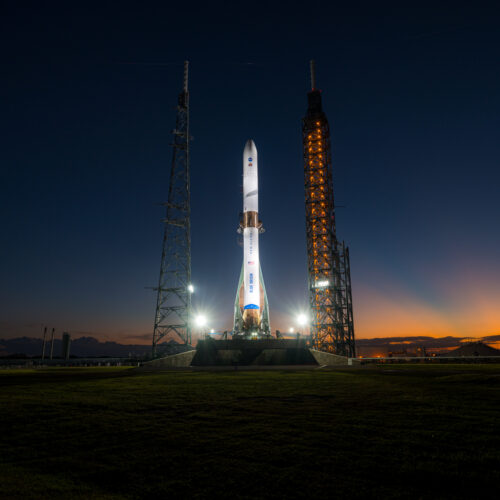
Blue Origin's New Glenn rocket on the launch pad at Cape Canaveral Space Force Station, Florida. Credit: Blue Origin
Story text

On Thursday evening Blue Origin attempted to test fire its massive New Glenn rocket at its Florida launch site, but something went very wrong after engine ignition. The super heavy lift rocket exploded in spectacular and disastrous fashion.

The static fire test was being filmed by NASASpaceflight.com on its Space Coast Live feed, which captured video of the conflagration that followed destruction of the booster. The first stage of New Glenn, fueled with methane, produced a massive fireball above the launch site along the Florida coast, LC-36A. It is possibly the most dramatic and powerful rocket explosion since the Soviet Union’s N1 rocket was destroyed during a launch attempt in 1969.

There was no immediate indication as to what caused the rocket to fail during the initial stages of the static fire test. The failure originated with the first stage of the rocket, which is powered by seven BE-4 engines. Sources said the problem appeared to start in the engine section of the vehicle.

“It’s too early to know the root cause but we’re already working to find it,” Blue Origin founder Jeff Bezos said on X. “Very rough day, but we’ll rebuild whatever needs rebuilding and get back to flying. It’s worth it.”

No one was injured during the failure, which sources said caused extensive damage to the company’s large and complex launch site. During a pad failure in 2016, with the smaller Falcon 9 rocket, it took SpaceX more than a year to rebuild its seriously damaged Space Launch Complex-40 pad.

A true catastrophe

This is the worst disaster in the history of Blue Origin, founded in 2000.

The company has launched New Glenn three times, during each of which the first stage performed well. The company had already demonstrated the ability to land the New Glenn first stage, and impressively reused it in April for the first time.

During that third flight, carrying the Blue Bird 7 satellite, an upper stage issue caused the mission to fail. However the company responded rapidly to the in-flight failure and returned to the launch pad in less than two months this week. The first stage for this mission, nicknamed No, It’s Necessary, was making its debut launch.

Prior to this launch attempt Blue Origin had in its inventory two first stages and about six New Glenn upper stages completed, and it was poised to break into a monthly launch cadence. By all accounts, the rocket was viewed as a major success for a company which, for so long, had seemed to plod along. New Glenn’s success catapulted the company to the upper echelon of spaceflight enterprises in the world. That Blue Origin was on the precipice of accelerating further makes this setback all the more painful.

New Glenn an essential part of a Moon base

The failure of New Glenn also has major implications for NASA and its surging efforts to return humans to the Moon before the end of this decade, and to establish a lunar base on the surface.

On Tuesday NASA announced that it had selected the New Glenn rocket to deliver the first two rovers, built by Lunar Outpost and Astrolab, to the lunar surface in 2028. Blue Origin has developed its own cargo lunar lander, Blue Moon Mark 1, designed to fly on top of New Glenn. It was due to launch this fall to the Moon for the first time, and again next year carrying the VIPER rover to the Moon for NASA.

Then there is the larger Blue Moon Mark 2 lander, which is due to fly on a larger and more powerful version of the New Glenn rocket with nine first stage engines, known as 9×4. NASA is counting on the Mark 2 lander, alongside SpaceX’s Starship vehicle, to carry humans to the Moon on a regular basis—and soon.

Pad infrastructure severely damaged

It is too early to determine the impacts from this failure, but they will be considerable. Early reports from sources suggest that the launch infrastructure at LC-36A is severely damaged. A source indicated that one of the lightning towers may not be salvageable, and that the transporter-erector may also be damaged beyond repair.

The company recently began construction on a second New Glenn launch site nearby, LC-36B. However work there is in its early stages. It is possible, however, that completing this new launch tower may be faster than rebuilding LC-36A. New Glenn almost certainly will not launch again in 2026, and frankly a launch during the first half of 2027 would be heroic given the launch site concerns.

Blue Origin has been doing a lot of developmental work on the larger 9×4 rocket, which is expected to become the workhorse of the fleet over the smaller 7×2 rocket variant that exploded on Thursday evening in Florida. It is possible that the company now throws all of its efforts into completing work on this larger rocket.

Bezos, who made his fortune from Amazon, has largely funded Blue Origin since its founding a quarter of a century ago. He has put tens of billions of dollars into the company. Fortunately for Blue Origin, he has the financial wherewithal to sustain the company through this failure and to accelerate its recovery efforts. NASA, too, will be very keen to see Blue Origin get back on its feet as expeditiously as possible.

If there’s a small silver lining, it’s that the rocket that exploded Thursday night did not carry its payload of Amazon Leo Internet satellites. They were safe, in a nearby integration facility, awaiting launch.

Photo of Eric Berger
Eric Berger Senior Space Editor
Eric Berger is the senior space editor at Ars Technica, covering everything from astronomy to private space to NASA policy, and author of two books: Liftoff, about the rise of SpaceX; and Reentry, on the development of the Falcon 9 rocket and Dragon. A certified meteorologist, Eric lives in Houston.
234 Comments
Staff Picks
EricBerger
I’ll take non-nuclear mushroom clouds for $1,000 please Alex.

I hope they got good data from one hell of a boom.
One silver lining is that the Space Force has very little data about methane-fueled rocket exclusion zones. It's a serious problem (i.e. how much of the Cape do you shutdown during Blue Origin or ULA or SpaceX launches with their heavy lift rockets. Now ... they have data.