
Historic interpreter taught millions to program on Commodore and Apple computers.
See full article...
See full article...

 (1978)
Unless they had HAL9000, I doubt that README.md was made 48 years ago. Whoopsie!The README on the github page...
[snip]
...the commit date is set correctly

And Apple ]['s! I taught myself programming on one, with a copy of The Applesoft Tutorial in hand that my dad had photocopied at work. To this day I don't think I'd seen that cover photo in colourDesigner Chuck Peddle created the 6502 specifically to bring computing to the masses, and manufacturers built variations of the chip into the Atari 2600, Nintendo Entertainment System, and millions of Commodore computers.


While this was certainly a coup for Jack Tramiel, given what we know about Tramiel, I don’t think the following necessarily follows:In 1977, Commodore licensed Microsoft's 6502 BASIC for a flat fee of $25,000. Jack Tramiel's company got perpetual rights to ship the software on unlimited machines
It’s well known that Tramiel drove impossibly hard bargains and didn’t hesitate to even put vendors out of business or go against his own interests if he thought he wasn’t getting an incredible deal.Had Microsoft negotiated a per-unit licensing fee like they did with later products, the deal could have generated tens of millions in revenue.
Nice. I learnt programming on a VIC-20, so news like this feels extra special.

The README on the github page is as horrible a bit of AI grandstanding spew as you will ever see.

They probably would have had their name on it regardless of how good or bad the deal was.Microsoft was smart in charging a flat rate licensing fee - it meant that millions of people saw the name 'Microsoft' on their computers and gave the company a foothold to become the industry giant it would later be.
I see someone posted this before I did!
They didn't want to but Tramiel/Commodore insisted, they also refused to let the Mirosoft name show up on the boot screen. That flat fee is part of why the 64 shipped with basic 2.0 along with 4.0 needing a bigger ROM. There was even a hidden poke that would spell out MICROSOFT! as an easter egg on some PETs that was hidden in the source code with the string obfuscated, and Commodre was very unhappy when that was found outMicrosoft was smart in charging a flat rate licensing fee - it meant that millions of people saw the name 'Microsoft' on their computers and gave the company a foothold to become the industry giant it would later be.
I see someone posted this before I did!
Having a 6502 basic from the PET pretty well set them up to deliver Applesoft Basic to Apple when the need for a floating point basic to replace Woz's Integer Basic became apparent. Though with the Altair/8080/Z80 and CP/M world already having MS Basic pretty entrenched Microsoft was pretty much the go-to for getting a BASIC for your computerWhile this was certainly a coup for Jack Tramiel, given what we know about Tramiel, I don’t think the following necessarily follows:
It’s well known that Tramiel drove impossibly hard bargains and didn’t hesitate to even put vendors out of business or go against his own interests if he thought he wasn’t getting an incredible deal.
I think the exposure in the Commodore computers are partially what gave Microsoft the position to have those later sales with per-unit licensing, and the goodwill for Commodore to allow Commodore engineer John Feagans to spend time with Gates, making what I wouldn’t be surprised to learn were “free” updates to Microsoft code, even though Commodore benefited as well.
Rolemaster is basically why I learned VBA! Good stuff.It is crazy thinking back to all the pretty complex programs I wrote on my Apple //c back in high school.
Animated simulators of the statistical drunken man principle. I was able to make an image of a guy running by combining two special characters. I did a number of these for statistics and physics class. Possibly instead of doing my actual homework, and without asking my teachers if I could, let alone for extra credit... I was probably a hard kid to grade.
A pretty full featured RoleMaster combat manager/tracker. I did some other RPG ones as well. I also made a complete Palladium 1e character sheet in PFS Write because the stock one was so terrible. I still have some of those character sheets with a little fringe from where the tractor feed guides on the side didn't pull off cleanly after printing on my ImageWriter. NO WYSIWYG or proportional fonts, of course. I had a 80 character wide screen, so it was an 80 character wide sheet. Just monospaced fonts with pipes and dashes for borders.
And, uh, a bunch of others I remember remembering fifteen years ago...
IIRC, the C64 did have a RGB output, so that S-video adaptor could well be an entirely analog device. The C64 predated S-VHS and thus consumer S-Video use by five years. While it wasn't used for computer stuff much, the chroma/luma separation made for such clearer looking text and sharp lines without the composite artifacts previously unavoidable without RGB end to end.Interestingly, just a couple weeks ago I pulled one of my old Commodore 64s out of a drawer, and ordered a C64 to S-video adapter on Amazon (pretty amazing that such a niche thing exists and can be delivered to my house in a few days...thanks to dedicated hobbyists, 3D printers, and custom PCB makers), and a USB video capture adapter with S-video input.
As a wizened grognard now, I look back on RoleMaster as pretty much RollMaster, with a really terrible mechanical complexity to game fun ratio. Having to look up a different table for each weapon made things so slow.Rolemaster is basically why I learned VBA! Good stuff.
A stone cold classic!I think my biggest project in the original basic was implementing the game Core Wars https://en.wikipedia.org/wiki/Core_War on the Commodore 128.
Yep, I think its an entirely passive adapter (I haven't actually opened it up to confirm that though), because the C64 basically had S-video before S-video was a standardized thing. The display on my USB captured S-video setup is much clearer than I ever had with the Magnavox composite video monitor I used back in the 80s when the C64 was my main PC (and even that was significantly better than a typical TV).IIRC, the C64 did have a RGB output, so that S-video adaptor could well be an entirely analog device. The C64 predated S-VHS and thus consumer S-Video use by five years. While it wasn't used for computer stuff much, the chroma/luma separation made for such clearer looking text and sharp lines without the composite artifacts previously unavoidable without RGB end to end.
(Pro tip, old pre-USB Apple Desktop Bus cables also used the 4-pin mini DIN connectors and work perfectly for S-video too).
I imagine there was other documentation as well, perhaps lost to time along the way.Wow, nice to see they've done this. The comments are basically the documentation as was common back then. Only one document to look after and it didn't get lost. I remember documenting most of the commercial 16 bit mini assembler operating system I worked on then in the source code files.
I also remember dissassembling the BASIC on my UK101 - A UK version of one of the OSI 6502 machines in 1979 on rolls of teletype paper and laboriously trying to comment and label the whole thing. I think that the 6502 journal had a similar article. Having the original source, albeit in a general macro form here is interesting. I remember getting stuck in the expression evaluator then. Sadly all that got lost in subsequent house moves.
It certainly appeared in the documentation which everyone read at the time.They didn't want to but Tramiel/Commodore insisted, they also refused to let the Mirosoft name show up on the boot screen. That flat fee is part of why the 64 shipped with basic 2.0 along with 4.0 needing a bigger ROM. There was even a hidden poke that would spell out MICROSOFT! as an easter egg on some PETs that was hidden in the source code with the string obfuscated, and Commodre was very unhappy when that was found out
Composite was one of the original sins of color TV. Instead of making an actual color system, we basically just did a color overlay on top of the existing B&W signal using not-enough bandwidth left over at the sides of the channel's frequency band. But there was no electronic way to accurately separate chroma from luma again, so sharp details would leak into weird color patterns. I remember the ties in Perry Mason being a classic example in circa 1980 TVs. 3D comb filters and such suppressed that kind of error in later devices, but TV broadcast never really got to be much more than a detailed B&W background with some crayon smeared on top, like an eight year old's coloring book.Yep, I think its an entirely passive adapter (I haven't actually opened it up to confirm that though), because the C64 basically had S-video before S-video was a standardized thing. The display on my USB captured S-video setup is much clearer than I ever had with the Magnavox composite video monitor I used back in the 80s when the C64 was my main PC (and even that was significantly better than a typical TV).
If I recall correctly, the C64 monitor output basically was S-video.Interestingly, just a couple weeks ago I pulled one of my old Commodore 64s out of a drawer, and ordered a C64 to S-video adapter on Amazon (pretty amazing that such a niche thing exists and can be delivered to my house in a few days...thanks to dedicated hobbyists, 3D printers, and custom PCB makers), and a USB video capture adapter with S-video input.
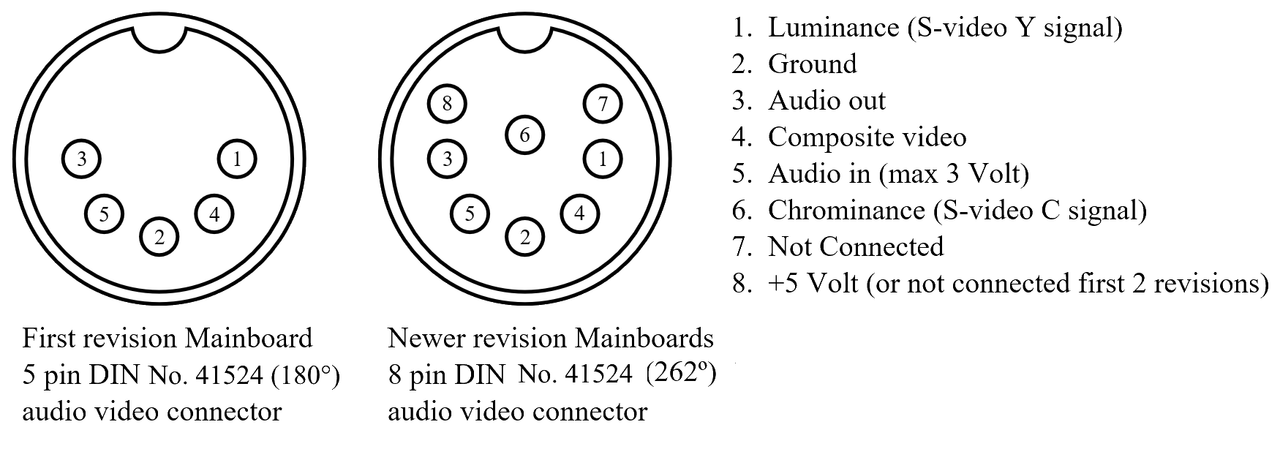
This 8-pin DIN in addition to having the composite video output on pin 4, also now had both a separate LUMA (luminance) and CHROMA (chrominance) output on pins 1 and 6. At the time this was known as Commodore Video but what Commodore had done was to basically implement what would one day be called S-Video which improved picture quality dramatically from the RF and composite signals.


