
You are using an out of date browser. It may not display this or other websites correctly.
You should upgrade or use an alternative browser.
You should upgrade or use an alternative browser.
Feds indict a leading Bitcoin exchange for money laundering
- Thread starter JournalBot
- Start date

It seems like the 21st century stereotype of Russians is not shaping up into anything positive lately.
(Not that Americans have much to celebrate either.)
(Not that Americans have much to celebrate either.)
Upvote
9
(18
/
-9)

I always get hate about it, but virtual currency really is nothing more than a haven for criminals and investors with more money than sense.
I get that people don't like having the government tracking their purchases and such, but currency rules exist not JUST for the convenience of the government, but to help control this kind of thing. Given the nature of virtual currency, it just way too easily lends itself to both attracting the criminal elements, and being targeted by the government (name any government) for much closer scrutiny for even relatively minor activity that would otherwise have gone under the radar.
I mean, people are entitled to do what they want with respect to using this kind of stuff, but when you wrap yourself up in a cloak of invisibility in order to give a gigantic, invisible, up-right middle finger to the government, it's difficult for any person to imagine that your intentions are always going to be perfectly legal and honorable. And in a scheme like this, where criminals are along side non-criminals in using the services, YOUR "money" is in as much danger of seizure or loss as theirs.
Where will that fine come from to be paid? Transaction fees? And what will this rather huge amount do to impact the value of bitcoins that will hit people NOT involved in crimes?
As a risk venture, bitcoins are probably a decent investment if you can afford to lose it (either by devaluation or straight-up loss). But I sure as hell wouldn't use them for purchases, nor put my life savings into them. YMMV on that, but for me, it's too fraught with risk with no actual advantage I can see.
I get that people don't like having the government tracking their purchases and such, but currency rules exist not JUST for the convenience of the government, but to help control this kind of thing. Given the nature of virtual currency, it just way too easily lends itself to both attracting the criminal elements, and being targeted by the government (name any government) for much closer scrutiny for even relatively minor activity that would otherwise have gone under the radar.
I mean, people are entitled to do what they want with respect to using this kind of stuff, but when you wrap yourself up in a cloak of invisibility in order to give a gigantic, invisible, up-right middle finger to the government, it's difficult for any person to imagine that your intentions are always going to be perfectly legal and honorable. And in a scheme like this, where criminals are along side non-criminals in using the services, YOUR "money" is in as much danger of seizure or loss as theirs.
Where will that fine come from to be paid? Transaction fees? And what will this rather huge amount do to impact the value of bitcoins that will hit people NOT involved in crimes?
As a risk venture, bitcoins are probably a decent investment if you can afford to lose it (either by devaluation or straight-up loss). But I sure as hell wouldn't use them for purchases, nor put my life savings into them. YMMV on that, but for me, it's too fraught with risk with no actual advantage I can see.
Upvote
12
(28
/
-16)
The Monkey King
Ars Centurion
So, wait, you're saying distributed ledgers actually work?
But the open nature of its shared transaction ledger, the blockchain, often makes it possible to do forensic analysis of financial flows on the Bitcoin network. And the indictment suggests that Vinnik didn't do a good job of covering his tracks. Funds stolen from Mt. Gox were deposited at BTC-e, to a now-defunct Bitcoin exchange called Trade Hill, and back to Mt. Gox under another account name.
Upvote
-5
(3
/
-8)

Funds stolen from Mt. Gox were deposited at BTC-e, to a now-defunct Bitcoin exchange called Trade Hill, and back to Mt. Gox under another account name.
Couldn't Mt. Gox have looked at the blockchains to find their stolen bitcoins? You'd think the theft was big enough they might have had some interest in doing so.
Upvote
-4
(3
/
-7)
Sending money overseas is a market that overcharges a ton, and the big players they push out smaller players in the market. Crypto currencies have saved a lot of money for poor families sending money to poorer families in other countries. There are legitimate markets that benefit from these types of decentralized currencies, but they are not very obvious to a lot of people.I always get hate about it, but virtual currency really is nothing more than a haven for criminals and investors with more money than sense.
I get that people don't like having the government tracking their purchases and such, but currency rules exist not JUST for the convenience of the government, but to help control this kind of thing. Given the nature of virtual currency, it just way too easily lends itself to both attracting the criminal elements, and being targeted by the government (name any government) for much closer scrutiny for even relatively minor activity that would otherwise have gone under the radar.
I mean, people are entitled to do what they want with respect to using this kind of stuff, but when you wrap yourself up in a cloak of invisibility in order to give a gigantic, invisible, up-right middle finger to the government, it's difficult for any person to imagine that your intentions are always going to be perfectly legal and honorable. And in a scheme like this, where criminals are along side non-criminals in using the services, YOUR "money" is in as much danger of seizure or loss as theirs.
Where will that fine come from to be paid? Transaction fees? And what will this rather huge amount do to impact the value of bitcoins that will hit people NOT involved in crimes?
As a risk venture, bitcoins are probably a decent investment if you can afford to lose it (either by devaluation or straight-up loss). But I sure as hell wouldn't use them for purchases, nor put my life savings into them. YMMV on that, but for me, it's too fraught with risk with no actual advantage I can see.
Upvote
29
(36
/
-7)
I always get hate about it, but virtual currency really is nothing more than a haven for criminals and investors with more money than sense.
I get that people don't like having the government tracking their purchases and such, but currency rules exist not JUST for the convenience of the government, but to help control this kind of thing. Given the nature of virtual currency, it just way too easily lends itself to both attracting the criminal elements, and being targeted by the government (name any government) for much closer scrutiny for even relatively minor activity that would otherwise have gone under the radar.
I mean, people are entitled to do what they want with respect to using this kind of stuff, but when you wrap yourself up in a cloak of invisibility in order to give a gigantic, invisible, up-right middle finger to the government, it's difficult for any person to imagine that your intentions are always going to be perfectly legal and honorable. And in a scheme like this, where criminals are along side non-criminals in using the services, YOUR "money" is in as much danger of seizure or loss as theirs.
Where will that fine come from to be paid? Transaction fees? And what will this rather huge amount do to impact the value of bitcoins that will hit people NOT involved in crimes?
As a risk venture, bitcoins are probably a decent investment if you can afford to lose it (either by devaluation or straight-up loss). But I sure as hell wouldn't use them for purchases, nor put my life savings into them. YMMV on that, but for me, it's too fraught with risk with no actual advantage I can see.
This is the exact same argument used in the war on physical cash. Increasingly the argument of "If you have nothing to hide, why do you need privacy" is being applied to financial transactions. Come on, only criminals need privacy. Only bad people want some measure of independence from the financial system. What are you, a terrorist?
But privacy also protects us from the government. And in an era with civil forfeiture on the scale we're seeing it, I think we need more privacy and independence from the government being entangled in our finances, not less.
Upvote
29
(33
/
-4)
If you were sending money to your poor family, you would be criminally stupid to use any cryptocurrency that can lose its value because the wrong person sneezed at the wrong time.Sending money overseas is a market that overcharges a ton, and the big they push out smaller players in the market. Crypto currencies have saved a lot of money for poor families sending money to poorer families in other countries. There are legitimate markets that benefit from these types of decentralized currencies, but they are not very obvious to a lot of people.I always get hate about it, but virtual currency really is nothing more than a haven for criminals and investors with more money than sense.
I get that people don't like having the government tracking their purchases and such, but currency rules exist not JUST for the convenience of the government, but to help control this kind of thing. Given the nature of virtual currency, it just way too easily lends itself to both attracting the criminal elements, and being targeted by the government (name any government) for much closer scrutiny for even relatively minor activity that would otherwise have gone under the radar.
I mean, people are entitled to do what they want with respect to using this kind of stuff, but when you wrap yourself up in a cloak of invisibility in order to give a gigantic, invisible, up-right middle finger to the government, it's difficult for any person to imagine that your intentions are always going to be perfectly legal and honorable. And in a scheme like this, where criminals are along side non-criminals in using the services, YOUR "money" is in as much danger of seizure or loss as theirs.
Where will that fine come from to be paid? Transaction fees? And what will this rather huge amount do to impact the value of bitcoins that will hit people NOT involved in crimes?
As a risk venture, bitcoins are probably a decent investment if you can afford to lose it (either by devaluation or straight-up loss). But I sure as hell wouldn't use them for purchases, nor put my life savings into them. YMMV on that, but for me, it's too fraught with risk with no actual advantage I can see.
Upvote
0
(20
/
-20)
unless they spent the money when it was received because it was needed at that time, thus saving more money by offsetting the transactional fees, and or gaining money by its upward trend.If you were sending money to your poor family, you would be criminally stupid to use any cryptocurrency that can lose its value because the wrong person sneezed at the wrong time.Sending money overseas is a market that overcharges a ton, and the big they push out smaller players in the market. Crypto currencies have saved a lot of money for poor families sending money to poorer families in other countries. There are legitimate markets that benefit from these types of decentralized currencies, but they are not very obvious to a lot of people.I always get hate about it, but virtual currency really is nothing more than a haven for criminals and investors with more money than sense.
I get that people don't like having the government tracking their purchases and such, but currency rules exist not JUST for the convenience of the government, but to help control this kind of thing. Given the nature of virtual currency, it just way too easily lends itself to both attracting the criminal elements, and being targeted by the government (name any government) for much closer scrutiny for even relatively minor activity that would otherwise have gone under the radar.
I mean, people are entitled to do what they want with respect to using this kind of stuff, but when you wrap yourself up in a cloak of invisibility in order to give a gigantic, invisible, up-right middle finger to the government, it's difficult for any person to imagine that your intentions are always going to be perfectly legal and honorable. And in a scheme like this, where criminals are along side non-criminals in using the services, YOUR "money" is in as much danger of seizure or loss as theirs.
Where will that fine come from to be paid? Transaction fees? And what will this rather huge amount do to impact the value of bitcoins that will hit people NOT involved in crimes?
As a risk venture, bitcoins are probably a decent investment if you can afford to lose it (either by devaluation or straight-up loss). But I sure as hell wouldn't use them for purchases, nor put my life savings into them. YMMV on that, but for me, it's too fraught with risk with no actual advantage I can see.
There were homeless people who regretted buying food with it when it jumped to $300 a coin, i bet they are kicking themselves with steel boots now.
Upvote
-14
(4
/
-18)
Post content hidden for low score.
Show…
My point is, if you can't afford to lose the money you don't deal with BTC. You don't use it to send money "to your poor family". There have been severe crashes in the past where BTC has lost over 80% of its value over a period of minutes. If you ask me, anyone sending indispensable funds over BTC has very little sense. Anyone investing sums they can't afford to lose in BTC has very little sense.unless they spent the money when it was received because it was needed at that time, thus saving more money by offsetting the transactional fees, and or gaining money by its upward trend.If you were sending money to your poor family, you would be criminally stupid to use any cryptocurrency that can lose its value because the wrong person sneezed at the wrong time.Sending money overseas is a market that overcharges a ton, and the big they push out smaller players in the market. Crypto currencies have saved a lot of money for poor families sending money to poorer families in other countries. There are legitimate markets that benefit from these types of decentralized currencies, but they are not very obvious to a lot of people.I always get hate about it, but virtual currency really is nothing more than a haven for criminals and investors with more money than sense.
I get that people don't like having the government tracking their purchases and such, but currency rules exist not JUST for the convenience of the government, but to help control this kind of thing. Given the nature of virtual currency, it just way too easily lends itself to both attracting the criminal elements, and being targeted by the government (name any government) for much closer scrutiny for even relatively minor activity that would otherwise have gone under the radar.
I mean, people are entitled to do what they want with respect to using this kind of stuff, but when you wrap yourself up in a cloak of invisibility in order to give a gigantic, invisible, up-right middle finger to the government, it's difficult for any person to imagine that your intentions are always going to be perfectly legal and honorable. And in a scheme like this, where criminals are along side non-criminals in using the services, YOUR "money" is in as much danger of seizure or loss as theirs.
Where will that fine come from to be paid? Transaction fees? And what will this rather huge amount do to impact the value of bitcoins that will hit people NOT involved in crimes?
As a risk venture, bitcoins are probably a decent investment if you can afford to lose it (either by devaluation or straight-up loss). But I sure as hell wouldn't use them for purchases, nor put my life savings into them. YMMV on that, but for me, it's too fraught with risk with no actual advantage I can see.
There were homeless people who regretted buying food with it when it jumped to $300 a coin, i bet they are kicking themselves with steel boots now.
Upvote
13
(20
/
-7)
Why should a government be able to devalue your money through inflation without your consent? Why should you be subject to your salary essentially being cut in half because your government decided to to invade another country and get itself slapped with international sanctions- again, without your consent? That's what cryptocurrency solves. I'd rather trust my wealth to an algorithm than to a group of power-hungry guys with guns and nukes.
You are trading central bank managed currency for the inflation of crypto-mining and massive market speculation. If you are comfortable storing your wealth in something that volatile power to you.
We may reach the day when a stable cryptocurrency is widely available, but I'd bet that it will be centrally managed. Your cryptocurrency is currently worthless without the ability to be traded in for government run fiat money.
Upvote
17
(18
/
-1)
jamesonista
Ars Centurion
This action should be a strong deterrent to anyone who thinks that they can facilitate ransomware, dark net drug sales, or conduct other illicit activity using encrypted virtual currency
Why does everyone think BTC transactions are encrypted? Your wallet is private but every transaction is public. The only way to obfuscate your transactions is to filter through multiple wallets or pay a service to do that for you (AFAIK).
Upvote
20
(21
/
-1)
My point is, if you can't afford to lose the money you don't deal with BTC. You don't use it to send money "to your poor family". There have been severe crashes in the past where BTC has lost over 80% of its value over a period of minutes. If you ask me, anyone sending indispensable funds over BTC has very little sense. Anyone investing sums they can't afford to lose in BTC has very little sense.unless they spent the money when it was received because it was needed at that time, thus saving more money by offsetting the transactional fees, and or gaining money by its upward trend.If you were sending money to your poor family, you would be criminally stupid to use any cryptocurrency that can lose its value because the wrong person sneezed at the wrong time.Sending money overseas is a market that overcharges a ton, and the big they push out smaller players in the market. Crypto currencies have saved a lot of money for poor families sending money to poorer families in other countries. There are legitimate markets that benefit from these types of decentralized currencies, but they are not very obvious to a lot of people.I always get hate about it, but virtual currency really is nothing more than a haven for criminals and investors with more money than sense.
I get that people don't like having the government tracking their purchases and such, but currency rules exist not JUST for the convenience of the government, but to help control this kind of thing. Given the nature of virtual currency, it just way too easily lends itself to both attracting the criminal elements, and being targeted by the government (name any government) for much closer scrutiny for even relatively minor activity that would otherwise have gone under the radar.
I mean, people are entitled to do what they want with respect to using this kind of stuff, but when you wrap yourself up in a cloak of invisibility in order to give a gigantic, invisible, up-right middle finger to the government, it's difficult for any person to imagine that your intentions are always going to be perfectly legal and honorable. And in a scheme like this, where criminals are along side non-criminals in using the services, YOUR "money" is in as much danger of seizure or loss as theirs.
Where will that fine come from to be paid? Transaction fees? And what will this rather huge amount do to impact the value of bitcoins that will hit people NOT involved in crimes?
As a risk venture, bitcoins are probably a decent investment if you can afford to lose it (either by devaluation or straight-up loss). But I sure as hell wouldn't use them for purchases, nor put my life savings into them. YMMV on that, but for me, it's too fraught with risk with no actual advantage I can see.
There were homeless people who regretted buying food with it when it jumped to $300 a coin, i bet they are kicking themselves with steel boots now.
A lot of the reason that bitcoin jumped into the 4 figures is because a lot of retail outlets and businesses are investing in it, and making it not only more valuable, but more stable. These growths are capping out the number of transactions per minute, and forcing questions to the growth of the platform, but this is a good problem to have for a cryptocurrency, as it shows both growth, and desire for more use.
Upvote
-5
(5
/
-10)
This action should be a strong deterrent to anyone who thinks that they can facilitate ransomware, dark net drug sales, or conduct other illicit activity using encrypted virtual currency
Why does everyone think BTC transactions are encrypted? Your wallet is private but every transaction is public. The only way to obfuscate your transactions is to filter through multiple wallets or pay a service to do that for you (AFAIK).
Yeah, there are alt coins dedicated to hiding more information so you can't even track wallet numbers since all transactions are public in BitCoin. DarkCoin I believe is one.
Upvote
4
(5
/
-1)
I always get hate about it, but virtual currency really is nothing more than a haven for criminals and investors with more money than sense.
I get that people don't like having the government tracking their purchases and such, but currency rules exist not JUST for the convenience of the government, but to help control this kind of thing. Given the nature of virtual currency, it just way too easily lends itself to both attracting the criminal elements, and being targeted by the government (name any government) for much closer scrutiny for even relatively minor activity that would otherwise have gone under the radar.
I mean, people are entitled to do what they want with respect to using this kind of stuff, but when you wrap yourself up in a cloak of invisibility in order to give a gigantic, invisible, up-right middle finger to the government, it's difficult for any person to imagine that your intentions are always going to be perfectly legal and honorable. And in a scheme like this, where criminals are along side non-criminals in using the services, YOUR "money" is in as much danger of seizure or loss as theirs.
Where will that fine come from to be paid? Transaction fees? And what will this rather huge amount do to impact the value of bitcoins that will hit people NOT involved in crimes?
As a risk venture, bitcoins are probably a decent investment if you can afford to lose it (either by devaluation or straight-up loss). But I sure as hell wouldn't use them for purchases, nor put my life savings into them. YMMV on that, but for me, it's too fraught with risk with no actual advantage I can see.
This is the exact same argument used in the war on physical cash. Increasingly the argument of "If you have nothing to hide, why do you need privacy" is being applied to financial transactions. Come on, only criminals need privacy. Only bad people want some measure of independence from the financial system. What are you, a terrorist?
But privacy also protects us from the government. And in an era with civil forfeiture on the scale we're seeing it, I think we need more privacy and independence from the government being entangled in our finances, not less.
Arguably civil forfeiture is an argument against cash. At least if money is taken from an account there is a record. If police stop you and seize your cash, it's your word....
That said, there are plenty of privacy reasons to want to use cash. You can't buy anything on credit without having that transaction recorded and the information about it potentially sold. That applies even if your purchase exposes your health status (e.g. over the counter drugs). Cash frees you from that intrusion.
Upvote
13
(13
/
0)
Lacedaemon
Ars Praetorian
Two minor corrections: it's the Financial Crimes Enforcement Network, not the Federal Crimes Enforcement Network.
And "These accounts, in term..." should be "These accounts, in turn..."
Good article.
And "These accounts, in term..." should be "These accounts, in turn..."
Good article.
Upvote
6
(6
/
0)
DepressedRobot
Ars Praefectus
Why should a government be able to devalue your money through inflation without your consent? Why should you be subject to your salary essentially being cut in half because your government decided to to invade another country and get itself slapped with international sanctions- again, without your consent? That's what cryptocurrency solves. I'd rather trust my wealth to an algorithm than to a group of power-hungry guys with guns and nukes.
You just proved that you have absolutely no idea what a "cryptocurrency" is.
First, a cryptocurrency isn't a currency. It is just a method of payment, like a debit card or prepaid card. You take fiat currency, purchase a digital unit of cryptocurrency, deposit it into a wallet. Then when you need to actually do something with the fiat currency you deposited into that wallet via a crypto unit, you sell that crypto unit for fiat currency. Just like a debit/prepaid card.
The only "value" cryptocurrency has is in potentially bypassing normal fiat currency exchange mechanisms and pseudo-anonymity. There might be a little bit of value in those features, but certainly not the kind of premium people are putting on cryptocurrencies.
You're going to say, oh of course cryptocurrency is a currency, because that's what every tulip buyer says. Ok, then tell me what a cryptocurrency is worth. If you say it's worth anything other than itself, then it isn't a currency, it's just a method of payment, a way to store fiat currency, just like a debit/prepaid card, a tulip. Except that tulips can be pretty.
Now, you might argue that the digital market is its own economy, like any other economy in the world with a government controlled currency. And you'd be partly right, except that again those cryptoprepaid cards aren't worth anything to anyone without being able to be exchanged into some fiat currency to be used in the real world. So, they aren't a currency. If the digital world and crypto was truly a self-contained economy, then all transactions within it wouldn't require conversion to a fiat currency at some point.
Back to your rant about inflation and such, you're saying being subject to the irrational movements of the crypto market are somehow better than the typically slowly moving fiat market. That makes no sense whatsoever. Perhaps you're talking about less developed nations, nations with dictators, nations with highly corrupt governments and disastrous central banks. Ok, yep, those are problems, except that once you send money to someone in one of those countries they still have to convert that crypto to local currency, so they haven't actually avoided any of the problems you mentioned, but did add on another layer of risk which is the psychotic crypto market.
Upvote
-4
(9
/
-13)
DepressedRobot
Ars Praefectus
My point is, if you can't afford to lose the money you don't deal with BTC. You don't use it to send money "to your poor family". There have been severe crashes in the past where BTC has lost over 80% of its value over a period of minutes. If you ask me, anyone sending indispensable funds over BTC has very little sense. Anyone investing sums they can't afford to lose in BTC has very little sense.unless they spent the money when it was received because it was needed at that time, thus saving more money by offsetting the transactional fees, and or gaining money by its upward trend.If you were sending money to your poor family, you would be criminally stupid to use any cryptocurrency that can lose its value because the wrong person sneezed at the wrong time.Sending money overseas is a market that overcharges a ton, and the big they push out smaller players in the market. Crypto currencies have saved a lot of money for poor families sending money to poorer families in other countries. There are legitimate markets that benefit from these types of decentralized currencies, but they are not very obvious to a lot of people.I always get hate about it, but virtual currency really is nothing more than a haven for criminals and investors with more money than sense.
I get that people don't like having the government tracking their purchases and such, but currency rules exist not JUST for the convenience of the government, but to help control this kind of thing. Given the nature of virtual currency, it just way too easily lends itself to both attracting the criminal elements, and being targeted by the government (name any government) for much closer scrutiny for even relatively minor activity that would otherwise have gone under the radar.
I mean, people are entitled to do what they want with respect to using this kind of stuff, but when you wrap yourself up in a cloak of invisibility in order to give a gigantic, invisible, up-right middle finger to the government, it's difficult for any person to imagine that your intentions are always going to be perfectly legal and honorable. And in a scheme like this, where criminals are along side non-criminals in using the services, YOUR "money" is in as much danger of seizure or loss as theirs.
Where will that fine come from to be paid? Transaction fees? And what will this rather huge amount do to impact the value of bitcoins that will hit people NOT involved in crimes?
As a risk venture, bitcoins are probably a decent investment if you can afford to lose it (either by devaluation or straight-up loss). But I sure as hell wouldn't use them for purchases, nor put my life savings into them. YMMV on that, but for me, it's too fraught with risk with no actual advantage I can see.
There were homeless people who regretted buying food with it when it jumped to $300 a coin, i bet they are kicking themselves with steel boots now.
A lot of the reason that bitcoin jumped into the 4 figures is because a lot of retail outlets and businesses are investing in it, and making it not only more valuable, but more stable. These growths are capping out the number of transactions per minute, and forcing questions to the growth of the platform, but this is a good problem to have for a cryptocurrency, as it shows both growth, and desire for more use.
No one is investing in it. Purchasing a crypto isn't an investment, it is a speculation at best, but really no more than a gamble.
Upvote
4
(9
/
-5)
Redwizard000
Ars Scholae Palatinae
If bit coin wallets are not under regulatory control, but is under regulatory laws, how do they recover the money?
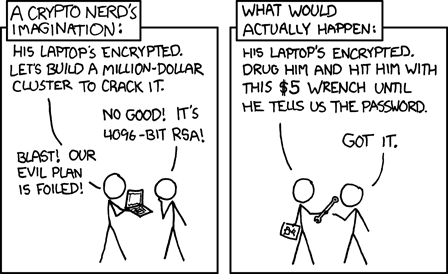
So the implication is that Whole Disk Encryption is pointless because the same criminals that are willing to commit the relatively low seriousness crime of stealing a laptop are also willing to kidnap and torture someone (a much much much more serious crime) to get their passphrase?
I tend to think that the "crypto-nerd's imagination" is more true to life 99% of the time.
Besides, most of the encrypted devices I have are owned by the company I work for, if someone kidnapped me to gain access to them they wouldn't need to hit me with a wrench I would just give up the passwords... My company doesn't pay me enough to put up with that shit.
Upvote
-7
(7
/
-14)
Two minor corrections: it's the Financial Crimes Enforcement Network, not the Federal Crimes Enforcement Network.
And "These accounts, in term..." should be "These accounts, in turn..."
Good article.
Fixed. Thanks!
Upvote
2
(3
/
-1)
DepressedRobot
Ars Praefectus
Sending money overseas is a market that overcharges a ton, and the big players they push out smaller players in the market. Crypto currencies have saved a lot of money for poor families sending money to poorer families in other countries. There are legitimate markets that benefit from these types of decentralized currencies, but they are not very obvious to a lot of people.I always get hate about it, but virtual currency really is nothing more than a haven for criminals and investors with more money than sense.
I get that people don't like having the government tracking their purchases and such, but currency rules exist not JUST for the convenience of the government, but to help control this kind of thing. Given the nature of virtual currency, it just way too easily lends itself to both attracting the criminal elements, and being targeted by the government (name any government) for much closer scrutiny for even relatively minor activity that would otherwise have gone under the radar.
I mean, people are entitled to do what they want with respect to using this kind of stuff, but when you wrap yourself up in a cloak of invisibility in order to give a gigantic, invisible, up-right middle finger to the government, it's difficult for any person to imagine that your intentions are always going to be perfectly legal and honorable. And in a scheme like this, where criminals are along side non-criminals in using the services, YOUR "money" is in as much danger of seizure or loss as theirs.
Where will that fine come from to be paid? Transaction fees? And what will this rather huge amount do to impact the value of bitcoins that will hit people NOT involved in crimes?
As a risk venture, bitcoins are probably a decent investment if you can afford to lose it (either by devaluation or straight-up loss). But I sure as hell wouldn't use them for purchases, nor put my life savings into them. YMMV on that, but for me, it's too fraught with risk with no actual advantage I can see.
Let me correct this for you...
"There are legitimate markets that benefit from these types of decentralized methods of payment..."
Upvote
2
(3
/
-1)
No one is investing in it. Purchasing a crypto isn't an investment, it is a speculation at best, but really no more than a gamble.
If you go to google, and search "Bitcoin ATM" then go to the news feed. Look at the timeline of stories, and what is happening, there is a lot of growth for companies accepting bitcoin directly, and many bitcoin ATM's popping up. This is financial infrastructure growth that is being invested in.
It doesnt have to mean the business is buying bitcoin, but rather is accepting it, or facilitating the trade to US dollars. There is growth, and it is gaining a lot of traction.
Do you not count this as growth or do you purely look at the mining, and purchase of cryptocurrency?
Upvote
2
(5
/
-3)
PSA: the ability of growing the monetary base in response of a growing economy is a feature of fiat currency, not a bug. The lack, by design, of this very specific feature from (AFAIK all) cryptocurrencies is what makes them good only for speculators and suckers.
Econ 101 - supply an demand: A growing economy increases the demand for currency. If the currency supply is limited the market will respond with an increase of the currency price. This in turn will incentivize hoarding, further compounding the problem. The end effect speculatory bubbles, which to reiterate my point, make the currency absolutely useless as a trading instrument or safe investment.
Econ 101 - supply an demand: A growing economy increases the demand for currency. If the currency supply is limited the market will respond with an increase of the currency price. This in turn will incentivize hoarding, further compounding the problem. The end effect speculatory bubbles, which to reiterate my point, make the currency absolutely useless as a trading instrument or safe investment.
Upvote
12
(13
/
-1)

It seems like the 21st century stereotype of Russians is not shaping up into anything positive lately.
(Not that Americans have much to celebrate either.)
Russia is so dirty, they can't list on international stock exchanges because official corruption is too high.
Upvote
7
(8
/
-1)
If you were sending money to your poor family, you would be criminally stupid to use any cryptocurrency that can lose its value because the wrong person sneezed at the wrong time.Sending money overseas is a market that overcharges a ton, and the big they push out smaller players in the market. Crypto currencies have saved a lot of money for poor families sending money to poorer families in other countries. There are legitimate markets that benefit from these types of decentralized currencies, but they are not very obvious to a lot of people.I always get hate about it, but virtual currency really is nothing more than a haven for criminals and investors with more money than sense.
I get that people don't like having the government tracking their purchases and such, but currency rules exist not JUST for the convenience of the government, but to help control this kind of thing. Given the nature of virtual currency, it just way too easily lends itself to both attracting the criminal elements, and being targeted by the government (name any government) for much closer scrutiny for even relatively minor activity that would otherwise have gone under the radar.
I mean, people are entitled to do what they want with respect to using this kind of stuff, but when you wrap yourself up in a cloak of invisibility in order to give a gigantic, invisible, up-right middle finger to the government, it's difficult for any person to imagine that your intentions are always going to be perfectly legal and honorable. And in a scheme like this, where criminals are along side non-criminals in using the services, YOUR "money" is in as much danger of seizure or loss as theirs.
Where will that fine come from to be paid? Transaction fees? And what will this rather huge amount do to impact the value of bitcoins that will hit people NOT involved in crimes?
As a risk venture, bitcoins are probably a decent investment if you can afford to lose it (either by devaluation or straight-up loss). But I sure as hell wouldn't use them for purchases, nor put my life savings into them. YMMV on that, but for me, it's too fraught with risk with no actual advantage I can see.
Few years ago, when I was sending the money this way, BTC transaction would take few minutes and person on the other side was able to cash it in via localbitcoins.com within 30 minutes. Much much much more efficient (and cheaper) than any other option available at the time.
Just because you don't use or understanding something doesn't mean you should talk about it.
Upvote
13
(16
/
-3)
I was replying to someone who invoked a "homeless person sending money to their poor family" argument. There have been several instances of BTC losing substantial value within minutes. Is that a risk you find sensible to take if your family's life depends on it? Because that was the extent of my argument.If you were sending money to your poor family, you would be criminally stupid to use any cryptocurrency that can lose its value because the wrong person sneezed at the wrong time.Sending money overseas is a market that overcharges a ton, and the big they push out smaller players in the market. Crypto currencies have saved a lot of money for poor families sending money to poorer families in other countries. There are legitimate markets that benefit from these types of decentralized currencies, but they are not very obvious to a lot of people.I always get hate about it, but virtual currency really is nothing more than a haven for criminals and investors with more money than sense.
I get that people don't like having the government tracking their purchases and such, but currency rules exist not JUST for the convenience of the government, but to help control this kind of thing. Given the nature of virtual currency, it just way too easily lends itself to both attracting the criminal elements, and being targeted by the government (name any government) for much closer scrutiny for even relatively minor activity that would otherwise have gone under the radar.
I mean, people are entitled to do what they want with respect to using this kind of stuff, but when you wrap yourself up in a cloak of invisibility in order to give a gigantic, invisible, up-right middle finger to the government, it's difficult for any person to imagine that your intentions are always going to be perfectly legal and honorable. And in a scheme like this, where criminals are along side non-criminals in using the services, YOUR "money" is in as much danger of seizure or loss as theirs.
Where will that fine come from to be paid? Transaction fees? And what will this rather huge amount do to impact the value of bitcoins that will hit people NOT involved in crimes?
As a risk venture, bitcoins are probably a decent investment if you can afford to lose it (either by devaluation or straight-up loss). But I sure as hell wouldn't use them for purchases, nor put my life savings into them. YMMV on that, but for me, it's too fraught with risk with no actual advantage I can see.
Few years ago, when I was sending the money this way, BTC transaction would take few minutes and person on the other side was able to cash it in via localbitcoins.com within 30 minutes. Much much much more efficient (and cheaper) than any other option available at the time.
Just because you don't use or understanding something doesn't mean you should talk about it.
Upvote
8
(11
/
-3)
artvandelayIIII
Ars Tribunus Militum
Tell that to people in Venezuela, which has hyper-inflation, and where Bitcoin-based remittances have helped a lot of families survive.If you were sending money to your poor family, you would be criminally stupid to use any cryptocurrency that can lose its value because the wrong person sneezed at the wrong time.Sending money overseas is a market that overcharges a ton, and the big they push out smaller players in the market. Crypto currencies have saved a lot of money for poor families sending money to poorer families in other countries. There are legitimate markets that benefit from these types of decentralized currencies, but they are not very obvious to a lot of people.I always get hate about it, but virtual currency really is nothing more than a haven for criminals and investors with more money than sense.
I get that people don't like having the government tracking their purchases and such, but currency rules exist not JUST for the convenience of the government, but to help control this kind of thing. Given the nature of virtual currency, it just way too easily lends itself to both attracting the criminal elements, and being targeted by the government (name any government) for much closer scrutiny for even relatively minor activity that would otherwise have gone under the radar.
I mean, people are entitled to do what they want with respect to using this kind of stuff, but when you wrap yourself up in a cloak of invisibility in order to give a gigantic, invisible, up-right middle finger to the government, it's difficult for any person to imagine that your intentions are always going to be perfectly legal and honorable. And in a scheme like this, where criminals are along side non-criminals in using the services, YOUR "money" is in as much danger of seizure or loss as theirs.
Where will that fine come from to be paid? Transaction fees? And what will this rather huge amount do to impact the value of bitcoins that will hit people NOT involved in crimes?
As a risk venture, bitcoins are probably a decent investment if you can afford to lose it (either by devaluation or straight-up loss). But I sure as hell wouldn't use them for purchases, nor put my life savings into them. YMMV on that, but for me, it's too fraught with risk with no actual advantage I can see.
https://www.forbes.com/sites/realspin/2 ... r-bitcoin/
Upvote
10
(12
/
-2)
The problem with bitcoin is that everyone is right. Almost every positive is true, and almost negative is true. It's just that people view these things from fundamentally different perspectives.
There are super bitcoin enthusiast who pay for everything in bitcoin. Could I? Fuck no. Can an entire end to end economy produce, ship, market and sell goods paid for entirely in bitcoin? Unlikely. At some point bitcoin needs to be converted to fiat.
But how is that different from a lot of international trade?
To me, bitcoin is the economic equivalent of how Christianity sort of set up a state within a state inside the Roman Empire, until it grew to a point where the institutions of the church replaced the institutions of the Empire.
There are super bitcoin enthusiast who pay for everything in bitcoin. Could I? Fuck no. Can an entire end to end economy produce, ship, market and sell goods paid for entirely in bitcoin? Unlikely. At some point bitcoin needs to be converted to fiat.
But how is that different from a lot of international trade?
To me, bitcoin is the economic equivalent of how Christianity sort of set up a state within a state inside the Roman Empire, until it grew to a point where the institutions of the church replaced the institutions of the Empire.
Upvote
8
(9
/
-1)

My point is, if you can't afford to lose the money you don't deal with BTC. You don't use it to send money "to your poor family". There have been severe crashes in the past where BTC has lost over 80% of its value over a period of minutes. If you ask me, anyone sending indispensable funds over BTC has very little sense. Anyone investing sums they can't afford to lose in BTC has very little sense.unless they spent the money when it was received because it was needed at that time, thus saving more money by offsetting the transactional fees, and or gaining money by its upward trend.If you were sending money to your poor family, you would be criminally stupid to use any cryptocurrency that can lose its value because the wrong person sneezed at the wrong time.Sending money overseas is a market that overcharges a ton, and the big they push out smaller players in the market. Crypto currencies have saved a lot of money for poor families sending money to poorer families in other countries. There are legitimate markets that benefit from these types of decentralized currencies, but they are not very obvious to a lot of people.I always get hate about it, but virtual currency really is nothing more than a haven for criminals and investors with more money than sense.
I get that people don't like having the government tracking their purchases and such, but currency rules exist not JUST for the convenience of the government, but to help control this kind of thing. Given the nature of virtual currency, it just way too easily lends itself to both attracting the criminal elements, and being targeted by the government (name any government) for much closer scrutiny for even relatively minor activity that would otherwise have gone under the radar.
I mean, people are entitled to do what they want with respect to using this kind of stuff, but when you wrap yourself up in a cloak of invisibility in order to give a gigantic, invisible, up-right middle finger to the government, it's difficult for any person to imagine that your intentions are always going to be perfectly legal and honorable. And in a scheme like this, where criminals are along side non-criminals in using the services, YOUR "money" is in as much danger of seizure or loss as theirs.
Where will that fine come from to be paid? Transaction fees? And what will this rather huge amount do to impact the value of bitcoins that will hit people NOT involved in crimes?
As a risk venture, bitcoins are probably a decent investment if you can afford to lose it (either by devaluation or straight-up loss). But I sure as hell wouldn't use them for purchases, nor put my life savings into them. YMMV on that, but for me, it's too fraught with risk with no actual advantage I can see.
There were homeless people who regretted buying food with it when it jumped to $300 a coin, i bet they are kicking themselves with steel boots now.
A lot of the reason that bitcoin jumped into the 4 figures is because a lot of retail outlets and businesses are investing in it, and making it not only more valuable, but more stable. These growths are capping out the number of transactions per minute, and forcing questions to the growth of the platform, but this is a good problem to have for a cryptocurrency, as it shows both growth, and desire for more use.
Nonsense. It's going up in value because of ransomware causing people to need some.
Businesses taking bitcoin in exchange for goods had better be careful, it's easy to get caught up in money laundering that way.
Upvote
-1
(4
/
-5)
Nonsense. It's going up in value because of ransomware causing people to need some.
Businesses taking bitcoin in exchange for goods had better be careful, it's easy to get caught up in money laundering that way.
That is likely a good factor to consider, but completely dismissing real market factors is not going to give you an accurate perspective. Japan formally recognized the cryptocurrency in April. These types of things are more likely to push not only a higher value, but longer term stability. If the ransomeware subsides with OS updates, and other methods of deterring it, and the price drops below pre 2016 levels id concede that point, but I doubt that will be the case.
Upvote
0
(2
/
-2)
Why should a government be able to devalue your money through inflation without your consent? Why should you be subject to your salary essentially being cut in half because your government decided to to invade another country and get itself slapped with international sanctions- again, without your consent? That's what cryptocurrency solves. I'd rather trust my wealth to an algorithm than to a group of power-hungry guys with guns and nukes.
You just proved that you have absolutely no idea what a "cryptocurrency" is.
First, a cryptocurrency isn't a currency. It is just a method of payment, like a debit card or prepaid card. You take fiat currency, purchase a digital unit of cryptocurrency, deposit it into a wallet. Then when you need to actually do something with the fiat currency you deposited into that wallet via a crypto unit, you sell that crypto unit for fiat currency. Just like a debit/prepaid card.
The only "value" cryptocurrency has is in potentially bypassing normal fiat currency exchange mechanisms and pseudo-anonymity. There might be a little bit of value in those features, but certainly not the kind of premium people are putting on cryptocurrencies.
You're going to say, oh of course cryptocurrency is a currency, because that's what every tulip buyer says. Ok, then tell me what a cryptocurrency is worth. If you say it's worth anything other than itself, then it isn't a currency, it's just a method of payment, a way to store fiat currency, just like a debit/prepaid card, a tulip. Except that tulips can be pretty.
Now, you might argue that the digital market is its own economy, like any other economy in the world with a government controlled currency. And you'd be partly right, except that again those cryptoprepaid cards aren't worth anything to anyone without being able to be exchanged into some fiat currency to be used in the real world. So, they aren't a currency. If the digital world and crypto was truly a self-contained economy, then all transactions within it wouldn't require conversion to a fiat currency at some point.
Back to your rant about inflation and such, you're saying being subject to the irrational movements of the crypto market are somehow better than the typically slowly moving fiat market. That makes no sense whatsoever. Perhaps you're talking about less developed nations, nations with dictators, nations with highly corrupt governments and disastrous central banks. Ok, yep, those are problems, except that once you send money to someone in one of those countries they still have to convert that crypto to local currency, so they haven't actually avoided any of the problems you mentioned, but did add on another layer of risk which is the psychotic crypto market.
More specifically, cryptocurrencies are a commodity. Most commodities have some inherent value - you can make wires with copper, burn oil for energy, and tulip bulbs make pretty flowers. Cryptocurrency is a bit of mathematical proof ("Hey, I can make a hash that starts with some number of zeros!") that has no inherent value, so it's only a carrier of value, as you say.
There may be some good things about that, but "not being subject to inflation" is not one of them, since like any commodity, you only do better or worse than inflation against any other currency based on demand fluctuations. And that's the real crazy part! A real commodity has SUPPLY fluctuations too. Cryptocurrencies, by definition, have a completely predictable supply, now and forever. Not even fiat currency, the cryptomaven's curse word, has that weakness. You can't wipe out the value of copper (at least not for long) because of buyer and seller momentarily losing their minds.
Am I pissed that I didn't mine a bit when I first heard of bitcoin1? Hell yes, I'd have a nice income selling it to crazy people right now.
---
1 It was on a Security Now episode, at the time bitcoin was going for a fraction of a cent each, and you could mine it on an ancient computer. Steve Gibson got 50 bitcoins (which he still has) running the software for less than 24 hours. WHY didn't I leave it running? Sigh.
Upvote
6
(6
/
0)
Nonsense. It's going up in value because of ransomware causing people to need some.
Businesses taking bitcoin in exchange for goods had better be careful, it's easy to get caught up in money laundering that way.
You're kidding me right? I for one haven't invested 70% of my net worth into cryptocurrencies because of ransomware. Try seeing what happens to your account when you buy Bitcoin on an exchange and attempt to send it to any known ransom-ware address. Also try taking a look at how much money is actually sent to ransomware wallets (its abysmal).
Upvote
0
(3
/
-3)
Nonsense. It's going up in value because of ransomware causing people to need some.
Businesses taking bitcoin in exchange for goods had better be careful, it's easy to get caught up in money laundering that way.
You're kidding me right? I for one haven't invested 70% of my net worth into cryptocurrencies because of ransomware. Try seeing what happens to your account when you buy Bitcoin on an exchange and attempt to send it to any known ransom-ware address. Also try taking a look at how much money is actually sent to ransomware wallets (its abysmal).
70% of nothing is still nothing. -- Cyrano Jones
Upvote
-1
(1
/
-2)
SymmetricChaos
Ars Tribunus Militum
Sending money overseas is a market that overcharges a ton, and the big players they push out smaller players in the market. Crypto currencies have saved a lot of money for poor families sending money to poorer families in other countries. There are legitimate markets that benefit from these types of decentralized currencies, but they are not very obvious to a lot of people.
How often does this actually happen? I feel like extremely poor countries would be difficult places to spend bitcoins or even cash them out.
Upvote
2
(3
/
-1)
It is shameful that people are downvoting this. The poster is pointing out that Bitcoin is actually the opposite of anonymous or "encrypted." There are ways to anonymize transactions through the rudimentary mechanism of passing bitcoins through intermediaries, but fundamentally the transaction ledger is public, and Vinnik is implicated precisely because it is public. It is quite a fascinating thing.So, wait, you're saying distributed ledgers actually work?
But the open nature of its shared transaction ledger, the blockchain, often makes it possible to do forensic analysis of financial flows on the Bitcoin network. And the indictment suggests that Vinnik didn't do a good job of covering his tracks. Funds stolen from Mt. Gox were deposited at BTC-e, to a now-defunct Bitcoin exchange called Trade Hill, and back to Mt. Gox under another account name.
Upvote
1
(1
/
0)
Fixed it for ya.First, a cryptocurrency isn't a fiat currency. It is just a method of payment, like a debit card or prepaid card. You take fiat currency, purchase a digital unit of cryptocurrency, deposit it into a wallet. Then when you need to actually do something with the fiat currency you deposited into that wallet via a crypto unit, you sell that crypto unit for fiat currency. Just like a debit/prepaid card.
Semantics are fun!

Beads, fancy stones, fur pelts, AND tulips are currencies.
They're just not fiat currencies.
Also, google "ancient currency", "fur currency", etc, yada, yada.
They just ceased to be considered real "currencies" when fiat currency dominated trade instead of other currencies. If currency X (whether it be fur pelts or bitcoin or 1800s currency or 1900s currency or 2100s currency) dominated most of transactions (say, more than 50% of the populations' transactions of value) -- then it's really the defacto main currency -- even if it's an overvalued dutch tulip, a common fur pelt, or a bitcoin or other crypto currency.
What is considered "currency" is all relative, ala Einstein, based on prevailing currency of the time/era/etc -- it then becomes the defacto unit.
Granted, dictionary definitions vary between dictionaries -- but some of them use this this POV in terms of commodity-backed currency, considering specific commodities (e.g. fur) as currency. Obviously, with what happened with the dutch tulip craze, and crazy fluctuations and crash, even fur pelts were prone to that too in bad hunting years. While tulips were a temporary fad currency, fur pelts and grain were a durable currency once upon a time. Now a relic, it gave way to modern fiat currencies.
Oxford dictionary simply says "A system of money in general use in a particular country." which can be grain (Aztecs), fur pelts or trading beads, etc. Nowadays it's fiat, so it's just the assumed definition of currency in this era.
In many dictionaries, money is mentioned as any item that is generally accepted as payment. (Even Wikipedia agrees too). It's just been defacto fiat currency in this era, but it wasn't 300 years ago, and it might not be 300 years from now.
Definition of money on Merriam-Webster Dictionary
"Something generally accepted as a medium of exchange, a measure of value, or a means of payment"
Definition of currency on Merriam-Webster Dictionary
a : something (such as coins, treasury notes, and banknotes) that is in circulation as a medium of exchange
b : paper money in circulation
c : a common article for bartering.
Furs were once used as currency.
Whether it's fur pelts, sheep, tulips or bitcoin. Whatever is the most popular form of unit of trade in 300 years ago or 300 years from now, becomes the implied money of the era, and thus, currency.
I hereby bill you 2 sheep and 1 cow for this reply.
Upvote
2
(4
/
-2)
more often than you'd think. Sometimes a family sends one person to america to work for better wages, and send money home to raise and feed the family. This happens from our neighbor to the south as well as from other African, Asian, and to a lesser extent European countries. It happens in India to pay for prepaid cellphone services to call back home, and in many other circumstances. There are a lot of countries that have businesses that do this because it makes good money undercutting the finance industry, and those countries have fewer regulations, and or more lax enforcement.Sending money overseas is a market that overcharges a ton, and the big players they push out smaller players in the market. Crypto currencies have saved a lot of money for poor families sending money to poorer families in other countries. There are legitimate markets that benefit from these types of decentralized currencies, but they are not very obvious to a lot of people.
How often does this actually happen? I feel like extremely poor countries would be difficult places to spend bitcoins or even cash them out.
Upvote
1
(2
/
-1)
DepressedRobot
Ars Praefectus
Fixed it for ya.First, a cryptocurrency isn't a fiat currency. It is just a method of payment, like a debit card or prepaid card. You take fiat currency, purchase a digital unit of cryptocurrency, deposit it into a wallet. Then when you need to actually do something with the fiat currency you deposited into that wallet via a crypto unit, you sell that crypto unit for fiat currency. Just like a debit/prepaid card.
Semantics are fun!
Beads, fancy stones, fur pelts, AND tulips are currencies.
They're just not fiat currencies.
Also, google "ancient currency", "fur currency", etc, yada, yada.
They just ceased to be considered real "currencies" when fiat currency dominated trade instead of other currencies. If currency X (whether it be fur pelts or bitcoin or 1800s currency or 1900s currency or 2100s cur4rency) dominated far more than 50% of transactions, then it's really a currency -- even if it's an overvalued dutch tulip, a common fur pelt, or a bitcoin or other crypto currency.
What is considered "currency" is all relative, ala Einstein, based on prevailing currency of the time/era/etc -- it then becomes the defacto unit.
Granted, dictionary definitions vary between dictionaries -- but some of them use this this POV in terms of commodity-backed currency, considering specific commodities (e.g. fur) as currency. Obviously, with what happened with the dutch tulip craze, and crazy fluctuations and crash, even fur pelts were prone to that too in bad hunting years. Now a relic, it gave way to modern fiat currencies.
Oxford dictionary simply says "A system of money in general use in a particular country." which can be grain (Aztecs), fur pelts or trading beads, etc. Nowadays it's fiat, so it's just the assumed definition of currency in this era.
In many dictionaries, money is mentioned as any item that is generally accepted as payment. (Even Wikipedia agrees too). It's just been defacto fiat currency in this era, but it wasn't 300 years ago, and it might not be 300 years from now.
Merriam-Webster: MONEY: "Something generally accepted as a medium of exchange, a measure of value, or a means of payment"
Whether it's tulips, fur pelts, grains, sheep, or bitcoin. Whatever is the most popular form of unit of trade in 300 years ago or 300 years from now.
I hereby bill you 2 sheep and 1 cow for this reply.
I suppose I'll agree with you if you're going to use the most general term possible to define a "currency". But let's think through some things.
Since you're arguing anything can be used as currency, as long as it is agreed upon by the traders, which sounds like a pretty good definition, then what is a prepaid card worth? A prepaid card is a "currency" by your definition, because it can be used to buy things. It must have worth. Or is it that it only has worth when a fiat currency is stored on it? If the latter, then it is just a method of payment, not an actual currency. If I can't exchange the empty prepaid card for a fiat currency, then it's worth is defined by the value of the fiat currency stored in/on it.
The same goes for Bitcoin. Unless Bitcoin can be exchanged for some amount of fiat currency, because some amount of fiat currency is being "stored" in Bitcoin, then Bitcoin is worthless, it has no value. As such, it is nothing more than a method of payment, just like a prepaid card.
The difference with goods like fur coats and such is that people could actually use those goods. Or if they couldn't, they knew someone who could. Or if they didn't, then those fur coats were worthless because they couldn't be exchanged for anything of need, so they then were no longer a currency, at least for that person at that place at that point in time. As you mentioned, "money" solved all of that because we didn't have to carry around cows and pigs to find someone to give us bread and beer.
Looking at Bitcoin again, what would Bitcoin be worth without fiat currencies? Currently it would have zero value. As such, it isn't a currency, but rather a method of payment.
Upvote
0
(1
/
-1)
- Status
- Not open for further replies.