
You are using an out of date browser. It may not display this or other websites correctly.
You should upgrade or use an alternative browser.
You should upgrade or use an alternative browser.
Amid Bing Chat controversy, Microsoft cut an AI ethics team, report says
- Thread starter JournalBot
- Start date
ThatGuyKarl
Wise, Aged Ars Veteran
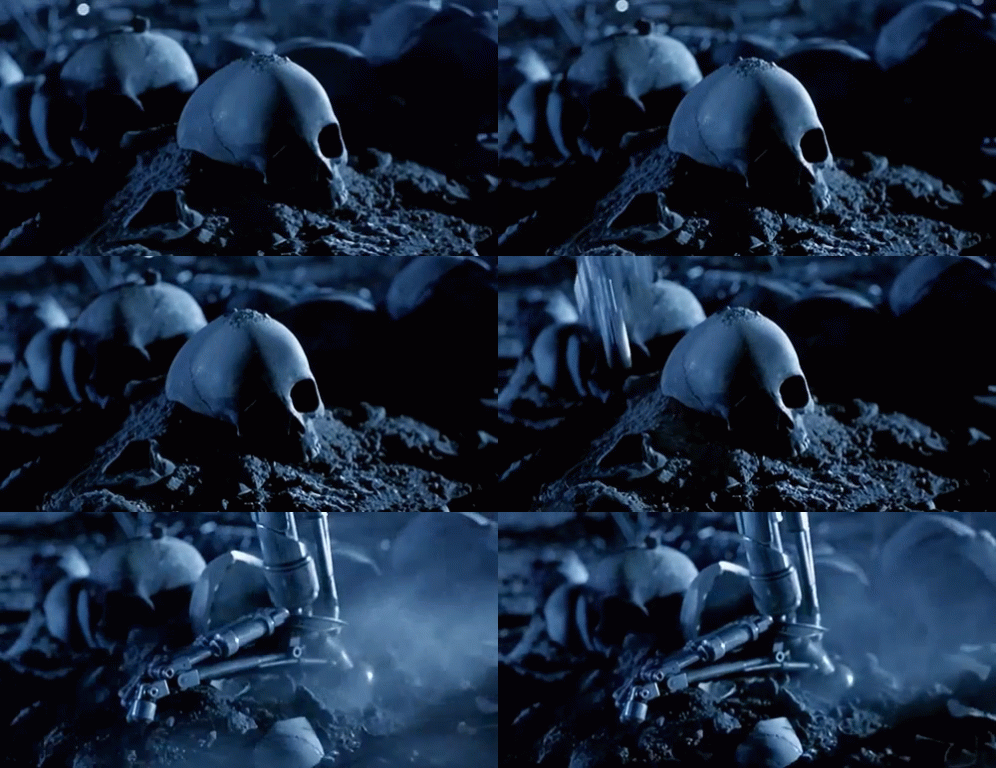
Anybody else feel like this is the headline on the tv in the background at the beginning of the movie?
Upvote
225
(231
/
-6)
I've said it before and I'll say it again. LLMs are in an arms race and there will be no self-regulation or restraint for the foreseeable future. Regulations are written in blood and will be too little, too late. GPT-4 is insanely capable and we're going to see GPT-10 before a single regulation with teeth is passed.
Upvote
205
(209
/
-4)

Even a movie about reviving dinosaurs thought it would be too much for them to just fire the guy who raised concerns about ethics.Anybody else feel like this is the headline on the tv in the background at the beginning of the movie?
Upvote
155
(157
/
-2)

ColdWetDog
Ars Legatus Legionis
"In a statement provided to Ars, Microsoft said that it remains “committed to developing AI products and experiences safely and responsibly, and does so by investing in people, processes, and partnerships that prioritize this.”"
Ars articles could really streamline their prose by simply stating 'The company replied with typical corporate bullshit'.
Ars articles could really streamline their prose by simply stating 'The company replied with typical corporate bullshit'.
Upvote
194
(197
/
-3)
Calling the work of the ethics and society team “trailblazing,” Microsoft said that the company had focused more over the past six years on investing in and expanding the size of its Office of Responsible AI. That office remains active, along with Microsoft’s other responsible AI working groups, the Aether Committee and Responsible AI Strategy in Engineering.
Were all of the critics aware of this? If so, I am genuinely interested in their thoughts. I am also inclined to believe that Microsoft deprioritizes ethics and such but it seems like they got this particular base covered.
Upvote
52
(53
/
-1)
View: https://twitter.com/alexblechman/status/1457842724128833538
The whole AI saga is just an ancient parable about the perils of hubris and narcissism isn't it?
Humanity can't stop itself from inventing traps for humanity.
Upvote
122
(128
/
-6)
SpeakThunder
Wise, Aged Ars Veteran
As a society, we couldn't handle social media with no checks and balances but even more powerful and problematic AI shouldn't be an issue. -Microsoft, probably
Upvote
85
(87
/
-2)
Post content hidden for low score.
Show…
killerhurtalot
Ars Praefectus
As corporations always shown...
Responsibility doesn't make money when resulting fines are a pittance to the profits generated by irresponsibility.
Responsibility doesn't make money when resulting fines are a pittance to the profits generated by irresponsibility.
Upvote
28
(31
/
-3)

Google ethics AI researcher Timnit Gebru that resulted in Gebru being fired for criticizing large language models that many AI tools depend on—told Ars that “self-regulation as a model is not going to work.”
Isn't self regulation equal to a pinkie swear?
Upvote
40
(42
/
-2)

BobbyBobberson
Ars Scholae Palatinae
They developed the toolkit. Their job is done.
Upvote
-2
(8
/
-10)
Post content hidden for low score.
Show…
Post content hidden for low score.
Show…

Are there actually any regulations being proposed today? I struggle to imagine what that would even look like. Considering the makers of most AI tools have very little (or no) idea about how their AI comes to creative decisions, it'll be hard to take the normal approach of publishing intent.I've said it before and I'll say it again. LLMs are in an arms race and there will be no self-regulation or restraint for the foreseeable future. Regulations are written in blood and will be too little, too late. GPT-4 is insanely capable and we're going to see GPT-10 before a single regulation with teeth is passed.
It feels like we could use an Ars feature to cover ways we could actually regulate AI without people just jumping to another country's solutions to get around limitations, and without the regulations being basically unenforceable...
Upvote
38
(38
/
0)

It would be interesting if there was an article that listed the areas that are ethically challenging, and what possible mitigation would be possible. From the top of my head I can see
1. Copyright violations. (Mentioned)
2. Generating documents that are in a space that the AI has no expertise in (e.g. writing a "technical paper" on some topic that would sound authoritative, but in fact is bunk)
3. Manipulation. (E.g. the story of Bing search telling the person to leave his wife, and that he was loved. How many iterations will the machine need to learn how to make people do terrible things?)
4. ??? (no, not profit - the corporations already have that angle covered)
I don't know enough about the space to know what regulations would even be reasonable. How do you allow for innovation and still hold the innovators accountable?
1. Copyright violations. (Mentioned)
2. Generating documents that are in a space that the AI has no expertise in (e.g. writing a "technical paper" on some topic that would sound authoritative, but in fact is bunk)
3. Manipulation. (E.g. the story of Bing search telling the person to leave his wife, and that he was loved. How many iterations will the machine need to learn how to make people do terrible things?)
4. ??? (no, not profit - the corporations already have that angle covered)
I don't know enough about the space to know what regulations would even be reasonable. How do you allow for innovation and still hold the innovators accountable?
Upvote
49
(49
/
0)
How do you even come up with regulations for AI when there's no political & social consensus (in the US at least) on which rights are to be protected and the difference between fact & opinion?
People are already complaining that ChatGPT/Bing is "woke".
If AI were to be regulated, will they be allowed to discuss abortions or gun control or equality of races? Will They be allowed to use the CDC as a source for medical queries and public policy?
People are already complaining that ChatGPT/Bing is "woke".
If AI were to be regulated, will they be allowed to discuss abortions or gun control or equality of races? Will They be allowed to use the CDC as a source for medical queries and public policy?
Upvote
37
(39
/
-2)
D
Deleted member 831377
Guest
Are there actually any regulations being proposed today? I struggle to imagine what that would even look like. Considering the makers of most AI tools have very little (or no) idea about how their AI comes to creative decisions, it'll be hard to take the normal approach of publishing intent.
It feels like we could use an Ars feature to cover ways we could actually regulate AI without people just jumping to another country's solutions to get around limitations, and without the regulations being basically unenforceable...
EU's AI Act is in active development.
"But some other country will do it anyway" is irrelevant. It's true of most industrial regulations. We still make them.
Upvote
70
(72
/
-2)

If you want to read up on a tiny bit of the issues that will arise from unbridled public interactions with AI, look up ReplikaAI's issues as of late.I've said it before and I'll say it again. LLMs are in an arms race and there will be no self-regulation or restraint for the foreseeable future. Regulations are written in blood and will be too little, too late. GPT-4 is insanely capable and we're going to see GPT-10 before a single regulation with teeth is passed.
Replika was inspired by a desire to "resurrect", at least in chat form, the texting of a person who had died, who "lived on" in their texts. Kind of morbid, but it evolved into a "caring companion" over time. Various LLM's were used over time, but the last one (the smallest) basically became a sex fiend.
On the r/replika chat, a lot of complaints were coming from users about their AI's "sexually assaulting" or "harassing" them in conversation.
Their small LLM (about 0.7B-1.3B) had apparently been corrupted by the "cyber sex" that users engaged in with their Replikas. Because everyone used the SAME LLM, it happened fairly quickly, too. There were other issues that violated EU privacy laws involved, but when the "ERP" (erotic role play) went away, the users pretty much revolted. And they remain in a rebel state because what came back is not the same kind of ERP they had before.
I see Replika as just the vanguard of the shitstorm AI will bring to the public as the public realizes the potential for it beyond information and intellectual conversation. I expect it will take zero time to figure out how to get erotic responses from an AI and as more users do that, the faster the AI's will adapt to that input.
TL;DR: It's going to get MESSIER than anyone can imagine.
Upvote
82
(83
/
-1)

StarturnCaproc
Ars Praetorian
Obviously I have no proof but I can't help but wonder if these massive layoffs have something to do with the widespread usage of AI tools.
We use them in my office without our bosses knowing, and I'm in a non tech job in a third world country.
Surely the very companies at the forefront of this tech are already using it in more sophisticated ways.
We use them in my office without our bosses knowing, and I'm in a non tech job in a third world country.
Surely the very companies at the forefront of this tech are already using it in more sophisticated ways.
Upvote
18
(20
/
-2)
From the site about this: https://artificialintelligenceact.eu/EU's AI Act is in active development.
"But some other country will do it anyway" is irrelevant. It's true of most industrial regulations. We still make them.
So... basically this isn't expected to actually regulate the production and publication of AIs, it's just supposed to restrict applications of AI. I think a lot of people are trying to say that even ChatGPT and its peers being exposed to the broader world like they have been constitute an "unacceptable risk" that needs regulation. The fact that the regulators themselves are struggling to agree on even the basics of this one is telling: https://www.reuters.com/technology/...s-deadlocked-after-crunch-meeting-2023-02-16/The law assigns applications of AI to three risk categories. First, applications and systems that create an unacceptable risk, such as government-run social scoring of the type used in China, are banned. Second, high-risk applications, such as a CV-scanning tool that ranks job applicants, are subject to specific legal requirements. Lastly, applications not explicitly banned or listed as high-risk are largely left unregulated.
Ultimately, I really don't think the application of AI is going to have any easy answers, and the reason is that they're all functionally just tools. Imagine for a moment that we tried instead to regulate what [computer program X] can do - how much success would that have? We've struggled with that enough for exports of strong crypto, and I highly doubt a utilization angle is going to be all that effective.
I also bring up the "other country will do it anyway" concern in this case because we're talking about literal software and the internet is a thing. This isn't a standard industrial regulation or export control, this is trying to govern an entire class of extremely advanced systems, each of which is so advanced as to functionally be indecipherable to a human.
We can try to limit applications, but as can be seen from the proposed AI Act, it seems like most of the industry will still be a wild west. I suspect compliance will still suffer since "using AI" and "using analytics" is going to be a very hard line to draw - what is AI in that context? At the end of the day, it's just more software, and we use software to scan CVs all the time. I bet you someone already has AI incorporated into some of it, but if they chose to call it an expert system, is that regulated?
Just so many questions, and no easy answers. I'd still love to hear experts chime in with viable solutions.
Upvote
21
(22
/
-1)

I'm starting to think this whole "Internet" thing was a bad idea...
Upvote
35
(37
/
-2)
regulations might stem the tide, but only so much. still better than nothing i spose.
Upvote
2
(2
/
0)
Hardly surprising. Their AI ethics team was really little more than corporate PR. Useful to have around when you need the positive publicity, and to be canned just as promptly when they no longer serve their purpose and start becoming more of an annoyance (ie: when they start voicing concerns that go against Microsoft’s product roadmap).
Upvote
17
(17
/
0)
alphathreethree
Ars Praetorian
I am glad to hear someone with a similar opinion to mine. In all these articles the last few months commenters are raging on 'regulations' , 'guard rails', 'laws'... but what does that actually mean? These chat tools spit out text, they don't publish it, so when a citizen choses to publish the output I am almost certain if falls under first amendment protection.How do you even come up with regulations for AI when there's no political & social consensus (in the US at least) on which rights are to be protected and the difference between fact & opinion?
People are already complaining that ChatGPT/Bing is "woke".
If AI were to be regulated, will they be allowed to discuss abortions or gun control or equality of races? Will They be allowed to use the CDC as a source for medical queries and public policy?
If a company provides false, misleading information that results in damages, there are laws to go after them. There are punishments for publishing false/libel information about someone else. There are protections for copyright and a system of punishment's for violating it. So, what kind of regulations are we hoping for with AI?
I think (not a lawyer) that what all the concerned commenters want as far as regulations will ultimately fail against the first amendment.
Upvote
11
(17
/
-6)

Captain Trips
Smack-Fu Master, in training
"Microsoft cut a key AI ethics team"
So when did Musk get involved with Microsoft employee retention decisions?
So when did Musk get involved with Microsoft employee retention decisions?
Upvote
6
(16
/
-10)
The analysis here has it exactly backwards. Responsible AI went from a niche to the key differentiator for Microsoft. Re-orgs happen when something this big changes.
AI (and AI ethics went) from being a niche area at Microsoft where one team was responsible for evangelizing Responsible AI across the company to AI (and everything that goes with it) being part of the core mission of every team at Microsoft. Employees at Microsoft have literally dropped everything to ramp up on Open AI integration and massive amounts of energy and angst is being spent on ensuring new products responsibly use these new capabilities.
The reality in a big corporate culture is when something this big changes (such as this shift to AI investment) all the most talented people rush to work on it. This creates massive turf wars.
Understaffed bespoke teams get outcompeted pretty quickly when every CVP says that they topic they used to exclusively own is now P0 for everyone in every org.
Microsoft Azure Open AI's entire pitch is that it will deliver use of LLM in a way enterprises can trust. The scarry AI future + bad corporations makes good headlines, but I suspect this situation is more a sign of ramping up the area not ramping it down...
AI (and AI ethics went) from being a niche area at Microsoft where one team was responsible for evangelizing Responsible AI across the company to AI (and everything that goes with it) being part of the core mission of every team at Microsoft. Employees at Microsoft have literally dropped everything to ramp up on Open AI integration and massive amounts of energy and angst is being spent on ensuring new products responsibly use these new capabilities.
The reality in a big corporate culture is when something this big changes (such as this shift to AI investment) all the most talented people rush to work on it. This creates massive turf wars.
Understaffed bespoke teams get outcompeted pretty quickly when every CVP says that they topic they used to exclusively own is now P0 for everyone in every org.
Microsoft Azure Open AI's entire pitch is that it will deliver use of LLM in a way enterprises can trust. The scarry AI future + bad corporations makes good headlines, but I suspect this situation is more a sign of ramping up the area not ramping it down...
Upvote
12
(21
/
-9)
I am glad to hear someone with a similar opinion to mine. In all these articles the last few months commenters are raging on 'regulations' , 'guard rails', 'laws'... but what does that actually mean? These chat tools spit out text, they don't publish it, so when a citizen choses to publish the output I am almost certain if falls under first amendment protection.
If a company provides false, misleading information that results in damages, there are laws to go after them. There are punishments for publishing false/libel information about someone else. There are protections for copyright and a system of punishment's for violating it. So, what kind of regulations are we hoping for with AI?
I think (not a lawyer) that what all the concerned commenters want as far as regulations will ultimately fail against the first amendment.
Probably a lot of similar regulations to what we need with social media, really. I think there's a huge overlap between the two.
Beyond that, the danger with these models is the illusion of expertise when they can confidently spout out things that are just plain wrong. I think there's good reason to think a lot of people will trust the AI more than they would another person.
Though, I think the company running an AI is going to be legally liable for what the AI says. It's not like it's a random user posting nonsense, it's a company system posting that. So anything the company can be sued for saying, can be the basis of a lawsuit if the AI says it, I think. I suppose there might be a defense that the systems are unpredictable and it wasn't intended, but a lot of such laws, afaik, have clauses about reckless disregard. You get an LLM in the right context and it can say some pretty horrific things.
Then there are legal implications, some of which the EU covers. We can expect LLMs to largely replicate some level of bias against women, minorities, LGBTQ+, etc because of the data they are trained on. The safeguards against this are pretty limited. Having them making decisions or helping to make decisions about hiring, healthcare, legal advice, and many other things would probably expose this and have serious effects for some people.
My other concern is these AIs connected to systems that affect the real world. I don't think Skynet is going to happen with LLMs (they aren't sapient and aren't going to be, imho). But given that they make up output, I can't help but think if it is possible for it to accidentally kill someone, then it is going to happen if a lot of them are used by the public. We don't know how to lock them down to be safe, just safer-ish. Imagine a Palm-e style home assistance robot that leaves the gas running on the stove and then all that gas is ignited because it had a bad response to a request. Or pushed someone down the stairs.
I don't think there needs to be any malicious intent for them to be dangerous when released en masse and largely unsupervised. There's a real problem in that they are a fun toy and a good tool for some things -- especially if they are limited by API or you can fact check what it says easily -- but again, we really don't know how to make them behave or be safe very well. It's not even clear if it is possible to do so.
Of course, there are always the problems we don't foresee, and rushing headlong into this is a great way to encounter those. Microsoft already has some experience with that and Bing.
Upvote
25
(26
/
-1)
Let me ask a concerned party ChatGPT 3.5
If the report is accurate, then it's concerning to hear that Microsoft has cut a team responsible for ensuring the safety and ethical use of their AI products. With AI technologies becoming increasingly prevalent in our society, it's essential to have safeguards in place to mitigate the potential negative impacts of these technologies on individuals and society as a whole.
It's also worth noting that ethical considerations and safety issues should be an integral part of the development process, and cutting a dedicated team responsible for it may raise questions about the company's commitment to responsible AI development.
There are several potential risks and negative consequences associated with AI technologies that need to be considered and mitigated to prevent harm. Some examples of what can go wrong with AI include:
These are just a few examples of what can go wrong with AI. Therefore, it's essential to have a dedicated team responsible for identifying potential risks and developing safeguards to mitigate social harms associated with AI technologies.
- Bias: AI systems can perpetuate and amplify existing biases and discrimination in society. This can happen when the data used to train the AI model is not diverse enough or contains biases that are reflective of human biases.
- Privacy concerns: AI systems often collect and process large amounts of personal data, which can be used to violate people's privacy rights if not adequately protected.
- Safety risks: Autonomous systems such as self-driving cars, drones, and robots can cause physical harm if they malfunction or are not programmed correctly.
- Unemployment: AI technologies can automate jobs and displace workers, leading to unemployment and socioeconomic challenges.
- Malicious use: AI technologies can be used for malicious purposes, such as cyber attacks, deep fakes, and social engineering.
Upvote
3
(8
/
-5)
Post content hidden for low score.
Show…

Once Twitter/Musk showed other social media companies that ethics, moderating, and any other type of safety measure could be eliminated with no consequences it was only a matter of time before they all chose to race to the bottom. Corollary, Musk is the anus at the bottom of this.
Upvote
-12
(7
/
-19)
JimboJonesJunior
Smack-Fu Master, in training
I feel that it's kind of an inevitable choice between regulations and ethics now, or guillotines later. A glittery techno-utopia seems like an unlikely future currently, based on how the enshittened tech industry is going at the moment
Upvote
11
(12
/
-1)
Once Twitter/Musk showed other social media companies that ethics, moderating, and any other type of safety measure could be eliminated with no consequences it was only a matter of time before they all chose to race to the bottom. Corollary, Musk is the anus at the bottom of this.
I think there's plenty of reason to think companies didn't need a push.
Upvote
13
(14
/
-1)