
You are using an out of date browser. It may not display this or other websites correctly.
You should upgrade or use an alternative browser.
You should upgrade or use an alternative browser.
This is the oldest evidence of people starting fires
- Thread starter JournalBot
- Start date
Asbestos Muffins
Ars Praetorian
one of the techniques used is simply to rope off the site into a grid and just spend all day digging in that one single square you're to work on. its kind of autistic in a way but it lets you pay attention to every pebble and pottery fragmentThis is my problem with archaeology. I'm pretty good with theory and interpretation. I resolutely do not have the attention to detail to notice that that tiny fragment of rock is unlike all the other tiny fragments of rock I might come across.
Upvote
3
(4
/
-1)

lunatic_cringe
Smack-Fu Master, in training
While we don’t know when and where the first fire-starter lived, I’d be curious if there’s archaeological evidence for the ability to preserve fire? It seems reasonable that somewhere along the line from chance encounters with wildfires to creating it anytime with a spark, it would have occurred to someone(s) that the hot coals from a campfire could be kept, and perhaps even carried in some way.
Upvote
0
(0
/
0)

I reckon. The woman(?) sitting just to the right of the flame seems to be casting a serious evil eye on the artist while the chap in the background gazing at the night sky has probably marked himself out as the prime candidate for next bog sacrifice to the chthonic gods.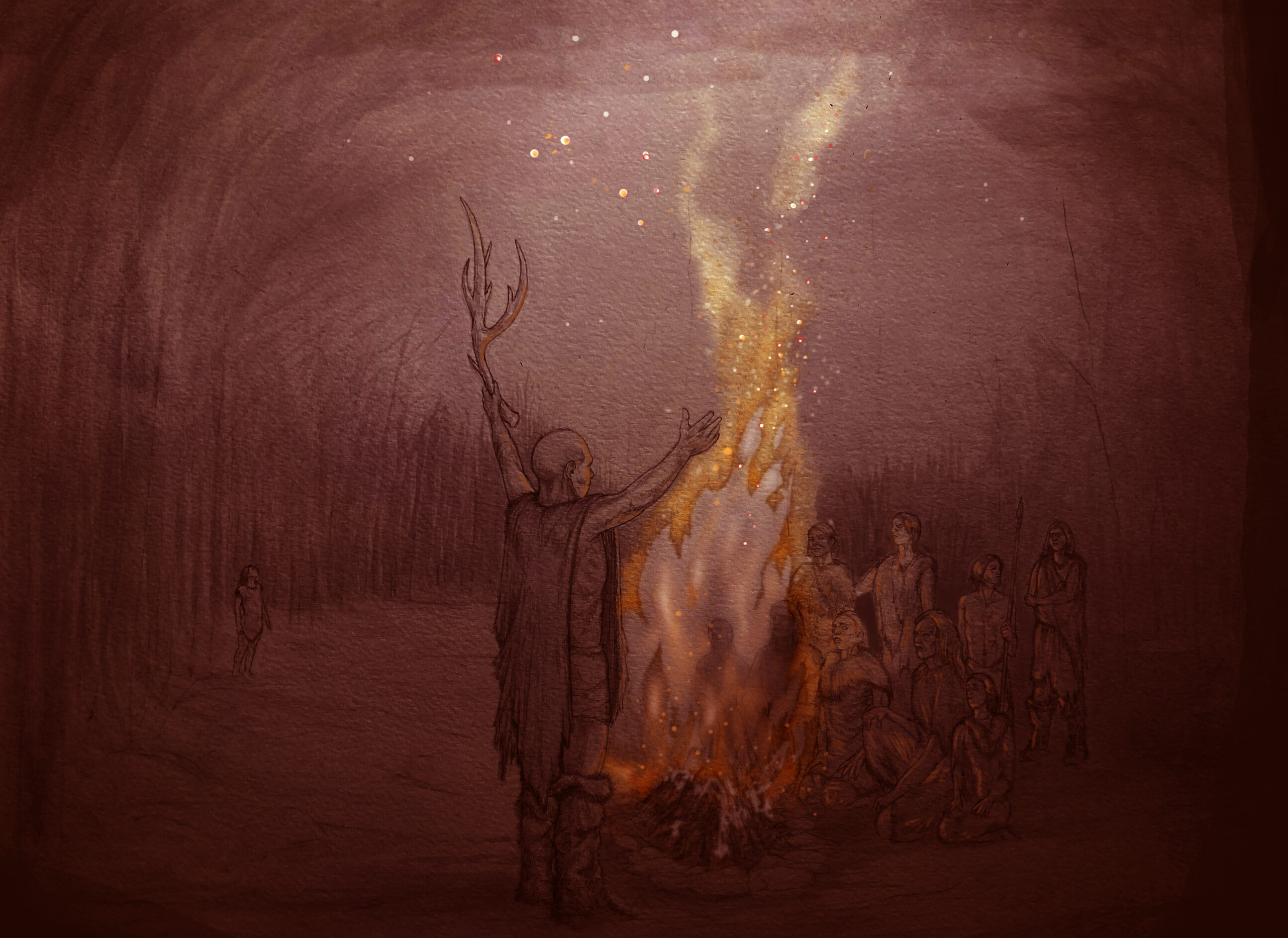
An artist's impression of the fires at Barnham hey? They really went all out on this one.
Upvote
1
(1
/
0)
Interesting bit of trivia re: humans and fire: Alexander the Great claimed circa 326BCE that they encountered a tribe (the Ichthyophagi) which had not discovered fire.
You could just call them fish-eaters. (And raw fish eaters at that...)
Upvote
7
(7
/
0)

You did[/] see it! First BJ too! My 20 something self thought it "not bad".Heh. A comedy: the paleolithic Three Stooges! Rae Dawn Chong introduces Everett McGill to the missionary position.
Yes, I have no doubt the actual folk in that era were far more eloquent, but somehow it got lost in translation...As I recall, the dialog left something to be desired
Upvote
1
(2
/
-1)

Ötzi was carrying such a thing, but that was preserved in ice only about 5,200 years ago and is just a little newer than the oldest leather object ever found — a shoe dated to 5,500 years ago.While we don’t know when and where the first fire-starter lived, I’d be curious if there’s archaeological evidence for the ability to preserve fire? It seems reasonable that somewhere along the line from chance encounters with wildfires to creating it anytime with a spark, it would have occurred to someone(s) that the hot coals from a campfire could be kept, and perhaps even carried in some way.
We’re very unlikely to ever find a leather/hide pouch from early enough for it to tell us anything about early human/hominin use of fire, considering that it would have to be hundreds of thousands of years ago, not merely thousands.
Upvote
8
(8
/
0)
If they where making flint axes I could guess that since that involves beating one rock with another they probably found that some created sparks and if such a spark set a leaf on fire that could very well be the discovery.I can't help but wonder if those early firestarters discovered the sparks from pyrite and flint through bored fidgeting with rocks, or if they were trying to do something else when they saw the same sparks that could spread fire over small barriers and gaps.
Probably the latter considering how often flint shows up in paleolithic technology.
Trying different rocks to find the ones that makes the most accurate edges would be a quite natural thing once you found that hitting flint with some other rock would cause it to chip and create a sharp edge.
And it would explain how it might be discovered in may places independently and also who a tribe isolated from others in an area without the right kind of stone might either never discover fire, or maybe forget it after enough generations in isolation, especially if they had enough supply of food and where in a climate where fire for heating was not really required.
Upvote
6
(6
/
0)
An artist's impression of the fires at Barnham hey? They really went all out on this one.
Last edited:
Upvote
0
(0
/
0)

"We" may have invented fire, but our colonial descendants are currently the arsonists.Great, all we needed was the British thinking they invented fire.
(400kya I don't think there was an island of Great Britain per se, just a fluctuating landmass more or less covered with ice or connected to the mainland. )
Upvote
4
(4
/
0)
Great, all we needed was the British thinking they invented fire.
Nah, we definitely didn't invent fire, you're good

But we definitely invented gravity.
Upvote
1
(1
/
0)

As a British person, it was strange seeing this on the BBC news. They did present it like we were the first, rather than merely the first found, which seemed unlikely.Great, all we needed was the British thinking they invented fire.
Upvote
0
(0
/
0)
Never mind my go bag, I have two fire starting items in my pockets. One is a tiny flint lighter, the other is a ferro rod and scraper. Also chord, several sources of light, a couple of knives and other tools.Fast forward to today. Do you have any fire starting items in your go bag?
In my view mastery of fire is one of the things which distinguishes us from animals, so if you don't have the wherewithal to start a fire, are you even human?
Upvote
0
(0
/
0)

Go to a few places in East Anglia and it's not much different now! Speaking as a Norfolk boy who grew up 30 odd miles from that locationFlakes of flint nearby conjure up images of Neanderthals sitting around the fire, knapping stone tools as they told each other stories long into the night.
I've passed Barnham a few times on my way back to visit my parents. Never knew about the interesting Neanderthal history that sat there.
Upvote
3
(3
/
0)
Coinductor
Ars Praetorian
Sitting around a campfire at night promoting socializing: some things haven't changed in a very, very long time.
Last edited:
Upvote
4
(4
/
0)
TechnicaGratiaArs
Ars Praetorian
Even where we stand on the shoulders of pygmies, their shoulders elevate us, especially when atop hundreds of thousands or millions of years of even short shoulders.It's undoubtedly a quirk of the brain, but reading this type of stuff always makes me feel a distant kind of kinship with those who came before. We stand on the shoulders of giants.
Upvote
1
(1
/
0)
400 kya seems to have been a sea level peak, as you can see on this page strangely titled "sea level in the past 200,000 years". So, island."We" may have invented fire, but our colonial descendants are currently the arsonists.
(400kya I don't think there was an island of Great Britain per se, just a fluctuating landmass more or less covered with ice or connected to the mainland. )
https://courses.ems.psu.edu/earth107/node/1496
I find it hard to get sources for that period; there's lots of discussion of the past 100 ky and of millions of years ago, but there's kind of a hole in the 100k-1M year range when it comes to googling.
Upvote
4
(4
/
0)
TechnicaGratiaArs
Ars Praetorian
Great, all we needed was the British thinking they invented fire.
Or that British cuisine was the prototypical meal from a kitchen.
Upvote
1
(1
/
0)
They were boiling lamb in mint sauce before there were lambs.Or that British cuisine was the prototypical meal from a kitchen.
Upvote
2
(3
/
-1)
SinclairZX81
Ars Praefectus
It struck me reading the article - and this is nothing more than pure amateur speculation, so you're getting what you paid for it - that fire-starting probably came about in relation to the process of creating stone tools. It's not like we magically "knew" flint was the way to go. There had to be some experimentation, even after the "industry" had settled on flint. So there was probably a body of knowledge that "hitting that shiny stone makes pretty sparks." It just took someone, either by thought or by accident, to realize that those sparks could ignite dry grass or leaves. Once you have that leap, the natural human tendency towards, "Do it again! That was cool! Do it again!" (or however that translates into Neanderthal or earlier hominin) takes over, and soon everyone's doing it.I can't help but wonder if those early firestarters discovered the sparks from pyrite and flint through bored fidgeting with rocks, or if they were trying to do something else when they saw the same sparks that could spread fire over small barriers and gaps.
Probably the latter considering how often flint shows up in paleolithic technology.
EDIT: From the several ninja's ahead of me, it would seem I'm not alone in this thinking.

Last edited:
Upvote
6
(6
/
0)
The daily news in nearly every newspaper (hey! remember those?) of local fires indicates that "mastery" is doing some heavy lifting.Never mind my go bag, I have two fire starting items in my pockets. One is a tiny flint lighter, the other is a ferro rod and scraper. Also chord, several sources of light, a couple of knives and other tools.
In my view mastery of fire is one of the things which distinguishes us from animals, so if you don't have the wherewithal to start a fire, are you even human?
Upvote
4
(4
/
0)
I think we have to differentiate “fire starting” from “fire starting using flint”. It’s entirely possible humans were using friction to start fires, before using flint. But it certainly makes for a highly plausible explanation for how starting a fire using flint might have been discovered.It struck me reading the article - and this is nothing more than pure amateur speculation, so you're getting what you paid for it - that fire-starting probably came about in relation to the process of creating stone tools. It's not like we magically "knew" flint was the way to go. There had to be some experimentation, even after the "industry" had settled on flint. So there was probably a body of knowledge that "hitting that shiny stone makes pretty sparks." It just took someone, either by thought or by accident, to realize that those sparks could ignite dry grass or leaves. Once you have that leap, the natural human tendency towards, "Do it again! That was cool! Do it again!" (or however that translates into Neanderthal or earlier hominin) takes over, and soon everyone's doing it.
EDIT: From the several ninja's ahead of me, it would seem I'm not alone in this thinking.
Upvote
4
(4
/
0)
??? What have you been eating / reading ???They were boiling lamb in mint sauce before there were lambs.
Upvote
1
(1
/
0)
Clearly a useful view on this matter:
https://www.johnhawks.net/p/sparking-ancient-fires
Too many potential quotes to choose from, I choose this one:
https://www.johnhawks.net/ (add
https://www.johnhawks.net/p/sparking-ancient-fires
Too many potential quotes to choose from, I choose this one:
Also, I recommend to anyone into paleoanthropology John Hawks' blog:Ancient hominins cooked foods to release energy, to strip toxins from otherwise-inedible plants, or simply to taste better. They systematically burned some landscapes to attract game. Those behaviors started much earlier and were adopted much more broadly than we once thought.
https://www.johnhawks.net/ (add
feed to get the RSS feed).
Upvote
2
(2
/
0)


Wheels were a good trick.fire 400.000 years ago wheels 5000 years ago mmh
But the stick! A great invention!
And string, now we're really getting somewhere.
The wheel thing, just a passing fad.
Upvote
0
(0
/
0)
Ummmm… the stick didn’t have to be invented. There are so many around it’s like they grow on trees or something.Wheels were a good trick.
But the stick! A great invention!
And string, now we're really getting somewhere.
The wheel thing, just a passing fad.
Upvote
2
(2
/
0)
Homo erectus deserves more credit here:
https://archaeology.org/issues/july...ies/we-didnt-start-the-fire-homo-erectus-did/
https://archaeology.org/issues/july...ies/we-didnt-start-the-fire-homo-erectus-did/
Upvote
0
(0
/
0)

They were boiling lamb in mint sauce before there were lambs.
Is that a nanotyrannus in your cauldron or are you just pleased to see me?
Upvote
0
(0
/
0)
Astérix!??? What have you been eating / reading ???
From googling, it looks like boiled lamb and lamb in mint sauce are actually separate typically British recipes.
Upvote
1
(2
/
-1)
I have never encountered boiled lamb or lamb in mint sauce.Astérix!
From googling, it looks like boiled lamb and lamb in mint sauce are actually separate typically British recipes.
English lamb is always roast; beef if tough is occasionally boiled.
Roast lamb with mint sauce and green vegetables is absolutely fine, and some French chefs have said so. Lamb fat is rather greasy and mint sauce (fresh mint leaves ground up with vinegr and a little sugar) cuts through it admirably.
As a separate aside, though, not that many restaurants in the UK in my experience are actually very good at it, in fact my one lunch experience at the Savoy was disappointing. It's very much domestic cooking, and the best roast lamb I ever had outside the home was a small family restaurant in Dijon.
Upvote
3
(3
/
0)

Aargh, now you are really making me hungry!I have never encountered boiled lamb or lamb in mint sauce.
English lamb is always roast; beef if tough is occasionally boiled.
Roast lamb with mint sauce and green vegetables is absolutely fine, and some French chefs have said so. Lamb fat is rather greasy and mint sauce (fresh mint leaves ground up with vinegr and a little sugar) cuts through it admirably.
A pity, then. Roast lamb can be quite delicious, sorry to hear about your bad experience, even if it had a silver Dijon lining.As a separate aside, though, not that many restaurants in the UK in my experience are actually very good at it, in fact my one lunch experience at the Savoy was disappointing. It's very much domestic cooking, and the best roast lamb I ever had outside the home was a small family restaurant in Dijon.
Upvote
2
(2
/
0)
Torbjörn Larsson OM
Ars Praefectus
The evidence is extraordinarily strong:
Speaking of speculation:
On the contrary, "Ichthyophagi" was part of the mythology of the time.
https://en.wikipedia.org/wiki/Ichthyophagi
But the press conference speculations are beside the evidence.The rarity of pyrite in the Breckland region is supported by extensive lithological studies of the regional Pleistocene geology. Analysis of over 121,000 individual clasts from 26 sites, including pre-Anglian fluvial gravels, Anglian glacial sediments and post-Anglian fluvial gravels, provides a robust dataset, with more than 33,000 clasts specifically from the Barnham area (Supplementary Information, section 3). None of the samples contained pyrite fragments, demonstrating the extreme rarity of this mineral in Pleistocene deposits in the region.
Speaking of speculation:
There are no contemporary evidence of what he said.Interesting bit of trivia re: humans and fire: Alexander the Great claimed circa 326BCE that they encountered a tribe (the Ichthyophagi) which had not discovered fire.
https://en.wikipedia.org/wiki/Alexander_the_GreatAlexander wrote and received numerous letters, but no originals survive. A few official letters addressed to the Greek cities survive in copies inscribed in stone and the content of others is sometimes reported in historical sources. These only occasionally quote the letters and it is an open question how reliable such quotations are. Several fictitious letters, some perhaps based on actual letters, made their way into the Romance tradition.[314]
On the contrary, "Ichthyophagi" was part of the mythology of the time.
https://en.wikipedia.org/wiki/Ichthyophagi
Upvote
2
(2
/
0)
andyatwork
Seniorius Lurkius
I loved this story. I'm a history of science nerd and what else can we call this but a really successful experiment by some of our earliest scientists. But even more so, I love how this takes something so minor in today's world and shows how it could be the thing that made us what we are. The image of people sitting around a fire and telling stories is just amazingly profound.
Upvote
0
(0
/
0)