Skip to content
Scraps and Scratches

Bin, app, and subscription combo pledges a cleaner kitchen, environment

Food waste is a big problem in the US. Is a Wi-Fi-equipped trash can a solution?

Doug Johnson | 154
Image of a white plastic trash can with the lid open.
Thanks to its wireless connection, the Mill can alert you when it needs emptying. Credit: Mill
Story text

A new subscription-based service launched today, but instead of bringing a box of meat or Japanese treats to your door, this one promises to take away your food waste. The creators of the service, called Mill, hope that it will reduce carbon emissions and help keep kitchens free of nasty smells and flies—all while feeding chickens with your kitchen waste.

The service is based on a trash can with Wi-Fi capabilities. Its creators say that while there are emissions associated with the bin’s creation and operation, the life-cycle assessment they ran on it shows that users still come out ahead when it comes to their emissions reductions.

Lots of waste

By some counts, around 119 billion pounds of food are wasted each year in the United States. This takes a toll on the environment, considering the energy that goes into growing, harvesting, packing, and transporting food. According to the World Wildlife Fund, between 6 and 8 percent of human-made greenhouse gas emissions could be eliminated by cutting down on this waste. Not including methane—which is considered 80 times worse than carbon dioxide—food waste and loss accounts for around 170 million metric tons of carbon dioxide equivalent each year in the US alone.

Matt Rogers, Mill’s co-founder and CEO, said he began working on Mill around two and a half years ago after learning about the environmental impact of food waste. “I was completely unaware of how big the problem of food waste was,” said Rogers, who was also the co-founder and chief product officer of smart home company Nest

“So [it’s an] epic, epic climate problem, let alone the fact we’re actually wasting food, which everyone’s grandma told them not to do,” Rogers told Ars.

Garbage on the go

People can subscribe to Mill for $33 per month with a one-year commitment or $45 per month on a month-to-month basis. You can sign up starting today, and Mill will get you set up in the early spring, Rogers said. The service is available across the US, and the company hopes to expand to Canada at some point in the future.

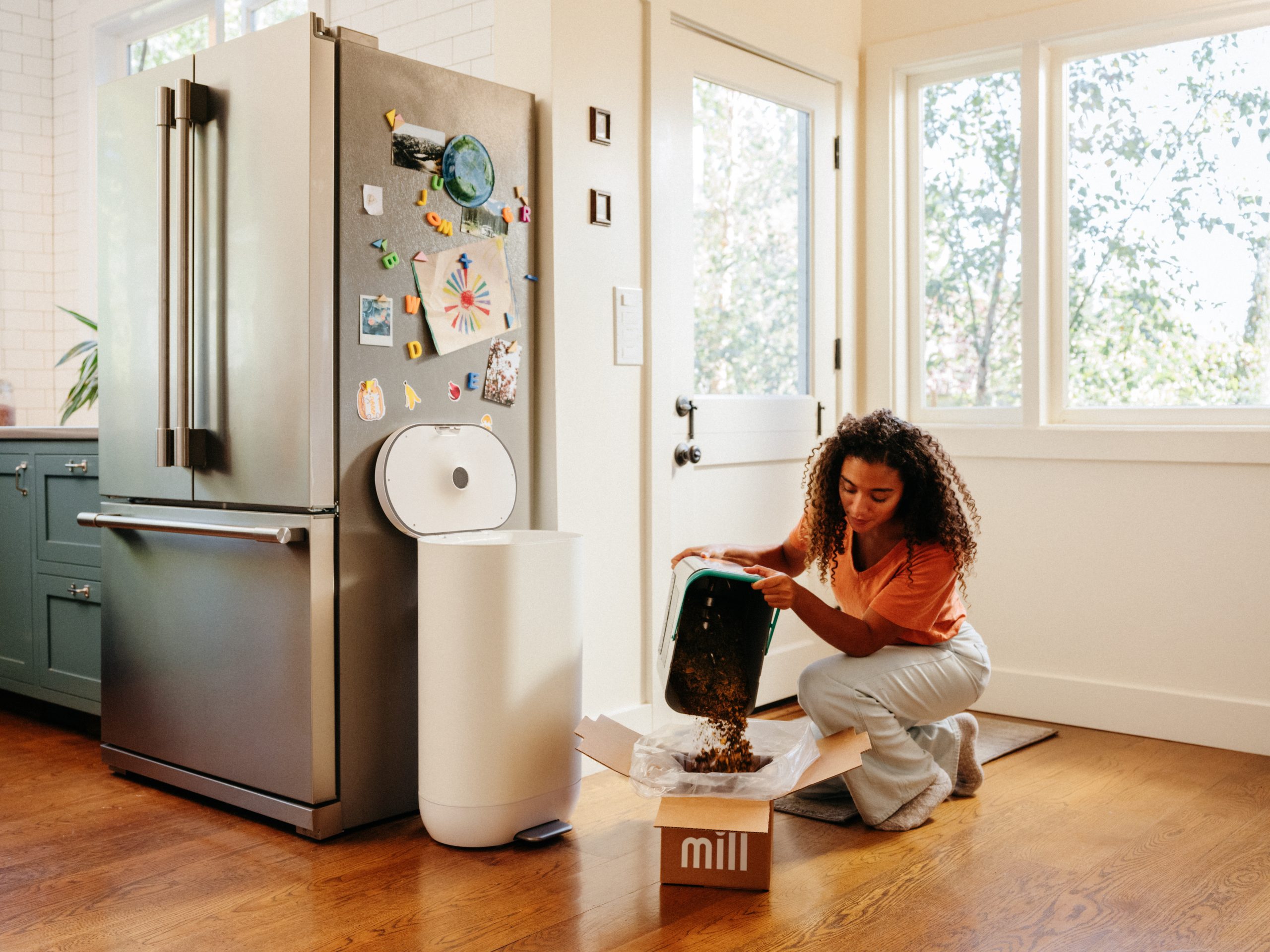
Mill sends subscribers a specialized garbage bin that connects to an app. The 2-foot-tall bin needs to be plugged in, but it dries and shrinks the garbage and removes odors from food waste, including meat and dairy. Inside, it features paddles and a small heater. When food goes in, the bin moves it around and warms it, drying it out and reducing it in size. “When you dry food out, it gets small and kind of breaks apart very easily,” he said.

A woman emptying a trash container into a shipping box.
Once processed, you ship your trash back to Mill. Credit: Mill

After processing, the material ends up looking like coffee grounds, Rogers said. The bin also comes with a charcoal filter to remove smells and a scale that determines how much food is in it. When the bin is full—which takes approximately three weeks, Rogers said—both the device and the app alert the subscriber. Mill provides users with boxes with pre-paid US postage. Using the app, they can book a pickup from the USPS and mail the dried-out organic material back to Mill’s HQ. (Users can also get more pre-stamped boxes for free from Mill through the app). The dried-out food waste doesn’t smell and is much lighter, being devoid of water, Rogers said.

Circle of life

Once the waste is received, the company does several quality control checks on the material. First, the waste is examined to see if there’s anything in there that shouldn’t be—a plastic fork, say. Next, the company pushes the matter through sieves to separate any other undesirable materials. After that, the matter is run through a magnet to draw out anything metallic, like jagged metal lids. Finally, the matter is heated to pasteurize it, killing unwanted pathogens.

Then the company ships the former kitchen waste to various chicken farmers. The dried, shipped, sieved, magnet-ed, and pasteurized feed retains calories and nutrients, Rogers said. He indicated that so far, all the farmers involved are in the Pacific Northwest, but the team hopes to get farmers in other parts of the country involved. He declined to say how many farmers have signed on.

The app also provides data on how much food waste a house produces, how it compares to the national average, and how many greenhouse gas emissions are averted due to its use as chicken feed. “The stuff that we don’t eat at home is really valuable,” Rogers said.

Waste not

But considering the manufacturing of the bin and the boxes, their shipment, and the emissions that result from powering the bin, is Mill actually good for the environment? Rogers said the company performed a “detailed” life-cycle assessment that considered these factors. After all that, the service still saves a household around a half metric ton of carbon emissions per year, he said. According to an emailed statement from Mill, the bin’s energy usage will depend on the kinds of waste put into it, but with future updates, the app and the bin will operate more efficiently.

There are other benefits as well, Rogers said. Mill diverts food that would otherwise end up in a landfill. Food waste is also generally unpleasant in the kitchen, as it often brings smells and the potential for insects. And that assumes people have the time, space, and energy to do something like composting—only 27 percent of Americans have access to compost bin programs.

“[Y]ou don’t have to take the trash out every day,” Rogers said. “When you don’t have any more stinky bins, no fruit flies, no rats—it’s just so much better.”

Listing image: Mill

Photo of Doug Johnson
Doug Johnson Science Correspondent
Doug Johnson is a Canadian writer, editor, and journalist, who focuses on science, tech and the environment.
154 Comments