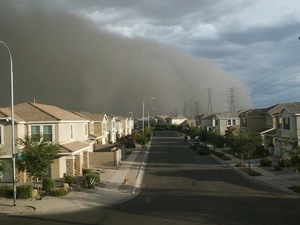
Anyone who has spent much time in the desert can attest to the misery of dust storms. Having spent my share of time driving across dirt roads that had sand dunes encroaching on them and consequently picking sand out of my hair, it’s easy for me to understand the frustration that would come with having to deal with this day in and day out.
The dust bowl of the 1930s led to one of the largest North American human migrations of the past century, likely comparable only to the evacuation of New Orleans following hurricane Katrina. This migration was caused by both the devastation of agriculture and the decreased quality of life which resulted from living in a dust cloud. Reports suggest that, at times, it was necessary to clear sand out of the streets with snow plows.
The dust bowl can be attributed in part to natural climatic patterns such as the El Ni�o-Southern Oscillation; however, a recent paper in the Proceedings of the National Academy of Science suggests that the agricultural expansion of the 1920s my have played an important role in amplifying the drought.
To assess the role of land use changes, the team used the NASA Goddard Institute for Space Studies (GISS) ModelE climate model, performing a series of model runs and compared the output to the rain and temperature anomalies observed during the period of 1932-1939. They forced all of the model runs with the observed La Nina sea surface temperatures (SST). The SST forcing alone caused a sizable drought across the great plains, but it was not nearly as large a drought as the one that actually happened, and the simulated drought was centered more on northern Mexico instead of Kansas and Oklahoma.
 Loading comments...