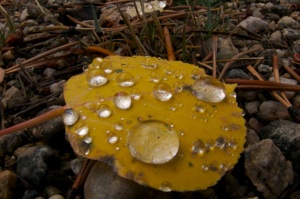
Image: Ethan Gutmann
Studying water droplets on leaves may seem like a triviality at best but, when you think about it, there are a lot of leaves out there, and it turns out to be a heck of a lot of water. Trees cover large portions of the earth's surface, and their leaves and needles provide a lot of surface area with which to trap water. Indeed, trees can intercept almost all of the water that falls during smaller rain storms.
Past studies have suggested that trees can intercept and hold around two and a half millimeters of rainwater—even in a modest sized rain event, in which 10mm of rain might fall, that is still one-quarter of the rain. When rain is caught by leaves, it may not have a chance to provide water to other plants, as it rapidly evaporates.
This process returns water to the atmosphere for another rain storm that may take place the next day, miles and miles away. Water that reached the soil below the tree is returned to the atmosphere over a period of several days, and thus has a significantly different impact on the timing of future rain events. This is important not just for weather forecasts, as studies have shown that land-atmosphere interactions play a significant role in future climate projections as well.
Current weather and climate models include a rough estimation of canopy interception, but they are rough because few good measurements of that interception are available. A recent study in the journal Water Resources Research aims to change that.
No, they did not brush water droplets off leaves one at a time; instead, they measured all of them at once. While past studies have measured changes in canopy water by weighing the entire plant over time, this is difficult when the plants you are interested in are large trees. So Jan Friesen and colleagues at Delft University of Technology figured they would use the tree itself as the scale.