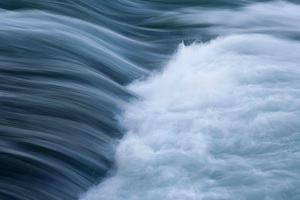
Turbulence has famously been called "the last great unsolved problem in classical physics" by Richard Feynman. Indeed, the chaotic nature of turbulence makes it nearly impossible to predict, and we are forced to talk about averages and probabilities. A recent paper in the journal Physical Review Letters takes a stab at the problem by making more precise measurements of the persistence of turbulence than any previous study. In particular, they focused on the probability that a puff of turbulence will decay back into laminar, non-turbulent, flow.
Fluid flow will tend to be laminar when viscous forces dominate over the inertial forces. A highly viscous fluid, such as honey, will tend towards laminar flow, while a less viscous fluid, such as water, will be more likely to flow turbulently. Of course, the intertial forces are also important. The faster a fluid flows, the more likely it is to flow turbulently. To quantify this relationship, we use the so-called Reynolds number. For flow in a pipe, the Reynolds number can be calculated as the fluid velocity times the pipe diameter divided by the kinematic viscosity.
To study the persistence of turbulence, Hof et al. set up a narrow pipe with water flowing through it, with a location at which they could inject a burst of water that would induce turbulence. They could then observe whether or not that turbulence persisted as it traveled down the pipe. They made their set up such that they could vary the Reynolds number around a critical value determined by a previous study.