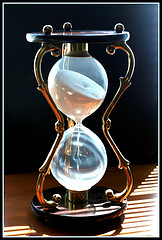
Image: John Morgan
Glass, sand, toothpaste, and silly putty are among the various materials that can act like a solid or a liquid, depending on the conditions. For example, we can walk across a sandy beach without sinking in, but we do sink into quicksand. We can also pour sand in much the same way we would pour any liquid, yet salt will often jam coming out of a salt shaker and a poorly designed hourglass can jam up.
What controls the flow of these materials? The motion of grains is influenced by the pressure, shear rate, and packing density. Using these variables, past studies have derived equations that approximate grain flows, but they often predict a feature known as the Kauzmann paradox in which the entropy of the grain configuration is predicted to be negative.
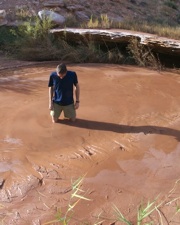
Thigh deep in quicksand that
I walked across earlier.
A recent study in Nature Physics manages to avoid this paradox and predict grain flow and the entropy states of various glasses. The authors accomplish this by including a "thermodynamic" type calculation. They do not include the actual temperature of the material, but rather a "temperature" that is a measure of the "fluffiness" of the granular mixture. This analogy makes more sense when one considers that the actual temperature of an object is a measure of how rapidly the atoms are bouncing around.