Skip to content
Whipping it out

The Great Circle is Indiana Jones for a post-Uncharted world

MachineGames isn’t just throwing Indy into Wolfenstein: The New Order.

Kyle Orland | 36
A time traveler with a flashlight would blow Indiana Jones' mind.
Story text

At first glance, Wolfenstein: The New Order developer MachineGames might seem like an awkward fit for the first (non-Lego) Indiana Jones video game since the Wii era. While there’s some overlap in the over-the-top Nazi villain department, the “shoot your way through every obstacle” nature of the new Wolfenstein games doesn’t seem to lend itself well to Indy’s more free-wheeling, adventurous exploration style.

For the upcoming Indiana Jones and the Great Circle, director Jerk Gustafsson said that going from first-person shooter to a “MachineGames adventure” style change has been a difficult tightrope walk for the developers. While the team never wanted to prevent the player from using their revolver during action scenes, there was the potential that giving a player that freedom would allow them to “just shoot their way through” in a way that’s antithetical to Jones’ character.

To help avoid this problem, Creative Director Alex Torvenius said most of the game has been balanced so that “it’s dangerous to shoot your gun and it’s dangerous to be shot at.” Guns-blazing action will be a winning strategy in some in-game situations, but “[there are] many scenarios where you can go through the environment without using guns at all,” he continued.

The design is focused on “trying to make sure you should foremost try to use your wits and your whip… navigating around an enemy rather than through them,” Torvenius added. “The only solution in this game is absolutely not to shoot your way through.”
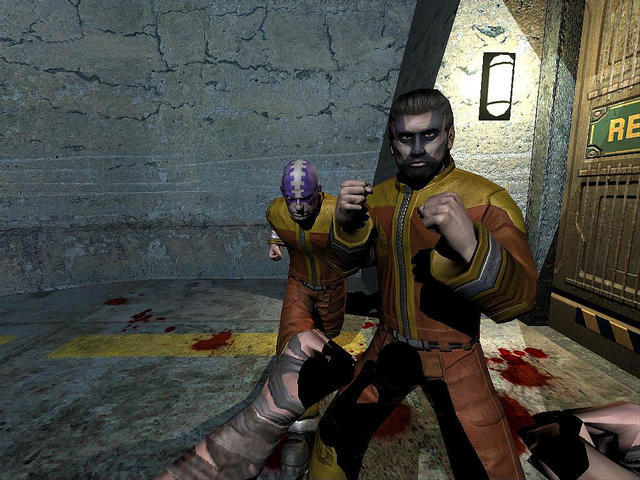
The hand-to-hand combat of the Chronicles of Riddick games was a big inspiration for MachineGames.

Gustafsson said this design was heavily inspired by the early 2000s Chronicles of Riddick games, which many of the MachineGames team worked on directly. As in those games, the combat focus in Great Circle is more on hand-to-hand fights or using improvised weapons gleaned from the immediate environment.

Gustafsson said he “likes to see the whip as the entry point to combat,” and during a short gameplay session viewed by Ars Technica, we saw that whip being used to disarm unaware enemies, trip them up from a sentry position, or simply to swing in from above to get the jump on them. We also saw Indy doing the tried-and-true “throw a bottle to make the guards think I’m over there” trick and using nearby hammers and even rolling pins as handy melee or throwing weapons. The revolver only came out occasionally during the demo, such as to take out a sentry on a far-off scaffolding.

The change in style from the guns-first Wolfenstein games has been a fun one for the studio, Gustafsson said. “You can see on the team the step from going from what we are so used to doing—the guns blazing, crazy shooting experience that we have done—to something that is much more lighthearted… It has taken some time to shepherd that transition for sure, but it has been refreshing for the team, for the studio.”

“Ignore the shooting part”

To help shepherd that transition, Gustafsson said the team decided to just “ignore the shooting part” early in the game’s development, in part because “we know that we can do it well, we know that we can get that right.” Instead, the early focus was on a scene that incorporated the many types of non-shooting tasks that would be integrated into the game, such as exploration, stealth, and traversing around trap-filled environments, as well as the aforementioned hand-to-hand combat.

Scenery-chewing Nazi villain? Check!

Set in 1937 during the gap between Raiders of the Lost Ark and The Last Crusade, The Great Circle starts with a break-in that focuses on a priceless relic in Jones’ home. Pursuing that break-in leads Jones and a team of unlikely allies to a set of mystical stones arranged in the titular “great circle” of locations that map a full arc around the globe. In pursuing those stones, the team is trying to outrun Dr. Emmerich Voss, a Nazi scientist who sees the artifacts as an otherworldly force that’s key to a grand global conspiracy.

The scenery-chewing villain and McGuffin-filled plot are all in service to gameplay focused heavily on exploration. Using a period-appropriate camera, Indy can take photos of various clues and detritus around the environment, providing the player with important spoken and written background information as he does (it’s like an old-fashioned version of Metroid Prime‘s scan visor). All those photos and clues go into a continually updated scrapbook that the player can consult at any time to solve minor mysteries and figure out what to do next.

Our gameplay demo showcased what seems like a standard exploration sequence, where Indy enters an underground tomb to find an ally that’s “trying to open this big door but I don’t know how.” A nearby logbook page that Indy finds highlights a “golden medallion” that can open the door and mentions that it’s guarded with a nearby group of Nazi soldiers. To infiltrate them, Jones has to don the disguise of a local worker and search for the medallion even as he serves drinks to the belligerent guards.

That’s one way to implement the mini-map display.

Past that formerly impassable door are the kinds of disbelief-suspending stonework traps that the Indiana Jones movies are known for. A floor gives way to a pit of spikes at one point. In another, a series of mirrors have to be carefully arranged to focus light from the ceiling. An errant sit-down on an ancient throne cuts off all the lights in a third moment, leading to a creepy wave of scorpions lit by a handheld torch.

A familiar tone

Through it all, Indy tosses out a few clever one-liners and uses his whip to swing across gaps and climb along walls. I’m reluctant to make the comparison to the Uncharted games here since Naughty Dog’s series was obviously an Indiana Jones homage in the first place. Still, it’s hard to see MachineGames’ version of Indy and not think that they’ve borrowed a little something from Nathan Drake’s style of getting around ancient ruins.

The best cave designers designing the best caves.

The developers say there will be a “clear direction” to the game’s main path, but also more open areas that let Indy explore freely and find optional side missions. And for players who don’t want to bother with solving the game’s mysteries, there will be a specific difficulty setting for reduced puzzle complexity (distinct from a separate slider for combat difficulty).

The demo did a great job showing off some well-crafted archaeological architecture and a score full of John Williams-esque strings that swell and dip in response to the on-screen action. Add in Indy’s self-assured, wise-cracking line delivery (Troy Baker doing his best old-school Harrison Ford impression), and you get a game that already feels like it will capture the tone of the classic Indiana Jones films to a tee (and perhaps even better than some recent Indy movies we could name).

While it’s hard to get a feel for the full Great Circle experience from a short, hands-off demo, the small taste has us excited to dive back into the world of Indiana Jones when the game hits Windows and Xbox Series X/S in December and the PS5 in Spring of 2025.

Photo of Kyle Orland
Kyle Orland Senior Gaming Editor
Kyle Orland has been the Senior Gaming Editor at Ars Technica since 2012, writing primarily about the business, tech, and culture behind video games. He has journalism and computer science degrees from University of Maryland. He once wrote a whole book about Minesweeper.
36 Comments
Staff Picks
JohnnySocko
Gustafsson said this design was heavily inspired by the early 2000s Chronicles of Riddick games, which many of the MachineGames team worked on directly.
Wow, this is fantastic news that I did not expect to hear. I have been waiting a long time for a successor as good as Chronicles of Riddick, and nothing has quite matched it. This at least has me encouraged.

Speaking of CoR, I don't even think it's available as a backward-compatible game on Xbox, which is tragic.