Skip to content
Crucial T700

Early testing shows PCIe 5.0 SSDs inch closer to their max potential

The T700 is set to be the fastest consumer SSD, but you still don’t need it.

Scharon Harding | 65
Crucial T700 without heatsink (left) and with heatsink (right)
The T700's optional heatsink is installed on the right. Credit: Crucial
Story text

It’s still not a good time to buy a PCIe 5.0 SSD. With faster options, less monstrous heatsinks, and lower prices all expected to hit the market eventually, it’s wise to wait if you can. Consumer-grade drives started rolling out earlier this year, and this week, reviewers shared early testing results for the Crucial T700 PCIe 5.0 x4 SSD scheduled for May. Being heralded as “the fastest consumer SSD in the world, at least for now,” it gets closer to the communication bus’s max potential than current options.

But we’re still working with speeds under the spec’s 14,000MBps theoretical max speed, a heatsink that is improved in size but still chunky, and likely high prices. Crucial hasn’t shared MSRPs for the 1TB, 2TB, or 4TB capacities coming out, but we can expect them to be as large as the drive’s optional heatsink.

Some caveats

Various publications this week published benchmark results for engineering samples of the 2TB T700. The performance of the final version made available to shoppers may differ. According to PCMag, Micron (which owns Crucial) expects to optimize random writes and power consumption. There are also “regulatory hurdles” and Trusted Computing Group’s Opal specifications to address and firmware to finalize.

PCMag said it doesn’t expect the final product’s results to differ “substantially,” but all results should still be taken with a grain of salt.

Specs

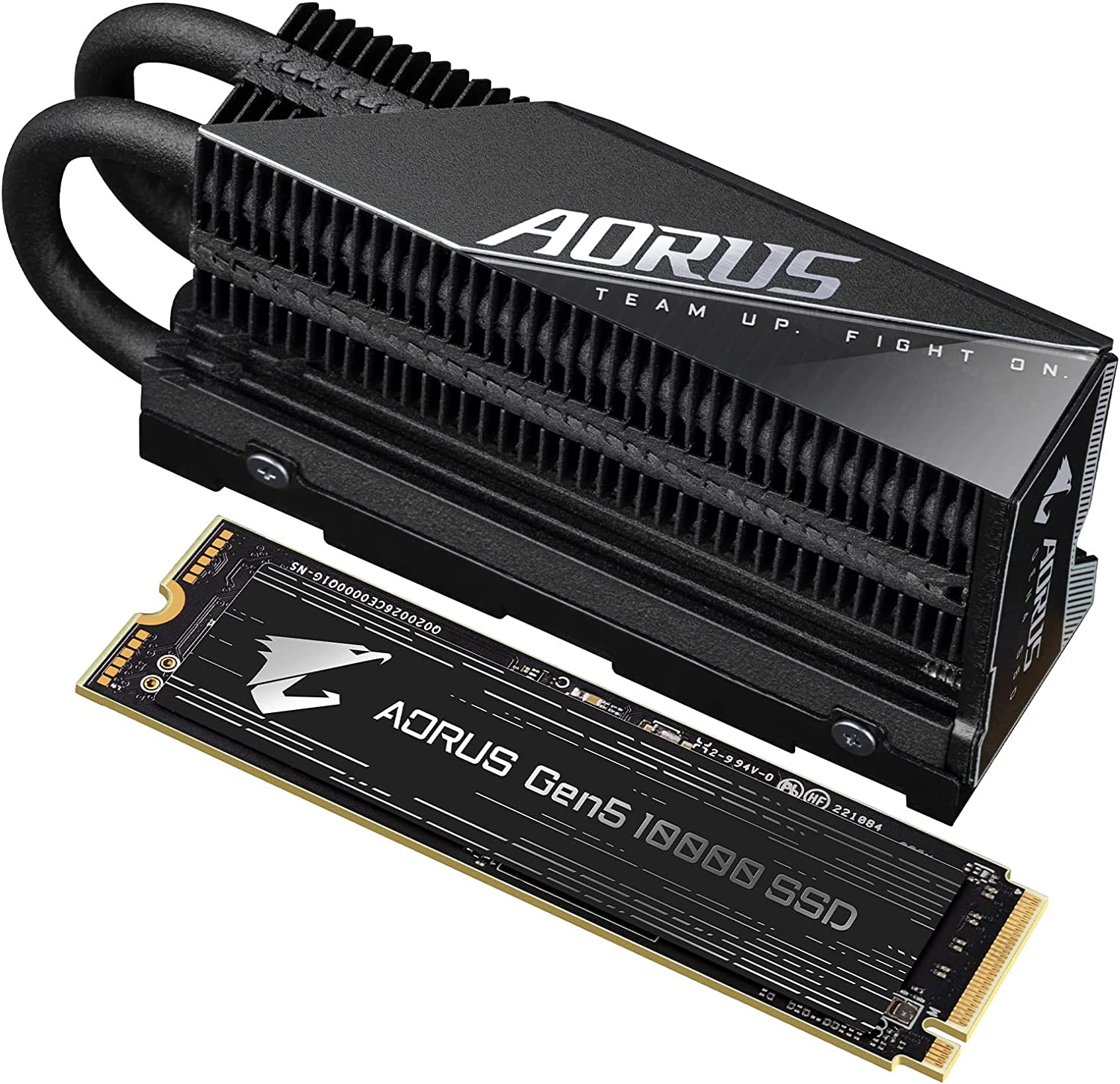
Like the other currently available PCIe 5.0 SSDs (if you can find them in stock)—Gigabyte’s Aorus Gen5 10000, which launched at $340 for 2TB, and Inland’s TD510, which launched at $400 for 2TB but is currently available for $280—the upcoming T700 uses Phison’s E26 controller. Each drive features the 232-layer TLC flash memory that Micron announced in May.

Crucial specs the drive with up to 12,400MBps sequential reads and 11,800 sequential writes. PCIe 5.0 is expected to bring SSDs with max theoretical read speeds of 14,000MBps. With Gigabyte and Micro Center Inland’s PCIe 5.0 SSD specs maxing out at 10,000MBps reads and 9,500MBps writes, the T700 looks like it will be the fastest consumer SSD. But as drives leveraging other controllers, heatsinks, and/or NAND chips come out, the title will surely be usurped.

According to Tom’s Hardware, the T700’s endurance is rated for up to 600TB (1TB capacity), 1,200TB (2TB), or 2,400TB (4TB) written. It also said the drive will feature “1.5 / 1.5 million IOPS in random read/write workloads with the 2TB and larger models,” noting “the 1TB model is slightly slower.”

Fastest PCIe 5.0 SSD… so far

There are only two PCIe 5.0 consumer SSDs to compare it to, but PCMag said the T700 engineering sample posted “the highest sequential read and write scores we’ve ever seen from a single internal drive, and outpac[ed] the Aorus—generally by a small margin—on nearly every other test.”

Tom’s Hardware, meanwhile, reported up to 12.4GBps sequential read throughput and 1.5 million random IOPS, saying that’s “70 percent faster than today’s highest-end PCIe 4.0 SSDs and 20 percent faster than the current crop of PCIe 5.0 drives.” The drive reportedly picks up speed by using faster flash (2,000 MTps I/O speed compared to the controller’s max support for 2,400 MTps).

“Impressively, it delivers this level of performance with passive cooling thanks to its well-designed heatsink, but if you remove the heatsink, the SSD will also work well in motherboards with proper M.2 heatsink coverage,” Tom’s Hardware noted.

Early numbers

Again, the tested T700 is an engineering sample, so we’ll have to wait for the released product to make final judgments. But the numbers are still interesting to check out. All drives tested are 2TB.

On the PCMark 10 Storage benchmark, Tom’s Hardware reported 860.6MBps bandwidth for the engineering sample, compared to the Gigabyte PCIe 5.0 drive’s 806.5MBps and the Inland PCIe 5.0 drive’s 804.1MBps. The top-performing PCIe 4.0 drive among the listed results, Samsung’s 990 Pro, hit 743MBps. The T700 showed a 15.8 percent improvement over the PCIe 4.0 drive.

In terms of latency, the T700 showed a 13.9 percent improvement over the Samsung drive (31 versus 36 microseconds), according to PCMark 10 Storage results Tom’s recorded.

Tom’s Hardware also tested the sample via DiskBench with its own 50GB dataset. The test copies “31,227 files of various types, including pictures, PDFs, and videos, to a new folder. A secondary test copies those same files from the drive to itself (so it’s both reading and writing data simultaneously). Finally, we follow up with a reading test of a newly written 6.5GB zip file.”

The most notable number was the T700’s copy transfer rate of 4,910MBps, compared to 4,599MBps for the Inland drive and 4,595MBps for Gigabyte’s. The top performing PCIe 4.0 drive in this test, a Solidigm P44 Pro, hit 4,042MBps, which is 21.5 percent slower than the Crucial engineering sample.

Crucial T700 without heatsink
The T700 has two NAND packages on each side, and its controller and LPDDR4 DRAM are on top.
The T700 has two NAND packages on each side, and its controller and LPDDR4 DRAM are on top. Credit: Crucial

Read and write transfer rates here topped the sample group by a small margin. The T700 posted 1,926MBps read and 2,261MBps write transfer rates, better than the Gigabyte (1,898 / 2,152MBps), Inland (1,925 / 2,126MBps), and PCIe 4.0-based Solidigm (1,891/ 1,974MBps).

The engineering sample also had the fastest read transfer rate of the 6.5GB zip file, but just by a hair. At 1,926MBps, it only outpaced the best-performing PCIe 4.0 drive among Tom’s results, Sabrent’s Rocket 4 Plus-G, by 1 percent (1,906MBps).

PCMag used the PCMark 10 Overall Store benchmark and recorded the T700 as scoring 3,987, compared to 3,849 for Gigabyte’s PCIe 5.0 drive and 3,577 for the top-performing PCIe 4.0 drive here, an Acer Predator GM7000.

With the PCMark 10 Copy test, PCMag recorded the Crucial drive as working at 6,276MBps on the ISO copy (20GB, four files) and 1,482MBps on the file copy (2.37GB, 339 files), compared to 3,469MBps and 1,169MBps, respectively, for the PCIe 4.0 Samsung 990 Pro.

Like preceding PCIe 5.0 drives, the T700 didn’t impress regarding 4K random workloads. PCMag’s numbers show the Crucial drive (78.8MBps reads / 296.2MBps writes on CrystalDiskMark 6.0 4K) falling behind PCIe 4.0 SSDs (as high as 87.8MBps reads and 282.7MBps writes, depending on the model) here.

Smaller heatsink

So far, PCIe 5.0 SSDs have earned a reputation for hefty heatsinks and, in some cases, a dedicated fan. The T700’s optional heatsink certainly isn’t tiny, but it is reportedly “positively petite compared with the Aorus 10000’s double-decker heatsink, which is more than twice as tall,” according to PCMag.

The Aorus 10000’s gargantuan heatsink could complicate builds. Credit: Gigabyte

Crucial says the T700 can work with a quality M.2 motherboard heatsink or one you select yourself. There’s also a copper thermal area. Reviewers agreed that the T700 requires some sort of heatsink for sustained workloads. Numbers taken by Tom’s Hardware show the T700 averaging 6.74 W during a 50GB file folder copy, with the PCIe 4.0 drives tested averaging 3.97 to 4.87 W, depending on the model. Crucial says it will work to improve power consumption before releasing the T700.

For a rough idea of the type of temperatures we’re looking at, we turn to Linus Tech Tips. Things could change in the final release, but the YouTuber found the engineering sample to reach a max operating temperature of 67° Celsius with its heatsink after pushing the drive to 100 percent disk usage for 15 minutes.

We’re expecting PCIe 5.0 drives to eventually be able to stay cooler as NAND chip selection improves.

The wait continues

PCIe 5.0 drives have only been available for a few months, and even after the T700 comes out, there will be minimal choices available to consumers. PCMag said vendors blame the scarcity on the limited availability of sufficiently powerful NAND flash memory. “The quickest flash memory available meant a limit of 10,000 MBps,” the publication said. We’ve also yet to see PCie 5.0 SSDs incorporate other controllers, like the Silicon Motion SM2508 rumored to be ready by Q4 2023 or InnoGrit’s IG5666, used in an Adata drive teased at CES this January. 

It’s still not time to invest in the latest and greatest SSD tech, but it will be interesting to watch these early products evolve into something more worthwhile and attainable.

Listing image: Crucial

Photo of Scharon Harding
Scharon Harding Senior Technology Reporter
Scharon is a Senior Technology Reporter at Ars Technica writing news, reviews, and analysis on consumer gadgets and services. She's been reporting on technology for over 10 years, with bylines at Tom’s Hardware, Channelnomics, and CRN UK.
65 Comments