
You are using an out of date browser. It may not display this or other websites correctly.
You should upgrade or use an alternative browser.
You should upgrade or use an alternative browser.
Webb telescope launch date slips again
- Thread starter JournalBot
- Start date
Piracy? For something this expensive can't we get an escort??
If it costs $6.5 million per day for a carrier group (https://www.lexingtoninstitute.org/wp-c ... roups2.pdf), and the telescope is already a $10 billion dollar effort, just send an entire carrier group to protect it. Relatively speaking, the cost is trivial.
I'm pretty sure you can deter Caribbean pirates with a single 150-ft USN ship.
Anything going after that isn't a pirate problem
That is what worries me. Our defenses are impenetrable for surface ships. Kaiju are not surface creatures.
I have it on good authority that Godzilla is an amateur astronomer, so he won't bother the JWST. Rodan, on the other hand, is a total asshole!
Upvote
9
(9
/
0)
DesiLurker
Seniorius Lurkius
Maybe XKCD should do a double graph charting JWST delays and fusion net positive timeline. If china surprises us its quite possible we may have fusion before JWST launches.
Upvote
0
(0
/
0)

So the next space telescope will need ~250 square meters and will need to be in Sagittarius A* orbit adjacent to the solar system?It's not a curse, it's just shitty project management. "What's the most super-duper-over-the-top space-telescope we could conceivably build? Lets bet everything on that" is a shitty starting point, that's how you end up with an irreplaceable, unriskable bird that will never meet schedules and blows though all the budget overruns you can imagine and more...The Ariane 5 is one of the most proven and reliable launch systems ever devised, but given the history of the James Webb Space Telescope I'm firmly in the camp of "check everything, check it again, then hire someone else to check it a third time... and maaaaybe just check it again after that".
Because the JWST is pretty much cursed, and everything that CAN go wrong WILL go wrong, so best make sure that NOTHING can go wrong. No tempting fate.
Technology development is a process of baby-steps, giant leaps are prohibitively expensive and prone to failure, you shouldn't plan for one unless you have no alternative or you are perfectly ready to write it off as a bad job if it doesn't deliver as expected...
It's not just bad project management (not that JWST hasn't had more than its share of bad project management.) It's also what the scientists told the managers to do. The astrophysics Decadal Surveys seem to assume, and many astronomers I've spoken to seem to agree, that if the next generation big telescope isn't an order of magnitude better than the previous one, it isn't worth building and flying. The managers were basically directed to take a giant leap rather than several baby steps.
No, but one of the next really big space telescope in the works, the Large Ultraviolet Optical Infrared Surveyor (LUVOIR), is going to observe at UV and visible wavelengths, which JWST can't. So the comparison to the previous one in Hubble. LUVOIR is going to have a 8-meter mirror (they wanted 15-meters...) which means it will have 11.1 times the collecting area of Hubble. So, yea, at least in some sense an order of magnitude improvement. Roman, the other big telescope in the pipeline, isn't a bigger mirror than Hubble, but it's designed to do full sky survey in the infrared, which HST can't do, and to do it, Roman will have a field of view ten times larger than HST.
Upvote
7
(7
/
0)
The number one source of security is secrecy.
Don't say when it is shipping....or how it will get there.
Avoid the Canal, if at all possible, as that is a chokepoint.
Create two shipping diversions.
Once underway, create a "no sail" zone for five miles around the carrier.
Take no chances with a $12 billion asset!
Then, put it on top of a rocket - whose most recent launch was a failure - and hope for the best!
Don't say when it is shipping....or how it will get there.
Avoid the Canal, if at all possible, as that is a chokepoint.
Create two shipping diversions.
Once underway, create a "no sail" zone for five miles around the carrier.
Take no chances with a $12 billion asset!
Then, put it on top of a rocket - whose most recent launch was a failure - and hope for the best!
Upvote
-10
(1
/
-11)

If they are that concerned about piracy, why not send a couple of destroyers and frigates along to escort it? I mean, that's seriously a cheaper alternative to possible piracy/damage/destruction, and even more so could be a useful exercise/training for the vessels as well as real, serious protection.
I agree. Isn't protecting important American assets at sea one of the main reasons to have a navy?
Wrong. The main purpose of the Navy is force projection.
well.. the navy has focused its missions on force projection; however, they still do civilian escort in potentially hostile waters, all the time. not to mention the fact that nasa has two f/a-18s of their own.
 (i know, they're chase/spotting planes, no ordnance. but still.)
Upvote
0
(0
/
0)
You don't necessarily have to set the boats on fire. Simply blinding the person trying to steer is pretty effective too.you got a giant mirror on a boat, piracy problem solved by Archimedes a long time ago!
Historians have tested that. It only works if the ships are wooden, with lots of rope and canvas sails, and most importantly if they are sitting still at anchor. (The Romans apparently stopped doing that after the first few fires. That's also why Archimedes grappling-hook-and-winch-to-capsize-boats idea only worked the first few times...)
Upvote
3
(5
/
-2)
If they are that concerned about piracy, why not send a couple of destroyers and frigates along to escort it? I mean, that's seriously a cheaper alternative to possible piracy/damage/destruction, and even more so could be a useful exercise/training for the vessels as well as real, serious protection.
Seriously, the thing costs as much as five Burke-class destroyers, give it an armed escort the whole way if this is a concern
Upvote
2
(2
/
0)
54R124G43B
Ars Praetorian
Piracy? For something this expensive can't we get an escort??
Security through obscurity should be good enough /s
Upvote
6
(6
/
0)
54R124G43B
Ars Praetorian
Why would a pirate steal it, when then could just let it launch then hack it and hold it ransom once it's in space?
Upvote
-9
(0
/
-9)
You don't say. Why not just put it out of its misery, and start again from scratch? Already 13 years late, it will carry obsolete technology. In addition, by scrapping it its successor can be named after some astronomer, not a racist bureaucrat who knew nothing about astronomy.
I'll pass over the nonsense of "it will carry obsolete technology" and point out that after a truly heroic effort investigating the (erroneous) rumors about James Webb supposedly aiding efforts to purge gays from the State Department in the 1940s and 1950s, Hakeem Oluseyi concluded that
andRather than exposing a bigot — as Webb was described in two popular articles reporting this story in 2015 — my research suggests that the purveyors of these allegations wrongly accused an innocent man who was, among more well-known achievements, a hero of diversity and inclusion in American government. He worked with Lyndon Johnson and John F. Kennedy to use NASA facilities in America’s southern states to promote racial integration and equal opportunity in employment.
Not only did Webb, at the instruction of President Kennedy and Vice President Johnson, make sure that NASA Centers in the Deep South were racially integrated, based on letters I’ve read between Webb and others, he appeared to have been personally motivated to take on the Southern politicians to achieve this goal.
Upvote
30
(30
/
0)
It's not a curse, it's just shitty project management. "What's the most super-duper-over-the-top space-telescope we could conceivably build? Lets bet everything on that" is a shitty starting point, that's how you end up with an irreplaceable, unriskable bird that will never meet schedules and blows though all the budget overruns you can imagine and more...The Ariane 5 is one of the most proven and reliable launch systems ever devised, but given the history of the James Webb Space Telescope I'm firmly in the camp of "check everything, check it again, then hire someone else to check it a third time... and maaaaybe just check it again after that".
Because the JWST is pretty much cursed, and everything that CAN go wrong WILL go wrong, so best make sure that NOTHING can go wrong. No tempting fate.
Technology development is a process of baby-steps, giant leaps are prohibitively expensive and prone to failure, you shouldn't plan for one unless you have no alternative or you are perfectly ready to write it off as a bad job if it doesn't deliver as expected...
It's not just bad project management (not that JWST hasn't had more than its share of bad project management.) It's also what the scientists told the managers to do. The astrophysics Decadal Surveys seem to assume, and many astronomers I've spoken to seem to agree, that if the next generation big telescope isn't an order of magnitude better than the previous one, it isn't worth building and flying. The managers were basically directed to take a giant leap rather than several baby steps.
There's a sort of chicken-and-egg problem that comes into it. If you only get to build one of these things every decade or two, it has to aim for a major jump in capability. But major jumps in capability are really difficult and expensive, so you can only do it once a decade or two.
Upvote
13
(13
/
0)
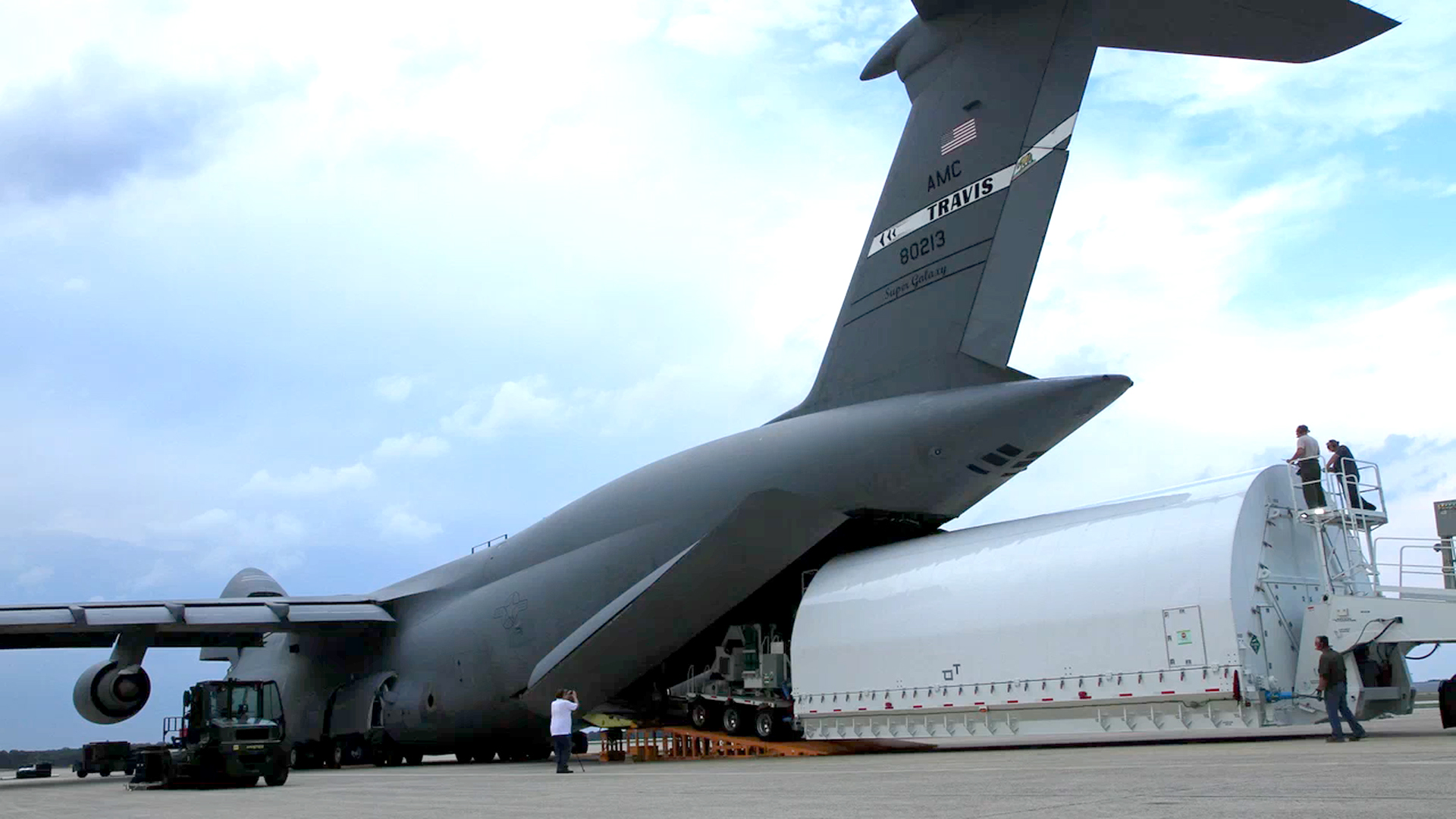
JWST had a special container called STTARS that was placed on a C-5 to get it from Houston to LA: https://www.nasa.gov/feature/goddard/20 ... -telescope. It barely fit in the aircraft, and that was before integrating the sunshield at Northrop in LA. Got anything larger than a C-5 laying around?Um, I was thinking naval escort too, but...
Why can't it be packed on a C-17 or something and flown down?
If it absorbs the Gs I think it does on launch why would a plane flight be out of the question?
If only NASA had an airplane they could use??

Upvote
14
(14
/
0)

JWST had a special container called STTARS that was placed on a C-5 to get it from Houston to LA: https://www.nasa.gov/feature/goddard/20 ... -telescope. It barely fit in the aircraft, and that was before integrating the sunshield at Northrop in LA. Got anything larger than a C-5 laying around?Um, I was thinking naval escort too, but...
Why can't it be packed on a C-17 or something and flown down?
If it absorbs the Gs I think it does on launch why would a plane flight be out of the question?
If only NASA had an airplane they could use??
Isn't the Super Guppy (shown in the original post) larger cargo-wise than the C-5?
EDIT: Nevermind. The Super Guppy can hold something that is 18 m long by 7 m diameter and the STARRS is 34 m long by 5 m wide by 5.2 m tall. Based on what NASA has on the STTARS page, the entire JWST will fit in the carrier so I suspect the reason that they don't want to fly it is vibration-related.
Upvote
4
(4
/
0)

ColdWetDog
Ars Legatus Legionis
JWST had a special container called STTARS that was placed on a C-5 to get it from Houston to LA: https://www.nasa.gov/feature/goddard/20 ... -telescope. It barely fit in the aircraft, and that was before integrating the sunshield at Northrop in LA. Got anything larger than a C-5 laying around?Um, I was thinking naval escort too, but...
Why can't it be packed on a C-17 or something and flown down?
If it absorbs the Gs I think it does on launch why would a plane flight be out of the question?
If only NASA had an airplane they could use??
Yes indeed. I'm sure that Mr. Putin would be happy to charter the An-225. Maybe even toss in a trampoline.

Upvote
9
(9
/
0)

normally butters
Ars Praefectus
The final S in STTARS is for Sea. The container is designed to fit in a C-5, and the whole assembled JWST payload is designed to fit in the container. The same container that was loaded on the C-5 will be loaded on the ship to Paracaibo wharf in Kourou.JWST had a special container called STTARS that was placed on a C-5 to get it from Houston to LA: https://www.nasa.gov/feature/goddard/20 ... -telescope. It barely fit in the aircraft, and that was before integrating the sunshield at Northrop in LA. Got anything larger than a C-5 laying around to use?Um, I was thinking naval escort too, but...
Why can't it be packed on a C-17 or something and flown down?
If it absorbs the Gs I think it does on launch why would a plane flight be out of the question?
If only NASA had an airplane they could use??
The container could be loaded on C-5 and flown to Kourou Airport, which is immediately adjacent to Guiana Space Center, with the west end of the runway just hundreds of feet from the main road that heads north to the launch complex. That's how most satellites get there.
The problem is that the short little access road connecting the airport to the main road crosses a short little bridge over a canal that runs alongside the main road. That bridge is fine for the containers used for transporting large GEO comsats, but it can't support the weight of the very robust STTARS container.
The route from the wharf to the main road doesn't cross any flimsy bridges, and that's really the only reason why JWST is being delivered by sea. I'm sure the Army Corps of Engineers would have no difficulty whipping up a temporary bridge using equipment they already have that would allow STTARS to be trucked across that pesky canal as if it were an Abrams tank, but I'm also sure it's not that simple when politics are involved.
Upvote
18
(18
/
0)
JWST had a special container called STTARS that was placed on a C-5 to get it from Houston to LA: https://www.nasa.gov/feature/goddard/20 ... -telescope. It barely fit in the aircraft, and that was before integrating the sunshield at Northrop in LA. Got anything larger than a C-5 laying around?Um, I was thinking naval escort too, but...
Why can't it be packed on a C-17 or something and flown down?
If it absorbs the Gs I think it does on launch why would a plane flight be out of the question?
If only NASA had an airplane they could use??
Yes indeed. I'm sure that Mr. Putin would be happy to charter the An-225. Maybe even toss in a trampoline.
The 225 was designed and built in the Ukrainian SSR, and is currently operated by a Ukrainian company. No need for Vlad's blessing.
Upvote
16
(16
/
0)
Ariane 5’s last launch was a success. It has been grounded not because it failed but out of caution from telemetry they didn’t like.Then, put it on top of a rocket - whose most recent launch was a failure - and hope for the best!
Upvote
12
(12
/
0)
The container could be loaded on C-5 and flown to Kourou Airport, which is immediately adjacent to Guiana Space Center, with the west end of the runway just hundreds of feet from the main road that heads north to the launch complex. That's how most satellites get there.
The problem is that the short little access road connecting the airport to the main road crosses a short little bridge over a canal that runs alongside the main road. That bridge is fine for the containers used for transporting large GEO comsats, but it can't support the weight of the very robust STTARS container.
The route from the wharf to the main road doesn't cross any flimsy bridges, and that's really the only reason why JWST is being delivered by sea. I'm sure the Army Corps of Engineers would have no difficulty whipping up a temporary bridge using equipment they already have that would allow STTARS to be trucked across that pesky canal as if it were an Abrams tank, but I'm also sure it's not that simple when politics are involved.
Politics (or budgets and how they can be spent) is almost certainly involved. NASA can't pay for infrastructure improvements in France. So if they wanted to fly JWST into Kourou, ESA would have to pay to fix up that bridge. I suspect that, when they were negotiating the responsibilities and budgets for the launch, they looked at what it would cost NASA to transport JWST by sea versus air, what the road work would cost ESA, and settled on transporting it by sea.
Upvote
6
(6
/
0)
If they are that concerned about piracy, why not send a couple of destroyers and frigates along to escort it? I mean, that's seriously a cheaper alternative to possible piracy/damage/destruction, and even more so could be a useful exercise/training for the vessels as well as real, serious protection.
I agree. Isn't protecting important American assets at sea one of the main reasons to have a navy?
Wrong. The main purpose of the Navy is force projection.
well.. the navy has focused its missions on force projection; however, they still do civilian escort in potentially hostile waters, all the time. not to mention the fact that nasa has two f/a-18s of their own.
Force projection isn't a mission. It's a capability that allows a country to conduct missions far away from home territory. The missions can be purely military in nature, or things like patrolling for pirates off Somalia or providing humanitarian aid after a natural disaster.
Being capable of force projection is as much a matter of logistics as it is firepower. For example, a carrier task force can't project power very well without the specialized cargo ships and training necessary to resupply and refuel the carrier and its escorts at sea.
Upvote
9
(9
/
0)
Or they could just build a new bridge, and have a newer, better bridge over which they could transfer other heavy payloads in the future.The container could be loaded on C-5 and flown to Kourou Airport, which is immediately adjacent to Guiana Space Center, with the west end of the runway just hundreds of feet from the main road that heads north to the launch complex. That's how most satellites get there.
The problem is that the short little access road connecting the airport to the main road crosses a short little bridge over a canal that runs alongside the main road. That bridge is fine for the containers used for transporting large GEO comsats, but it can't support the weight of the very robust STTARS container.
The route from the wharf to the main road doesn't cross any flimsy bridges, and that's really the only reason why JWST is being delivered by sea. I'm sure the Army Corps of Engineers would have no difficulty whipping up a temporary bridge using equipment they already have that would allow STTARS to be trucked across that pesky canal as if it were an Abrams tank, but I'm also sure it's not that simple when politics are involved.
Politics (or budgets and how they can be spent) is almost certainly involved. NASA can't pay for infrastructure improvements in France. So if they wanted to fly JWST into Kourou, ESA would have to pay to fix up that bridge. I suspect that, when they were negotiating the responsibilities and budgets for the launch, they looked at what it would cost NASA to transport JWST by sea versus air, what the road work would cost ESA, and settled on transporting it by sea.
Upvote
6
(7
/
-1)

I feel like when they were dividing up the member countries contributions somebody should have pointed out that they could launch from just up the coast from it’s final construction location, and skip the whole “how are we going to ship our incredibly fragile space telescope half way across the world to launch”
Upvote
1
(2
/
-1)
At least the next one can skip the "unfold the mirror" step if it fits through the starship door.
Reuse the mirror tiles, put more of them, remove part of the fragile moving parts...
We learnt enough with this prototype, can we order 4 or 6 of the cost-reduced version ?
Why not just make an even bigger one then
Upvote
0
(0
/
0)
So instead you want to ship a whole Ariane 5 up to Vandenburg, and build a brand new launch complex for it?I feel like when they were dividing up the member countries contributions somebody should have pointed out that they could launch from just up the coast from it’s final construction location, and skip the whole “how are we going to ship our incredibly fragile space telescope half way across the world to launch”
Upvote
9
(9
/
0)
The Super Guppy is used to move rocket parts around the world. I think it would do if the shipping crate weren't so large.JWST had a special container called STTARS that was placed on a C-5 to get it from Houston to LA: https://www.nasa.gov/feature/goddard/20 ... -telescope. It barely fit in the aircraft, and that was before integrating the sunshield at Northrop in LA. Got anything larger than a C-5 laying around?Um, I was thinking naval escort too, but...
Why can't it be packed on a C-17 or something and flown down?
If it absorbs the Gs I think it does on launch why would a plane flight be out of the question?
If only NASA had an airplane they could use??

Upvote
0
(1
/
-1)
normally butters
Ars Praefectus
The best thing I can say about their infrastructure choices is that, given the decision to use large solid rocket boosters, at least they had the good sense to produce the SRBs on-site. They built heavy rail lines to carry the boosters to the mobile launch platform, the MLP to the final assembly building, and then the whole stack to the pad.Or they could just build a new bridge, and have a newer, better bridge over which they could transfer other heavy payloads in the future.
But that also meant the roads only had to be strong enough to handle the payloads and the empty liquid stages. I would imagine that they planned on towing a 21-ton Hermes spaceplane over that bridge on some sort of transporter, and that would be the heaviest load it would see. But STTARS is 75 tons empty. A typical container for an Ariane 5 primary payload weighs a little less than 10 tons empty and has a maximum payload capacity slightly higher than 10 tons. The core stage weighs 12.2 tons dry.
I don't blame anybody for failing to foresee a 75-ton payload container for a medium launch system. If SpaceX designs vertical payload canisters for rapidly-loading Starships with 100 tons of Starlinks, those payload canisters might be as heavy as STTARS.
Upvote
14
(14
/
0)
JWST used epoxy instead of screws to save mass. I'm pretty sure the new launch location would cost enough performance penalty that it wouldn't make orbit. To the solar plane the optimal would be 23 deg. So Kourou is too far south but inside the direct orbit. VAFB is well North. Oh, and it can't launch east.So instead you want to ship a whole Ariane 5 up to Vandenburg, and build a brand new launch complex for it?I feel like when they were dividing up the member countries contributions somebody should have pointed out that they could launch from just up the coast from it’s final construction location, and skip the whole “how are we going to ship our incredibly fragile space telescope half way across the world to launch”
Upvote
3
(3
/
0)
Well, hell. Given the mass constraints the sun shade had to work in, the STARSS designers should have been required to drive over that bridge.The best thing I can say about their infrastructure choices is that, given the decision to use large solid rocket boosters, at least they had the good sense to produce the SRBs on-site. They built heavy rail lines to carry the boosters to the mobile launch platform, the MLP to the final assembly building, and then the whole stack to the pad.Or they could just build a new bridge, and have a newer, better bridge over which they could transfer other heavy payloads in the future.
But that also meant the roads only had to be strong enough to handle the payloads and the empty liquid stages. I would imagine that they planned on towing a 21-ton Hermes spaceplane over that bridge on some sort of transporter, and that would be the heaviest load it would see. But STTARS is 75 tons empty. A typical container for an Ariane 5 primary payload weighs a little less than 10 tons empty and has a maximum payload capacity slightly higher than 10 tons. The core stage weighs 12.2 tons dry.
I don't blame anybody for failing to foresee a 75-ton payload container for a medium launch system. If SpaceX designs vertical payload canisters for rapidly-loading Starships with 100 tons of Starlinks, those payload canisters might be as heavy as STTARS.
Upvote
2
(2
/
0)
I’m really not sure why STTARS needs to be so heavy. Over-engineered?The best thing I can say about their infrastructure choices is that, given the decision to use large solid rocket boosters, at least they had the good sense to produce the SRBs on-site. They built heavy rail lines to carry the boosters to the mobile launch platform, the MLP to the final assembly building, and then the whole stack to the pad.Or they could just build a new bridge, and have a newer, better bridge over which they could transfer other heavy payloads in the future.
But that also meant the roads only had to be strong enough to handle the payloads and the empty liquid stages. I would imagine that they planned on towing a 21-ton Hermes spaceplane over that bridge on some sort of transporter, and that would be the heaviest load it would see. But STTARS is 75 tons empty. A typical container for an Ariane 5 primary payload weighs a little less than 10 tons empty and has a maximum payload capacity slightly higher than 10 tons. The core stage weighs 12.2 tons dry.
I don't blame anybody for failing to foresee a 75-ton payload container for a medium launch system. If SpaceX designs vertical payload canisters for rapidly-loading Starships with 100 tons of Starlinks, those payload canisters might be as heavy as STTARS.
Upvote
4
(4
/
0)
At least two destroyersIf they are that concerned about piracy, why not send a couple of destroyers and frigates along to escort it? I mean, that's seriously a cheaper alternative to possible piracy/damage/destruction, and even more so could be a useful exercise/training for the vessels as well as real, serious protection.
Upvote
0
(0
/
0)
blackhawk887
Ars Legatus Legionis
If they are that concerned about piracy, why not send a couple of destroyers and frigates along to escort it? I mean, that's seriously a cheaper alternative to possible piracy/damage/destruction, and even more so could be a useful exercise/training for the vessels as well as real, serious protection.
I agree. Isn't protecting important American assets at sea one of the main reasons to have a navy?
Wrong. The main purpose of the Navy is force projection.
The main purpose of a navy is to protect a nation's shipping, while also posing a threat to enemy shipping in time of war. Projecting power is useless if your nation is starving because the ships bringing in the food are lying on the bottom of the ocean. Ask England about that.
England was a global superpower for centuries largely because of the force projection of its navy.
Upvote
2
(3
/
-1)

An aside. The Super Guppies, built in the '60s, were modified from Boeing 377 Stratocruiser from the '50s. It in turn was developed from the B-29 of the '40sUm, I was thinking naval escort too, but...
Why can't it be packed on a C-17 or something and flown down?
If it absorbs the Gs I think it does on launch why would a plane flight be out of the question?
If only NASA had an airplane they could use??
Upvote
1
(1
/
0)
Force projection isn't a mission. It's a capability that allows a country to conduct missions far away from home territory. The missions can be purely military in nature, or things like patrolling for pirates off Somalia...
Or forcing the Barbary states to stop committing piracy against US flagged ships, around 1800? That was, actually, why the United States built the Navy's first six frigates (the ones which were the core of the country's original navy.)
Upvote
10
(10
/
0)
I feel like when they were dividing up the member countries contributions somebody should have pointed out that they could launch from just up the coast from it’s final construction location, and skip the whole “how are we going to ship our incredibly fragile space telescope half way across the world to launch”
How would that work? They need to launch on an Ariane 5 and they only fly out of Kourou in French Guiana. JWST was built in Los Angeles, the launch complex ``just up the coast'' from there is Vandenberg, and Ariane launch vehicles do not and can not launch from there.
Upvote
1
(1
/
0)
WickWick noted the technical issues with my quip about “just launching from Vandy”, however what “need” did they have to use Ariane 5 other than it being part of the EU’s contribution to the program?I feel like when they were dividing up the member countries contributions somebody should have pointed out that they could launch from just up the coast from it’s final construction location, and skip the whole “how are we going to ship our incredibly fragile space telescope half way across the world to launch”
How would that work? They need to launch on an Ariane 5 and they only fly out of Kourou in French Guiana. JWST was built in Los Angeles, the launch complex ``just up the coast'' from there is Vandenberg, and Ariane launch vehicles do not and can not launch from there.
Upvote
2
(2
/
0)
I’m really not sure why STTARS needs to be so heavy. Over-engineered?The best thing I can say about their infrastructure choices is that, given the decision to use large solid rocket boosters, at least they had the good sense to produce the SRBs on-site. They built heavy rail lines to carry the boosters to the mobile launch platform, the MLP to the final assembly building, and then the whole stack to the pad.Or they could just build a new bridge, and have a newer, better bridge over which they could transfer other heavy payloads in the future.
But that also meant the roads only had to be strong enough to handle the payloads and the empty liquid stages. I would imagine that they planned on towing a 21-ton Hermes spaceplane over that bridge on some sort of transporter, and that would be the heaviest load it would see. But STTARS is 75 tons empty. A typical container for an Ariane 5 primary payload weighs a little less than 10 tons empty and has a maximum payload capacity slightly higher than 10 tons. The core stage weighs 12.2 tons dry.
I don't blame anybody for failing to foresee a 75-ton payload container for a medium launch system. If SpaceX designs vertical payload canisters for rapidly-loading Starships with 100 tons of Starlinks, those payload canisters might be as heavy as STTARS.
Probably. Maybe someone remembered that Galileo's high gain antenna didn't deploy properly because dry lubricant got shook off during transportation. And said, ``We've got a lot more deployments that that, so let's be extra, extra careful about the transportation container.'' If so, that would probably be going far beyond reasonable precautions. But when you're talking about a $10 billion dollar spacecraft, the people involved tend to think there's nothing wrong with taking unreasonable precautions. (And that's part of how you end up with a $10 billion spacecraft, although that's a different topic.)
Upvote
11
(11
/
0)
At least two destroyersIf they are that concerned about piracy, why not send a couple of destroyers and frigates along to escort it? I mean, that's seriously a cheaper alternative to possible piracy/damage/destruction, and even more so could be a useful exercise/training for the vessels as well as real, serious protection.
Modern destroyers are basically designed to deal with threats from submarines and aircraft. I know they were originally ``Torpedo boat destroyers'', but that's not the task the modern ones are designed for. If you're worried about piracy in the Caribbean, today, Navy frigates or Coast Guard cutters would be a better option.
Upvote
4
(4
/
0)
WickWick noted the technical issues with my quip about “just launching from Vandy”, however what “need” did they have to use Ariane 5 other than it being part of the EU’s contribution to the program?I feel like when they were dividing up the member countries contributions somebody should have pointed out that they could launch from just up the coast from it’s final construction location, and skip the whole “how are we going to ship our incredibly fragile space telescope half way across the world to launch”
How would that work? They need to launch on an Ariane 5 and they only fly out of Kourou in French Guiana. JWST was built in Los Angeles, the launch complex ``just up the coast'' from there is Vandenberg, and Ariane launch vehicles do not and can not launch from there.
I'm going to guess it was a launch vehicle with a 5-meter fairing which could get a 6500 kg spacecraft on its way to the Earth-Sun L2 point. A Delta IV Heavy might be able to do that, but a Delta IV Heavy is very expensive, and the Ariane 5 would probably have been cheaper. Especially since NASA wouldn't have to pay for the launch.
Upvote
6
(6
/
0)
blackhawk887
Ars Legatus Legionis
WickWick noted the technical issues with my quip about “just launching from Vandy”, however what “need” did they have to use Ariane 5 other than it being part of the EU’s contribution to the program?I feel like when they were dividing up the member countries contributions somebody should have pointed out that they could launch from just up the coast from it’s final construction location, and skip the whole “how are we going to ship our incredibly fragile space telescope half way across the world to launch”
How would that work? They need to launch on an Ariane 5 and they only fly out of Kourou in French Guiana. JWST was built in Los Angeles, the launch complex ``just up the coast'' from there is Vandenberg, and Ariane launch vehicles do not and can not launch from there.
I'm going to guess it was a launch vehicle with a 5-meter fairing which could get a 6500 kg spacecraft on its way to the Earth-Sun L2 point. A Delta IV Heavy might be able to do that, but a Delta IV Heavy is very expensive, and the Ariane 5 would probably have been cheaper. Especially since NASA wouldn't have to pay for the launch.
DIVH has quite a bit more performance than Ariane 5 ECA. Going on DIVH would have helped that super-tight mass budget a bit, which might have reduced cost somewhat...
Upvote
7
(7
/
0)