
You are using an out of date browser. It may not display this or other websites correctly.
You should upgrade or use an alternative browser.
You should upgrade or use an alternative browser.
Shift Happens is a beautifully designed history of how keyboards got this way
- Thread starter JournalBot
- Start date

michaeltherobot
Ars Centurion
If you're reading this: Hi Marcin! We first crossed paths at Google back in 2006 when you submitted a caching patch to my FaceToAName greasemonkey script. It put contact card links on Googlers' names in internal docs because hiring was exploding and nobody knew each other. I've thought of you from time to time over the years, and am stoked to hear about your huge and awesome project. Congratulations on getting to the finish line and I'm looking forward to owning a copy!
Upvote
58
(58
/
0)
While QWERTY may be the undeniable winner now, it wasn't certain for a long time. Even in the 30s, there were some really weird - but popular - alternatives, like the AEG Mignon, which forwent a keyboard entirely, and used a stylus to point to the appropriate letters instead. It was popular in Europe and several hundred thousand of the type were created.
Still, if I recall correctly, the Mignon's fell firmly on the 'use a shift key' side of things.
But it's probably for the best QWERTY won out. I mean, imagine trying to play Doom with those controls!
Still, if I recall correctly, the Mignon's fell firmly on the 'use a shift key' side of things.
But it's probably for the best QWERTY won out. I mean, imagine trying to play Doom with those controls!
Upvote
25
(25
/
0)

Every woman reading this is laughing a bitter laugh.... and skirts would start getting bigger pockets.
That aside, I love the anecdote about the SGI laptop prototype. It's also worth noting that Marcin is on mastodon: https://mastodon.online/@mwichary
Upvote
34
(34
/
0)
I stumbled upon Mr. Wichary's efforts via the Twitter thread mentioned in the article (
View: https://twitter.com/mwichary/status/791710212390526976
) and immediately subscribed to his newsletter about the process of making the book --> https://newsletter.shifthappens.site/
Several things stand out about his writing, and those things made me jump at the chance to back the Kickstarter campaign that allowed the book to come to life. A non-comprehensive list:
1. In my humble opinion, Mr. Wichary is an excellent writer because he is able to showcase his passion for the subject while at the same time providing excellent context and chronology. This allows the reader to fully grasp not only the details but how they fit into the overall picture
2. The level of openness about the process of creating the book in my opinion is quite fascinating, and almost as interesting as the intended topics themselves. In my opinion, the anecdotal stories alone would make for an interesting compendium.
I look forward to receiving my copy of 'Shift Happens', and it will receive pride of place in my home.
A interesting side note, 'Shift Happens' has also inspired others to take on this daunting task in other areas, one example being the effort by Doug Wilson to write a book about the Linotype machine (after already having produced a film on the subject) --> https://linotypebook.com/
View: https://twitter.com/mwichary/status/791710212390526976
) and immediately subscribed to his newsletter about the process of making the book --> https://newsletter.shifthappens.site/
Several things stand out about his writing, and those things made me jump at the chance to back the Kickstarter campaign that allowed the book to come to life. A non-comprehensive list:
1. In my humble opinion, Mr. Wichary is an excellent writer because he is able to showcase his passion for the subject while at the same time providing excellent context and chronology. This allows the reader to fully grasp not only the details but how they fit into the overall picture
2. The level of openness about the process of creating the book in my opinion is quite fascinating, and almost as interesting as the intended topics themselves. In my opinion, the anecdotal stories alone would make for an interesting compendium.
I look forward to receiving my copy of 'Shift Happens', and it will receive pride of place in my home.
A interesting side note, 'Shift Happens' has also inspired others to take on this daunting task in other areas, one example being the effort by Doug Wilson to write a book about the Linotype machine (after already having produced a film on the subject) --> https://linotypebook.com/
Upvote
23
(23
/
0)

He put a lot of work into crafting the link underlines at Medium and explaining font fallbacks at Figma.
2018 really has me not wanting to ask what "Figma" is.
Upvote
1
(3
/
-2)
Woe betide those who do not write their books in (La)TeX.To have a word be surrounded by a rounded rectangle—a visual representation of a key—is a few lines of CSS or a few clicks in Figma. But for the book, I had to cut my own font and then write Python scripts to do typesetting inside the font-making software, which I’m pretty sure you are not supposed to do?
Upvote
31
(33
/
-2)
So in that last photo, of the original QWERTY model, why are there no "0" and "1" keys? Are you supposed to use "I" and "O" instead? It seems to be an all-caps keyboard, so at least we can rule out "l".
(A chill runs down the spine of every programmer reading this...)
(A chill runs down the spine of every programmer reading this...)
Upvote
35
(35
/
0)
I'm a proud backer of the Kickstarter, and am so excited to get my hands on the books.
Marcin's passion for his subject material is infectious, and he's a great photographer and writer besides. I suspect I'd have backed this Kickstarter no matter what the subject material was...I'm just glad that his interests and my own overlap the way they do. There's no telling what would end up sitting on my coffee table otherwise.
Marcin's passion for his subject material is infectious, and he's a great photographer and writer besides. I suspect I'd have backed this Kickstarter no matter what the subject material was...I'm just glad that his interests and my own overlap the way they do. There's no telling what would end up sitting on my coffee table otherwise.
Upvote
5
(5
/
0)

Actually, yes. Adding more keys meant more cost and more to go wrong. They put in just the minimum at the time.So in that last photo, of the original QWERTY model, why are there no "0" and "1" keys? Are you supposed to use "I" and "O" instead? It seems to be an all-caps keyboard, so at least we can rule out "l".
(A chill runs down the spine of every programmer reading this...)
Upvote
35
(35
/
0)
Man, this is one of my more impulsive buys once I heard about this. Having grown up as a lefty kid in the 70s, writing was a chore for me and getting my first C64 with word processor and printer was a godsend for me. I had to blaze the trail at school for letting kids submit their papers using a dot-matrix printer. Who else remembers the OKI printers with the 24 pin printheads? Slow be quite good, or 8pin and fast!
Luckily I also skipped over most of the typewriter use and went straight to WP use, but I'm still enamored of key boards with good feel which makes typing easier and less fatiguing and just more pleasurable.
Luckily I also skipped over most of the typewriter use and went straight to WP use, but I'm still enamored of key boards with good feel which makes typing easier and less fatiguing and just more pleasurable.
Upvote
19
(19
/
0)
MachGoGoGO
Smack-Fu Master, in training
Fable of the Keys might be worth a read. https://papers.ssrn.com/sol3/papers.cfm?abstract_id=1069950I would have thought one of the first lines of this article, would be why QWERTY?
Here's a nice article that explains this origins...
Upvote
0
(0
/
0)

Mungus the Unhyphenated
Ars Tribunus Militum
Yes, that's exactly how it was done. I'm old enough to have actually owned a typewriter that worked that way, and typed a number of school reports on it while growing up.So in that last photo, of the original QWERTY model, why are there no "0" and "1" keys? Are you supposed to use "I" and "O" instead? It seems to be an all-caps keyboard, so at least we can rule out "l".
(A chill runs down the spine of every programmer reading this...)
But it actually got just a bit more complicated than that for the number one. If you had a typewriter with a serif typeface, you used a lower-case "L" to make a one. If your typewriter had a sans-serif typeface, you could choose between upper case "i" and lower-case "L", whichever looked better on your machine. But, of course, you had to keep it consistent.
It was probably somewhere in the later half of the 20th century when typewriters started sporting a full row of numerals including one and zero as a standard. By then, efficiency was the order of the day, and it was more efficient to standardize so that typists could learn one basic numeric pattern that worked for all machines. And of course, the advent of computer keypunches was also driving the need for a full set of numeric characters and therefore a more standardized key layout.
Upvote
45
(45
/
0)
So in that last photo, of the original QWERTY model, why are there no "0" and "1" keys? Are you supposed to use "I" and "O" instead? It seems to be an all-caps keyboard, so at least we can rule out "l".
(A chill runs down the spine of every programmer reading this...)
Yes, although 0 became a common key on later typewriters and with the introduction of shifting cases, the lowercase L became the normal key for 1.
l/1 became the standard pretty much for every typewriter. I have something like 25 typewriters, but the only one with a proper 1 key is my 1920s Corona three-bank, and I suspect that was only because they had a separate “figures” shift key and had room to spare.
Upvote
27
(27
/
0)
MachGoGoGO
Smack-Fu Master, in training
Exclamation point = apostrophe + backspace + periodYes, although 0 became a common key on later typewriters and with the introduction of shifting cases, the lowercase L became the normal key for 1.
l/1 became the standard pretty much for every typewriter. I have something like 25 typewriters, but the only one with a proper 1 key is my 1920s Corona three-bank, and I suspect that was only because they had a separate “figures” shift key and had room to spare.
Upvote
45
(45
/
0)
No mention of the original typewriter, which was invented in my home town, 100 yards from my studio by
.
Christopher Latham Sholes
.
Upvote
-18
(0
/
-18)
No mention of the original typewriter, which was invented in my home town, 100 yards from my studio by
Christopher Latham Sholes
.
Um, a Sholes and Glidden typewriter is the last image in the article and the subject of the last answer.
Upvote
28
(28
/
0)
Having done a bit of manual typesetting, I found myself wondering if you could make a keyboard where more-common keys were larger, à la the arrangement of bins in a traditional typecase. It would probably make the keyboard too big for regular use, leading to increased shoulder and elbow RSI, but it might work for a software keyboard.
Upvote
1
(1
/
0)

RickRoyLeonPrisZhoraRacha
Ars Scholae Palatinae
I found an Olivetti electric and put in my garage. I need to get it down and "see about a ribbon inking"... and I think its a Lexikon or something like that...
Sadly, when my life giver passed on, his Underwood typewriter was never found. An evil sibling (ironic the dbag also got the estate and its contents) lied that "he must have given it away to a care giver"... a fraud and now, a loss to that Underwood Number 5.
Sadly, when my life giver passed on, his Underwood typewriter was never found. An evil sibling (ironic the dbag also got the estate and its contents) lied that "he must have given it away to a care giver"... a fraud and now, a loss to that Underwood Number 5.
Upvote
0
(0
/
0)

JonnyOneNote
Ars Centurion
Wonderful article and great exposure for a book that I hope sells out and goes into a Second Printing. The link to the Kickstarter page took me the author's actual web site, which is actually fun and informative (try out the interactive keyboards; pressing 3 or 4 keys all at once didn't prove easy for me on one such illustration example!).
I just ordered the book! As someone who's been a professional typesetter (and later, a book designer) for his entire post-schooling life (and that's a lot of keyboard layouts to learn and adjust every 2–3 years!) this is going to make a very nice Christmas present — for me!*
(*Well, maybe I'll order one for my oldest brother — I've taught him to be a type aficionado, too!)
I just ordered the book! As someone who's been a professional typesetter (and later, a book designer) for his entire post-schooling life (and that's a lot of keyboard layouts to learn and adjust every 2–3 years!) this is going to make a very nice Christmas present — for me!*
(*Well, maybe I'll order one for my oldest brother — I've taught him to be a type aficionado, too!)
Upvote
5
(5
/
0)
I found an Olivetti electric and put in my garage. I need to get it down and "see about a ribbon inking"... and I think its a Lexikon or something like that...
Sadly, when my life giver passed on, his Underwood typewriter was never found. An evil sibling (ironic the dbag also got the estate and its contents) lied that "he must have given it away to a care giver"... a fraud and now, a loss to that Underwood Number 5.
Olivettis are really popular and re-inking is never worth the trouble. You can almost certainly get a new cartridge (or ribbon) for it, assuming that it isn’t imported and obscure locally. I’ve worked in a surprising number of places that kept electrics around for the odd occasion (usually IBMs), so there’s oddly still a market beyond hobbyists.
If you need help finding a refill, I’d recommend asking on Typewriter Talk. It’s not as active as r/typewriters, but it tends to be a bit more knowledgeable.
Upvote
3
(3
/
0)
One thing I've always wondered, is whether there have been keyboard designs for other scripts with more keys.
For example, devanagari has about 52 characters and no distinction between small and capital letters, so in the typical keyboard layout shift toggles between two different characters, rather than capitalising the same character. Now this is not very different in principle from using alt to get characters like ø and ß, so I am sure that it's just something that people who often write in devanagari get used to pretty quickly.
But I wonder whether there haven't been attempts to build physically larger keyboards with more keys, such that every character gets its own key, and there's still room for additional keys for numbers and punctuation marks. It seems easy enough, and the potential market is quite large, so I can't imagine it hasn't been tried at least once, somewhere (even if it never caught on).
For example, devanagari has about 52 characters and no distinction between small and capital letters, so in the typical keyboard layout shift toggles between two different characters, rather than capitalising the same character. Now this is not very different in principle from using alt to get characters like ø and ß, so I am sure that it's just something that people who often write in devanagari get used to pretty quickly.
But I wonder whether there haven't been attempts to build physically larger keyboards with more keys, such that every character gets its own key, and there's still room for additional keys for numbers and punctuation marks. It seems easy enough, and the potential market is quite large, so I can't imagine it hasn't been tried at least once, somewhere (even if it never caught on).
Upvote
6
(6
/
0)
Sounds interesting, particularly if you pair it with:
- The Chinese Typewriter: A History, by Thomas S Mullaney
to get an opposite perspective.
(Saw the speaker at the Cheltenham Science Festival a few year back - dryly fascinating ...)
- The Chinese Typewriter: A History, by Thomas S Mullaney
to get an opposite perspective.
(Saw the speaker at the Cheltenham Science Festival a few year back - dryly fascinating ...)
Upvote
6
(6
/
0)

Well, one goal I originally had was to figure out a mysterious key on the first QWERTY typewriter ever—a key with three dots—and after so much research and investigation, I‘m not sure I ever got a conclusive answer.
Vertical Ellipsis? mainly for vertical lists, or more modern matrices. Definitely pre-Excel stuff. Or, perhaps it was for compatibility with vertical writing languages.
Upvote
-2
(0
/
-2)
One thing I've always wondered, is whether there have been keyboard designs for other scripts with more keys.
For example, devanagari has about 52 characters and no distinction between small and capital letters, so in the typical keyboard layout shift toggles between two different characters, rather than capitalising the same character. Now this is not very different in principle from using alt to get characters like ø and ß, so I am sure that it's just something that people who often write in devanagari get used to pretty quickly.
But I wonder whether there haven't been attempts to build physically larger keyboards with more keys, such that every character gets its own key, and there's still room for additional keys for numbers and punctuation marks. It seems easy enough, and the potential market is quite large, so I can't imagine it hasn't been tried at least once, somewhere (even if it never caught on).
I can’t speak to Indic languages (beyond what anyone can Google), but yes, definitely. With European languages, they usually either use a dead key with diacritics or replace less commonly used keys with language specific letters. Typewriters were hugely customizable. I have a Royal Model 10 from 1924 that was customized for a Polish user. They replaced keys like “1/4” with Ł, etc. Arabic typewriters have particularly clever solutions, since written Arabic needs isolated, medial (connecting to the previous and next letter) and final forms of each letter. On most Arabic typewriters, the isolated and final form of each letter is the same, typed by shifting to caps, whereas the medial (non-shifted) is designed to overstrike the the previous and next letters, making them look connected. Basically, you’d shift at the first and last letter of every word.
Upvote
17
(17
/
0)
Vertical Ellipsis? mainly for vertical lists, or more modern matrices. Definitely pre-Excel stuff. Or, perhaps it was for compatibility with vertical writing languages.
This article pretty much nails it. Wichary actually comes up, which makes it a bit strange that he says it’s unsolved.
Upvote
2
(2
/
0)
Well yes, but that's repurposing other existing keys. I probably didn't express myself clearly, but I am wondering about physically larger keyboards with a larger total number of keys, e.g. an entire additional row of keys.I can’t speak to Indic languages (beyond what anyone can Google), but yes, definitely. With European languages, they usually either use a dead key with diacritics or replace less commonly used keys with language specific letters. Typewriters were hugely customizable. I have a Royal Model 10 from 1924 that was customized for a Polish user. They replaced keys like “1/4” with Ł, etc. Arabic typewriters have particularly clever solutions, since written Arabic needs isolated, medial (connecting to the previous and next letter) and final forms of each letter. On most Arabic typewriters, the isolated and final form of each letter is the same, typed by shifting to caps, whereas the medial (non-shifted) is designed to overstrike the the previous and next letters, making them look connected. Basically, you’d shift at the first and last letter of every word.
Upvote
0
(0
/
0)
and also in this article which also names Marcin directly, however down in the comments there are even more exploratories, truly a rabbit hole, like he said.This article pretty much nails it. Wichary actually comes up, which makes it a bit strange that he says it’s unsolved.
and this one which features an example from Mark Twain
Last edited:
Upvote
5
(5
/
0)
Row counts can be variable even on QWERTY typewriters.Well yes, but that's repurposing other existing keys. I probably didn't express myself clearly, but I am wondering about physically larger keyboards with a larger total number of keys, e.g. an entire additional row of keys.
For Devanagari specifically, it looks like there’s a lot of overstriking, like what I explained with Arabic.
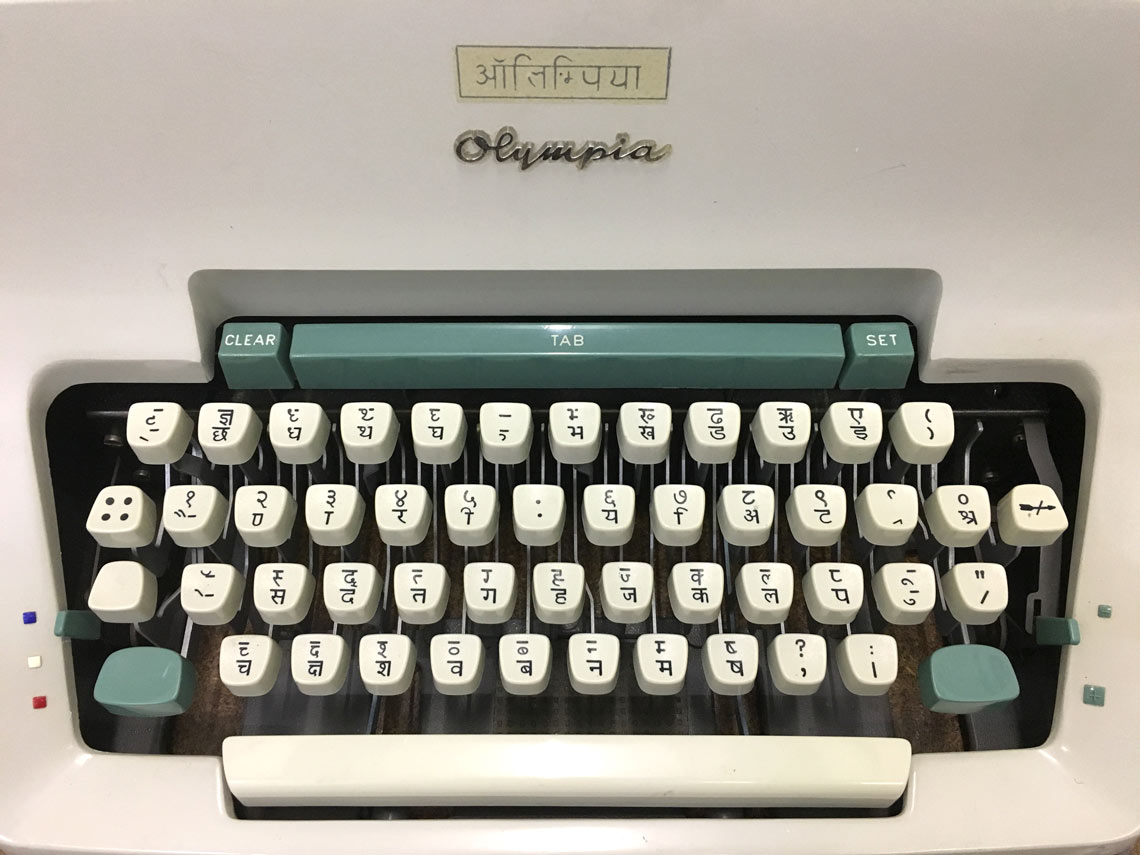
I’m sure someone tried a homegrown solution at some point, but all I’ve seen online are typewriters from western companies with custom keys (the above is a German Olympia).
Here’s a Thai typewriter with 7 rows:

Upvote
19
(19
/
0)

Fuzzypiggy
Ars Scholae Palatinae
See this is exactly why we must protect and encourage the printed word and not ever go full digital. There are so many niche books like this on thousands of subjects, beautifullly designed and presented works that catalogue human endevour.
While it might seem like a trivial subject to write about, you just think for a second how many millions of us around the world sit on a keyboard for hours every single day and this niche book catalogues such an important part of human evolution and technology.
While it might seem like a trivial subject to write about, you just think for a second how many millions of us around the world sit on a keyboard for hours every single day and this niche book catalogues such an important part of human evolution and technology.
Upvote
13
(13
/
0)
ZippyPeanut
Ars Legatus Legionis
Wow! How cool is this! I'd love to have this book.
So, the author had an editor--Glenn Fleishman--but no publisher and launching on Kickstarter. So, presumably entirely self-published.
I found this on https://shifthappens.site/: "Scout Festa, a veteran editor and proofreader, has served as a proofreader on the book, and helped develop its style guide." I would LOVE to see that style guide! And I bet proofreading this beast was somehow both fun and a nightmare.
So, the author had an editor--Glenn Fleishman--but no publisher and launching on Kickstarter. So, presumably entirely self-published.
I found this on https://shifthappens.site/: "Scout Festa, a veteran editor and proofreader, has served as a proofreader on the book, and helped develop its style guide." I would LOVE to see that style guide! And I bet proofreading this beast was somehow both fun and a nightmare.
Upvote
7
(7
/
0)
Here’s a Thai typewriter with 7 rows:
Thanks, that's the type of layout I was thinking about! Now I wonder whether there are any modern-day Thai keyboards that look similar to this.
Upvote
5
(5
/
0)
and also in this article which also names Marcin directly, however down in the comments there are even more exploratories, truly a rabbit hole, like he said.
For what it’s worth, I like Fine’s explanation more, because he has examples of that character in print. I agree with him that the Morse code thing seems like a stretch, since there’s no reason to transcribe it into type.
As a reformed archaeologist, that reasoning sets of the same kinds of alarm bells that go off for me whenever I’d see someone link a strange bit of metal or ceramic to something they found a single mention of in an obscure text.
Upvote
5
(5
/
0)
That evidence seems a bit thin. The post itself (I hesitate to say article since it's so short) leans entirely on a single, really short historical paper. I'll have to examine that a bit more. It's incontrovertible that the Qwerty/Sholes layout is mechanically inefficient for English text, and that it "just happens" to alternate hand usage in a way that would mitigate key bar jams seems a bit much to simply wave away.I would have thought one of the first lines of this article, would be why QWERTY?
Here's a nice article that explains this origins...
Upvote
0
(1
/
-1)
Evil Overlord
Ars Centurion
You can imagine adding more rows of keys—indeed, some ThinkPads used to go wild there!—but you have less space horizontally.
Many of us loved the 7 row ThinkPad - though it used space vertically, not horizontally.
Upvote
3
(3
/
0)
ZippyPeanut
Ars Legatus Legionis
Yeah, that was my thought too! Before clicking, I saw that Purdy wrote the article and assumed the possibility that Scharon wrote the book. Let's hope that Ars buys her a copy to read and review!Really surprised this article wasn't written by Scharon
Upvote
4
(4
/
0)