
You are using an out of date browser. It may not display this or other websites correctly.
You should upgrade or use an alternative browser.
You should upgrade or use an alternative browser.
Kubuntu Focus Ir14 Gen 2 review: Using Linux instead of messing with it
- Thread starter JournalBot
- Start date

nevarDeath
Wise, Aged Ars Veteran
Thank you Focus team! This will surely be the year of Linux on Desktop!
Upvote
28
(47
/
-19)

adrianovaroli
Ars Tribunus Militum
It looks amazing, but is it me or "no ethernet port" is weird on a work notebook?
Upvote
16
(41
/
-25)
No because your ethernet port should be on your docking station.It looks amazing, but is it me or "no ethernet port" is weird on a work notebook?
Upvote
59
(87
/
-28)
adrianovaroli
Ars Tribunus Militum
Also, I've used Ubuntu as my main and basically only operating system for about 20 years now, and I really cannot remember the last time I had to compile anything to do anything, much less to solve an actual problem in my system. Maybe it's time to put that cliché to pasture.
I mean I certainly could if I wanted to, and some tools do compile stuff for reasons (e.g. Perl's CPAN compiles some modules upon installation) but it's not something I've personally needed to do in ages.
I mean I certainly could if I wanted to, and some tools do compile stuff for reasons (e.g. Perl's CPAN compiles some modules upon installation) but it's not something I've personally needed to do in ages.
Upvote
121
(124
/
-3)
42Kodiak42
Ars Scholae Palatinae
It is an incredibly strange choice. Work notebooks are the one type of laptop that's most likely to require an ethernet connection. It is the biggest port that a work notebook might need, so there's a very real possibility that you would need to hook up an ethernet to USB adapter or a dock.It looks amazing, but is it me or "no ethernet port" is weird on a work notebook?
Upvote
31
(41
/
-10)
42Kodiak42
Ars Scholae Palatinae
@Kevinpurdy are there any interesting options for notebook docking? You didn't mention any specialized docking ports so I'm wondering if your only options for docking are through the USB-C, and do you know if a dock can supply power through that port?
Upvote
29
(29
/
0)

I previously thought a decade of Chromebooks in schools would have nudged more people into Linux. Now, I hope an OEM like this that can offer a useful replacement for terrible Dells will popularize Linux. Almost everything is a web app and Steam supports Linux gaming via Proton so it should happen one of these years.Thank you Focus team! This will surely be the year of Linux on Desktop!
Upvote
24
(24
/
0)
It says in the specs that there's a Thunderbolt port. Can't get more "docking port" than that nowadays.@Kevinpurdy are there any interesting options for notebook docking? You didn't mention any specialized docking ports so I'm wondering if your only options for docking are through the USB-C, and do you know if a dock can supply power through that port?
Upvote
82
(82
/
0)
No, we're as past that as we are headphone jacks on phones.It looks amazing, but is it me or "no ethernet port" is weird on a work notebook?
Yes, I want Ethernet on everything I own too, but for laptops that means putting those type-C ports to work. My laptop is thinner than an Ethernet port.
Upvote
51
(69
/
-18)
Post content hidden for low score.
Show…
I'm looking at my bog-standard company issued ThinkPad and it doesn't have an ethernet port, either. We can complain about it, but I think @antibolo has it right - you're going to find that ethernet port in your docking station.It is an incredibly strange choice. Work notebooks are the one type of laptop that's most likely to require an ethernet connection. It is the biggest port that a work notebook might need, so there's a very real possibility that you would need to hook up an ethernet to USB adapter or a dock.
Upvote
68
(69
/
-1)

as I've gotten older, my desire to mess with things, either for "just right" or "for the heck of it," has waned considerably, even if my appreciation for Linux and open source tools has not.
Same, I’m more concerned about getting things done now with applications rather than the OS.
Upvote
33
(33
/
0)
adrianovaroli
Ars Tribunus Militum
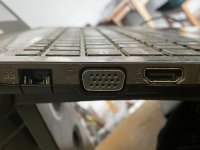
I checked and, comparing the hdmi ports, my notebook seems to be in the thinness ballpark of this one. Here’s the Ethernet port.No, we're as past that as we are headphone jacks on phones.
Yes, I want Ethernet on everything I own too, but for laptops that means putting those type-C ports to work. My laptop is thinner than an Ethernet port.
To be clear, I'm not arguing that this is a bad thing or whatever. My work computer is a few years old now, and I really haven't kept up with changes. It was a honest question.
Attachments
Upvote
2
(16
/
-14)

Thunderbolt and Lightning, very very confusing, ME!TIL what a thunderbolt port is. My brain always turned off when I saw "Apple" and thought "Oh, that's just an iPhone thing, right?"
 (Galileo)
If it helps, I think "USB Type-C, but this one goes to 11" when I see Thunderbolt. It's fast and it supports all the bells and whistles.
Upvote
63
(63
/
0)
Yeah, you might be able to squeeze one of those janky collapsible ports on this laptop.I checked and, comparing the hdmi ports, my notebook seems to be in the thinness ballpark of this one. Here’s the Ethernet port.
I'd rather use an adapter than one of those fucking things. As a bonus, I can get >1GBASE-T.
Upvote
29
(30
/
-1)
TheColinous
Ars Tribunus Militum
Really lovely piece of kit, it seems. I keep installing Linux all the time, and I really want it to work. Most of the time it just does. Unfortunately (and that’s no fault of Linux) the software I use daily don’t work on Linux. I am not influential enough to tell the IT guys “Screw it, roll it out enterprise wide”. Sometimes I wish Android would press into computing from phones and through an interconnection deus-ex-machina kind of thing make companies develop for Linux.
Upvote
10
(10
/
0)
42Kodiak42
Ars Scholae Palatinae
As someone who once had an upgradable laptop, there can easily be a lack of retail suppliers for laptop hardware. When I wanted to upgrade my old gaming laptop with newer parts, I discovered that Nvidia just didn't sell laptop graphics cards for retail sale like they sold full size computer parts, and had made the decision to stop shortly after I originally bought that laptop.A laptop easy to upgrade is a good thing .
Hopefully the market for laptop parts is at least extant nowadays.
Upvote
16
(16
/
0)
JonathanSmith
Ars Tribunus Militum
I'm pretty sure refusing to touch the deeper system files is why you had no unexpected behavior. 80% of a linux laptop's problems come from trying to fix the original 20%.I used the Ir14 Gen 2 for Ars Technica work and my personal needs for at least two weeks. Setting the system up with Focus’ guided wizard, installing apps from its store, and refusing to touch any of the deeper system files, I achieved something pretty remarkable: no unexpected behaviors on a Linux laptop.
Upvote
54
(56
/
-2)
Socketed GPUs never took off in laptops.As someone who once had an upgradable laptop, there can easily be a lack of retail suppliers for laptop hardware. When I wanted to upgrade my old gaming laptop with newer parts, I discovered that Nvidia just didn't sell laptop graphics cards for retail sale like they sold full size computer parts, and had made the decision to stop shortly after I originally bought that laptop.
Hopefully the market for laptop parts is at least extant nowadays.
But it's nice to see memory and storage not soldered to the board.
Upvote
44
(44
/
0)
Post content hidden for low score.
Show…
I have been running kubuntu for years on a set of different PCs, bot desktop and mobile. KDE have given me a decent experience (besides the infamous V3 to V4 transition).
I ditched Ubuntu in favor of Arch Linux because Ubuntu was always waiting on "upstream updates" even on critical bits for my daily job. Which meant (and still means) waiting on a "best effort" distro like Debian.
Arch Linux is far from perfect, honest, but my experience has been quite smooth so far. Plenty of documentation and usually fast response to bugs. Not to talk about the community.
I for one won't ever come back to Ubuntu. Sorry.
I ditched Ubuntu in favor of Arch Linux because Ubuntu was always waiting on "upstream updates" even on critical bits for my daily job. Which meant (and still means) waiting on a "best effort" distro like Debian.
Arch Linux is far from perfect, honest, but my experience has been quite smooth so far. Plenty of documentation and usually fast response to bugs. Not to talk about the community.
I for one won't ever come back to Ubuntu. Sorry.
Upvote
20
(20
/
0)
Pretty sure I compiled from source one time in 2006.Also, I've used Ubuntu as my main and basically only operating system for about 20 years now, and I really cannot remember the last time I had to compile anything to do anything, much less to solve an actual problem in my system. Maybe it's time to put that cliché to pasture.
Upvote
22
(22
/
0)
No, you "lug around" a tiny adapter that's as much hassle to pull out of your bag as the patch cables you have to lug around to connect to anything anyway.So, I now have to lug around a docking station too "just in case" I need a ethernet port? or buy 2 or 3 of them so I have one "at home", "at work" and "on the road"? A laptop without built-in ethernet is a laptop I won't be buying.
Upvote
68
(72
/
-4)
YetAnotherPoster
Ars Scholae Palatinae
If it's a slimline model then the ethernet port is probably the first port they choose to drop, even if it's supposedly a work laptop. You need a USB dongle or USB dock instead, at extra cost.It looks amazing, but is it me or "no ethernet port" is weird on a work notebook?
We can thank the fruit factory for starting that trend.
Upvote
27
(34
/
-7)

RickRoyLeonPrisZhoraRacha
Ars Scholae Palatinae
Memories... my last use was Ubuntu on an old, really, old but working IBM Thinkpad (pre-Lenovo). It just worked. I was able to talk to devices, configure Ubuntu and start to learn Linux. Eventually moved on to Mint. Then batteries were hard to get. And since it was IDE and didn't make sense for spending on SATA adaptor and putting an SSD in such a slow bus... this Kubuntu sounds like what we should have had from the start... $1k isn't that bad.
Upvote
10
(12
/
-2)
Do we really have to explain the existence of USB ethernet adapters to you in 2024So, I now have to lug around a docking station too "just in case" I need a ethernet port? or buy 2 or 3 of them so I have one "at home", "at work" and "on the road"? A laptop without built-in ethernet is a laptop I won't be buying.
Upvote
29
(42
/
-13)

A botched Ubuntu Studio LTS update pushed me to try Fedora again, and it's been nice so far. I like Arch, but I'm giving some other distributions a try when it comes to gaming and audio production.I have been running kubuntu for years on a set of different PCs, bot desktop and mobile. KDE have given me a decent experience (besides the infamous V3 to V4 transition).
I ditched Ubuntu in favor of Arch Linux because Ubuntu was always waiting on "upstream updates" even on critical bits for my daily job. Which meant (and still means) waiting on a "best effort" distro like Debian.
Arch Linux is far from perfect, honest, but my experience has been quite smooth so far. Plenty of documentation and usually fast response to bugs. Not to talk about the community.
I for one won't ever come back to Ubuntu. Sorry.
I did Linux From Scratch once in college, using an Athlon II CPU without a heat sink. GCC took two days to compile.Pretty sure I compiled from source one time in 2006.
As for the laptop itself in the article, it seems nice enough. Here's hoping we can continue to whittle away the "Linux hard" mentality so more people can switch.
Upvote
27
(28
/
-1)
Post content hidden for low score.
Show…
Ditto. I've been 100% Linux or FreeBSD workstation (personally: 20+ years; at work: 10+ years) and really haven't had to compile anything outside of my own stuff I'm working on. I think a few edge cases were I was chasing bugs for maintainers and maybe once or twice trying to enable some experimental feature.Also, I've used Ubuntu as my main and basically only operating system for about 20 years now, and I really cannot remember the last time I had to compile anything to do anything, much less to solve an actual problem in my system. Maybe it's time to put that cliché to pasture.
I mean I certainly could if I wanted to, and some tools do compile stuff for reasons (e.g. Perl's CPAN compiles some modules upon installation) but it's not something I've personally needed to do in ages.
Currently running Fedora 40 KDE spin on both my personal and work workstations with testing repos enabled and it's been 1) stable, 2) Wayland only and 3) once I add in the Microsoft and rpmfusion repos I'm up and running. I haven't edited anything outside of /home (except for the repos and whatever changes I make via the KDE "system settings" GUI) since I installed it.
I work in a 98% Windows environment except for the servers and services our team maintains and really the web versions of Office are good enough for everything I've tried / need to do. Outlook on the web is fine too. OneDrive and SharePoint got rid of Samba mounts. Teams and Teams Phone works fine in Chromium or MS Edge. LibreOffice is good enough for "reading" docs you get if you have to and you can just dump them to OneDrive and open them in the web if you need to edit them. Use rclone if I want to sync my files one way or the other to OneDrive / SharePoint. It all works fine. freerdp works great for the handful of times I need to RDP.
Upvote
24
(24
/
0)
AltoClefScience
Ars Praetorian
"Docking stations" with an ethernet port and typically some number of video outputs are cheap, small, and ubiquitous dongles. I've been "lugging" one around for over a decade. Buying three, keeping one at home, one at work, and throwing one in your laptop bag is hardly an inconvenience for the vast majority of users. I could see it being a minor inconvenience if your job was, say, IT or network engineering (though I can't imagine many other uses that would benefit from using ethernet away from a home base.) So if it's a dealbreaker for you that's fine, it's just not for the vast majority of people that are happy to use WiFi even at their desks. I would like to use ethernet at my desk, but my company only wires up workstations that need to sling around massive piles of data on 10 gb connections, and I haven't yet be bothered to wire up my house either.So, I now have to lug around a docking station too "just in case" I need a ethernet port? or buy 2 or 3 of them so I have one "at home", "at work" and "on the road"? A laptop without built-in ethernet is a laptop I won't be buying.
Upvote
18
(24
/
-6)
adrianovaroli
Ars Tribunus Militum
The update from 22.04 LTS to 24.04 LTS was an absolute disaster, no argument there.A botched Ubuntu Studio LTS update pushed me to try Fedora again, and it's been nice so far. I like Arch, but I'm giving some other distributions a try when it comes to gaming and audio production.
Upvote
11
(11
/
0)
You know what's standard? WiFi.Counterpoint: if I have to get extra adapters and a docking station "because it's standard for a work computer nowadays" then I'd better see that shown up there in the table where it talks about the price. I mean, since it's standard. For a work computer.
You know how every "work laptop" is going to connect to a network? Either WiFi or a docking station at a desk. An Ethernet port would be used by 10s of us nerds who might walk out laptop over to a rack and need a hardline in. Normal people would never.
Upvote
34
(41
/
-7)
heartburnkid
Ars Legatus Legionis
It's getting to be more and more common. Most 2-in-1 designs forego Ethernet, for example, as do some of Dell's Precision laptops.It looks amazing, but is it me or "no ethernet port" is weird on a work notebook?
Upvote
10
(11
/
-1)
On the road, you use Wi-Fi like a normal person. Or you use smartphone tethering. There are no public Ethernet ports anywhere anymore anyway.So, I now have to lug around a docking station too "just in case" I need a ethernet port? or buy 2 or 3 of them so I have one "at home", "at work" and "on the road"? A laptop without built-in ethernet is a laptop I won't be buying.
At work and (if you want) at home, yes, you have docks, not just for Ethernet, but for charging and KVM.
The use case for Ethernet on a mobile device is vanisingly rare and thus adequately served by dongles
Last edited:
Upvote
42
(46
/
-4)

Did the new knowledge embiggen your mind?Had to look up cromulent.
It's a bit cliché, but as I've gotten older, my desire to mess with things, either for "just right" or "for the heck of it," has waned considerably, even if my appreciation for Linux and open source tools has not.
I have also hit this point in my life recently. All of my PCs/SBCs are still running some flavor of Linux, but my desire to tweak and tinker has fallen over the years. "Just work" is now something that I care a lot about, and fortunately desktop Linux has gotten really good at that. It's pretty rare that I need to do any sort of deep customizations or package replacements.
We are spoiled for choice these days with all the different ways software is packaged / containerized anyway. There is precious little that I cannot accomplish from a Linux desktop. I do keep a Windows 10 installation around on a dual-boot mini-PC when those situations arise, but between VMs, WINE, Bottles, Proton, Lutris, etc., I almost never need Windows. Fusion 360 is the one piece of software that I haven't had a lot of success with under Linux (unsurprisingly), but I also haven't tried it under WINE in a couple of years now.
I may need to replace my aging XPS 13 in the not too distant future, so having one more company offering a nice, polished Linux experience out of the box is a great thing.
Last edited:
Upvote
30
(30
/
0)
Does using Linux on the desktop not have to involve compiling from source, searching for that one relevant forum comment related to a problem, wondering where the fault lies along the chain from kernel to desktop to repository to me?
What is this on about? Maybe your experience was true 20years ago, but I installed Ubuntu on my random Dell laptop, and everything just works. Are there sometimes programs crashing? Yes, of course; no different than on the windows machine I use sometimes.
Upvote
44
(45
/
-1)