
Google's new generation of Tensor AI chips is actually two chips, one for inference and one for training.
See full article...
See full article...


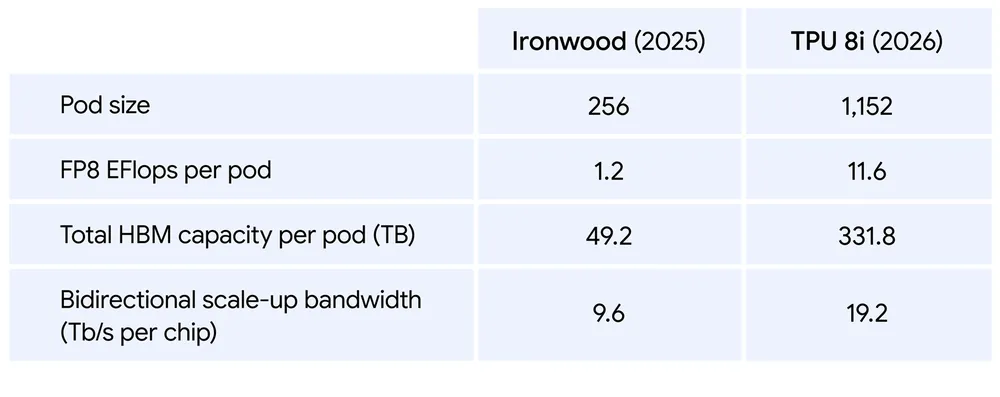
The eighth-gen TPUs don’t exactly sip power, but Google claims the chips offer twice the performance per watt compared to Ironwood
Makes sense, why would billionaires want to waste money training assets they aren't even allowed to own??It's a bit sad to see we're spending more on educating AI models than we are on educating humans.

The Google AI summaries arrive at the wrong answer faster than having to watch a 20 minute YouTube video to arrive at the same wrong answer so that's a definite win in my book!I know some people that put AI to good use (my brother loves Claude for coding) so I'm not saying it's an useless bubble but in my personal case I have yet to found a compelling use case for anything. Perhaps save some effort on Google searches.
You need AI to tell you to get a haircut...Always the case with technology where early adopters see incredible use cases, but it takes many years for a killer app for the general public. Just like the iPhone, give it a few years and it will truly be ubiquitous.
Simple things that will affect your day-to-day: eventually every retail store will incorporate AI ordering and customer support. This will happen within 3 years, just like how kiosks are in almost every store today.
Apple/Microsoft/Google will have personalized reminders and alerts based on AI reading of your phone and emails - Opt-out, not opt-in. Remember to get a haircut, remember to respond to that email - here's a draft.
Advanced financial advice will almost go all AI, it's far more efficient to setup AI-run portfolios to maximize tax-loss harvesting with index reconstruction. Think parametric for the masses.
"Minor" healthcare advice will get pre-screened with AI, the big insurance companies will push this through legislatively. I suspect we will get huge lobbying to get basic care pre-screened. We'll also see AI intake forms happen - no more filling out your info by hand when you visit the doctor/dentist. Think MDCalc + Telehealth.
You need AI to tell you to get a haircut...
Jesus fucking Christ

I am saddened (but not any kind of shocked) to see the zeitgeist OpenAI is trying to manufacture with their tv ads for 20-somethings, where everyday miracles like GPT reciting a pasta recipe prior to your date (there are free pasta recipes on the internet?? unpossible¡¡¡), or GPT telling you "Don't give up, Johnny; keep doing those push-ups!" (you can insert another "JFC" here).... is resonating and becoming a thing, despite how easily every type of day-to-day information can be looked up on one's phone or laptop with a liteteral 10 second web search. I used to make fun of these ads on this very forum, but now that I've seen this, the fun is dead.You need AI to tell you to get a haircut...
Jesus fucking Christ
This is why I think in the long term OpenAI is probably screwed. Eventually this bubble is going to pop and then it is going to be about whoever can drive their costs the lowest, and that won't be the companies paying Nvidia billions of dollars a quarter for less specialized hardware.2x the performance in 1 year (FP8 EFlops/pod size) in the same power envelope. That's incredible.

Well, you win the comparing apples to geese competition.Lest we forget all the naysayers in this previous article from November: https://meincmagazine.com/ai/2025/11/...ble-capacity-every-6-months-to-meet-ai-demand.
Google is on track to double capacity.
yeah totally, i haven't seen even one use case where ai is useful.Yet another solution in search of a problem to solve, what a giant waste of money.

Until some LLM provider actually backs up their product by taking responsibility for the product output instead of foisting responsibility on the user, I do not see the mass market appeal. Companies using customer facing LLMs will have to take on the liability for LLM failures. B2B works as companies will take on liability as a LLM customer. You still have the end market problem that LLM's will be commodities. Same sources of data, same methodology - they will, as now, shift around on the performance 'leaderboard', but effectively be equivalent for most uses. As commodities their margins will be poor. Apple for example spends way less than others on LLMs and simply bought access to Gemini at a tiny fraction of what Google spends ($1B vs. $185B). They could do that because they shopped around and got the best deal and Gemini was good enough. Like the internet bubble, nobody said the internet was going away. The bubble was that investment was so overhyped that many investors were burned. LLM hype is so large it will burn a lot of ordinary folks when the stock market takes the hit. LLMs will still be around though.Always the case with technology where early adopters see incredible use cases, but it takes many years for a killer app for the general public. Just like the iPhone, give it a few years and it will truly be ubiquitous.
Simple things that will affect your day-to-day: eventually every retail store will incorporate AI ordering and customer support. This will happen within 3 years, just like how kiosks are in almost every store today.
Apple/Microsoft/Google will have personalized reminders and alerts based on AI reading of your phone and emails - Opt-out, not opt-in. Remember to get a haircut, remember to respond to that email - here's a draft.
Advanced financial advice will almost go all AI, it's far more efficient to setup AI-run portfolios to maximize tax-loss harvesting with index reconstruction. Think parametric for the masses.
"Minor" healthcare advice will get pre-screened with AI, the big insurance companies will push this through legislatively. I suspect we will get huge lobbying to get basic care pre-screened. We'll also see AI intake forms happen - no more filling out your info by hand when you visit the doctor/dentist. Think MDCalc + Telehealth.
The individual pod’s performance scaling 10x is nearly as important as the effciency gains. Model training runs into non-linear constraints scaling beyond the rack scale interconnects within a given “pod” (Nvidia and AMD use different terms.) In no small part this is due to copper’s inherent data losses over a given length, and hence the hybrid optical/copper solutions that have become in vogue.2x the performance in 1 year (FP8 EFlops/pod size) in the same power envelope. That's incredible.
I think we're all talking about whether is does useful work, not about investment valuations. If it does useful work that's all that matters in the long run, which companies win or lose is irrelevant.Until some LLM provider actually backs up their product by taking responsibility for the product output instead of foisting responsibility on the user, I do not see the mass market appeal. Companies using customer facing LLMs will have to take on the liability for LLM failures. B2B works as companies will take on liability as a LLM customer. You still have the end market problem that LLM's will be commodities. Same sources of data, same methodology - they will, as now, shift around on the performance 'leaderboard', but effectively be equivalent for most uses. As commodities their margins will be poor. Apple for example spends way less than others on LLMs and simply bought access to Gemini at a tiny fraction of what Google spends ($1B vs. $185B). They could do that because they shopped around and got the best deal and Gemini was good enough. Like the internet bubble, nobody said the internet was going away. The bubble was that investment was so overhyped that many investors were burned. LLM hype is so large it will burn a lot of ordinary folks when the stock market takes the hit. LLMs will still be around though.
Right now one of the only use cases pointed out for AI use in the thread is to remind you to cut your hair.yeah totally, i haven't seen even one use case where ai is useful.
this broke mindset leads no where.
Cynical. But unfortunately true.Makes sense, why would billionaires want to waste money training assets they aren't even allowed to own??
I don't know why people look down upon personal and home tasks. It's the single largest mass market opportunity in the nexus of AI and robotics - beyond replacing expensive coders, where do we impact people's lives for the better. Where we free people from domestic labor and the mental labor that largely falls upon women in the US.Right now one of the only use cases pointed out for AI use in the thread is to remind you to cut your hair.
Not exactly inspiring for the future of humankind or that there will be some explosion in jobs because of this.
You haven't explained how the AI is a better technology for this purpose than a calendarI don't know why people look down upon personal and home tasks. It's the single largest mass market opportunity in the nexus of AI and robotics - beyond replacing expensive coders, where do we impact people's lives for the better. Where we free people from domestic labor and the mental labor that largely falls upon women in the US.
Juggling tasks and appointments: school, sports, doctors, dentists, grooming, playdates, shopping, cleaning, maintenance, transportation, takes up an enormous amount of time.

Sounds like hell.Always the case with technology where early adopters see incredible use cases, but it takes many years for a killer app for the general public. Just like the iPhone, give it a few years and it will truly be ubiquitous.
Simple things that will affect your day-to-day: eventually every retail store will incorporate AI ordering and customer support. This will happen within 3 years, just like how kiosks are in almost every store today.
Apple/Microsoft/Google will have personalized reminders and alerts based on AI reading of your phone and emails - Opt-out, not opt-in. Remember to get a haircut, remember to respond to that email - here's a draft.
Advanced financial advice will almost go all AI, it's far more efficient to setup AI-run portfolios to maximize tax-loss harvesting with index reconstruction. Think parametric for the masses.
"Minor" healthcare advice will get pre-screened with AI, the big insurance companies will push this through legislatively. I suspect we will get huge lobbying to get basic care pre-screened. We'll also see AI intake forms happen - no more filling out your info by hand when you visit the doctor/dentist. Think MDCalc + Telehealth.
I'm glad to know you think so little of women that you think they can't even decide for themselves when they should get a haircut.It's an example of what a high-end personal assistant does. You match up the social event calendar with the season. Many women don't cut their hair as frequently as men do. Other examples include scheduling mani/pedi, blow outs, etc. The women's grooming market is ~$70 billion per year.

You know, if LLMs could just accurately copy and paste the ingredients list from the bottom of the god damn online recipes to save me having to scroll for 5 minutes past theI am saddened (but not any kind of shocked) to see the zeitgeist OpenAI is trying to manufacture with their tv ads for 20-somethings, where everyday miracles like GPT reciting a pasta recipe prior to your date (there are free pasta recipes on the internet?? unpossible¡¡¡), or GPT telling you "Don't give up, Johnny; keep doing those push-ups!" (you can insert another "JFC" here).... is resonating and becoming a thing, despite how easily every type of day-to-day information can be looked up on one's phone or laptop with a liteteral 10 second web search. I used to make fun of these ads on this very forum, but now that I've seen this, the fun is dead.
This is normally the part where I say the current crop of 20-somethings were utterly failed by their parents, also get off my lawn, etc etc.... but instead I think I'll just continue on with today's "news journey of despair."
Misanthropic is the way.
Almost all of whom aren't paying for it and ChatGPT, as a company, has yet to be revenue positive--in spite of tens of billions of capex pinky-promise never mind all their past R&D spending.I think we're all talking about whether is does useful work, not about investment valuations. If it does useful work that's all that matters in the long run, which companies win or lose is irrelevant.
There's a huge amount of defensive people who are religiously anti-AI and a huge amount of pro people who use AI all the time - for context there's ~900 million weekly chatgpt users.
LLMs are here to stay, the open models are incredibly good. For example, I use Gemma (Google) for millions of OCR tasks daily and it is incredible at scale.

The same was true of dot.com in 1999Yet another solution in search of a problem to solve, what a giant waste of money.
It takes a lot of time to actually DO those things - not to plan and schedule them. If people are having a lot of issues handling the average scheduling of everyday life then we need to look back at what is being taught in school. Those people need to learn better task/schedule management a lot more than they need software to tell them what to do and when.Juggling tasks and appointments: school, sports, doctors, dentists, grooming, playdates, shopping, cleaning, maintenance, transportation, takes up an enormous amount of time.
Something or someone has to create the calendar first. In case it’s not clear, AI is a tool capable of creating a calendar.You haven't explained how the AI is a better technology for this purpose than a calendar
Huh?Something or someone has to create the calendar first. In case it’s not clear, AI is a tool capable of creating a calendar.
Scheduling work is a huge undertaking. Doing it successfully is the difference between a good and a great project manager.It takes a lot of time to actually DO those things - not to plan and schedule them. If people are having a lot of issues handling the average scheduling of everyday life then we need to look back at what is being taught in school. Those people need to learn better task/schedule management a lot more than they need software to tell them what to do and when.
Calendars are blank by defaultHuh?
Calendars already exist. Am I missing something here?
Scheduling work is a huge undertaking. Doing it successfully is the difference between a good and a great project manager.
