Does a bigger case actually run quieter if you’re using the same number of fans?

QuestionAsker

Smack-Fu Master, in training
31
For my silent-focused, air-cooled music production PC I'm building:

I’m debating between two cases — the Fractal Define 7 and the Define 7 XL — and I keep seeing claims that the XL is quieter. But here’s where I’m confused…

If I’m using 140mm fans (which both cases support), the total number of fans I can install is the same in both. So wouldn’t the smaller Define 7 actually have better airflow (higher air pressure per volume), and therefore potentially run cooler and quieter at the same fan speeds?

Or is there something about the XL's larger internal space — more room for sound to dissipate, lower turbulence, etc. — that actually makes it quieter, even with the same fans?

Curious what others have experienced or measured here. Anyone done noise or thermal comparisons between the two with identical fan setups?

-------------------

SPECS / NOTE:

(air-cooled, trying to get it as quiet as possible at idle and light-usage. I don't mind higher noise / temps if I'm gaming or doing higher-intensive tasks... just need it as quiet as possible when recording with microphones and light usage)
 
  • Like
Reactions: Belliroz

continuum

Ars Legatus Legionis
97,680
Moderator
Short version: fluid dynamics are not that simple.

Long version: you've hit on most of it. What's very difficult to measure is what you're actually asking; I suspect testing with the resolution and accuracy you want is going to be difficult (can not say without testing facilities I suspect no one is going to have at home unless your name is Mike Chin).

Slightly more speculative/based on experience commentary: you want cooler intake airflow where you need it, to the correct area of your components, and then hot air efficiently removed. The interior volume of the chassis I suspect will not have a huge effect on the volume of the noise unless there is some interaction between a fan/fans in the system that is ameliorated by the extra distance.


(air-cooled, trying to get it as quiet as possible at idle and light-usage. I don't mind higher noise / temps if I'm gaming or doing higher-intensive tasks... just need it as quiet as possible when recording with microphones and light usage)
What setup/hardware do you have now, and is it quiet enough for your needs? If it is, knowing where you're starting from might help make this less daunting of a task. If it's not but you feel you're close, maybe it's reasonable to reduce fan speeds on that in measured amounts to see.

I'm thinking this way because while I have a few test systems, ideally, I'd pull two brand-new factory fresh cases (with attendant fans) directly from stock, assemble, and test, but I don't think I have enough inventory that I can pull to do, nor are any of our test bench spaces anywhere near quiet enough for the sort of measurements you want.
 
  • Like
Reactions: QuestionAsker

Paladin

Ars Legatus Legionis
33,561
Subscriptor
I would just go with whatever case has good reviews and fits the fans that you want (which are also reviewed for low noise). Then get parts that have a silent/no fan mode. There are some power supplies and GPUs that do that, and a good quality motherboard with no fans but good power stages to avoid any possible whine or noise from that. Then tweak the fan curves so the fans are near 0 RPM under a certain temperature and you should be fine as long as you are not doing anything intense with the machine while recording.
 
  • Like
Reactions: QuestionAsker

whoisit

Ars Legatus Legionis
12,368
Subscriptor
Please buy these fans for half of your purchase, and the other half whateva for comparison. Report back with pics--please? 😁

1000003454.gif
 

redleader

Ars Legatus Legionis
35,861
(air-cooled, trying to get it as quiet as possible at idle and light-usage. I don't mind higher noise / temps if I'm gaming or doing higher-intensive tasks... just need it as quiet as possible when recording with microphones and light usage)
You really should not have meaningful noise at idle unless your cooling is really inadequate. With a reasonable heatsink you can turn fans down to minimum or even completely off and still cool the 10 or 20w the system pulls at idle. Even at 1-2 core load you're probably still looking at running 140mm fans at a close to minimum, at least for AMD.

Noise is more about how you cool 100-200w at max load. No way to do that without spinning fans.
 
  • Like
Reactions: QuestionAsker
Above and beyond any airflow noise from the different case shapes, you also have potential resonances. If the fans are poorly isolated from case panels, or if the case panels are loose or vibrate significantly, that can add substantial noise.

The bigger case also has a little more room for internal noise to spread out and diminish, and larger panels to absorb noise, but I'm not sure how significant that actually is.
 
  • Like
Reactions: QuestionAsker
There's negative returns both ways so there is a sort of a sweet spot - on one hand you have completely open air review cases with no meaningful sides where you can still force some airflow by having fans near the components, but these generally work worse and result in less airflow than a closed case, on the other end you have cases that are clearly too small so you have to get smaller fans and higher RPM which results in high frequency noise.
I'd say simply go with what's available on the market - and the reality is is 140mm is where most 'high-end' fans like noctua are because these can give relatively high airflow and low RPM so there's no unexpected noise from coils, fan blades and vibration.
A relatively large size case also means the airflow can go around components like RAM sticks which are still usually in the way of the CPU radiatior airflow.
Looking at things from that perspective I'd probably be looking at cases that can accommodate 3 140mm fans in the front and maybe 1-3 fans at the back and top to actively suck out the hot air ( but generally you want positive air pressure in the case) and you're golden.
 
  • Like
Reactions: QuestionAsker

steelghost

Ars Tribunus Angusticlavius
6,187
Subscriptor++
Typically it's the coolers of the components that make the most noise. So you want to have the coolest air you can manage in the case plenum, but with the lowest fan noise coming from that.

This is why open cases like the Torrent series can sometimes be quieter than the more traditional "quiet" cases like the Define 7; their design owes more to a time when hard drives were a major source of noise that had to be considered.

If you want a build that is near silent at idle, you want
  • a PSU with a fan stop function at low loads (common but should not be assumed)
  • fan stop for the GPU (again, common but not universal)
  • case fans that will actually stop when you set the PWM low enough (Noctuas and many Arctic fans will do this, probably BeQuiet! as well but I am not very familiar with their fan range)
  • CPU cooler with the most thermal mass and largest fans you can manage
  • ideally, a motherboard with a separate thermal probe so you can have the case fans only come on when the case plenum is above a certain temperature
  • if you're using Windows, you could use Fan Control to give you more sophisticated and granular control over your fans. It's been a while since I used it but I think you could give yourself a "silent" mode where only the CPU fan and maybe one other fan runs, which you could activate when recording.
 

Andrewcw

Ars Legatus Legionis
19,018
Subscriptor
Does it really matter when the sound of purring masks a lot of the noise? ;)
Only if it starts to water cool it out of spite.

For less noise you want to duct everything so if possible you have a high CFM pulling from outside the room and i'm assuming you have air input somehow into the room itself that is cool.

Vent holes etc are great for cooling. But they let out noise.
 
Last edited:

Cool Modine

Ars Tribunus Angusticlavius
9,162
Subscriptor
case fans that will actually stop when you set the PWM low enough
Gigabyte’s fan controls support outright stopping the fan, so you don’t need anything special from the fans.
This is why open cases like the Torrent series can sometimes be quieter than the more traditional "quiet" cases like the Define 7
I’ve wondered about that. In particular, once the fans spin up under load there’s nothing damping all that fan noise on an open case.
 

steelghost

Ars Tribunus Angusticlavius
6,187
Subscriptor++
once the fans spin up under load there’s nothing damping all that fan noise on an open case.
As with all things, there's a lot of "it depends" going on here. But if your better ventilated case means that the GPU and CPU within don't need to spin up their respective coolers as hard, then the end result can be quieter and / or less annoying than a more closed up case that struggles to keep internal temperatures under control.
 
  • Like
Reactions: grommit!

juanxer

Ars Scholae Palatinae
692
I don't know if this helps in any way: I have two old non-XL Define cases, both offering similar internal volume, used in radically different ways. I moved from a cheesegrater Mac Pro to the oldest one first.
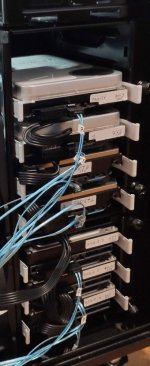
  • A Define R4 for my daily driver PC, using three Arctic P12 Max for front intake and rear exhaust, and recycling the included Fractal 140 mm. fans as side intake (some extra PCIe cards there) and top exhaust (it seems to contribute). It has a chibi RTX 4060, a Noctua tower for the CPU, and a mechanical HDD for backups alongside the SSDs and NVMes. The drive cage at mid height is empty.

    I bought this case because of its soundproofing lining's reputation, and I think it is deserved. Adding the Max fans were about them being more silent than the non-Max models at the same rpm ranges. With the usual FanControl app I have things set so that it is whisper quiet or even inaudible in normal use. Something that is a factor, too, is that it is under a desk that acts as if a noise screen or deflector: it really helps a lot.

  • A Define R5 for a NAS full of HDDs., adquired a few months ago. This one has been a letdown for this use case. I chose this series because it still offers a side fan mount (second hand server PCIe cards to cool), and because the newer models didn't come with all the drive trays needed, just three or four instead of eight or more).

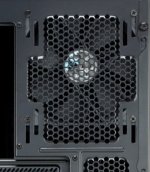
    As the HDDs I'm using are extra thick, I decided on Arctic P14 Max for front and side intake and back exhaust, not just for the extra power (keeping the drives cool-ish this summer has been a battle) and less noisier (ha!) but the extra drive coverage (120 mm. fans looked like not fully covering the drives aligned to their tops and bottoms).

    The case is more watercooling-friendly than fan-friendly. Rubber grommets slide out, honeycomb grill noise is high, fans locations' case insets make things difficult (I had to order extra-long watercooling-style screws due to the Max's extra thickness), the HDD tray spacing is a bit too tight for nowadays' server type HDDs…

    I'm still tinkering with it (will probably try some spare P12 Max to test whether the P14 Max are just worse), but I think I won't get to make it any better. The case was meant to stay in a storage room. Its noise would be intolerable otherwise.
 

juanxer

Ars Scholae Palatinae
692
What exact model of hard drives are you using?
Two 16 TB Exos, two 14 TB Toshibas, and three 6 TB HGSTs. As those use more platters than usual, they are this bit thicker. I suspect the resulting reduced gap between them is so small that they also radiate heat to each other.

EDIT: as Continuum mentions in the next post, their thicknesses seem to be the standard for drives of those capacities.

(Either the Toshibas' temperature reporters are lying through their teeth or these are defying the laws of physics: 28º C while room temp is 30º C? 😅)

An issue with the older R4 is that one of those HDD makes and models use a different screw hole arrangement standard that the drive trays didn't have appropriate holes for (the trays have perforations to allow the user to slide in vibration dampener rubber pieces). The R5's trays solve that. Also, their sides are less air-blocking.

(I should re-center that fan. Also, don't mind the cables in front of the trays: that was an experiment in laziness)
 

Attachments

  • HDDs.jpg
    HDDs.jpg
    78.4 KB · Views: 19
  • fans.jpg
    fans.jpg
    38.1 KB · Views: 20
Last edited:

continuum

Ars Legatus Legionis
97,680
Moderator
As those use more platters than usual, they are this bit thicker.
They removed the middle screw hole to fit the extra platters, they didn’t make them thicker per se. Sorry just trying to clear up why you’re saying they’re thicker.

https://www.seagate.com/content/dam...ets/exos-x24/exos-x24-DS2080-2307US-en_US.pdf

26.1mm thick (height) for Exos X24.

Compared to, say, Barracuda 8TB, which are an old design with the previous “normal” number of platters.

https://www.seagate.com/www-content/datasheets/pdfs/3-5-barracudaDS1900-11-1806US-en_US.pdf

Also 26.1mm thick (height).
 

juanxer

Ars Scholae Palatinae
692
They removed the middle screw hole to fit the extra platters, they didn’t make them thicker per se. Sorry just trying to clear up why you’re saying they’re thicker.

https://www.seagate.com/content/dam...ets/exos-x24/exos-x24-DS2080-2307US-en_US.pdf

26.1mm thick (height) for Exos X24.

Compared to, say, Barracuda 8TB, which are an old design with the previous “normal” number of platters.

https://www.seagate.com/www-content/datasheets/pdfs/3-5-barracudaDS1900-11-1806US-en_US.pdf

Also 26.1mm thick (height).
I see. Thanks for taking the effort to check that (I'll add a correction to my posts). My guess is I was accustomed to the non-server type drives I used to have, 1 to 3 TB capacity. Those were this slightly or even fairly thinner.

In any case, I still think the gaps between drives in these Define cases (and others from the same era, 2015 or so) are insufficient: in a previous cheap case of mine were the worst offenders (the HGSTs) had an empty bay between them the cooling was far more effective.
 
  • Like
Reactions: continuum

continuum

Ars Legatus Legionis
97,680
Moderator
My guess is I was accustomed to the non-server type drives I used to have, 1 to 3 TB capacity. Those were this slightly or even fairly thinner.
Ahhhhh got it!

Yes. Seagate (maybe some others too, but definitely Seagate) did do a few drives thinner than usual, 1TB at 20.2mm height as an example (ST1000VM002):

https://www.seagate.com/content/dam...s/manual/ce/Pipeline HD Series/100633414u.pdf

Definitely a few desktop drives like but not terribly popular, although we encountered plenty.

n any case, I still think the gaps between drives in these Define cases (and others from the same era, 2015 or so) are insufficient:
Entirely reasonable a statement!
 

Velvet G

Ars Tribunus Angusticlavius
6,135
My current case if a beast of a tank and even with Doom Dark Ages cranked up and streaming a movie on the second screen, my temps are freakishly good. That bigger case allows better airflow because with that much room, the cable management isn't restricting it as much as my last, smaller case. The fans just don't seem to work as hard moving air around and it's silent now. YMMV though.
 

Cool Modine

Ars Tribunus Angusticlavius
9,162
Subscriptor
I”ve got 8x 18TB Western Digitals in an R5; temps are all between 37-40 C. Ambient is 23 C or so. In my book that’s perfectly fine. I don’t remember what fans are in front of the drives, probably some Arctic 120s. That system is due for some maintenance anyways. One of the fans on the Assasin 120 died terrifically, less than a year old. The bearing is so shot that the blades/hub rock from side to side, enough that the blades started rubbing on the frame of the fan. It was making a lot of noise from that rubbing. And delightfully, while pulling the dead fan off of the CPU, I stuck a finger into the rear exhaust fan and snapped a blade off of it. I’ve got a pair of Noctuas to drop in there.
They removed the middle screw hole to fit the extra platters
I’ve got a Rosewill rack mount case. The rails for the drives only take one screw each, in that missing middle position. The rails have alignment pins in the other two positions. Fortunately, a small piece of double-sided tape is all that it takes to keep the rails on the drive. Honestly, the tape isn’t really necessary - neither the rails nor the drives are going anywhere once they slid into the case.
 
  • Like
Reactions: continuum

Leaping Gnome

Ars Tribunus Angusticlavius
9,489
Subscriptor
If you want a quiet case the Fractal Define 7 XL R2 is what you want.

Built with thick steel panels with sound deadening applied.

I have two of them and you have to set your fans to roar to be bothered much by them with this case.

No glass panel though, if that is important to you.

I echo this. I went to the XL from an old Corsair Carbide 88R case and the Define is silent in comparison, using the same four fans. I am using multiple hard drives as well, but spaced them out with an empty bay between each of them.
 

patttraclaaar

Smack-Fu Master, in training
9
I've tested both. I can say that with the same fans, the XL is usually a little quieter. Since the extra internal volume and distance allow for sound dissipation and reduced turbulence around the components. The difference is especially small. So choose the XL if you care about silence and case space, otherwise the regular Define 7 will do.
 
  • Like
Reactions: steelghost