The US already lags far behind China and Europe, but we're going too fast, dealers say.
See full article...
See full article...
None of them. I think I am a careful car buyer - I do a lot of research, watch videos, read specs and CR. It usually takes me a few months to decide what to get. When I bought my Honda CR-V in 2021 the search and buying process took about three months.
The point that I would like is that, even though I am generally enthusiastic about EVs, none of the EVs currently available are so superlatively good that it would cause me to change my car buying practices.
I am generally a fairly early adopter of technology: I had a WiFi network up and running in my house as early as 2000 and I bought an iPhone soon after it was introduced. Somehow when it comes to EVs, I just don't feel the same level of enthusiasm.
To charge a home battery during the day and use it to charge the car you’d need a very large home battery. The RoI on that would be pretty crap.I really want to install solar panels (with battery backup) on my roof, but the state I live in is so antagonistic to the idea, and the PSC is so captured by the monopoly electric company, that they refuse to let customers who have solar sell it back to the grid at fmv. In fact, the utility thinks if you have solar you should pay an extra $30-$40 for the privilege (oh you did get that it’s a monopoly electric utility). Without some sort of home charging solution such as solar...it's harder to make it work. If you had an EV that you were charging with solar stored in a battery during the day to charge overnight or if you were home during the day, you would see the return on investment a lot quicker, and would pay essentially nothing to fuel your car...
What do you mean by FMV? Do you mean that if you are paying $0.12/kWh for electricity you buy, that they should pay you $0.12/kWh?that they refuse to let customers who have solar sell it back to the grid at fmv.
Like a Tesla Powerwall for example.To charge a home battery during the day and use it to charge the car you’d need a very large home battery. The RoI on that would be pretty crap.
If you drive like 40 miles per day and average around 250 wh/mile, that is 10kWh. Maybe you'd need more like 12 kWh figuring in losses.To charge a home battery during the day and use it to charge the car you’d need a very large home battery. The RoI on that would be pretty crap.
And even people who do, but who are used to the pre-pandemic idea of what the “discount” will be on a car’s sticker price.But having it there does tend to drive away customers who never even bother negotiating with a sales person.

Agreed. I have been driving my two-series BMW since 2014 after months of looking at options back then, and think I can get another 4-5 years from it. My current inclination to a replacement is a Subaru hybrid, but we will see where the market takes us. I'd go for a a full EV, but the HOA would make make pay for the plug.Same here! In fact, we bought a CR-V in 2021 (though got a better equipped leftover 2020 over a 2021). We started shopping October 2020 and didn't sign on the dotted line until January 2021.
That said, "I have yet to see an EV that makes me want to buy one on the spot - I'm just not feeling any enthusiasm" -- this gives off a vibe that it is EVs that have yet to give you a strong urge to just do it, while it sounds like it is more just cars in general.
Though I'd also say that for any large purchase, I think avoiding impulse buys is probably for the best.
It makes way more sense to charge the car during the day at work and use the car battery as a battery. Rather than use a battery to charge the car battery, which has a bit too much “yo dawg” energy to it.If you drive like 40 miles per day and average around 250 wh/mile, that is 10kWh. Maybe you'd need more like 12 kWh figuring in losses.
This would work out nicely with a Powerwall unit, as they are 13.5 kWh each. From the Cleantechnica article from this past summer [1], you'd be looking at about $11,500 installed, before accounting for any state and federal tax credits that you might qualify for. Let's just go with $10k...?
Assuming that you are able to get most of your ~10 kWh per day out of it (enough panels to get that year round and your daily driving is enough to not leave it unused too often) and figuring about $0.15/kWh, I get 18 years. Ouch. Maybe more like 16-17 years, since I guess you'd get to use anything leftover for regular house stuff...? Still a long time to break even.
Hell, with that much use, did you even make it to 16-18 years without having to replace (or accept notable losses to capacity)?
But, maybe the combination of battery costs coming down and a future where used cells are more plentiful will shave off a lot from those costs and get us to a point where the break-even is soon enough to actually make financial sense?
[1] https://cleantechnica.com/2023/08/15/how-much-does-it-cost-to-have-a-tesla-powerwall-installed/
I didn't claim otherwise-- I was responding to your comment of:It makes way more sense to charge the car during the day at work and use the car battery as a battery. Rather than use a battery to charge the car battery, which has a bit too much “yo dawg” energy to it.

A couple of dealers have websites set up, so you can do everything over the net.
The only time you see an employee of the dealership is when you pick up the vehicle.
Base models and trims are at MSRP, or slightly below.
Dealer options are somewhat above MSRP.
However, you get to choose the options, and thus how much over MSRP you end up paying.
The downside is you wait for your vehicle --- up to one year.
The dealership website I was playing with, cancelled the configuration process with a statement that combinations of options that statistically take more than one year to deliver, are automatically cancelled and rejected.
If your heart is set on a specific set of options, the site advises one to set an appointment with a sales rep, to explore how to obtain a vehicle with those probably-not-available-from-OEM options. What the site doesn't say, is that you will pay a very pretty penny for those options.
I know I'm very late to this party, but a lot of folks kept referring to "trickle charging" an EV. You could say it's just semantics (and I think you in particular were subtly pointing this out with the scare quotes), but using a 120V Level 1 EVSE to charge is not trickle charging. That's what you do with a 12V lead acid battery to charge it up or keep it topped off when not connected to a running vehicle. It's not something you can do with lithium-ion batteries.Where are you "trickle" charging a PHEV? If you can charge a PHEV to commute on battery, you can charge an EV to commute, and use fast chargers for long distance trips.
I recently checked a trip I took in 2018 in A Better Route Planner to see how the route looks today. Initially it wasn't giving me any stops, since I can make the whole trip on one charge when starting from 100%, so I made it a round trip with the destination treated as a waypoint. Happily, there is now a DCFC on that leg of I-29 that it had me stopping at. On a 15%->80% charge I was seeing the same: 45 minutes. Knowing that the Bolt is kind of at the bottom of the DCFC barrel and even it doesn't take an hour to charge I think the OP had no clue what he was talking about with the whole "stopping for hours".Even with the Bolt being slow at 54 kW being its maximum charging speed we're looking at only 45 minute stops on a road trip, and I wouldn't buy the Bolt primarily to be a good road tripping car. For very long road trips I'd be more likely to rent a car, and look forward to those rentals also being electric in the future. (I saved about $15k over faster charging EV's. I can rent a lot of cars and still come out ahead financially.)
With going to my family, which is my most common road trip I take multiple times a year, which is a good 6 to 6.5 hour drive with ICE, I am looking at less than an hours worth of charging at two stops.
Well this is just a whole bunch of stupid. A lot of it has been debunked, so I'll just add my anecdote to drive the point home. Since October of 2017 my Bolt EV has been my only car and daily driver. I have a ~35 mile round trip commute and no place to charge at work. With one exception, I've only ever charged it at home - on Level 1 charging at 12A. That means it takes on average about 9 hours to recharge. Occaisionally I accidentally forget to plug it in when I get home and have to drive the next day without a full charge. All that means is that when I charge it the next night it probably won't be back to the 90% hilltop reserve level by the time I need to leave the day after. It may take a whole two overnight charging sessions to get back there!Honestly i think this is part of the issue that no one seems to be talking about. EVs take a lot of planning and most Americans are too 'jump in the car and go' people. You have to live in housing that supports charging. You have to REMEMBER to plug it in at night and charge it when the battery runs low. If you forget and you get in your car to drive to work the next morning and the battery is dead you're taking an Uber to and from work. If you have to charge on the road, well good luck. All those Tesla chargers may not be compatible with your vehicle. I own a PHEV and I'm starting to see the realities of EVs and i'm not encouraged. I would buy another PHEV but a pure EV? Nope. I'll wait for the hydrogen fuel cell Toyotas.
Can you expand on this by any chance? All I've been able to find are sites with names like "GM Parts Direct" or "OEM Parts Online" that turn out to be connected with various dealers' service centers and are a very mixed bag on Reseller Ratings - when you can find the specific site listed at all. Oh, there's also "parts.chevrolet.com", which is the official Chevy parts site and lets you look up the parts you need... and then directs you to a local dealer to purchase it.While it is a new skill set, you can order OEM parts from companies like GM and I imagine there will be after market parts for them as well. There is no reason why you can't work on the high voltage components. You do need to learn some new safety related stuff, though.

So... you want a single-purpose, non-touch-sensitive screen taking up space on your dashboard? Because... you're getting a screen in the dashboard. That's kind of required for the mandated backup camera.Yep - sell me a 1990s style EV. I mean something with buttons, no touchscreen, single DIN radio, three knobs for the heat and a/c controls, I don't need luxury car features in a car I'm simply commuting to work in and running errands with. And make it a reasonable size. I mean like 1st gen CRV size, not fullsize. I don't need a fullsize anything. Ever.
The market appears to be clamoring for hybrids. Many of us do not have thee ability to charge an EV.Blame the dealer…..never mind the stats showing something around half of adults not wanting an EV to begin with.
I’m no fan of the circus car dealers operate in. A colonoscopy is (slightly) more desirable.
When your product is actively ignored, you sell what the customer wants. No amount of ‘selling’ will force a buyer to pay for something they don’t want.
The market didn’t and doesn’t clamor for EVs.
I know I don't, but a hybrid isn't the solution in any case. We need to stop using fossil fuels altogether. The solution is better support for a charging solution in housing solutions like what you and I have where electrical outlets aren't available where we park.The market appears to be clamoring for hybrids. Many of us do not have thee ability to charge an EV.
I wholly agree. As it sits today, I would need to hire an architect, get HOA approval for the plan, then hire a contractor to install it. On my dime. In four or five years, I will seek a place closer to my son's high school, and access to charging will be on the list.I know I don't, but a hybrid isn't the solution in any case. We need to stop using fossil fuels altogether. The solution is better support for a charging solution in housing solutions like what you and I have where electrical outlets aren't available where we park.
In my case where I park is up to chance, so even if I DID get an outlet in one spot, there's no telling if I'd be able to park in that space consistently. The only chance would be for the owners of the complex to install plugs in every spot, and then set up some means of charging specific tenants for their electric usage, so that likely means some sort of card swipers would need to be installed.I know I don't, but a hybrid isn't the solution in any case. We need to stop using fossil fuels altogether. The solution is better support for a charging solution in housing solutions like what you and I have where electrical outlets aren't available where we park.

Or you could just not do that. I don't know why EVs necessarily need to satisfy not only only trips more sensibly done by other modes of transportation, but also forgive our lack of preparation and forethought.I've done west coast to chicago in a day and a half in an ICE car, and I started the day with an empty fuel tank. Took about 90 seconds to go from near empty to a full "charge" just before getting on to the highway.
Just for our knowledge, where are you parking now? Streetside? Townhouse complex outdoor communal parking?In my case where I park is up to chance, so even if I DID get an outlet in one spot, there's no telling if I'd be able to park in that space consistently.
In theory, they could repurpose some of the parking spots to dedicated EV-charging and put in for pay chargers there. Obviously there are a variety of logistical issues that need to be solve.The only chance would be for the owners of the complex to install plugs in every spot, and then set up some means of charging specific tenants for their electric usage, so that likely means some sort of card swipers would need to be installed.
Or you could do that and fill up on snacks for the drive while the car charges as you're driving away from home. Given the lack of preparation, I think it's safe to assume there's no snacks either.Or you could just not do that. I don't know why EVs necessarily need to satisfy not only only trips more sensibly done by other modes of transportation, but also forgive our lack of preparation and forethought.
Because every once in awhile "the way we want things to happen" runs smack into "a bad day". The more gracefully it's handled the better.Or you could just not do that. I don't know why EVs necessarily need to satisfy not only only trips more sensibly done by other modes of transportation, but also forgive our lack of preparation and forethought.
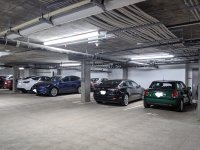
At the risk of self doxing, I live in an apartment complex that won't be growing at any point in the future, based on how other complexes function. It's already walled in on all sides so there's nowhere for it to grow, and the buildings can't grow "up" either. So, at the very least they won't have to plan for that. Parking is "first come first serve" unless I was willing to pay an extra hundred per month to get an assigned mini-garage. If I did THAT, I'd have an outlet I could use though, with apartment style three-phase power, but power all the same. But, I'm not really willing to take on that particular cost burden.Just for our knowledge, where are you parking now? Streetside? Townhouse complex outdoor communal parking?
In theory, they could repurpose some of the parking spots to dedicated EV-charging and put in for pay chargers there. Obviously there are a variety of logistical issues that need to be solve.
Here are some of my stream of conscious brainstorm thoughts and definitely don't answer all of the potential problems/challenges
- use simultaneous charging cables to help will utilization as most people technically only need to charge a few hours.
- daytime (10AM-4PM) idle fee of say $2/hour (basically like a parking meter once charge session is over).
- grant a overnight amnesty until say 10AM for people charging overnight.
- to measure occupancy or session duration use one of those charging stalls where the connector is only unlocked on payment, and the session is only closed when the connector is return to charging stall. alternatively you could use a camera to measure occupancy (like how traffic light cameras sense left turn lanes) privacy concern might be an issue, but I feel like it would effectively be a complex security camera
- it would cut into parking spots available so that is a consideration.
- you probably want to plan for potential future expansion over the decades (I don't know if American property managers think that far ahead)
- you could have an indicator light on the stalls signally valid charging session (for parking security). Again it would be like the little red flag on a parking meter.
That's true of all things in life and it goes on a "pros vs cons" spectrum.Because every once in awhile "the way we want things to happen" runs smack into "a bad day". The more gracefully it's handled the better.
For growth, I meant growth of the ratio of BEVs the ICEV. Like right now with BEV adoption at 5% and apartment ratio probably lower than that... we are talking like 3 BEVs per 100 vehicle... so two dual cable charging stalls would be enough right now, but not in 5/10/15 years... and so an apartment complex might want to plan for that (although as I said, I'm not sure property managers really look that far into the future)At the risk of self doxing, I live in an apartment complex that won't be growing at any point in the future, based on how other complexes function. It's already walled in on all sides so there's nowhere for it to grow, and the buildings can't grow "up" either. So, at the very least they won't have to plan for that.
I'm not sure would be "VERY expensive" to to implement a smart powering system that attributes the electricity usage to the proper account. Ubitricity developed has a "simplystocket" that is a smart outlet designed to be install in light posts, and the installation cost was around $1,600 per outlet they way they handle payment is because each EV driver need to own their own "smart charging cable" which records the amount of electricity they are using. Now that cost doesn't include the wiring of the parking spots (so it isn't the only cost) and there are probably connectivity hurdles that might need to be address in an underground parking structure, but I don't see and serious issues with this couldn't be adapted to work in a parking garage instead of streetlight.Parking is "first come first serve" unless I was willing to pay an extra hundred per month to get an assigned mini-garage. If I did THAT, I'd have an outlet I could use though, with apartment style three-phase power, but power all the same. But, I'm not really willing to take on that particular cost burden.
The only real solution in this case is providing power to every spot, because as it is parking is so tenuous that there are often times I have to park in front of another building because all the ones in front of mine are taken up. I understand, after a little research, that "smart powering" could identify the car connected and charge the appropriate tenant, so it's feasible, but would be VERY expensive for the complex to implement short of a government program to cover such costs (which I do hope becomes a reality as well by the way).
Under... ground? What's that? We don't have that here, like in the whole state. It's a standard above-ground flat slab of concrete.For growth, I meant growth of the ratio of BEVs the ICEV. Like right now with BEV adoption at 5% and apartment ratio probably lower than that... we are talking like 3 BEVs per 100 vehicle... so two dual cable charging stalls would be enough right now, but not in 5/10/15 years... and so an apartment complex might want to plan for that (although as I said, I'm not sure property managers really look that far into the future)
I'm not sure would be "VERY expensive" to to implement a smart powering system that attributes the electricity usage to the proper account. Ubitricity developed has a "simplystocket" that is a smart outlet designed to be install in light posts, and the installation cost was around $1,600 per outlet they way they handle payment is because each EV driver need to own their own "smart charging cable" which records the amount of electricity they are using. Now that cost doesn't include the wiring of the parking spots (so it isn't the only cost) and there are probably connectivity hurdles that might need to be address in an underground parking structure, but I don't see and serious issues with this couldn't be adapted to work in a parking garage instead of streetlight.
Ontop of that I definitely think there would likely a government program to help cover the cost. The US Department of Energy explicitly keeping an eye on about disadvantaged communities (DAC) and multifamily housing in it's ongoing monitoring of current EV charging infrastructure trends. I found a couple of municipal utilities already offering multifamily building EV incentives at around $8,000 per charger installed.
View attachment 69150
View attachment 69151
Also... I'm not sure why you think even an a parking lot without reserve parking spaces... it has to be that power is provided at every spot. Again, why can't the property reserve some spots for EV charging and have it patrolled/billed like a parking meter or resident only 9PM-9AM parking? I understand that it would take up some of the existing parking... but it's not clear that this automatically is a showstopper.
Why do you need to get an architect for installing solar + battery? Also, is there a specific HOA rule about solar installations? I'm really confused about the first part (solar companies basically look at a Google map picture of your roof and give you an estimate about how many solar panels they can install), and the few HOAs that have rules against solar get some massive public pushback against them.I wholly agree. As it sits today, I would need to hire an architect, get HOA approval for the plan, then hire a contractor to install it. On my dime. In four or five years, I will seek a place closer to my son's high school, and access to charging will be on the list.
HOA requirements, as said.Why do you need to get an architect for installing solar + battery? Also, is there a specific HOA rule about solar installations? I'm really confused about the first part (solar companies basically look at a Google map picture of your roof and give you an estimate about how many solar panels they can install), and the few HOAs that have rules against solar get some massive public pushback against them.
And if you're not installing solar, you're just installing a dryer plug in your house. In the worst case scenario, you have an old 100 Amp panel that is maxed out, and you need an electrician to install a 200 Amp one. That may require approval from the electric company, but that's an outlier.
Really curious about what your HOA and house look like that getting a charger installed has such hurdles.
I ask that before, but you didn't directly reply. So above ground is probably easier to wire up with a charger (I think, I'm not way a road construction expert or electrician, but I've seen them go up inside condo parking garages and and in above ground parking spots and negotiated the contract to have someone add two L2 chargers to my company office parking lot).Underground? What's that? We don't have that here, like in the whole state. It's a standard above-ground flat slab of concrete.
I did previously mention limited existing parking space as a limiting factor. I'm sure people will complain en masse because they complain about basically everything both valid (rent raises, maintenance issues, noise, pest/mold) and less valid (a friend of my had a neighbor sued the condo association because he was told he couldn't park his 3 vehicles and a trailer in the guest parking spots (he was a hoarder and filled his garage with stuff).And, the reason we can't have reserved "charge only" spots is because every single spot is already in use and people can and will complain, en masse, at being excluded from those spots.
While it possible that it might be cheaper to put them in front (closer to the existing power). Technically, it wouldn't need to be in the front as I agree that would be unnecessarily preferential treatment. I think putting them at the mid-range location would balance the competing priorities between the ICEV owners and the BEV owners.I can even understand, since they'd need to put a spot in front of each building and someone's going to look at that spot and get frustrated they can't park there.
Does that work at your complex when they repeatedly parking in the handicap parking spots without a handicap plate or temporary placard? YMMV, but I had my car towed in the city once for being 2 inches past where the curb cut down to the road. The private tow truck company didn't care as they got more money out of the situation.Then they'll just lie and say their car is an EV if challenged on it. That's just the way people are.

Extension cord?HOA requirements, as said.
Not sure if you're joking, and I've avoided contributing this anecdote because I'm fuzzy on the details, but my brother and sister-in-law owned a Leaf years before I bought my Bolt. They currently live in a house they bought, but when I visited them in either 2016 or 2017 they were still living in an 2nd floor apartment in a complex with first come, first served parking and no garage space. I can't say how often they did it, but at least once in the extended weekend I was there they were charging their Leaf by running a plain old orange extension cord out from their apartment to a Level 1 EVSE to charge the Leaf.Extension cord?
From where? The tenants closest to outlets use them. Per the HOA, I would need a architectural design and their approval. It is what it is. It would be awesome if the HOA equipped every unit with a plug-in parking space, but I am not holding my breath.Extension cord?
Almost every spot is in front of a building. Sorry, I suppose I'm not fully capturing the picture here.I ask that before, but you didn't directly reply. So above ground is probably easier to wire up with a charger (I think, I'm not way a road construction expert or electrician, but I've seen them go up inside condo parking garages and and in above ground parking spots and negotiated the contract to have someone add two L2 chargers to my company office parking lot).
I did previously mention limited existing parking space as a limiting factor. I'm sure people will complain en masse because they complain about basically everything both valid (rent raises, maintenance issues, noise, pest/mold) and less valid (a friend of my had a neighbor sued the condo association because he was told he couldn't park his 3 vehicles and a trailer in the guest parking spots (he was a hoarder and filled his garage with stuff).
If your apartment complex already offers reserved parking spots, it is "possible" for them to push through dedicating a few spots (say 2-4 out of 100) to get the tax incentives/benefits. Obviously it would be a judgement call depending on the situation... but technically if there are 5 residents who potentially want to charge their BEV. "at home"... the net effect is the same (those residents would have been taking up parking spots anyway).
While it possible that it might be cheaper to put them in front (closer to the existing power). Technically, it wouldn't need to be in the front as I agree that would be unnecessarily preferential treatment. I think putting them at the mid-range location would balance the competing priorities between the ICEV owners and the BEV owners.
Does that work at your complex when they repeatedly parking in the handicap parking spots without a handicap plate or temporary placard? YMMV, but I had my car towed in the city once for being 2 inches past where the curb cut down to the road. The private tow truck company didn't care as they got more money out of the situation.
"OK, our mistake, let's go out to your car and show us where the charging port is on it?"Then they'll just lie and say their car is an EV if challenged on it.
So they've already split up the parking into two segments; those with a mini-garage with 120v power and those without. Wouldn't the suggested change just be further segmenting the spots?Almost every spot is in front of a building. Sorry, I suppose I'm not fully capturing the picture here.
You mention taking the reserved spots and... they're already there with power, they are the "minigarage" strips I mentioned... which cost an extra hunder a month that I'm not willing to pay. That solution just makes electric vehicles even harder a sell for most of us here.
This is a super confusing position.I know I don't, but a hybrid isn't the solution in any case. We need to stop using fossil fuels altogether. The solution is better support for a charging solution in housing solutions like what you and I have where electrical outlets aren't available where we park.
They're never even going to challenge anyone on it, most likely. I mean, if you were to ask me if this or that car is an EV or not, I wouldn't be able to tell you at a glance. It's like when someone says "what's the make and model of the car that hit you?" How the heck should I know?! I'm not a "car" person. Do you know how many different kinds of cars there are? There are dozens! Literally, dozens!"OK, our mistake, let's go out to your car and show us where the charging port is on it?"
... and/or ...
"hmmm, it doesn't seem to be plugged in at the moment-- since you aren't using the spot to charge your car at this time, would you prefer moving it to another spot or having it towed to an impound lot?"
This is a super confusing position.
Electricity is, in every single country where EVs are sold, largely generated by consumption of fossil fuels. There is no efficiency gain (and arguably efficiency LOSS) from having the power for your car come from a central power plant or one that is internal to the car.
Hybrids are wildly more practical than EVs for over 90% of Earth's surface area.
Wait what's your argument then? By your reasoning why would a hybrid be better than a pure gas model?This is a super confusing position.
Electricity is, in every single country where EVs are sold, largely generated by consumption of fossil fuels. There is no efficiency gain (and arguably efficiency LOSS) from having the power for your car come from a central power plant or one that is internal to the car.
Hybrids are wildly more practical than EVs for over 90% of Earth's surface area.

They're never even going to challenge anyone on it, most likely. I mean, if you were to ask me if this or that car is an EV or not, I wouldn't be able to tell you at a glance. It's like when someone says "what's the make and model of the car that hit you?" How the heck should I know?! I'm not a "car" person. Do you know how many different kinds of cars there are? There are dozens! Literally, dozens!