
You are using an out of date browser. It may not display this or other websites correctly.
You should upgrade or use an alternative browser.
You should upgrade or use an alternative browser.
$199 Analogue Pocket promises FPGA accuracy for portable retro gaming
- Thread starter JournalBot
- Start date

It's all about integer scaling. Modern high rez screens give you a lot more options for playing these old low rez titles properly.The Pocket's 3.5", 1600 x 1440 resolution, 615 dpi LTPS LCD display frankly seems like a bit of overkill, considering the Game Boy Advance topped out at 240 x 160 and about 100 dpi.
1440 / 160 = 9 so you'll get properly crisp pixels in the correct aspect ratio.
Upvote
112
(112
/
0)
Instant Sunrise
Ars Centurion
I wonder if it will support super gameboy pallets and borders?
I'd love to be able to play Donkey Kong 94 with full super gameboy support.
I'd love to be able to play Donkey Kong 94 with full super gameboy support.
Upvote
14
(14
/
0)
I've always thought Analogue's stuff was interesting, but this could potentially be the one that I actually buy. The hybrid design with the dock makes it a lot more appealing than a dedicated portable or console system, and I can see that second FPGA being used to do some really cool stuff.
Upvote
37
(37
/
0)
sphenodont
Ars Tribunus Militum
I appreciate the planned Lynx support but now I've got to find some other sucker here in town to buy one so we can play Warbirds.
Upvote
22
(22
/
0)
D
Deleted member 1
Guest
It's all about integer scaling. Modern high rez screens give you a lot more options for playing these old low rez titles properly.The Pocket's 3.5", 1600 x 1440 resolution, 615 dpi LTPS LCD display frankly seems like a bit of overkill, considering the Game Boy Advance topped out at 240 x 160 and about 100 dpi.
1440 / 160 = 9 so you'll get properly crisp pixels in the correct aspect ratio.
At that resolution you could even leave a line of pixels blank in between to emulate the old pixels that had a little bit of a gap between them too! Would look really nice I think.
Upvote
39
(40
/
-1)
dragonzord
Ars Scholae Palatinae
They could even add shadow effects to simulate the old non-lit LCD under the sunIt's all about integer scaling. Modern high rez screens give you a lot more options for playing these old low rez titles properly.The Pocket's 3.5", 1600 x 1440 resolution, 615 dpi LTPS LCD display frankly seems like a bit of overkill, considering the Game Boy Advance topped out at 240 x 160 and about 100 dpi.
1440 / 160 = 9 so you'll get properly crisp pixels in the correct aspect ratio.
At that resolution you could even leave a line of pixels blank in between to emulate the old pixels that had a little bit of a gap between them too! Would look really nice I think.
Upvote
32
(33
/
-1)
dragonzord
Ars Scholae Palatinae
Unlikely since they aren't doing emulation, unless they can also add super game boy and SNES support into it. They already have a SNES product, so it's possible if they're using the same FPGA chipI wonder if it will support super gameboy pallets and borders?
I'd love to be able to play Donkey Kong 94 with full super gameboy support.
Upvote
1
(2
/
-1)
Here's what that would look like:At that resolution you could even leave a line of pixels blank in between to emulate the old pixels that had a little bit of a gap between them too! Would look really nice I think.
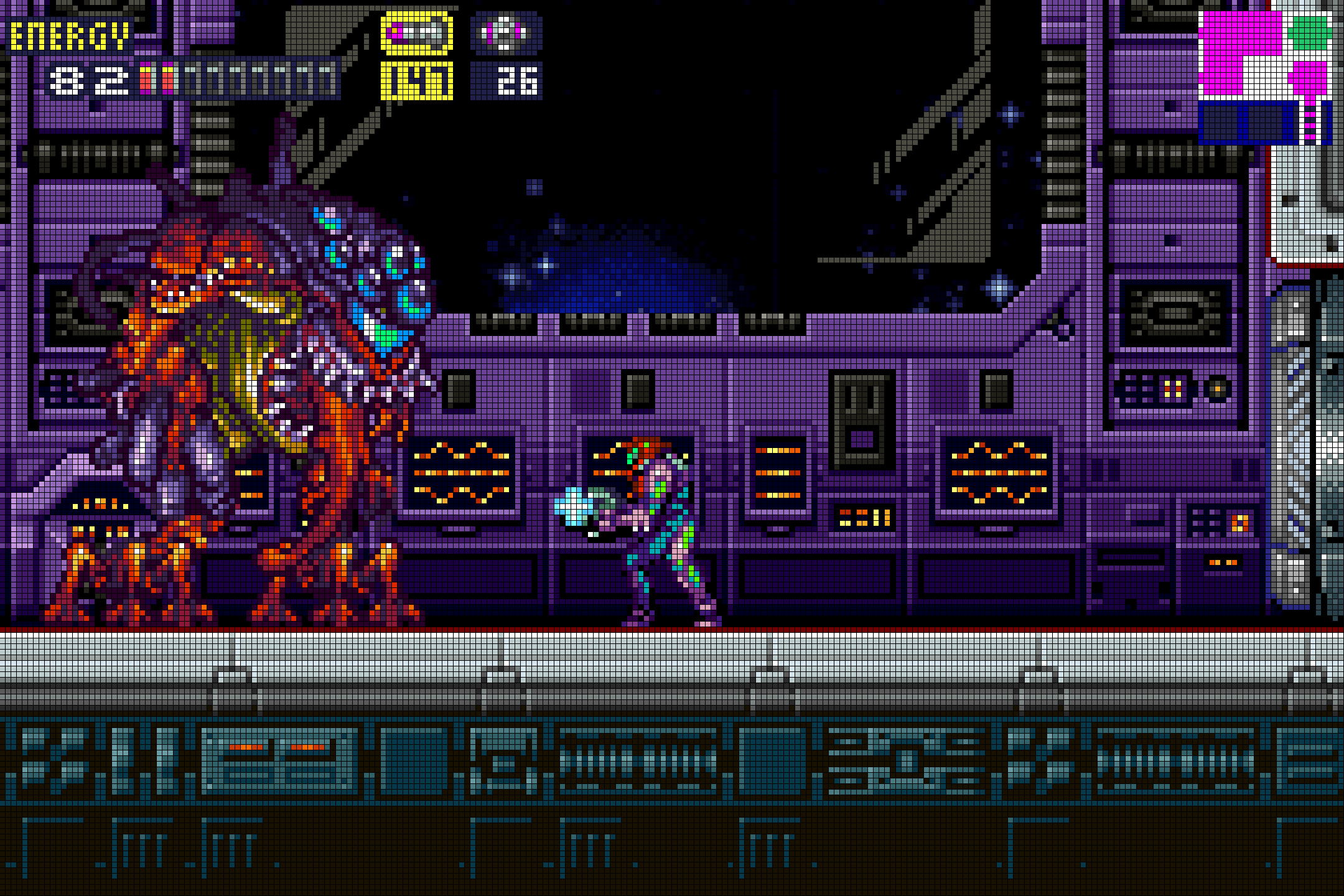
Upvote
127
(130
/
-3)
Just simply as a development-only device this is attractive.
- A nice screen
- Nice buttons
- Dedicated FPGA for development
- Easy-access storage included
The fact that it includes the functionality for all those legacy game systems is the cherry. I love FPGA development and I adore this device.
- A nice screen
- Nice buttons
- Dedicated FPGA for development
- Easy-access storage included
The fact that it includes the functionality for all those legacy game systems is the cherry. I love FPGA development and I adore this device.
Upvote
56
(56
/
0)
IntergalacticWalrus
Ars Praefectus
Welp this is the FPGA handheld of my dreams. Definitely buying this.
Re: resolution: too bad they didn’t go slightly higher for 2048x1568, which would allow displaying NES/SNES games at their ideal aspect ratio with 8x7 pixels. Still pretty kickass display though.
Re: resolution: too bad they didn’t go slightly higher for 2048x1568, which would allow displaying NES/SNES games at their ideal aspect ratio with 8x7 pixels. Still pretty kickass display though.
Upvote
30
(30
/
0)

Being able to play these games like on a 'real' console, i.e. on a big screen with controller, is the biggest draw for me. I just can't handle the crummy (by modern standards) Game Boy screen and cramping my hands any more.
Though maybe this screen will be bitchin' enough it's not necessary, but real controller will still be nicer.
Though maybe this screen will be bitchin' enough it's not necessary, but real controller will still be nicer.
Upvote
5
(5
/
0)
They're using the same FPGA chip. It's also got a second FPGA that's accessible to developers, so things that aren't supported out of the box could conceivably be built for that by someone else.Unlikely since they aren't doing emulation, unless they can also add super game boy and SNES support into it. They already have a SNES product, so it's possible if they're using the same FPGA chipI wonder if it will support super gameboy pallets and borders?
I'd love to be able to play Donkey Kong 94 with full super gameboy support.
Upvote
21
(21
/
0)
They're using the same FPGA chip. It's also got a second FPGA that's accessible to developers, so things that aren't supported out of the box could conceivably be built for that by someone else.
There are plenty of FPGA and emulation-type devices out there where it wasn't the case that someone else came along and did the work - however I seriously hope this floats to the top. Seeing that picture was a *gasp* moment for me, and I'm hoping it will have the same effect on the much-smarter folks who know how to make this hum.
Upvote
2
(2
/
0)
IntergalacticWalrus
Ars Praefectus
Considering the price tag of their existing products I have to say I’m surprised that this one will be “only” $200, though? Especially given that screen and the two cores?
Almost sounds too good to be true.
Almost sounds too good to be true.
Upvote
23
(23
/
0)
That would mean non-integer scaling for the thing this was actually designed for though, so I'm glad they didn't do that.Re: resolution: too bad they didn’t go slightly higher for 2048x1568, which would allow displaying NES/SNES games at their ideal aspect ratio with 8x7 pixels. Still pretty kickass display though.
There's no one resolution that will allow every different system to be perfectly displayed, but if you gotta pick one for this system Game Boy Advance feels like the one to get right, and let everything else work around it.
Upvote
35
(35
/
0)
Post content hidden for low score.
Show…
Considering the price tag of their existing products I have to say I’m surprised that this one will be “only” $200, though? Especially given that screen and the two cores?
Fully agreed. If you add up the pennies for components, they are still making a profit after assembly but the $200 surprises me.
(Assuming it ships as advertised) This is a product which deserves reward from the market. I'll buy.
Upvote
15
(15
/
0)
DigitalFirefly
Seniorius Lurkius
Very pretty device, but like the Gameboy, that looks way too small and uncomfortable for my adult hands. Had they gone for a more ergonomic design I may be interested.
Upvote
2
(3
/
-1)
Thomas Harte
Ars Tribunus Militum
The Atari Lynx is one of the titles I've written homebrew for; I'm a little surprised by its inclusion since quite a lot about the hardware is still essentially unknown — not just edge-case calculation results but fairly fundamental timing issues. I guess the lucky thing is that there is such a small number of titles, I think somewhere around 80, that it's not too onerous to test reasonable guesses against all known software.
Or, at least, test it against Shadow of the Beast. That's the best title.
Or, at least, test it against Shadow of the Beast. That's the best title.
Upvote
11
(11
/
0)

I've been impressed by everything I've seen of Analogue's devices so far but haven't bitten the bullet and bought one yet.
This looks like it might be the one to buy.
This looks like it might be the one to buy.
Palettes and borders might be doable, but "full Super Game Boy support" -- border animations, the SGB UI, Space Invaders compatibility, etc. -- would require simulating an actual Super NES with a Super Game Boy ROM. That won't happen out of the box, though I'm curious whether it would be possible with a custom core on that second processor.I wonder if it will support super gameboy pallets and borders?
I'd love to be able to play Donkey Kong 94 with full super gameboy support.
Upvote
4
(5
/
-1)
Here's what that would look like:At that resolution you could even leave a line of pixels blank in between to emulate the old pixels that had a little bit of a gap between them too! Would look really nice I think.
I get the idea and, with some good code, this could go further. Game boy pixels are a bit round - mostly due to old fashioned production techniques and a bit "noisy" too.
There's enough pixel ratio to blend/blur some of there effects and more (noisy scan lines, data bleeding between row/column data lines etc).
I had some fun simulating a sort of LED based calculator display a while back and some of the more modern scan line shaders look unreal on a 4K or 5K display.
600+ PPI is going to lead to some proper nice effects.

Upvote
21
(22
/
-1)
If only they had chosen the original (landscape) GBA form factor instead of the (portrait) GB. 
Much easier to hold, easier on the wrists, and leads to much less cramping overall. And would be easier to add/access shoulder buttons.
Much easier to hold, easier on the wrists, and leads to much less cramping overall. And would be easier to add/access shoulder buttons.
Upvote
33
(34
/
-1)
Netherhigal
Wise, Aged Ars Veteran
This thing looks absolutely worth 200 usd. I know one thing is going to irk me is the start/select/menu button location at the bottom right edge. Not only am I going to accidentally trigger that often with the way I'd grip this, but for any games that use them it is not my first instinct to reach there. Same issue with the first GBA for me.
Upvote
3
(3
/
0)
I think they chose the resolution based on what works best with most of the systems rather than just one system. 1600x1440 is exactly ten times the resolution used by the Game Boy and Game Gear on both axes. It also fits well with the Lynx's 160x102 resolution, since it matches perfectly on the horizontal axis and still fits along the vertical.That would mean non-integer scaling for the thing this was actually designed for though, so I'm glad they didn't do that.Re: resolution: too bad they didn’t go slightly higher for 2048x1568, which would allow displaying NES/SNES games at their ideal aspect ratio with 8x7 pixels. Still pretty kickass display though.
There's no one resolution that will allow every different system to be perfectly displayed, but if you gotta pick one for this system Game Boy Advance feels like the one to get right, and let everything else work around it.
It actually leaves the GBA out a bit - it scales well on the vertical axis, but the horizontal one needs to fit and that doesn't quite divide with 1600. The NGPC is also a bit off, since fitting it to the horizontal axis cuts off some of the vertical pixels. Unless I'm doing my math wrong, you can't get a full width/full height image on either of those with integer scaling.
That said, it seems like a non-issue to me. 3/5 is pretty fantastic, and the pixel density is so stupidly high that it should be hard to spot any issues anyways.
Upvote
11
(11
/
0)
They could even add shadow effects to simulate the old non-lit LCD under the sunIt's all about integer scaling. Modern high rez screens give you a lot more options for playing these old low rez titles properly.The Pocket's 3.5", 1600 x 1440 resolution, 615 dpi LTPS LCD display frankly seems like a bit of overkill, considering the Game Boy Advance topped out at 240 x 160 and about 100 dpi.
1440 / 160 = 9 so you'll get properly crisp pixels in the correct aspect ratio.
At that resolution you could even leave a line of pixels blank in between to emulate the old pixels that had a little bit of a gap between them too! Would look really nice I think.
Not truly complete unless they add a light sensor to dim the screen to the point that you can't use it during night time car rides
The shadow effect would be very interesting, especially if it was able to determine the direction of the brightest light source.
Upvote
10
(11
/
-1)
Post content hidden for low score.
Show…
reallynotnick
Ars Centurion
This looks amazing, I might have to pick one up. I just wish it had support for Bluetooth headphones (in addition to the 3.5mm jack of course). And while ergonomically I do prefer the GBA original style, there is just something so iconic about this look I think they made the right choice. Now the million dollar question is do I get it in white or black...
Upvote
1
(1
/
0)
It's fine if you prefer an FPGA-based retro console, but that doesn't mean that emulator-based ones shouldn't exist. Saying that the only things that "should exist" are things that personally appeal to you is myopic.This is the ONLY kind of retro gaming console that should exist, emulators running on cheap shitty ARM SOCs have no value because you can easily run all of those on any computer including your watch or graphing calculator, what's the point?
If I'm serious enough to buy an actual piece of hardware just for retro gaming, it should at least have some craftsmanship and work like the original.
The Analogue Pocket in no way is going to be more powerful than the Nintendo Switch. The FPGA chips are great for simulating old CPUs and GPUs, but in terms of raw performance, they're terrible.Also, isn't it stupid that this thing probably has better hardware than a modern Nintendo Switch?
Upvote
40
(40
/
0)
Day 1 purchase. So excited.
If that second fpga is strong enough to run snes/genesis this thing will be the end all of portable consoles for me.
If that second fpga is strong enough to run snes/genesis this thing will be the end all of portable consoles for me.
Upvote
4
(4
/
0)
They don't infringe on any trademarks, any hardware patents have long since expired, and they don't use any copyrighted BIOS code from the original hardware, so they're perfectly legal clone machines.What's the legal status of this kind of console? I guess it is a general computing tool that can also be programmed to run these games?
Upvote
29
(29
/
0)
This is for the retro gaming connoisseur. The one that has a collection of cartridges of several portable systems and only wants the finest way to play them.
If you just want GB/GBC/GBA support, its cheaper to buy a used GBA SP and replace the battery, or even mod the screen with better backlight. I know because i did it a year ago.
If you just want GB/GBC/GBA support, its cheaper to buy a used GBA SP and replace the battery, or even mod the screen with better backlight. I know because i did it a year ago.
Upvote
1
(2
/
-1)
Yeah, I recently got a refurb GBA SP, and while that screen is gorgeous, it's not nearly as comfortable to hold as a GBA (or other landscape systems like the DS/3DS and PSP).If only they had chosen the original (landscape) GBA form factor instead of the (portrait) GB.
Much easier to hold, easier on the wrists, and leads to much less cramping overall. And would be easier to add/access shoulder buttons.
Any patents Nintendo owned on the Game Boy hardware are expired. (Same goes for Atari and the Lynx, Sega and the Game Gear, etc.) Reverse engineering an electrical circuit and reimplementing that circuit in software is not illegal.What's the legal status of this kind of console? I guess it is a general computing tool that can also be programmed to run these games?
Encouraging players to use original hardware cartridges also signals good faith by the hardware developers: while this device certainly could, and almost certainly will, be modified to play illegally-acquired ROMs, that's not what it's for. It's for playing real games using original cartridges. This is an expensive device for serious collectors; it's not somebody throwing a complete ROM set on a Raspberry Pi.
The Analogue Pocket is completely legal. So are the rest of Analogue's devices. They can be modified, after purchase, to run unauthorized software that the user has acquired through illegal means -- but the same is true of literally every computer. The manufacturer is not responsible for actions taken by the user after purchase.
That doesn't necessarily mean Nintendo or Atari's shambling corpse or whatever other company couldn't sue. People file groundless nuisance suits all the time, and such a thing would certainly be an inconvenience for Analogue. (Sony lost its lawsuit against Bleem, but still bankrupted the company.)
However, given that hardware vendors haven't really gone after clone manufacturers in the past, I don't think that's likely. Nintendo will continue cracking down on ROM sites (and fan games -- Nintendo gonna Nintendo), but a $200 piece of niche hardware designed to run Game Boy cartridges is probably not worth paying any mind to.
Upvote
22
(22
/
0)
chickenboo
Ars Praetorian
Day 1 purchase. So excited.
If that second fpga is strong enough to run snes/genesis this thing will be the end all of portable consoles for me.
I'm mulling the idea of getting one myself. I'd have to pick up more carts off aliexpress or ebay. I'd much prefer my Switch had an expansion port for my existing carts though, because that would be the end all of portable consoles. Something modern to play today's games AND old titles, rather than having two separate devices for different purposes. I have enough gadgets.
Upvote
0
(0
/
0)
They address the BIOS question at the bottom of the product page:They don't infringe on any trademarks, any hardware patents have long since expired, and they don't use any copyrighted BIOS code from the original hardware, so they're perfectly legal clone machines.What's the legal status of this kind of console? I guess it is a general computing tool that can also be programmed to run these games?
https://www.analogue.co/pocket/
Analogue Pocket does not operate utilizing preexisting bios files from any other entities. Analogue engineers everything from scratch, in house.
There's also a FAQ, although it currently doesn't answer much:
https://support.analogue.co/hc/en-us/ar ... Pocket-FAQ
Upvote
2
(2
/
0)