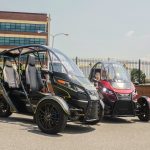
The Arcimoto FUV slices through a wet Vegas parking lot, kicking up spray from puddles and smiles from passersby. Despite the unusual downpour, I stay bone dry under the electric tricycle’s semi-enclosed canopy, twisting the throttle to zip back and forth with a grin on my face.
While taxis on the road beside me inch through traffic toward the annual CES trade show, the world’s first Fun Utility Vehicle is living up to its name. It’s nippier than a car, drier than a scooter, and easier to handle than a motorbike.
From the back seat, Arcimoto founder and CEO Mark Frohnmayer shares his dreams of turning this ultra-efficient (230mpg-equivalent) trike into the world’s greenest rideshare vehicle. “Around 80 percent of taxi trips are just one passenger,” he says. “In a world where all vehicles are autonomous and you can hit a button and jump in, it doesn’t make sense that you’d be jumping into a seven-passenger 5,000lb vehicle all by yourself.”
Although the FUV is enjoyably manual for now, Arcimoto is working with two unnamed technology partners to get a self-driving version on the roads later this year, just as soon as it begins mass production of the FUV at a new factory in Eugene, Oregon. “We’ve got 2,250 pre-orders to fulfill first, then we want to produce 10,000 vehicles in 2019 and beyond,” says Frohnmayer.
To help scale up production at its current factory and start work on a second, Arcimoto is about to submit an application for a loan from the Advanced Technology Vehicles Manufacturing (ATVM) program at the US Department of Energy (DOE). This Bush-era project is intended to support the production of fuel-efficient, next-generation vehicles in the US with long, low-interest loans. Even in an era of Trumpian cuts and climate skepticism, ATVM retains more than $16 billion in loan authority to distribute—at least until the White House succeeds in killing the program, as it hopes to do this year.





 Loading comments...