Skip to content
Cars

Waymo has a big lead in driverless cars—but here’s how it could lose it

Even if Waymo gets to market first, it’ll face stiff competition from rivals.

Timothy B. Lee | 84
Credit: Getty / Aurich
Story text

Waymo has long had a sizable lead in self-driving technology, and recent reports indicate that Larry Page, CEO of Waymo parent company Alphabet, is determined not to let it slip away. According to The Information’s Amir Efrati, Waymo CEO John Krafcik is under pressure to launch a commercial service in the Phoenix metro area as soon as this fall.

But at a Monday event with reporters at Waymo’s Castle testing grounds in California’s Central Valley, Krafcik was non-committal about the company’s launch plans. In fact, he cast doubt on whether a driverless taxi service would even be Waymo’s first product, as almost everyone has assumed it would be.

“We’ll have to see,” Krafcik said, noting that the company was also working on self-driving truck technology. “We’re also considering working directly with cities.”

It was a puzzling stance because the point of the event was to show off the self-driving minivans Waymo is developing for use in a Phoenix-area taxi service. Ars and others experienced a driverless ride and got to see the testing facilities and procedures firsthand. Krafcik’s comments certainly didn’t seem like the words of a CEO weeks away from launching that product.

Luckily for Krafcik, Waymo has a big head start on most of its rivals. Ford set a target last year to introduce fully self-driving cars in 2021 and has downplayed this goal since then. An Audi representative told me earlier this year that full self-driving capabilities were at least four years away. Elon Musk predicted in April that Tesla would have fully self-driving cars available in 2019, but there’s reason for skepticism that the company can hit this target.

One of Waymo’s strongest competitors is Cruise, the self-driving car startup GM bought last year. In August, Cruise showed off an app its employees can use to hail self-driving cars—with safety drivers—to get around San Francisco. GM CEO Mary Barra said last week that GM was “quarters, not years” away from being able to deploy cars without safety drivers.

Even if Waymo brings a product to market before GM and other rivals—and that still seems likely—the larger problem for Waymo is that things will only get harder from here. The next steps toward deploying its technology—manufacturing millions of vehicles, managing fleets all over the country, and attracting a broad base of customers—are areas where rivals like GM, Ford, Uber, and Lyft have deeper expertise than Waymo. So Waymo is in danger of falling far behind as other companies are able to scale up more quickly.

Waymo’s cars are a work in progress

Credit: Waymo

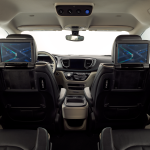
The big selling point for Waymo’s press event was a chance to ride in Waymo’s driverless car. The company provided Ars and a number of other publications an early look at the user interface Waymo is designing for its cars. Seatback-mounted displays show a schematic view of the road ahead, with other cars, pedestrians, and other obstacles marked. The displays give passengers confidence that the car understands the world around it.

Users interact with the car using a row of four buttons mounted on the ceiling. One button places a call to Waymo’s customer support center. A second locks and unlocks the door. A third instructs the vehicle to pull over. You push the final button when you want to start a ride.

Waymo says passengers in its Phoenix early rider program hail vehicles with an Uber-style app, but we didn’t get a chance to see this app in action. And when I asked if I could press the “pull over” button to see how that feature worked, our chaperone said it was still under development. (Update: a Waymo spokesman tells Ars that the “pull over” button does work. However, the event had a tight schedule, and it would have slowed things down too much to let reporters push it.)

Overall, Waymo’s technology was impressive. We got to see Waymo vans navigate complex traffic circles, interact with bicycles, and avoid aggressive drivers who cut them off. Still it wasn’t hard to see why Krafcik might be cagey about the product’s launch date. The cars made for an impressive demo, but they clearly weren’t quite ready for prime time.

Manufacturing cars is hard

GM workers assembling a test car for Cruise.
GM workers assembling a test car for Cruise. Credit: Cruise

The larger concern for Waymo, though, is that things will get harder—not easier—for Waymo after it launches its initial driverless taxi service in the Phoenix suburbs of Chandler. Computer hardware has become so cheap and versatile that scaling an online service from hundreds to millions of users is pretty easy. The car industry isn’t like that.

Modern car manufacturing plants cost billions of dollars, and using that equipment efficiently requires years of careful planning. Managing a large workforce of blue-collar workers on an assembly requires very different skills than managing a staff of software designers and programmers. Tesla is learning this lesson the hard way as it suffers through “production hell” trying to automate production of its low-cost Model 3.

In the past, Waymo considered designing its own self-driving car from scratch, but it eventually concluded this wasn’t worth the effort. Waymo is hoping to sidestep a lot of manufacturing headaches by partnering with automakers. The company inked a deal with Fiat Chrysler last year to buy 100 minivans, a deal it expanded to 500 vehicles this year.

But partnering with Fiat Chrysler hasn’t solved Waymo’s problems in this area, as illustrated by a September Amir Efrati story reporting that Waymo had only put 50 of its 100 Fiat Chrysler minivans on the road.

“Part of the difficulty in deploying autonomous vehicles is the calibration Waymo must make to its hardware so that it works with the vehicles, plus other technical issues that have been harder to anticipate,” Efrati wrote. “It also must wait for the other 500 cars it ordered to be fixed following a June recall by Fiat Chrysler related to a small electronic part in all of its Pacifica vans.”

On Monday, Krafcik said Waymo had completed work on the initial batch of 100 cars, and work on the next 500 was ongoing. Waymo will obviously need to build a lot more than 500 vehicles to claim a major share of the driverless car market.

Of course, some difficulties were to be expected in this kind of cutting-edge project. But the arm’s-length relationship between Waymo and Fiat Chrysler surely makes this more difficult.

Being owned by GM could enable Cruise to scale a lot faster

To see why GM ownership would allow quicker scale, it’s helpful to draw a contrast to the experience Cruise has had at GM. In September, Cruise CEO Kyle Vogt unveiled a new self-driving car design that was the result of collaboration between engineers at Cruise and GM.

“We started rebuilding our systems using automotive grade components and automotive suppliers when possible,” Vogt wrote. “We started modifying and replacing code on the dozens of systems and controllers inside the vehicle so that they cleanly interfaced to the self-driving technology from Cruise.”

This kind of deep collaboration is a lot easier when it happens among engineers who all work for the same company. GM can give Cruise engineers unrestricted access to the hardware and software for all of the sub-systems within GM vehicles, and Cruise engineers have every reason to help their GM counterparts fix problems that arise with Cruise-designed systems.

When independent companies collaborate, it’s much easier for frictions to crop up that limit cooperation, something that Waymo discovered last year when it tried to forge an ambitious deal with Ford.

The Information’s Efrati reports that Waymo’s partnership with Ford “fell apart because Waymo (then still part of Google) didn’t want to front some of Ford’s cost to expand manufacturing capacity to eventually produce thousands or potentially millions of electric light passenger vehicles that would be powered by Google software.”

Passenger cars are a low-margin business for Ford, and Ford worried about spending a lot of money up front without capturing much of the upside Waymo would enjoy if the service was successful. This kind of thing wasn’t a concern for GM, of course, because GM owns Cruise and would fully share in any profits Cruise generated.

By working closely together, Vogt says, Cruise and GM have been able to design a car that can be manufactured at scale. Vogt wrote that the new car model was “designed to be built on one of GM’s high volume assembly lines.”

So even if Cruise enters the market a year or two later, it may be able to ramp up car production a lot faster, allowing it to get hundreds of thousands—and then millions—of cars on the road more quickly than Waymo can.

Managing cars is hard

Even if Waymo can figure out how to ramp up car production, there are a lot of logistical challenges involved in building a national ride-sharing network, as is made clear by the safety report Waymo released in mid-October.

Waymo plans to have an operations center staffed with people to respond to customer calls and deal with emergency situations. Given the complexity of self-driving cars, these workers may need extensive training and supervision.

Waymo has been meeting with Phoenix-area law enforcement agencies and offering training on interacting with self-driving cars. Presumably, Waymo will need to do similar prep work in every city where they start offering service, requiring a significant staff to travel around the country preparing to expand into new cities.

Scaling all these functions up to the entire country—or even the world—in a few years would be a challenge for any company. It’ll be especially challenging for Waymo, a company whose Google roots could make it ill-suited to this kind of work. When Google has ventured into selling hardware (like Pixel smartphones), offering labor-intensive services (like the Google Express delivery service), or building infrastructure (like Google Fiber), the results have rarely been great.

The products work fine, but Google isn’t known for having the hustle or the marketing savvy required for expanding rapidly, grabbing market share, and keeping costs low.

As with the Fiat Chrysler deal, Waymo has tried to handle this by working with an outside company that has skills Waymo lacks. The firm recently signed an agreement with Avis to manage Waymo’s fleet in Phoenix. So far, however, that deal seems fairly narrow. Avis will clean, repair, refuel, and store Waymo’s self-driving minivans. But media reports so far suggest that other important activities, like customer service, marketing, emergency response, and so forth, will still be handled by Waymo.

So there’s a risk that Waymo might get out-hustled by companies with more experience in this kind of business. Waymo’s vision for self-driving cars poses an existential threat to rental car companies. These companies have a lot of experience buying cars from carmakers, managing vast fleets, and renting to the general public. If they team up with incumbent car companies, they might be able to stand up a national network of self-driving cars a lot faster than Waymo can do on its own.

Building a customer base is hard

Once you have cars and the infrastructure to manage them, you still need customers. It’s not clear if Waymo will try to build its own ride-hailing app or rely on existing providers like Uber and Lyft. But there’s reason to believe that going at it alone will be difficult.

There’s a lot more to a ride-hailing service than software alone. Jason Doran, a business strategist who has spent time at SideCar and then GM, points out that conventional ride-hailing companies bring a lot to the table. “Look at all the different products that Uber and Lyft have created,” Doran said. “They have business relationships with enterprises. They do event transportation.” The wide range of customer-facing products “makes it very easy to plug a new car into that.”

Uber and Lyft have millions of established customers and extensive experience managing demand and handling customer complaints.

If Waymo decides to build a ride-hailing service from scratch, it will need to duplicate all of these features and build up its own customer base, a process that might take years. This could be particularly challenging because initially, Waymo’s cars will only serve a limited area—most likely centered on Chandler, Arizona. Some customers will want to go to other parts of the Phoenix metro area, and if Waymo relies entirely on its self-driving taxis it won’t be able to offer these customers service, creating a bad user experience.

So there are strong reasons for Waymo to work with Lyft, which has cannily positioned itself as a neutral marketplace for other companies to offer self-driving cars to the public. Waymo can tell Lyft where its cars can go, and Lyft can automatically dispatch Waymo cars to service passengers who are inside Waymo’s service area, dispatching conventional human-driven cars for other trips.

But if Waymo pursues this route, it also means that there will be low barriers to entry for other companies building self-driving cars. If customers are getting a mix of Waymo driverless cars and conventional human-driven cars, they won’t mind sometimes getting driverless cars from GM, Tesla, or Drive.ai as those companies enter the commercial market.

Why Waymo could still have a big advantage

Credit: Waymo

Despite these challenges, there are a few reasons to be bullish on Waymo’s prospects.

One reason, as Ars Technica’s Ron Amadeo pointed out to me, is that there is one example of Google successfully managing a large labor force, and it’s an important one: Google Maps. Google sends cars all over the country to take pictures for Street View, managing a labor force of thousands of independent contractors. Google Maps and Google-owned Waze collect a vast amount of geographic data about traffic patterns that will be hugely helpful to Waymo as it enters new cities.

Another reason to be bullish on Waymo: it’s possible that the various aspects of operating a self-driving car network will prove so inter-connected that there are big advantages to having all the key functions under one roof. Because Waymo will be both designing self-driving car software and operating a self-driving car network, it will be able to quickly use what it learns from real-world customer feedback to make its technology better. That might be harder to do if a motley coalition of ride-sharing companies, rental car companies, and carmakers are trying to work together to deliver a driverless taxi service.

It’s also possible that Waymo will choose to offer a vertically integrated service initially but shift to another business model once it has proven the value of its technology. For example, it might ultimately license its software and hardware designs to carmakers to integrate into their vehicles. Or it might pursue a franchise model, where other companies can license Waymo’s technology stack to build driverless taxi services in particular cities.

Regardless, the bottom line is that getting a fully driverless car is not the end of the driverless technology race. Launching a self-driving car service before anyone else certainly helps. But Waymo will have a long slog ahead of it to become a major player in the 21st Century transportation business.

Listing image: Cruise

Photo of Timothy B. Lee
Timothy B. Lee Senior tech policy reporter
Timothy is a senior reporter covering tech policy and the future of transportation. He lives in Washington DC.
84 Comments