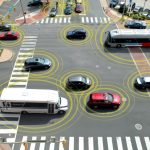
Nearly three years after it was first mooted, the National Highway Traffic Safety Administration published a Notice of Proposed Rulemaking on Tuesday that will mandate vehicle to vehicle (V2V) communication systems in all new cars and trucks. Once the rule is finalized, car makers will have two model years to begin including V2V systems, with some added leeway for product cycles. V2V-equipped cars will communicate with each other at short ranges to prevent the kinds of accidents where current advanced driver assistance systems, most of which depend on line of sight, aren’t effective.
V2V, and the related vehicle to infrastructure (V2I), relies on the Dedicated Short-range Radio Communication (DSRC) wireless protocol to communicate between devices at ranges of up to 984 feet (300m). Vehicles will be able to send out standardized “basic safety messages” that trigger driver alerts or even emergency avoidance actions to prevent crashes. (For a more detailed explanation of how V2V works, check out this piece from Ars’ Sean Gallagher.)
Recognizing the immense implications of an insecure protocol, the notice asks industry and the public for input on the proposed security specifications and proposes that “vehicles contain “firewalls” between V2V modules and other vehicle modules connected to the data bus to help isolate V2V modules being used as a potential conduit into other vehicle systems.” Privacy is also given due attention, and the proposed rule would prevent cars from sending out identifiable data like a vehicle’s VIN or a driver’s name or address.
It has taken a long time to get here—even longer than the 33 months we’ve waited to see the NHTSA’s notice. The Federal Communications Commission set aside the 5.9GHz band for V2V and V2I back in 1999, although it took until 2002 before work began on the 802.11p protocol. Back then, a dedicated communications protocol seemed like a great idea since cell networks weren’t thought capable of sufficiently low latency to be useful in this context. But nearly two decades later, it looks like 5G solves that problem, and you can bet that automakers will be packing 5G modems into cars as soon as they can get their hands on them. (With that in mind, the notice includes proposals for interoperability with non-DSRC protocols.)

 Loading comments...