Skip to content
Cars

Breaking the sound barrier by air, by land, and in free fall

We don’t always celebrate it, but October 14 is a special anniversary for speed freaks.

Jonathan M. Gitlin | 67
Story text

On October 14, 1947, high above California’s Antelope Valley, Charles “Chuck” Yeager became the fastest man alive. That day Yeager—an Appalachian farm boy-turned-fighter ace—flew an experimental rocket plane called the Bell X-1 through the sound barrier and into the history books. Fifty years and one day later (and only about 500 miles due north), another fighter pilot—RAF Wing Commander Andy Green—equaled Yeager’s feat but on four wheels. Thrust SSC was the name of his ride, and it made Green the fastest man on Earth. It’s a title he still holds.

But 65 years to the day after Yeager’s supersonic flight, an Austrian skydiver named Felix Baumgartner got his own entry into the record books. Baumgartner rode a helium balloon from Roswell, New Mexico, (yes, that Roswell) 128,100 feet (39,045m) into the atmosphere and then stepped out of its gondola, breaking the sound barrier with nothing more than a pressure suit and the laws of gravity. Luckily for Green, Baumgartner became the fastest man en route to Earth.

All three of these historic supersonic firsts happened on (or about) October 14, but the pursuit of speed isn’t some endeavor confined to a single day. The speed of sound—otherwise known as Mach 1 after an Austrian physicist—varies depending upon the medium through which that sound is passing. On a warm day at sea level, it’s about 768mph, or 343.2m/sec if you prefer to think in SI units. Throughout the 17th century, scientists in England and France worked to calculate the speed of sound, getting ever closer before William Derham got there—or thereabouts—in 1709. Derham used a telescope, a pendulum, and his church tower in Upminster (now a far suburb of London) to arrive at the answer by observing the interval between seeing a rifle flash and hearing its crack. It would be more than 200 years before a human could attempt to travel that fast, however.

The Right Stuff

Glamorous Glennis herself. The plane now hangs in the Smithsonian’s National Air and Space Museum in Washington, DC.
The X-1’s cockpit. It was unheated, and extremely cold at 40,000 feet. Problems with the screen frosting over were solved with liberal applications of shampoo.
Chuck Yeager grins down from the X-1’s cockpit.
The X-1 in flight.

The first challenger would have to wait for World War II. The demands of aerial combat during the war meant fighter planes were pushed ever faster, but there appeared to be a limit to just how fast. Aerodynamic drag would build up the closer a propeller-driven plane got to the speed of sound, aka before things started to go wrong. A plane’s control surfaces would lock up as the air began to flow faster and faster over them, overwhelming and resisting any inputs from the cockpit (this is called compressibility). More than a few unlucky pilots rode their uncontrollable vehicles into the ground as they got closer to Mach 1, usually in a steep dive. This led to the idea of the sound barrier—literally a speed beyond which a plane could not pass.

Towards the end of the war, the US National Advisory Committee for Aeronautics (NACA, the organization that eventually became NASA) wanted to explore powered flight at these transonic speeds. Wind tunnels, like one built at NACA’s Langley Memorial Aeronautics Laboratory, proved useless. As the air was blown through at faster velocities, shockwaves would form that bounced off the tunnel walls and the models within. To properly understand flight at these speeds, manned aircraft would have to be flown by test pilots. In 1944, NACA, the Army, and the Navy agreed to such a research program to investigate high-speed flight.

As might be expected, a rivalry began between the Army and Navy, with each picking a different contractor to build their test planes. The Army went with the Bell Aircraft Company, the Navy with Douglas, but both were powered by Reaction Motors’ rocket engines that burned ethyl alcohol and liquid oxygen. The Bell machine, first called the XS-1 but later renamed the X-1, would be carried aloft by another plane and released mid-air, saving weight that could then be devoted to making it go fast (as well as carrying several hundred pounds of instruments to gather data). The X-1 would be required to fly for at least two minutes to an altitude of 35,000 feet (10,688m) at speeds of up to 800mph (1,287km/h), and it would be capable of withstanding 18G (the actual planes would fly faster and much, much higher).

It was known that .50 caliber bullets traveled at supersonic speeds, so Bell built a plane that had roughly the same shape (plus a pair of wings and a tail, obviously). Bell was based in Buffalo, New York, and the X-1’s flight tests were initially conducted in Florida, but the need for a long runway on which to land it led the Army to relocate the program to the dry lake beds of the Southern California desert. Its home would be Muroc Army Air Field, later renamed Edwards Air Force Base (the US Air Force was spun out of the Army in September 1947). Muroc Dry Lake is in Antelope Valley in the eastern Mojave Desert. Although only 100 miles from Los Angeles, it was the far side of the San Gabriel mountains, making it remote and difficult to reach by road. The Army used it as a bombing range during the war and decided it was also a perfect location for a secret test flight program.

Despite this remote location, the Army set about building the infrastructure needed for the X-1. Liquid oxygen and nitrogen tanks were constructed, as was a loading pit to mate the plane to its mothership, a Boeing B-29 Superfortress. Bell’s test pilot, Jack Woolams, led the program at first, but he was tragically killed in a crash practicing for the National Air Races in 1946. He was replaced by Chalmers “Slick” Goodlin, who made 26 flights in the X-1; However, arguments between Bell and the Army over compensation for the test program meant he lost the chance to take the X-1 supersonic. Rather than paying Bell and Goodlin—who wanted $150,000 to break the sound barrier—in April 1947 the Army decided to use one of its own pilots. Enter Chuck Yeager.

Yeager was a gifted and natural pilot, and he loved flying the X-1, describing it as “the best damn airplane I ever flew.” He made his first powered flight in the X-1—a plane he named Glamorous Glennis after his wife—on August 29, 1947, building up speed over the following weeks in a carefully controlled test program. At speeds above Mach 0.85, the X-1’s sweet handling characteristics changed. Describing a flight on October 5, 1947, Yeager likened the experience of reaching Mach 0.86 to being as if “I was driving on bad shock absorbers over uneven paving stones.” Things got worse the closer he got to Mach 1. At Mach 0.94, a shock wave formed on the plane’s elevator, removing his pitch control (the ability to point the nose up or down).

Regardless, the team continued the test program, tweaking the horizontal stabilizer (that pair of wings on the X-1’s tail). October 14, 1947 would be the year’s ninth powered flight; the 50th for the X-1. Even then, things weren’t entirely smooth. Yeager managed to fall off a horse the weekend before the flight, breaking a rib and injuring his shoulder, something he kept quiet from his superiors lest he be grounded.

On that fateful morning, Yeager and the X-1 were dropped from the B-29 mothership at 20,000 feet (6,096m). The B-29 wasn’t actually going fast enough, and Yeager had to fight the plane to prevent a stall before firing all four chambers of the Reaction Motors’ XLR-11 rocket. Leveling off at 42,000 feet (12,802m), he found the faster the plane went, the smoother things got. On the ground, NACA staff were tracking his progress when they heard his sonic boom. Yeager had done it, reaching a speed of Mach 1.07 (700mph or 1,127km/h at that altitude). The sound barrier had been broken.

Battle at Black Rock

Thrust SSC’s shape was first arrived at by CFD, then proven on a test range on the Pendine Sands in the UK (home to land speed attempts before WWII).
Thrust SSC emerges from the belly of an Antonov An-124 into the Nevada sunshine.
Thrust SSC streaks across the measured mile at more than 750mph.
Andy Green (left) is congratulated by Craig Breedlove (right) after his supersonic record run.

Even Yeager would have likely admitted it’s easier to set a speed record with an airplane than a car. A plane is almost entirely free of things to collide with, but a car needs miles and miles of flat hard ground. The air is also thinner the higher up you go, which makes drag somewhat less of a problem. It would take just longer than half a century before anyone drove a car fast enough to break windows with a sonic boom, and a conventional vehicle powertrain of an engine turning the wheels via a gearbox and differential wouldn’t cut it. In fact the last land speed record set by what was still recognizably a car was set a month before Yeager’s Mach 1 flight, when John Cobb couldn’t quite break 400mph (643km/h).

Surplus jet engines found their way into private hands in the 1960s, and Craig Breedlove used a surplus General Electric J79 engine (from an F-4 Phantom) on his way to 600mph in 1965, losing his record first to Gary Gabelich in 1970 (622mph/1,001km/h) and then Richard Noble in 1982 (633mph/1,019km/h). By the mid-1990s, Breedlove and Noble were racing to see who could get to the other side of 700mph (1,127km/h). Breedlove would stick with his J79 engine for his car, Spirit of America Formula Shell LSRV. Over in the UK, Noble had not one but two Rolls Royce Spey turbofans (from the British version of the Phantom). Noble also had Ron Ayers, an aerodynamicist recently retired from British Aerospace.

To keep himself busy in retirement, Ayers was volunteering at the museum at Brooklands (the world’s first purpose-built race track and site of some early speed records). He began to delve into Brooklands’ archive of land speed record history and met Noble in 1992. By this point Noble knew that Breedlove was planning on taking away his speed record, and he wanted to build a car to keep the record for the UK. Noble also realized that the speed of sound was just a little bit faster than 700mph, so he might as well try and break the sound barrier on land while he was at it. When we spoke to Ayers last year, he told Ars that he thought Noble would kill himself at first, but curiosity got the better of him. Soon plans were afoot to build a car that could go Mach 1.

That car was Thrust SSC. It looked more like a wingless jet fighter, a narrow fuselage (complete with tail and stabilizer) sandwiched between two massive jet engines. The shape emerged from computational fluid dynamics, since there wasn’t (and still isn’t) a wind tunnel with a rolling road capable of supersonic speeds anywhere in the world. CFD was still in its infancy in the early 1990s, and Ayers didn’t fully trust the results he got from the University of Swansea. As a result, he spent some time firing rocket-powered models down a sled track owned by the UK military, which proved the concept (and CFD) to his satisfaction.

Although Noble held the land speed record, he wouldn’t be at the wheel this time. Running Thrust SSC—and raising the funds to do so—was a full-time effort. A search led to RAF Wing Commander Andy Green, a fast jet pilot with a lot of supersonic time in both F-4 Phantoms and also Tornados. During late summer and early Fall, Thrust SSC and Spirit of America built up to speed on the alkali flats of Black Rock Desert, Nevada, (now home to Burning Man). The British car had twice as much power as its American rival, but also twice the weight and frontal area. Overall, the pair was rather well-matched. Thrust SSC proved to be a lot more stable, though, presumably thanks to Ayers’ extensive aerodynamic work on the car.

By late September, Green had set a new land speed record of 714mph (1,149km/h), but there was more yet to come. Thrust SSC actually broke the sound barrier for the first time on October 13, 1997, setting a two-way average speed of 762.15mph (1,231.40km/h, or Mach 1.005). However, an official land speed record requires both runs to be completed within an hour, and Thrust SSC took 60 minutes and 50 seconds. Green would have to try again, but October 14 was spent inspecting and repairing the car, parts of which were getting a supersonic sandblasting from the desert floor. The following day saw Thrust SSC start its first run a little after 9am local time. By 9:13am, Green had piloted the car through the measured mile at 763.6mph (1,229km/h), repeating the feat less than an hour later. With a two-way average of 763mph, Thrust SSC had driven on land at Mach 1.02.

Record setting, 21st century-style

The launch of the helium balloon seen during the unmanned flight for Red Bull Stratos, a mission to the edge of space to break the speed of sound in freefall, at Roswell, New Mexico, USA on January 18, 2012.
On August 16, 1960, Col. Kittinger stepped from a balloon-supported gondola at the altitude of 102,800 feet. In freefall for 4.5 minutes at speeds up to 714mph and temperatures as low as -94 degrees Fahrenheit, he opened his parachute at 18,000 feet.

While breaking the sound barrier is quite an event, the records discussed above were relatively quiet affairs by modern standards. Yeager’s supersonic flight was top-secret, and for quite some time many thought that a British pilot, Geoffrey de Havilland Jr., had broken the sound barrier (the result of a David Lean movie of the same name). It took Tom Wolfe’s The Right Stuff for Yeager to really gain recognition for his feat. Thrust SSC obviously wasn’t top-secret, and footage of the car and its supersonic shockwaves made the evening news around the world. But the 1990s were a significantly different time period for media and the spread of news. Green wasn’t necessary a hero thrust into the late night talk show circuit overnight.

But when Felix Baumgartner set out to break the speed of sound himself in 2012, the public was well-aware. Baumgartner had more than 9.5 million people watching him live on YouTube throughout his nine-minute jump.

The effort was called Red Bull Stratos (as it was backed by the energy drinks giant), and the effort was directed by another former military test pilot (and daredevil), Joseph Kittinger. In the late 1950s and early 1960s, Kittinger worked at the Aerospace Medical Research Laboratories at Wright-Patterson Air Force Base in Ohio. An hour from Cincinnati, the Aerospace Medical Research Laboratory was home to a Colonel John Stapp, a flight surgeon and researcher investigating the effect of acceleration and deceleration on the human body.

Stapp was no lab-bound academic, acting as test subject as well as principal investigator. In 1954, he strapped into a rocket sled at Holloman, New Mexico, and went from a standstill to 632mph (1,017km/h) in about five seconds before pulling more than 46 Gs as the sled slowed to a complete stop in just 1.4 seconds (other Stapp feats included flying in a jet with no canopy at 570mph (917km/h) to test whether pilots would be safe should the same happen to them). Kittinger worked for Stapp on Project Excelsior, which was designing parachutes safe for high-altitude ejections. In 1960, Kittinger jumped from a helium balloon at 102,800 feet (31,333 m), free-falling for more than four-and-a-half minutes and at speeds of up to 613mph (987km/h) before his parachute opened at 17,500 feet (5,334m).

Baumgartner’s objective was to beat Kittinger’s records. As with our other record attempts, doing so involved a careful test program carried out over a number of months. In December 2011 and January 2012, the Red Bull Stratos team conducted a pair of unmanned test flights with the balloon and gondola. Two months later, Baumgartner put on his pressure suit—made by David Clark, which also made the pressure suits for SR-71 and U-2 pilots—and jumped from 71,581 feet (21,818m), free-falling for 3 minutes and 40 seconds.

His second test jump wasn’t until July of that year, in part because Baumgartner was dealing with intense claustrophobia caused by wearing the pressure suit. The feeling became so powerful that he almost quit the project. But Baumgartner pushed ahead, and the July jump was conducted from 97,145 feet, or 29,610m, with a similar time in free fall (although he reached a top speed of 537mph/864km/h this time, compared to just 365mph/587km/h for the lower test). With the balloon, the suit, the chute, and the communications and safety systems checked, a record attempt was now possible.

The original plan wasn’t actually to break the sound barrier on the same day as Yeager’s anniversary. As with Thrust SSC, the actual record attempt was a few days earlier—in this case October 9—but weather was uncooperative. Thus, the stars aligned again on October 14. Before dawn, helium started to be pumped into the 30 million cubic foot (849.5 million liter) polyethylene balloon. By 9:30am local time the balloon was ready to launch, ascending from Roswell, New Mexico for two hours and 21 minutes. At 128,100 feet—39,045m, or 24 miles—Baumgartner went through his checklist and prepared to jump. It wasn’t a trouble-free ascent. On the way up his visor heater wasn’t working properly, causing it to fog and ice over, something in common with Yeager who had similar problems with the Bell X-1’s screen more than 65 years earlier.

Just after mid-day, Baumgartner radioed mission control (and those 9.5 million YouTube viewers), telling them “I know the whole world is watching now. I wish you could see what I can see. Sometimes you have to get up really high to understand how small you are… I’m going home now.” The descent was nerve-racking at times, particularly when Baumgartner went into a high-speed spin for almost half a minute before regaining stability. After four minutes and 16 seconds in free fall, he deployed his parachute, which opened four seconds later, at 8,254 feet (2,516m). During those 260 seconds, Baumgartner had reached a top speed of 843.6mph (1,357.6km/h), easily breaking the speed of sound without the aid of an engine. Although Baumgartner set several records on his way down, he did leave one still standing. His mentor Kittinger still holds the record for longest free fall by several seconds.

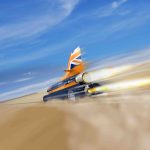
Of these three supersonic pioneers, both Green’s and Baumgartner’s records still hold. The Cold War saw to Yeager’s, as aircraft went ever higher and faster, culminating with the X-15 test program that set speeds of Mach 7. And while Alan Eustace—Google’s Senior VP of Knowledge, no less—broke some of Baumgartner’s records in October 2014 (highest free-fall jump and total free-fall distance), he didn’t go quite as fast. As for Green, he’s actually planning on beating his own top speed with Bloodhound SSC, another Noble project. But to quote Grandmaster Flash, “first is forever.”  Records may come and go, but history will always remember Yeager, Green, and Baumgartner—especially on October 14.

Photo of Jonathan M. Gitlin
Jonathan M. Gitlin Automotive Editor
Jonathan is the Automotive Editor at Ars Technica. He has a BSc and PhD in Pharmacology. In 2014 he decided to indulge his lifelong passion for the car by leaving the National Human Genome Research Institute and launching Ars Technica's automotive coverage. He lives in Washington, DC.
67 Comments