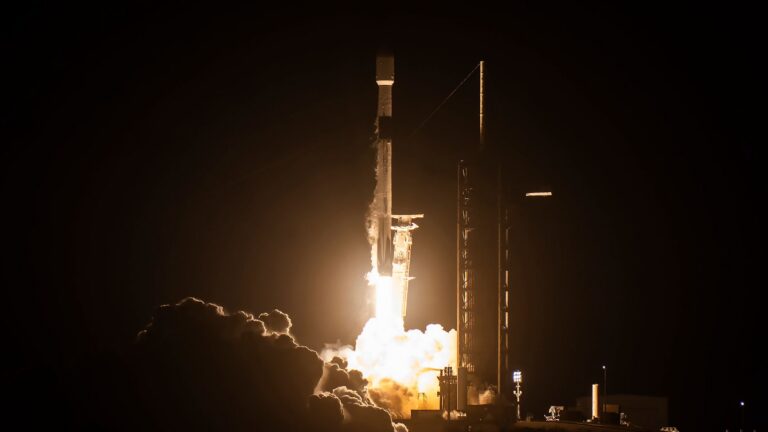
Russia’s space agency successfully launched a robotic spacecraft Thursday on a journey to the Moon, the country’s first lunar explorer since the Soviet Union’s Luna 24 sample return mission in 1976.
The Luna 25 mission lifted off from the Vostochny Cosmodrome, located in Russia’s Far East, at 7:10 pm ET (23:10 UTC). Heading east, a Soyuz-2.1b rocket propelled Luna 25 through an overcast cloud deck and into the stratosphere, then shed its four first-stage boosters about two minutes into the flight. A core stage engine fired a few minutes longer, and the Soyuz rocket jettisoned its payload shroud.
A third-stage engine fired next, then gave way to a Fregat upper-stage to place Luna 25 in orbit around Earth. The Fregat engine fired a second time to send the nearly 4,000-pound (1.8-metric ton) lunar probe on a roughly five-day trip toward the Moon. Russia’s space agency, Roscosmos, declared the launch a success less than 90 minutes after liftoff, shortly after the Luna 25 spacecraft separated from the Fregat upper stage.
This is historic for Russia’s space program. Russia hasn’t launched a lunar mission in nearly 50 years and hasn’t had a mission successfully fly to any other planetary body since 1988, despite several attempts. Thursday’s launch was a major moment for Luna 25, but its departure from Earth on a reliable and proven Soyuz rocket was not the riskiest part of the mission. That will come in a couple of weeks when Luna 25 begins its powered descent toward the lunar surface.
A big lift for a fading space power
Russia would like the Luna 25 mission to rekindle the country’s once-stellar record in the realm of interplanetary exploration. Luna 24, the Soviet-era mission that was Russia’s last probe to land on the Moon, returned lunar soil samples to Earth on a robotic spacecraft in August 1976, nearly four years after NASA’s last Apollo landing with astronauts. That feat was not repeated until China’s Chang’e 5 sample return mission scooped up lunar soil and brought it back to Earth in 2020.



 Loading comments...