Skip to content
Just like us, only different

Neanderthals spread diverse cultures across Eurasia (before we came along)

Two recent archaeological studies reveal a lot more than Neanderthal diets.

Kiona N. Smith | 71
painting showing a group of Neanderthals butchering a slain elephant by the shores of a lake
This artist's conception shows how Neanderthals might have faced down the mammoth task of butchering a freshly-killed elephant. Credit: Benoit Clarys, courtesy of Schoeningen Project
Story text

Two recent studies of Neanderthal archaeological sites (one on the coast of Portugal and one in central Germany) demonstrate yet again that our extinct cousins were smarter and more adaptable than we’ve often given them credit for. One study found that Neanderthals living on the coast of Portugal 90,000 years ago roasted brown crabs—a meal that’s still a delicacy on the Iberian coast today. The other showed that 125,000 years ago, large groups of Neanderthals came together to take down enormous Ice Age elephants in what’s now central Germany.

Individually, both discoveries are fascinating glimpses into the lives of a species that’s hauntingly similar to our own. But to really understand the most important thing these Neanderthal diet discoveries tell us, we have to look at them together. Together, they show that Neanderthals in different parts of Europe had distinct cultures and ways of life—at least as diverse as the cultures that now occupy the same lands.

Neanderthal beach party

On the Iberian coast 90,000 years ago, groups of Neanderthals living in the Gruta de Figueira Brava cave spent their summers catching brown crabs in tide pools along the nearby shore, then feasting on crab roasted over hot coals back in the cave.

Among the stone tools and remains of ancient hearths in Gruta de Figueira Brava, archaeologist Mariana Nabais (of the Catalan Institute of Human Paleoecology and Social Evolution) and her colleagues found numerous shells and claws from brown crabs, a sturdy North Atlantic and Mediterranean species with a carapace that makes it look tantalizingly like a meat pie with legs and claws.

color photo of a reddish brown crab on a black background
Its carapace really does look like a pie crust with perfectly scalloped edges.
Its carapace really does look like a pie crust with perfectly scalloped edges. Credit: By © Hans Hillewaert, CC BY-SA 4.0, https://commons.wikimedia.org/w/index.php?curid=359132

Some of the shells and claws that Nabais and her colleagues found had black scorch marks, which suggested they had been roasted at temperatures between 300° and 500° Celsius; boiling or steaming the crabs wouldn’t leave black marks on the shells, but roasting over coals would. Many claws bore a telltale pattern of damage: They’d been hit with something hard right at the base of their claws, opening long fractures that would be perfect for removing the tasty crab meat.

“The marks seen on the archaeological material are very similar to those empirically produced when eating them today,” said Nabais. Brown crabs are still a popular summertime meal for people in Portugal, Spain, France, and Italy, where the crabs migrate to shore during the summer to breed. Some things haven’t changed much in 90,000 years.

Almost all of the crabs Nabais and her colleagues found at Gruta de Figueira Brava were adult males, toward the larger end of the species’ size range (one 16-centimeter-wide crab can yield about 200 grams of meat, for the record). That points to Neanderthals not harvesting crabs with nets, which would have caught a wider range of animals. Instead, they seem to have treated the tide pools as a Paleolithic version of the lobster tank at a seafood restaurant. Except crabs are quick and dodgy, and the wild ones don’t have their claws tied.

Modern people living on other coastlines, like the Wampanoag in Massachusetts or the Nehalem Tillamook in Oregon, have developed very similar ways of crab hunting. The Wampanoag use spears to bonk Dungeness crabs just behind the eyes, stunning the crabs so they’re easy (and safe) to pick up. In some cultures, that’s usually work for men, while in others, it’s mostly a job for women; we have no way to know how—or if!—Neanderthals divided up their tasks.

But we do know that crab roasts on the beach are a very different way of life than the one we usually picture Neanderthals living. “The notion of Neanderthals as top-level carnivores living off large herbivores of the steppe-tundra is extremely biased,” said Nabais. “Such may well apply to some extent to the Neanderthal populations of Ice Age Europe’s periglacial belt, but not to those living in the southern peninsulas.”

Gathering for the feast

Speaking of Ice Age Europe’s periglacial belt, there’s now evidence that large groups of Neanderthals were working together to bring down elephants along the shores of a sprawling lake. Weighing in at 12 tons and standing 4 meters high at the shoulder, a male straight-tusked elephant would have been about twice the size of a modern African elephant and carried enough meat to feed a group of 25 people for about three months.

painting showing a group of Neanderthals butchering a slain elephant by the shores of a lake
This artist’s conception shows how Neanderthals might have faced down the mammoth task of butchering a freshly killed elephant.
This artist’s conception shows how Neanderthals might have faced down the mammoth task of butchering a freshly killed elephant. Credit: Benoit Clarys, courtesy of Schoeningen Project

Archaeologists unearthed the 125,000-year-old bones of about 70 elephants from the Neumark-Nord 1 site in central Germany about 25 years ago. Other evidence from the area revealed that Neanderthals had lived near the lake at around the same time, during a period just before the last Ice Age when the local climate would have been relatively warm and mild.

Much more recently, archaeologist Sabine Gaudzinski-Windheuser (of the Archaeological Research Center and Museum for Human Behavioral Evolution) and her colleagues examined the bones under a microscope and discovered the faint nicks and cuts left behind by ancient people cutting meat and fat away from the bones. Those cut marks looked similar to the pattern left behind when modern people butcher African elephants today; Neanderthal hunters had cut the meat from the limbs and the ribs, but they’d also gone after the brain, the trunk, and the fatty cushions at the bottoms of the feet.

“These foot cushions… together with the trunk, form a highly prized body part for consumption by recent indigenous elephant hunters,” wrote Gaudzinski-Windheuser and her colleagues. The fatty material also lasts longer before it spoils.

The cut marks also suggested that the elephants had been freshly killed when the butchering started; a scavenged corpse would have had more time to “ripen,” as Gaudzinski-Windheuser and her colleagues put it, which, if nothing else, would make removing large muscles much easier and require less cutting. But all of the elephant bones at Neumark-Nord 1 had lots of cut marks on the long bones of the leg, which means detaching the muscle was probably a lot of work. That’s an #IceAgeWorldProblem for hunters, not scavengers.

Ancient DNA and a few groups of footprints seem to tell us that Neanderthals lived in fairly small groups of around 20 to 30 people. But bringing down enormous prey like a straight-tusked elephant probably would have taken a much larger group working together, and harvesting the meat afterward would have been several days of work even for several people. Modern hunter-gatherer groups often live in fairly small bands, but they also sometimes come together for ceremonies or cooperative hunts, and the Neanderthals at Neumark-Nord 1 may have done something similar.

Gaudzinski-Windheuser and her colleagues calculate that based on the number of elephants unearthed from the site and the ages of the oldest and youngest bones, people probably killed one elephant every three to five years—it would have been a big event, one that would have left even a gathering of 100 people with about a month’s supply of food from a single kill. That kind of gathering would also be the perfect time for Neanderthal communities to exchange marriage partners, trade goods, or swap stories and maybe new technology, just as such meetings are for hunter-gatherers today.

If that’s the case, then a few faint cut marks on elephant bones from central Germany reveal not just what Neanderthals ate but maybe something about their social structure and the big communal events that brought them together (although that part is largely speculation, it has some support from archaeological evidence and modern comparisons).

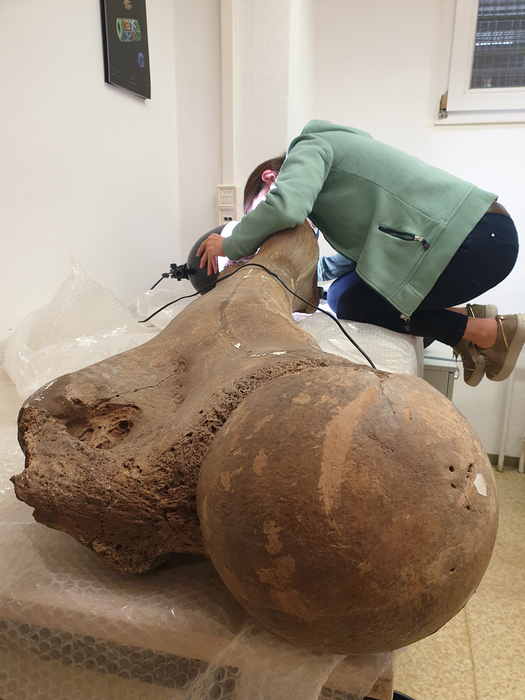
photo of a woman alongside a much larger femur
This is a straight-tusked elephant femur, with archaeologist for scale. Credit: Lutz Kindler, MONREPOS

Long-lost Neanderthal cultures

“It is increasingly clear that Neanderthals were not a monolith and, unsurprisingly, had a full arsenal of adaptive behaviors that allowed them to succeed in the diverse ecosystems of Eurasia for over 200,000 years,” wrote archaeologist Britt Starkovich of the University of Tuebingen in a paper commenting on the elephant-hunting study.

And that’s really what’s important about these two studies. They don’t just tell us that Neanderthals living in different environments ate different foods; they also offer a tantalizing glimpse of the very different cultures shaped by those foods. Archaeologists have unearthed many Neanderthal skeletons, and geneticists sequenced a handful of their genomes. That information tells us that Neanderthals had a complicated population history long before our species arrived on the scene; groups of Neanderthals migrated and mingled for hundreds of thousands of years in Eurasia.

Along with the Neanderthals themselves, we have the things they made and used: tools of wood and bone (and stone) and even a few scraps of plied thread. But for all that, we still know relatively little about their lives, and it’s too easy to picture the whole species—hundreds of thousands of years’ worth of lives, lived from the mountains of Siberia to the shores of Southern Portugal—as sharing one generic “Neanderthal culture.”

In reality, a visitor to Paleolithic Eurasia would probably encounter a diverse range of cultures with distinct ways of making a living, creating art, and explaining the world around them. And in that way, more than in any specific detail, Neanderthals would have been a lot like us.

Frontiers in Environmental Archaeology, 2023 DOI: 10.3389/fearc.2023.1097815;
Science Advances, 2023 DOI: 10.1126/sciadv/add8186;  (About DOIs).

Listing image: Benoit Clarys, courtesy of Schoeningen Project

Photo of Kiona N. Smith
Kiona N. Smith Science correspondent
Kiona is a freelance science journalist and resident archaeology nerd at Ars Technica.
71 Comments