Skip to content
enhanced by proteins

Fresh chemical clues emerge for the unique sound of Stradivari violins

Another study found older, high-quality violins produce stronger combination tones.

Jennifer Ouellette | 92
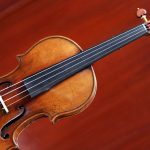
Violin against a red background.
A 1729 Stradivari known as the "Solomon, Ex-Lambert" on display at Christie's in New York in March 2007. Credit: Don Emmert/AFP/Getty Images
Story text

Musicians and music aficionados alike have long savored the rich sound quality of the violins created by Antonio Stradivari, particularly at the dawn of the 18th century (the so-called “golden period”). Scientists have been equally fascinated by why Stradivari violins seem to sound so much better than modern instruments; it has been an active area of research for decades.

A recent paper published in the journal Analytical Chemistry reported that nanoscale imaging of two such instruments revealed a protein-based layer at the interface of the wood and the varnish, which may influence the wood’s natural resonance, and hence the resulting sound. Meanwhile, another paper published in the Journal of the Acoustical Society of America showed that the better resonance of older violins produces stronger combination tones, which can also affect the perception of musical tones.

I’ve written extensively about this topic in the past, and you can read a handy summary of some of the research in this area to date here. Per my 2021 article, the (perceived) unique sound can’t just be due to the instrument’s geometry, although Stradivari’s geometrical approach gave us the violin’s signature shape. One hypothesis is that Stradivari may have used Alpine spruce that grew during a period of uncommonly cold weather, which caused the annual growth rings to be closer together, making the wood abnormally dense. Another popular theory has to do with the varnish: namely, that Stradivari used an ingenious cocktail of honey, egg whites, and gum arabic from sub-Saharan trees—or perhaps salts or other chemicals.

It’s the varnish that has received the most attention in recent years. The theory dates back to 2006 when Joseph Nagyvary, a professor emeritus of biochemistry at Texas A&M University, made headlines with a paper in Nature claiming that it was the chemicals used to treat the wood—not necessarily the wood itself—that was responsible for the unique sound of a Stradivarius violin.

Specifically, it was salts of copper, iron, and chromium, all of which are excellent wood preservers but may also have altered the instruments’ acoustical properties. He based his findings on studies using infrared and nuclear magnetic resonance spectroscopy to study the chemical properties of the backboards of several violins (the backboard is the instrument’s largest resonant component).

More evidence in favor of Team Varnish came from a 2016 study by researchers at the Swiss Federal Laboratories for Materials Science and Technology (EMPA). They studied how a varnish’s chemical composition, thickness, and degree of penetration into the wood affected the acoustics of the instrument. The researchers found that all the varnishes increased the wood’s dampening ability—that is, how well it absorbs and stops vibrations, bringing out a warmer, mellower, and aesthetically pleasing sound. A 2017 study by Taiwanese researchers compared the maple used by Stradivari with modern, high-quality maple wood. Their analysis showed evidence of chemical treatments in the form of aluminum, calcium, and copper, among other elements.

And last year, researchers analyzed trace chemicals preserved in the maple wood used to make the soundboards of Stradivari and Guarneri instruments. The research involved a rare collection of Cremonese wood samples of spruce and maple used by Stradivari, Guarneri, and Amati, and the results were then compared to modern spruce and maple tonewoods, as well as woods from antique Chinese zithers and less exceptional old European violins. They found traces of borax and several metal sulfates in the wood samples dating between 1600 to 1750. “I believe that chemically processed wood was the missing key that prevented us from reproducing Stradivari’s tone,” co-author Bruce Tai told Ars last year.

A closer look at the chemistry

Two Stradivari violins side by side
A highly precise, nanometer-scale imaging technique revealed a protein-based layer between the wood and the varnish coating of these two Stradivarius violins.
A highly precise, nanometer-scale imaging technique revealed a protein-based layer between the wood and the varnish coating of these two Stradivarius violins. Credit: C. Stani et al., 2022

While prior research largely focused on the chemistry of the varnishes, Chiaramaria Stani of the Central European Research Infrastructure Consortium (CERIC) and co-authors were keen to take a closer look at the treatments used before varnishing the instruments to fill the outer pores of the wood. It’s a matter of considerable academic debate since some studies found just a layer of drying oil between the varnish and the wood. Other studies using chemical staining and gas chromatography showed the presence of proteins—most notably animal glue (collagen) found in two early 18th-century violoncellos, and casein found in a 1730 violin. Traces of unidentified proteins were also detected in violins from 1677, 1706, and 1720 using staining tests.

Synchrotron radiation Fourier transform infrared (FTIR) microscopy showed promise for helping resolve the debate, although the team found in an earlier study that it is difficult to disentangle all the variables involved. Stani et al. thought that combining that technique with infrared-scattering scanning near-field microscopy (IR s-SNOM) would provide more useful information about the materials used for the preparation of the ground layer. So they applied those techniques to microsamples taken from the tailpieces of two Stradivari violins: the San Lorenzo 1718 and the Toscano 1690.

The micro-FITR revealed that both samples did indeed have an intermediary layer between the wood and the varnish, but the technique proved insufficient for discriminating between the composition of that layer and the wood next to it. IR s-SNOM involves collecting images mere tens of nanometers wide using a microscope and then measuring how infrared light scatters off both the coating layer and the wood to yield a 3D picture of the kinds of substances present. This revealed that the in-between layer contained protein-based compounds clustered in patches at the nanoscale.

“For the analyzed Stradivari’s violins, proteins are too diluted in the wooden matrix to clearly stand out from the background at the microscale, whereas the nanoresolved approach clearly highlights the local chemical composition,” the authors concluded. They were unable to generalize their conclusions based on just those two microsamples, but their experiments demonstrate that IR s-SNOM could very likely help resolve the protein-based materials debate if used to study microsamples from a greater number of Stradivari instruments.

A question of resonance

an early 18th century Totoni violin
This Tononi violin, made in Bologna in 1700, produced the strongest and most audible combination tones in a new study.
This Tononi violin, made in Bologna in 1700, produced the strongest and most audible combination tones in a new study. Credit: G. Caselli et al., 2022

There is also a new study this week by Italian researchers, who took a closer look at so-called “objective” combination tones produced by five different violins (old and new, high quality and lower quality). Combination tones are what the human ear sometimes perceives when two musical notes are played at the same time. These often are subjective (i.e., psychoacoustic), meaning that different people will perceive their intensities differently—like the auditory illusion known as “Tartini third tones.” (The tones are named after Giuseppe Tartini, an 18th-century Venetian composer and violinist who was the first known owner of a Stradivari violin.)

The Italian team focused on objective combination tones that can be detected by microphones, measured, and recorded since those tones can linger in the air. They brought in a professional violinist to play a series of two-note dyads on the instruments onstage in an auditorium, recording and processing the sounds produced. All the violins produced combination tones, with the strongest coming from a 1700 Italian violin made by the famous luthier Carlo Annibale Tononi, followed by another older violin. More recent, factory-made instruments produced the weakest combination tones.

The authors attribute this to the air resonance produced by each instrument; the older, high-quality violins produced a stronger air resonance, likely due to the materials used to make the violins, as well as the unique manufacturing techniques from the period (including chemical treatments). They plan to expand their experiments to test more violins of even greater variety in the future.

DOI: Analytical Chemistry, 2022. 10.1021/acs.analchem.2c02965  (About DOIs).

DOI: Journal of the Acoustical Society of America, 2022. 10.1121/10.0014600  (About DOIs).

Photo of Jennifer Ouellette
Jennifer Ouellette Senior Writer
Jennifer is a senior writer at Ars Technica with a particular focus on where science meets culture, covering everything from physics and related interdisciplinary topics to her favorite films and TV series. Jennifer lives in Baltimore with her spouse, physicist Sean M. Carroll, and their two cats, Ariel and Caliban.
92 Comments