The thing about a global climate change is that it isn’t as simple as shifting the temperatures everywhere by a set number of degrees. The temperature change isn’t uniform around the globe, and these regional differences can drive considerable knock-on effects on weather patterns.
The Arctic, for example, will warm more than the equatorial region. For our current global warming venture, there will be consequences of this fact beyond the Arctic itself. One juicy hypothesis is that the greater Arctic warming affects the behavior of the polar jet stream, driving significant changes on extreme weather patterns in the mid-latitudes. This idea is the subject of ongoing research, as well as genuine scientific debate and uncertainty.
Lessons from the past
One way to study patterns like this is to look to past climate changes. That’s what a team led by Northern Arizona University’s Cody Routson did, compiling paleoclimate records of rainfall in the Northern Hemisphere over the last 10,000 years.
This spans most of the period known as the Holocene—the warmer “interglacial” that has followed the end of the last ice age. The clockwork timing of the ice ages has been driven by cyclical wobbles in Earth’s orbit, which slightly alter the strength of summer sunlight in the high-latitude north—where most of the great ice sheets were located. That summer sunlight cycle peaked around 10,000 years ago, and Arctic temperatures started to slowly decline shortly after that.
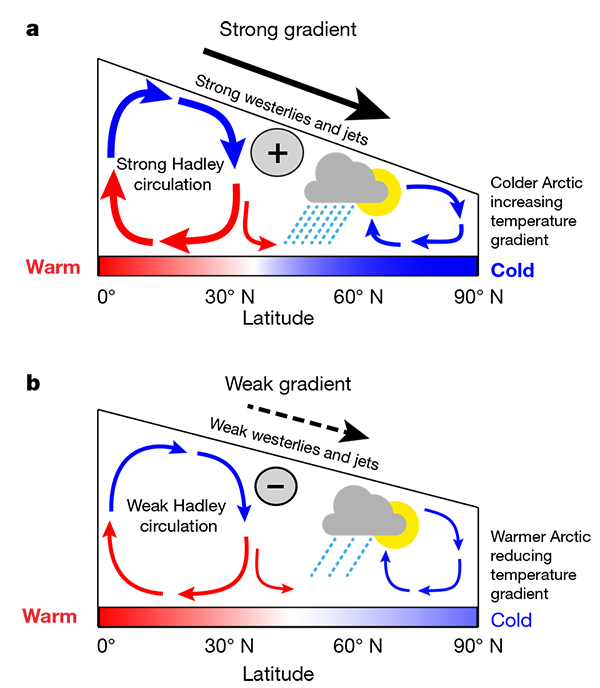
That means that the trend from 7,000 years or so up to the Industrial Revolution was the polar opposite (if you will) of our current human-caused warming trend: as the sensitive Arctic cooled more quickly than the equator, the pole-to-equator temperature difference grew. The question the researchers set out to answer was how this changing pole-to-equator temperature difference affected the amount of precipitation in the mid-latitudes.
To answer, they compiled as many published temperature and precipitation records as possible for the last 10,000 years, based on everything from tree rings to insects found in lake mud. These records were separated into latitude bands from the equator to the Arctic. Based on the temperature data, the researchers were also able to calculate the pole-to-equator temperature difference as it grew over time.


 Loading comments...