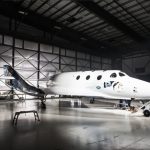
On a clear and cold Thursday morning in the Mojave Desert, Virgin Galactic’s White Knight Two aircraft took off. It carried the VSS Unity spacecraft, which on its fourth powered flight, sought to make the company’s highest and fastest flight ever. It succeeded.
With Mark “Forger” Stucky and C.J Sturckow piloting the vehicle, VSS Unity was dropped from White Knight Two before burning its rocket motor for 60 seconds, reaching a velocity of Mach 2.9 and soaring to an altitude of 82.68km. These were records for the company, which may begin flying space tourists in 2019.
How big of a deal is suborbital flight?
On one hand, it’s difficult to get any rocket to fly high and true. Consider that Virgin Galactic was founded in 2004. It had a basic architecture at that time—an air-launched, rocket-powered spaceship based upon a proven design—and ample funding from a British billionaire. It still took 14 years for the company to make its first spaceflight.
However, suborbital flight is still relatively easy compared to an orbital flight. This is because the energy required to reach orbit, in which a spacecraft is in free fall around the planet, is about 32 times greater than the energy needed for a parabolic flight to an altitude of 100km. So be careful about drawing an equivalence between Thursday’s achievement and NASA’s upcoming commercial crew flights.
What is space, anyway?
This is a great question, because there is no internationally agreed upon boundary for “space.” Probably the closest thing to this comes from the World Air Sports Federation, or FAI, which uses 100km (the Karman line) to delineate the boundary of space for the purposes of establishing world records. However, this organization says it is looking at lowering this boundary from 100km to 80km, due to “Recently published analyses (that) present a compelling scientific case for reduction in this altitude.”



 Loading comments...