A paper published in Nature Energy analyzed the opinions of 163 wind power experts from around the globe and found that they expect the cost of wind energy to fall even further. Those experts said that by 2030, both onshore and offshore wind turbines will get bigger, leading to additional cost reductions and smoother energy generation.
The median response from experts was that wind power cost could be reduced by 24 to 30 percent by 2030 based on the advances in turbine technology that are either projected or already being seen today.
The authors of the study also acknowledge that estimates about wind power cost reductions have generally been conservative in the past—today in some areas wind energy is already competitive with fossil fuels.
The study was conducted by researchers from Berkeley Lab, the National Renewable Energy Laboratory (NREL), University of Massachusetts, and participants in the IEA Wind Technology Collaboration Programme Task 26. They gathered information from experts providing basic “learning curve” assessments based on previous growth and cost projections, as well as engineering assessments that involve “detailed modeling of specific technology advancements.” The engineering assessments are less common than other kinds of forecasts due to the detail and cost they require to complete.
The survey, which the paper suggests is the largest of its kind to date, came up with some interesting numbers.
In 2015, onshore wind turbines averaged a hub height of 82m, a rotor diameter of 102m, and a power output of 2 MW. In 2030, experts on average suggest that onshore wind turbines will have a hub height of 115m, a rotor diameter of 135m, and a power output of 3.25 MW.
Offshore, the story is more dramatic. Where today’s turbines have a hub height of 90m, a rotor diameter of 119m, and a power output of 4.1 MW on average, 2030’s offshore wind turbines will measure 125m and 190m in hub height and rotor diameter, respectively, and output an insane 11 MW on average—each.
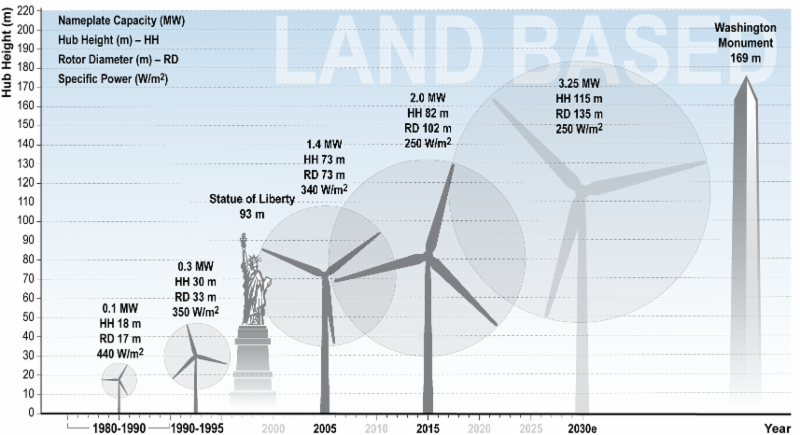
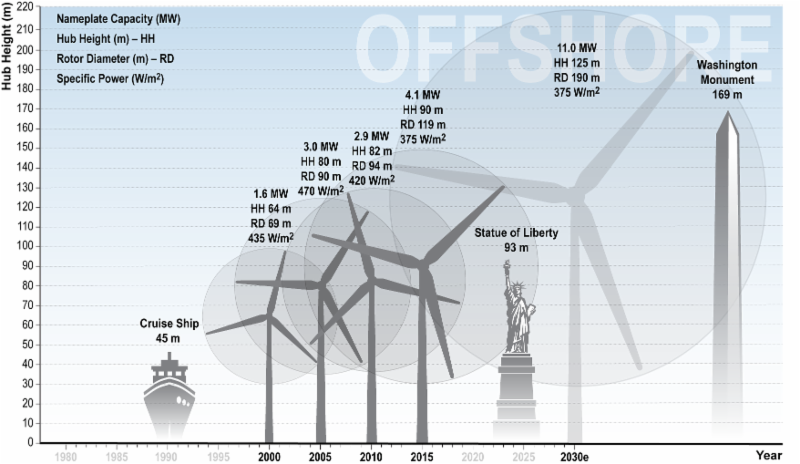
As each turbine gets bigger and produces more energy, the cost of building that turbine will be easier to offset by the power it produces.
The paper’s authors note that currently wind power is supplying 4.3 percent of the world’s power supply, up from less than 1 percent in 2006. The increase in supply was assisted by regulatory policies, but recently wind power infrastructure has become increasingly viable due to technology advancements and economies of scale. With recent global efforts to fight climate change, organizations like the International Energy Agency and Global Wind Energy Council have suggested that by 2040, 6 to 15 percent of global energy production could come from wind, and in 2050 that number could be 17 to 31 percent.



 Loading comments...