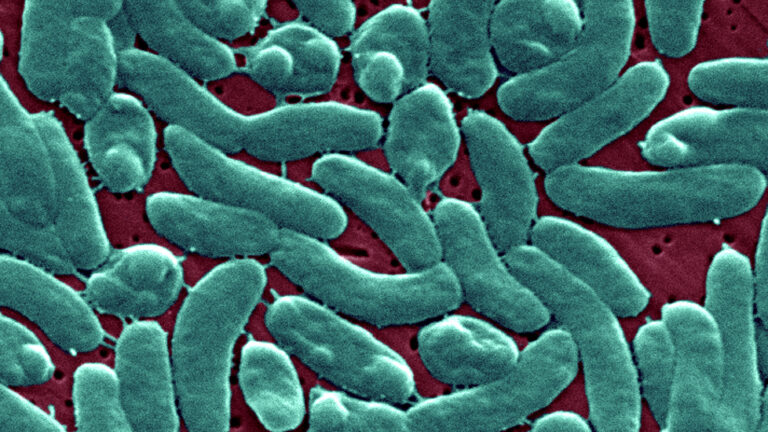
Bacteria are wizzes at developing resistance to our most powerful antibiotics. This unfortunate skill leads to millions of difficult-to-treat infections worldwide and growing fears that bacteria may one day become unstoppable. But these microbes’ evolutionary prowess can just as easily be their downfall, scientists reported last week in Nature Chemical Biology.
By gaming the evolutionary system, researchers have fooled drug-resistant Escherichia coli into tossing their resistance. Then, with a shot of the drug that the bacteria could previously withstand, the E. coli met their end. Though the study was just done in lab dishes, the authors, led by researchers at Harvard, are hopeful that the one-two punch could be useful in reversing drug resistance and restoring the effectiveness of life-saving antibiotics.
This strategy could “add valuable tools to our antimicrobial arsenal,” they conclude.
To pull off the evolutionary bamboozle, the researchers started the study knowing that some types of drug resistance come with exploitable drawbacks. That is, not all drug resistance is equal—and it depends on the type of antibiotic the bacteria have evolved to dodge.
Some antibiotics, such as ciprofloxacin and other fluoroquinolones, work by effectively tossing a wrench into bacterial cell division, while others, such as penicillin and its ilk, sabotage bacterial cell walls, leading to a leaky mess. Still others, such as tetracyclines and aminoglycosides (eg. Streptomycin), foul up protein production in bacteria, bringing the microbes’ essential biological processes to a grinding halt.
Bacteria have evolved clever defenses against almost all types of drugs. Some bacteria have used mutations to mask a drug’s primary target. For instance, some germs resist penicillin by disguising the cell wall component that the drug blocks. Other bacteria have enzymes to degrade specific antibiotics or have actual pumps (efflux pumps) that forcibly toss drugs out of a bacterial cell before they can do any damage.
Occasionally, these resistance strategies arise through new mutations that offer an advantage when a bacterial population gets a non-lethal dose of a drug. However, much resistance stems from already highly evolved and specialized genes that bacteria can share with each other, such as those on transferrable rings of DNA called plasmids or transposable elements, aka “jumping genes.”
Weakness in antibiotic armor
Knowing all the particulars about a bacterial population’s resistance can be key to finding a weakness, the authors argue. For instance, some drug-dissolving enzymes may require a lot of energy to make. Thus, if a bacterium is strapped for resources and in a place where it’s not being bombarded by drugs, it may quickly ditch the plasmid carrying the enzyme’s blueprints. Additionally, there are the resistance genes that inadvertently make bacteria immune to one drug but more sensitive another—a scenario first reported in 1952, dubbed collateral sensitivity.

 Loading comments...