Skip to content
Science

Building an archive on the Moon (and doing science, too)

In theory, an extraterrestrial data archive will pay for some unique science.

Jonathan M. Gitlin | 42
Credit: Lunar Mission One
Story text

Is there a business case that would support a private, unmanned mission to the moon? The people at Lunar Mission One certainly think so. If they’re right, an unmanned lander will touch down on a crater rim near the Moon’s south pole in 2024. Part of the lander will be devoted to scientific exploration, drilling through the regolith into the underlying rock and then analyzing the cores.

Once the borehole is drilled, the lander will fill it with what Lunar Mission One calls “the ultimate time capsule.” This will actually be a pair of archives—one public, containing a digital record of life on Earth, and a second private archive. The latter, with up to 10 million individual “digital memory boxes,” is what’s going to pay for the mission. We recently spoke with David Iron, the founder of Lunar Mission One, to find out a bit more.

Iron has a lengthy background in the space industry, and he came up with the idea of crowdfunding a moon landing after the UK government asked him to put together the case for funding space exploration. Iron said he was thinking about how to persuade people to pay to put their stuff on the moon. “Information is OK, but you’ll only get a few tens of dollars from each person, which isn’t enough,” he told Ars. “It wasn’t until I realized that we can also store hair, because it’s incredibly small and light, that people would pay hundreds of dollars for that, and I realized we had a business case.”

The digital memory boxes will also be able to hold a strand of hair each, so for $300 you can send not just a digital record of your life on earth (or whatever else you want to use those bytes for) but also a copy of your genome. Lunar Mission One’s market research suggests that, globally, there should be sufficient interest in the idea that it will appeal beyond just space enthusiasts. “People have tried to crowdfund space projects before; you can only raise tiny amounts. You will not get the space community and space enthusiasts [alone] to fund something like us,” Iron said.

Indeed, previous attempts to crowdfund a space launch didn’t go well for the Moonspike project.

After drilling the borehole and analyzing the core samples for science, the lander will use its robot arm to place the capsules into the hole.
If you were on the moon in 2014, this might be what you would have seen as the capsules went into the hole.

“The idea of a private archive—your story, your DNA—it’s not everyone’s cup of tea, but it takes us well beyond the space community. We need to prove it properly with sales, which we’ll do step by step,” Iron said.

First was a Kickstarter campaign in 2014, which raised just over $1 million. Next up is a joint mission with Astrobotic, one of the Google Lunar XPRIZE competitors. Astrobotic plans to land on the moon in 2017; along for the ride will be a digital archive from Lunar Mission One.

The project, called Footsteps on the Moon, is part of the outreach strategy. Lunar Mission One is trying to democratize access to our closest neighbor in space. “The concept is that the moon is for everybody, and you can stand on the moon in a virtual way by sending a photograph of your foot to the moon,” Iron said.

Some people will be inspired to do more, spending $25 or so on a private data allocation. In turn, that exposes them to more information about the project. “What they do is then learn about the 2024 mission, the billion-year archive, step by step, which allows us to test the market every year of this eight- to ten-year program,” he said.

Of course, there’s more to Lunar Mission One than just drilling a hole and filling it with digital life stories and some hair samples. There are actually two separate projects of equivalent size and cost. The first is meant to help develop science and technology for space exploration; the second is a crowdsourced snapshot of life on Earth that should outlast everything until the Sun’s gradual decline into old age swells it up into a red giant that eats the moon, the archive, and everything else this side of Mars.

Space science

There are actually three components to the space science: “science of the moon, science on the moon, and science from the moon,” as Iron puts it.

First is the drilling, which ideally will go as deep as 100 meters. This is the most technologically challenging part of the entire mission. Although the Apollo and Soviet unmanned moon landings brought back plenty of moon rocks, “unfortunately, it’s from these boring dark areas called mare where there was volcanic activity, the last bits of the moon to solidify. Where we’re going to dried earlier, and it’s much more broken up,” he told Ars.

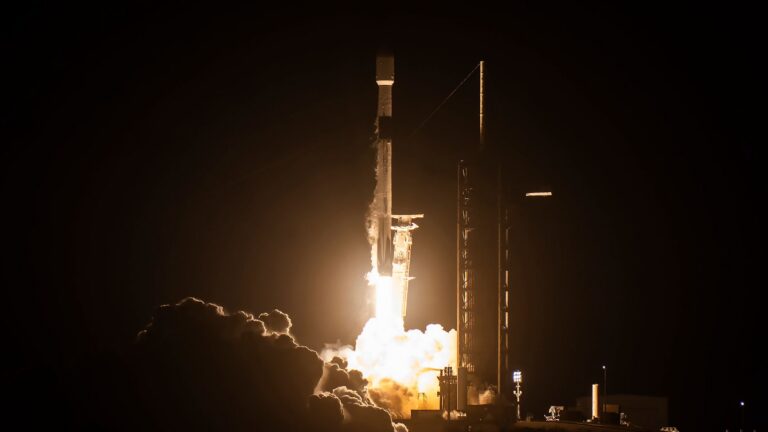
Lunar Mission One has taken a low-risk approach to the launcher, which will be purchased commercially. Iron told us that the SpaceX Falcon 9 currently meets the company’s cost and performance profile. “More and more launches are a commodity,” Iron noted. “From Earth orbit, getting to the moon isn’t actually much harder than geostationary orbit. Slowing down into lunar orbit isn’t that difficult, either. What is difficult is the landing.”

The Apollo missions picked rather boring landing sites on the moon to guarantee NASA’s astronauts the greatest chance of landing safely. The south polar region that Lunar Mission One (and others) are interested in is much rockier by contrast, and the lander will need a much greater degree of precision when it comes time to land. “We’re talking about the size of a football stadium,” Iron said. “That’s never been done before to that accuracy. There are projects underway to improve the navigation which allows that accuracy down to 100m or so, but it hasn’t yet been tested. We don’t think we’ll be the first one, but we might be.”

The lander’s drill will be on an articulated arm, so that it gets more than one chance to drill the borehole.
A rendering of the drill in action.

The idea is to land on the rim of a crater formed during the late heavy bombardment, near the south pole (the European Space Agency has already identified a number of possible landing sites). “What we’re looking at [as the lander drills down into the crater rim] is stuff that’s been brought up and dug out from lower down, sometimes even kilometers of depth, by an asteroid 4.5 billion years ago forming the rim of the crater. That in itself is interesting because it means by going down only a few meters, you can actually pick up rock that originally was kilometers in depth when the moon was first formed,” Iron said.

Although the lander won’t be able to relocate once it’s on the Moon’s surface, the drill will be mounted on a moveable arm so that the project doesn’t end if the first drilling attempt goes poorly. According to Iron, the most difficult part will be the first two or three meters.

“Once you’re below a few meters, it gets easier. The risk is still there, but the risk per meter increases as you go deep,” he said. “If we can’t break the surface properly, we’re expecting the drill to be on an arm, so we’ll drill at a different place within the radius of the arm. We’ll probably get three or four attempts from one landing position.”

Principal analysis of the core samples will be conducted aboard the lander, but provisions are being made to return any particularly interesting pieces back to Earth. From there, the next component is research to inform future manned lunar bases. The lander will test whether plans to use convert regolith into water, oxygen, and fuel are plausible, and it will also measure levels of ionizing solar radiation. This “science from the moon” should give us a better idea of whether low frequency radio astronomy from the far side of the moon is possible.

Imagine a herd of spherical cows

The other big component is the data that will make up the public archive. Here, Lunar Mission One takes its inspiration from the BBC’s Domesday Project (in 1986 to celebrate the 900th anniversary of the Domesday Book, the BBC got schools and communities to survey the UK and catalogue what life was like at the time). “We’re swapping the standalone BBC Micro computers for the Internet and opening it up to the whole planet. It doesn’t take much imagination to realize we’re talking about something that could involve literally tens of millions of school children putting together a record of life on earth. If we can get the BBC Domesday model working worldwide, then we’ll have a fantastic inclusive program,” Iron said. A pilot program is being set up in schools around the world to test parts of the education program in advance.

We asked Iron why Lunar Mission One didn’t plan to just aggregate existing species databases and send that data to the Moon instead. “The problem with existing databases is their data definitions are different,” he told us. “The problem with recording life is that people record what they find, where they find it, when they find it. They don’t record why—the dependencies between the species, the preconditions, and the postconditions for other life.”

Instead, Iron told us the goal is to get enough data to build accurate models. “Weather forecasting has improved enormously since the 1940s when it started, but it’s still got a long way to go. Well, the environmental modeling is even more difficult than that,” he said. However, the database that goes to the moon will just be a first edition. “We worked out it’s cheaper to send another mission up than redesign the lander with a receiver and the ability to update the archive from Earth,” he added.

Given that the archive is meant to last for potentially billions of years, we wondered how Lunar Mission One was approaching the problem of making it readable to whoever discovers it in the distant future. “We can assume they’re intelligent, because they got to the moon, but we can’t presume any knowledge,” Iron explained. “We’ve got to tell them everything—what the archive is and how to read it. The best view we have on it is to have a layered approach, with three or four or five layers, and each layer explains the next one until you get to the point where you can read the archive.” The design of that future proofing, as with almost every other component of the mission, will be outsourced to experts in the relevant fields.

Does all of this add up to a plausible moon shot? We think it might, and Iron is optimistic, although engaging the American public (and industry) will be key. “We tested the market successfully in the UK, but it was seen to be a UK mission. It’s not, it’s a UK idea, but the leadership of the mission is to be defined in the setup phase in the next few years,” he said. Lunar Mission One’s market research suggests that over half its revenue will come from the US, and Iron thinks that the US will play an increasingly large role.

“A lot of the technology will be American; the launcher will probably be American, the drilling will almost certainly be American, based in Houston (the two largest drilling companies in the world are both based there), and the spacecraft will be built there,” he said. “There’s a view that the center of gravity of the project will cross the Atlantic over the next few years or so.”

According to the project’s feasibility study, Lunar Mission One needs at least $750 million to get to the moon. It’s predicting revenue at $4.5 billion, which should be more than enough. “Funding is the main issue now, as we get more and more confident about the funding, we’ll concentrate more on the technology,” Iron told us. “Drilling is the critical part. if it can be done quicker, then we can bring forward the mission launch, if it takes longer, then we delay the launch. The timescale is determined by the drilling.”

Listing image: Lunar Mission One

Photo of Jonathan M. Gitlin
Jonathan M. Gitlin Automotive Editor
Jonathan is the Automotive Editor at Ars Technica. He has a BSc and PhD in Pharmacology. In 2014 he decided to indulge his lifelong passion for the car by leaving the National Human Genome Research Institute and launching Ars Technica's automotive coverage. He lives in Washington, DC.
42 Comments