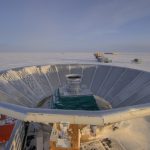
Earlier this year, researchers who used a telescope based at the South Pole called BICEP announced that they obtained evidence for gravity waves caused by the Big Bang itself. The results would provide direct evidence that a model of the Universe’s origin called inflation had left its mark on the present-day Universe.
But in reporting on the results, our own Matthew Francis suggested that the discovery was not as definitive as it might be, writing “the story of BICEP2, inflation, and primordial gravitational radiation is just beginning.” And since then, it became clear that there was a complicating factor—dusty material in our own galaxy—and that the BICEP team’s way of controlling for it left a little something to be desired (it involved using processed data obtained from a PDF used in a conference presentation).
Yesterday, the team that put the PDF together in the first place released its own analysis. And they’ve determined that BICEP was probably staring at dust, rather than the earliest moments of the Universe.
Signs of the big blow up
All of the results hinge on inflation, a theory that nicely explains how the Universe can be both incredibly even—matter is rather spread out through its expanse—yet sufficiently lumpy that we have large-scale structures like galaxy clusters. Inflation suggests that, very early in its history, the Universe expanded at a furious pace. This expansion took small quantum fluctuations and blew them up into the large scale structures we see today.
By looking at the Cosmic Microwave Background, which provides a window into the Big Bang, we’ve found evidence that’s all consistent with inflation. But we haven’t found any evidence of a signal that’s been predicted specifically to be produced during inflation. BICEP was built to search for one.

 Loading comments...