In Zynga’s July 2011 prospectus to future shareholders, company founder and CEO Mark Pincus outlined his firm’s ambitious plan to take over the gaming world.
“My kids decided a few months ago that peek-a-boo was their favorite game,” he wrote. “While it’s unlikely that we can improve upon this classic, I look forward to playing Zynga games with them very soon. When they enter high school, there’s no doubt that they’ll search on Google, they’ll share with their friends on Facebook, and they’ll probably do a lot of shopping on Amazon. And I’m planning for Zynga to be there when they want to play.”
Will it? At the time, Pincus had ample reason for confidence. Zynga was riding high after several years of success. Since its July 2007 founding, Zynga raked in hundreds of millions of dollars in venture capital, launched massive hits like FarmVille, Mafia Wars, and CityVille, and turned a 2010 profit of $90.5 million. It was also on an acquisition binge, picking up 11 companies in as many months between 2010 and 2011.
But even as the prospectus was published, Zynga’s star was losing its luster. For one thing, profitability was an aberration; 2010 was the only year that Zynga made a profit, and since 2008 the company has sustained a net loss of just under $600 million.
Then there was the company’s stock. After the December 2011 initial public offering (IPO) at $9.50 per share, the stock price rose as high as $14.69 on March 2, 2012. It’s been on a steady decline since. As of this writing, the stock price is hovering around $3.00 per share.
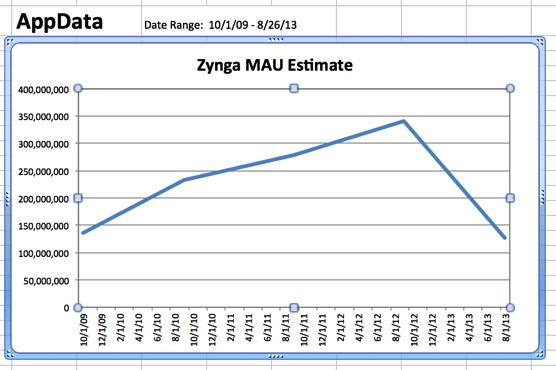
Finally, Zynga has seen a massive erosion of its user base, one that has accelerated in recent months. The industry analysis firm AppData estimates that Zynga’s Monthly Average Users (MAUs) have now fallen below 127 million, the company’s lowest level in four years. And in just a single quarter during 2013, the company lost more than one-quarter of its most loyal daily users.




 Loading comments...