Skip to content
Ars Cardboard

Kingdom Death: Monster is the $400 board game born from bloody nightmares

Massive bosses. Civilization-building. Everyone you love dying for no reason.

Sam Machkovech | 78
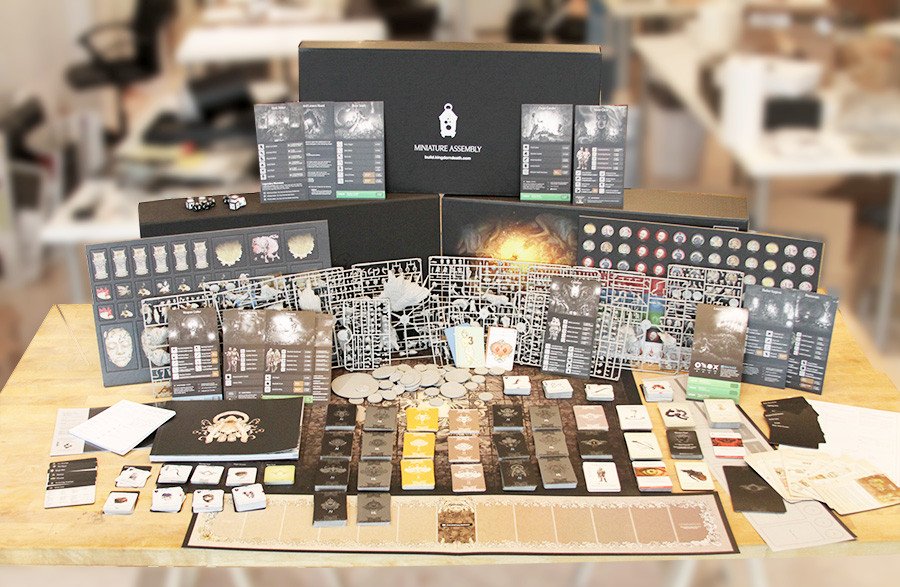
Comes with everything you see here. Credit: Adam Poots Games
Story text
Comes with everything you see here. Credit: Adam Poots Games

You’ll never encounter a more brutal game than the pen-and-paper monstrosity that is Kingdom Death: Monster. Let’s rattle off every one of its negatives:

Its print run is incredibly limited, meaning you can currently only buy the game from eBay resellers. Their insane price hikes make the game’s retail ask of $400 seem quaint.

The box is crammed to the brim with enough content to terrify anybody. There’s a 223-page book, a series of elaborate play boards, a gazillion minis, and hundreds of cards split into dozens of decks.

The minis arrive in pieces. Players are expected to put them together and take them apart throughout the stages of a given campaign.

A full KD:M playthrough, from the beginning of your characters’ village to its end, takes no less than 60 real-life hours, if we estimate a little over two hours of play for every “year” of your campaign’s 25-year lifespan.

Worst of all are the elaborate systems for improving your in-game characters. They would be fine in most pen-and-paper games, but the amount of death KD:M throws at your heroes makes all the build-up feel that much more bittersweet.

Should you count yourself among board gaming’s biggest masochists, however, you’re in for the four-player co-op adventure of your wildest dreams.

Putting the “pro” in “intestinal prolapse”

Let’s add some armor.
Here’s a basic archer.

A few months ago, I received a brief e-mail from my favorite board gaming friend on the planet—the kind of guy who goes to multiple “board game retreats” per year to try out weird new games that haven’t even been translated into English yet. He gets excited about games, but he’s not wordy, so when I saw his brief, big-group e-mail asking anybody to join a KD:M session (“it’s ridiculous and awesome”), I jumped on the chance.

I’d heard whispers about this elaborate monstrosity from my gaming group, framed in an assumption that this whole crazy-sounding thing was Kickstarter vaporware. So I was shocked to hear that we knew someone who’d actually bought it—and loved it. A few days later, I arrived at that friend’s house. That’s when I saw the whole game spread out over his massive board-gaming table.

Surprisingly, there’s a brief way to describe how the game works. At its core, KD:M offers two kinds of gameplay in each of its campaign “years:” a D&D-styled co-op battle against a single, brutally difficult boss monster and a 4X-ish management phase for your warriors’ home settlement after each fight.

The first thing worth understanding about KD:M‘s quality is how it hooks players into its complicated systems so that in each half of the game, players are minding what consequences will play out in the other half. The decisions you make in a bloody battle reverberate in ways that you can foretell to some extent, while the pre-battle management of crafting, shops, skill upgrades, and villagers’ romances offer a lot of “do we take a benefit now or hold out for even bigger stuff later” weighing at all times.

Before all of that, your group of four (and that number is firm) must wake in its first year, mostly naked and weak, to do battle with an out-of-nowhere monster. So long as even one of your warriors survives, he or she will build a settlement whose residents must contend with a new monster every year as part of a lantern festival, though in some years, players will get to choose which monster they hunt. Different monsters drop different, random loot, but certain crucial items, weapons, and armor sets require parts from specific monsters to be crafted, so you have hunt decisions to make.

For example, do we keep fighting the easy monster and try to finish its crafting possibilities? Or do we risk more deaths by facing a monster class we’re not ready for so that we might craft stronger stuff that’ll get us through the required super-boss fights in various years? After all, some years present required bosses by default, while card-based events force other fights to take place when you least expect them.

The battle phase shouldn’t terrify anybody familiar with pen-and-paper RPGs like D&D. Place minis on a board covered in square grids; pick from a set of powers to attack and do other maneuvers; roll dice to determine success or failure. Kingdom Death‘s key difference is in its emphasis on specific body parts. If a monster records a hit on one of your heroes (meaning, a high-enough roll on a d10), it’ll then roll a “damage location” die. Should enough hits land on, say, your waist, you’ll be forced to roll against a mortal-damage chart. The mortal damage charts ranges from a mere knockdown to the lopping of your genitals to an intestinal prolapse—which means your hero can no longer wear “waist” armor—to full-on death.

Expect your heroes to roll against this mortal-damage chart on the regular. Boss characters have no shortage of brutal abilities. Player characters can find themselves in trouble even if they roll a successful “attack” roll, which then requires players to roll against a specific monster card. These sometimes offer perks for rolling a “crit” (usually meaning a 10, though sometimes also a 9), but they also punish players for not rolling a big enough number. Additionally, occasional “hits” turn up a card that says their sword stab, for whatever reason, still gets your warrior in trouble.

That’s all to say that as a KD:M campaign extends over dozens of hours, expect fights that end with only one hero returning to the village to be considered a rousing success.

KD:M‘s version of foreplay: Dice and consequences

Hello, villagers! We have returned from battle with the following loot.
Let’s spend that loot and some of our allowed actions on this not-at-all-complicated looking settlement phase.
A zoom on the kinds of weapons and armor we can produce based on shops we’ve unlocked and loot we’ve gathered.
You’ll come across a LOT of these kinds of dice-fueled decision moments during the settlement phase. They all reverberate over time.

The settlement phase is harder to describe, if only because KD:M wants its players as clueless about its contents as possible. The game’s giant book is full of event descriptions, including consequences that must be accounted for throughout the rest of your settlement’s existence. Pick a side in an innocent-seeming situation in year two, and expect that decision to matter for some reason in year 12. That sort of thing.

Running a settlement includes accounting for all of the loot players picked up (if they lived) during the last battle, combined with a mix of loot-spending and decision-making to reinforce the village. Maybe you’ll expend resources on a few really useful items, or maybe you’ll dump them into creating a new kind of shop, where future resources can be spent on even greater items and bonuses for your warriors. A few giant, descriptive boards and a series of explanatory cards walk you through all of these processes between battles.

Ultimately, you have a limited number of actions during the settlement phase, which can also be spent rolling dice to “use” items within the settlement. One example is a big-ass conga drum that heals your warriors if you roll well enough. This action phase can also be spent on trying to make new villagers via sweet, sweet lovemaking (meaning, rolling dice—and risking the character stats of a male and female in your camp, should you roll badly). Considering how often you face death in the annual hunt, you need to keep your population ample enough to get through the full 25 years. (Should your warriors live long enough, they begin to suffer age-related ailments.)

The hardest part about KD:M is how badly things can go in the settlement phase, which includes mandatory calamities that your group faces while marching towards its next hunt. Pull the wrong card or roll the wrong dice, and you can take out two of your best warriors in one fell swoop. The game is tuned with pain and hardship in mind—yet it’s clear the game’s designers realize this, because certain surprising cards trigger at the most terrifying moments to turn the tide in your favor. My group’s first harrowing battle saw us face an attack that would bludgeon its victim to death, thanks to it granting the boss awfully generous dice rolls. Should the victim not die from this specific attack, players are instructed to grab a special card. We’re still talking about the results of that crazy moment.

There’s a certain board-porn glimmer to KD:M that is hard to ignore. If you like the idea of gluing all of the game’s plastic minis together—and being able to augment your minis as a campaign progresses by attaching plastic weapons and armor—then you’re in for mini-fueled heaven. KD:M‘s humans and monsters have been printed with the utmost attention to detail, and you do get around $400 of value out of how much detailed, customizable content is packed into the box, so long as you don’t mind doing the assembling and painting. (Worth noting: Your weapons and armor are typically not wiped out, so you can keep your glued-together armor minis in one piece and put them onto your next generation of soldiers, which helps with the game’s most frustrating moments, at least.)

More surprising is how well the game’s many systems line up with each other. Kingdom Death: Monster could have just been printed as an excuse to sell its handsome art book, killer boards, and lovely minis. But there’s a damned good game in here, so long as your group isn’t disheartened by constant death. That’s no small asterisk: my KD:M group has been disbanded ever since a heartbreaking settlement phase wiped much of our progress.

I really want us to resume, however. I love the memorable moments that arise from KD:M‘s many interlocking systems. I love the feeling that our warriors have survived, faces soaked in blood, to overcome another year’s monstrosity. I love that we’re so invested in our settlement’s growth and advancement that something like a warrior wipe devastated us emotionally. I want to live out my lantern years with my brothers and sisters, all swollen with wounds and intestinal prolapses. I want to see the campaign to its end.

78 Comments