Skip to content
Gaming

Batman v Superman: The Showgirls of superhero films

Dreadful acting and incoherent plotting fill the year’s biggest Batmobile wreck.

Sam Machkovech | 340
"Bats, sweetie, listen. You need a breath mint." Credit: Warner Bros.
Story text
Spoiler warning: Our review of Batman V Superman contains minor plot spoilers, but little beyond what you can figure out from the film’s trailers.

Kids have spent decades arguing over which of DC’s two major superheroes, Batman and Superman, would prevail in a fight. That’s all well and good for a schoolyard, but the bigger question might be why the stars of this week’s Batman V Superman: Dawn of Justice would find it necessary to wage war. It’s the question I kept coming back to as I watched director Zack Snyder do his damnedest to trash both heroes’ legacies in one fell swoop.

Viewers will have many opportunities to mock, belittle, and cringe at his take on DC Comics’ ultimate fan service fantasy, as Batman V Superman suffers from painful dialogue, flat acting, humorless characters, and baffling plot leaps all over planet Earth. Perhaps worse than all of those shortcomings, however, is how Snyder hangs his film’s 2 hours and 40 minutes runtime on the most unconvincing superhero disagreement imaginable.

What a scattershot plot

Blue lens flare: check.
Blue lens flare: check. Credit: Warner Bros.

Metropolis’s across-the-bay distance from Gotham City is emphasized at the outset of Batman V Superman—where, apparently, one of Bruce Wayne’s colossal office towers stands. Gotham’s finest (played this time by Ben Affleck) flies in a helicopter across the bay to check on things during the events of 2013’s Man of Steel—meaning, he’s catching the tail-end of Superman and General Zod’s massive battle from that film. Wayne arrives just in time to see his Metropolis tower come crumbling down.

Wayne runs toward the wreckage and finds a man trapped under a block of concrete who is screaming about his legs. The victim somehow stops being concerned long enough to look at Wayne and exclaim, “You’re… the boss, boss.” Seconds later, Wayne finds a little girl who has appeared at the fallen tower seconds after its collapse yet looks totally unscathed. “We’re gonna find your mom,” Wayne says, although there’s no apparent reason to believe that she’s looking for a parent (let alone a specific parent).

Next—wham—the camera cuts to “somewhere in the Indian Ocean.” A pair of children discover a statue’s head underwater and drag it up to give to a haggard-looking white man, who smashes it to reveal a bunch of glistening green crystals (assumedly, Kryptonite). But before we can get our globe-trotting bearings, the film warps its viewers to Nairobi, where Lois Lane (played by Amy Adams) dramatically snarls at a robe-wearing man holding a machine gun and camping out at an apparent terrorist stronghold. “I’m not a lady, I’m a journalist,” she says. Within minutes, Lane’s intrepid photographer is revealed to be a CIA agent, nearly everyone gets shot, and Superman magically appears—giving a knowing nod to Lane before plowing into her captor and saving her life.

Forget Lyft, Lois. Superman will give you actual lifts whenever you need anything in this film.
Forget Lyft, Lois. Superman will give you actual lifts whenever you need anything in this film. Credit: Warner Bros.

Confused yet? Good, because now we’re sitting in a Congressional hearing in the United States, where an angry senator screams about this whole Nairobi event and blames Superman for deaths—even though barely any Americans were apparently involved. “He answers to no one,” Senator Finch (played by Holly Hunter) grumbles. “Not even, I think, to God.” Who in the US military greenlit this Nairobi mission? What was the point of Lane going there? Dunno, but this film needs to establish Superman hate somehow.

The next five scenes, which whip by in roughly 14 minutes, feel just as scattershot. Lane relaxes in a bathtub while arguing with Clark Kent (played once more by Henry Cavill) about the seriousness of their relationship and the number of people who died in Nairobi (“I don’t know if it’s possible… for you to love me and be you”), which he magically dispels by handing her a rose and kissing her in the tub. (Really, she laughs the whole thing off.) Then we’re whisked to a creepy underground dungeon filled with over a dozen enslaved women, where we follow a policeman on his way to finding a tied-up perp—and an apparent sex trafficker—while Batman hangs out perched on the ceiling, apparently waiting for the cop to show up before grimacing at said officer and vanishing.

It’s tiring enough cataloguing those scenes, but they don’t even get to the latest incarnation of Wayne’s butler Alfred—now a philosophical mechanic (played by Jeremy Irons) who prattles about “what turns men cruel”—or the aforementioned legless man devolving into a fatalistic conspiracy theorist. There’s also the first appearance of Lex Luthor, played by Jesse Eisenberg.

If the film’s insistence on hopping from scene to scene doesn’t make you feel disoriented, Eisenberg’s shockingly bad turn as a villain will. While comparisons between this film’s super-rich tech billionaire and Eisenberg’s recent turn as Mark Zuckerberg seem obvious, Batman v Superman doesn’t contain any of the neurotic nuance that made The Social Network a pretty solid film. Here, Eisenberg’s arsenal of expression is limited to two maneuvers employed ad nauseum: making his face twitch and shrieking loudly. The result looks like a freshman college student who got really high, saw Heath Ledger’s Joker, and got inspired to join a local improv group.

Frank Miller’s Batman—but with none of the good stuff

Affleck can lay claim to the title of “best actor in this film,” which isn’t saying much. He’s hamstrung by a pretty sloppy Batman conceit. Despite the film opening with an overlong, slow-motion-laden flashback to both his parents’ death and the resulting funeral (which sees him, I kid you not, fall into a giant well and then get lifted up by a swarm of bats while holding a Jesus Christ pose), we’re fast-forwarded to a grown-up Bruce Wayne who simmers with rage, blames Superman for his tower’s collapse, and thinks it’s fine to shoot and kill people.

Snyder wastes time on that opening sequence alongside two overlong Wayne dream sequences full of dripping blood, flying monkey-soldiers, and other bizarre visual nonsense. In terms of letting viewers into just why the heck Wayne has become such a gruff, unlikeable anti-hero, however, Snyder provides a lot more “tell” than “show.” We get Frank Miller’s version of Batman but with none of the requisite, tension-loaded buildup; Snyder is too busy dabbling in ham-fisted dream metaphors to make us believe in this bat.

Making friends wherever he goes. Credit: Warner Bros.

Additionally, Wayne never gets any further evidence about Superman’s evils than that one tower collapsing—and, uh, wasn’t that Zod’s fault? That’s still all the Dark Knight needs to feel hell-bent on… hijacking Lex Luthor’s plot to kill Superman (using the recovered Kryptonite from earlier, obviously). Meanwhile, Clark Kent’s day job at the Daily Planet sees him investigating Batman’s whole stop-the-sex-trafficker story. Once Kent is sent some Polaroids revealing that Batman burnt his batarang-shaped brand into the perp’s skin, he’s convinced that Batman has gone too far.

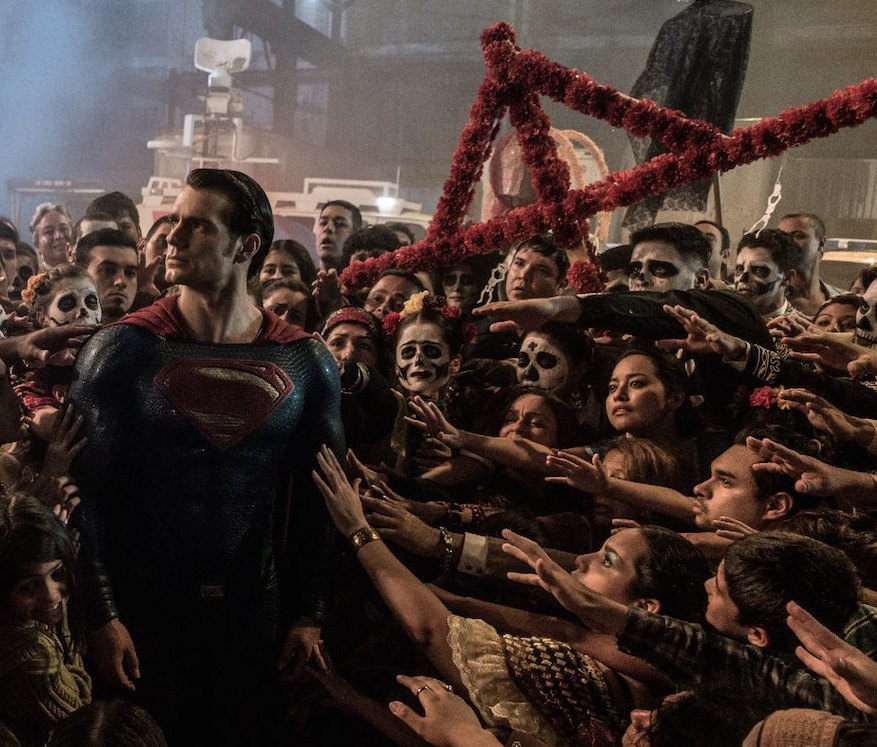
Batman V Superman stretches itself too thin trying to follow two leading heroes along separate plot lines, and it tries to make up for this failing by leaning heavily on known archetypes. But the film also breaks those archetypes just enough to leave us confused. We get no explanation for why this Batman is so willing to murder people or why he’s so bad at hitting on women, not to mention why Superman is so selective about what atrocities he’s going to stop—like when he bails on a crucial Luthor-related showdown to save a single little girl’s life in South America. (This bizarre scene, by the way, ends with Superman carrying this girl to her family while roughly 60 Latino onlookers fawn in slow motion, pawing Superman and looking upon him like their eyes are rolling backwards in their heads.)

Each hero’s justification for taking down his rival is so laughable that the film’s resolution—the point at which Batman and Superman look each other in the eyes and essentially mutter, “Can’t we all just get along?”—sees the conflict break apart like a knife through butter. This whole movie’s conceit is so stupid that Snyder winds up using that fact as a scriptwriting asset.

The heroes’ separate plot lines take way too long to solidify into anything sensible enough to follow, and the same could be said for the tossed-in attempt at connecting hatred of Superman to American jingoism. Thankfully, that metaphor never really takes despite Snyder filling his film with a ton of real-life talking heads trying to make the point for him, including Anderson Cooper, Charlie Rose, and Neil Degrasse Tyson. (Poor Neil. He, out of everybody in this movie, deserves better than to be associated with this Batmobile wreck.)

The film’s substance otherwise boils down to one-liners, which are all either delivered flatly or over-dramatically. Amy Adams may very well have turned in the most forced performance of her career here, with lifeless declarations such as “there’s no halo over my head,” while Affleck has to fake his rage left and right with such comic book throwaway lines as, “Do you bleed? You will.” (I could also list a zillion bad Eisenberg quotes, all delivered with the grace of a bad kid’s commercial actor, but that’s punching down at this point.) The only actor who comes away unscathed is Gal Gadot, whose turn as Wonder Woman mostly involves her looking steely faced and mysterious.

Wonder Woman kicks serious ass in her Batman V Superman scenes. Pity they’re so brief.
Wonder Woman kicks serious ass in her Batman V Superman scenes. Pity they’re so brief. Credit: Warner Bros.

The best part of the film comes nearly two hours in, at which point Batman and Superman finally trade blows. The battle sees the film pick up some much-needed momentum and consistency, which it then maintains into an immediate follow-up fight sequence. This climax, more than any of the other half-hearted action sequences (which suffer from a lack of intriguing Batman toys) or jarring plot jumps, nearly offers a worthwhile payoff. It’s the kind of over-the-top, Dragon Ball Z-styled combat that Marvel’s best films in recent memory haven’t quite pulled off, so hats off to Snyder for that accomplishment.

But Marvel’s latest masterworks have all been careful to make sure its characters are believable—and likeable—enough within the framework of the film. In contract, Batman V Superman essentially asks viewers to look for figurative, “see Man of Steel #42” captions as if this were some overly referential comic book. This film depends on the hammiest dialogue and zaniest plot turns ever seen in a tentpole superhero film, and those qualities can make it enjoyable—if you’re into trashy camp a la Showgirls, Sex In The City 2, or any of Mystery Science Theater 3000‘s finest.

I look forward to the inevitable live-commentary screenings of Batman V Superman, the ones in which catty hosts squeal and twitch alongside Eisenberg, deadpan with Adams, and strike out with women right next to Affleck. Until then, steer clear—or synchronize your watch to show up in time for the final action sequences, then bail before BvS‘ horridly cheeseball, sequel-setup ending kicks into gear.

Listing image: Warner Bros.

340 Comments