Skip to content
Gaming

From DJ Hero to Guitar Hero: How Freestyle is making rhythm games sexy again

This is not the Guitar Hero I grew up with.

Mark Walton | 30
Story text

Freestyle Games’ Jamie Jackson hands me an odd, beige coloured slab of plastic, a shrunken facsimile of semi-hollow Gibson 335 guitar. It’s non-functional, but it’s easy to see where the six buttons spread over two rows at the bottom of the fret board are meant to be. On the body there are several knobs, along with the familiar strum bar of the Guitar Hero series. Made during rapid prototyping on a 3D printer, the brittle guitar (I’m warned not to drop it several times) never made its way into full production. With plans for pearl inlays, multiple non-functional knobs, and gold-coloured detailing resulting in the guitar costing over £60 ($100) just to manufacture, it was deemed too expensive by the powers that be at Activision.

At one stage, Guitar Hero Live—the first new Guitar Hero game since 2010’s Warriors of Rock—didn’t even have a guitar controller. Early prototypes used console camera systems in an attempt to turn drunken air guitar (admit it, we’ve all done it) into a game. Unsurprisingly, it didn’t work. But this was all part of the process, a “washing off of what Guitar Hero was,” as Jackson tells it. Other prototypes would follow, including the first iteration of what would become the Guitar Hero Live guitar, which was made out of the plastic trunking that lines the walls of Freestyle Games’ Leamington Spa studio, and some buttons ripped out of an old controller.
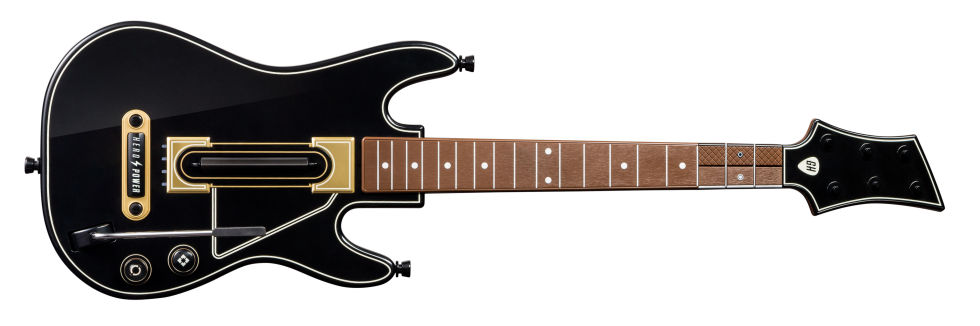
The final version of the Guitar Hero Live guitar.
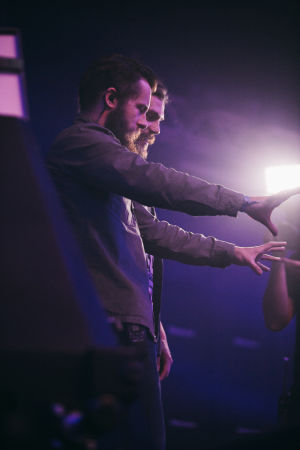
Freestyle Game’s Jamie Jackson (left) on the set of Guitar Hero Live.

This wasn’t an entirely foreign process to Freestyle Games. As the studio behind the cult classic DJ Hero, it had been down a path of rapid prototyping before. Many of the original prototypes for DJ Hero were built inside Jackson’s garage, the product of smashed up Guitar Hero controllers and some shoddy soldering. By building a guitar out of trunking—something that would later become known as the “Frankentar”—the team could easily toy with different configurations, moving the buttons around to mess with the fundamental mechanics of the series. By switching to two rows of three buttons, the awkward pinkie presses of old—something even real guitar players have a hard time with—were removed, making gameplay more accessible, but also allowing for the introduction of new, complex chord shapes.

This was the breakthrough moment. Paired with some basic graphics—a “1980s Atari type thing” I’m told—the basic gameplay of Guitar Hero Live was born. Oddly enough, Jackson didn’t see the magic at first. “I’ll be totally honest with you: when the team presented it to me and Dave Osborne the design director, we looked at it and were like ‘what the fuck are you doing? You can’t change the buttons!’” explained Jackson. “But then we sat down and played it, and thought ‘that was really cool, we take it back.’” The end result is a game and a guitar that’s comfortingly familiar, yet very different to the Guitar Hero games of old.

While notes still stream in from the top of the screen to the bottom along a note highway, now there are two different colours for notes: black for the top row of buttons and white for the bottom. Even for those that were Guitar Hero pros, this presents quite the challenge, particularly as chord shapes are introduced. Pushing down across a single row represents most power chords, with extensions on the bottom row adding in higher notes. Songs with open chords ape classic fingerings like the three-finger spread of an open C, or the claw-like grip of a G.

Despite this added complexity, the game remains true to its Guitar Hero roots. You still activate star power by tilting the guitar (or hitting a button by your palm), while jiggling on the whammy bar to add vibrato to those extended notes for extra points. The retail design of the guitar—the final product from all of Freestyle’s prototyping—also maintains the same distance between the buttons as in Guitar Hero guitars of old, while also sporting a similar profile and body shape. It was very nearly bigger, though, like that earlier beige prototype. But Freestyle got its way with at least one love-it-or-hate-it aesthetic decision: the flashy gold highlights remain.

A game of two halves

It’s the sole addition of bling to a game, and a studio, that prides itself on being—for want of a better word—real. It’s hard to imagine a game on the scale of Guitar Hero Live, which is attached to one of the biggest games publishers on the planet, being made in such humble surroundings by a team of such personable human beings. But there’s evidence of Live‘s impending release scattered around the studio: meeting rooms filled with computers and TVs for last-minute play testing, and computer screens in the kitchen that stream debugging information for Guitar Hero TV, the game’s ambitious always-on music TV service.

While the note highway is only three notes wide, there are two different colours for notes: black for the top row of buttons and white for the bottom.

In another room a team of musicians—most without any games industry experience—create note highways in MIDI software. They show me how, for each of the six buttons on the guitar and the open strum bar, there’s a line of MIDI information for the note highway. Programming the timeline is as simple as clicking to input a block of MIDI information. The musicians start with the expert level—a note-for-note transcription to Live’s six buttons—before stripping out notes to accommodate less skilled players. A peer review process ensures that, despite the missing notes, the song’s basic rhythmical structure remains. When the song needs to be play-tested, potential note highways can be exported to a PC version of the game in seconds.

Elsewhere there are sound designers bashing out some Judas Priest on expert, testing the game’s 70/30 (front/rear) 5.1 surround mix, while upstairs there’s a newly formed analytics team amassing gigabytes of data on what songs people are playing, and how often they’re being played. With a team of 180 people behind the scenes, it’s a complex operation for a complex game. Divided into two parts—the online music video channel Guitar Hero TV (more on that later), and the offline campaign Guitar Hero Live—development at the studio is split down the middle: the former got a crash course in running a TV station, while the latter became film directors.

Live‘s high-concept aesthetic, that of “stage fright,” has resulted in a look that’s quite unlike the Guitar Hero games of old. Instead of staring at an oddly animated 3D band, you get a full, live-action sequence of walking through Spinal Tap-like winding corridors of the backstage area, past the stage hands, and the groupies, and your fellow bandmates, before leaping up onto the stage in front thousands of adoring fans. Eventually, when the song gets underway, you’re provided with an an eerily accurate first-person representation of playing the guitar in front of a live audience.

The live-action footage looks modern in a way that even the most well-animated of 3D models never could, but for a studio used to pixels and polygons, it presented a huge technical challenge.

Technical difficulties

To capture the first-person perspective of a real-world performance, the studio started with a helmet-mounted camera. A jib, mounted on the camera operator’s back, helped position the camera atop the helmet, which bore most of the weight. It was unwieldy, and heavy, requiring two runners to walk alongside the camera operator in order help him walk along the stage to perform. After just half a day of filming, the first camera operator left. The second iteration of the helmet cam was far smaller, this time made with the camera mounted centrally, along with a display placed in front of the camera operator’s eyes so he could frame the shot. While aesthetically effective, it proved difficult to use. “Try walking down the street with your iPhone in front of your face switched onto camera mode. It’s really weird,” chuckled Jackson.

Neither solution solved Freestyle’s biggest problem: how to smoothly cut between a good player performance, with the band and the crowd pumped up, and a bad player performance, with the band and the crowd telling you to get it together. Freestyle could help alleviate the problem with sharp scripting, getting the band and the crowd to recreate their movements as best they could between different takes. But getting a shot-for-shot take from the camera operator proved impossible. The solution was to use a robotic, fully programmable camera. It settled on a high-tech rail-mounted MRMC Bolt high-speed Cinebot and a RED Digital Cinema camera, a system already used by several Hollywood blockbusters to great effect.

The Bolt high-speed Cinebot in action on stage.

“The Bolt is great for on-stage action, and that captures our entire performance,” explained Jackson. “Not only did it give us the frame-for-frame shots—everything is exactly the same—but it gave us a lot of help with building the 3D backgrounds [which fill in the green screen sections]. We could start building the 3D backgrounds straight away, we could start to get into it, we knew where everything was. If you’re tracking off of a handheld camera, you’ve got to track every single frame. Having the 3D data of the camera that you can put into the software straight away, it already gets you the majority of that tracking, as you start to line stuff up with the frame.”

To drive the Bolt, bands were brought down to a warehouse in Oxford for motion capture sessions, with recreations of the stages they would eventually perform on. Leon—Freestyle’s star camera operator who would also go on to film the handheld backstage shots for the game—took the place of the Bolt, filming with a virtual camera that could pick up the 3D mo-cap data of the band. Combined with the studio’s pre-made 3D environment, a screen mounted on top of Leon’s camera cleverly allowed for each shot to be framed exactly as it would look in the game, with every bit of 3D information being captured for later use with the Bolt.

Each band’s ability to follow direction and replicate a performance down to an individual strum was crucial to the success of each shot, not only for the end result, but also for safety. “Imagine a one and a half ton robot hitting someone in the head,” says Jackson. “If it hits you in the face it’s gonna really fucking hurt. We had this big pink section printed out that was called the ‘killzone,’ which basically meant ‘don’t be in here!’ Apparently I nearly got clocked by [the Bolt] on the last day of filming. It missed me by about half an inch.”

Musicians were put through strenuous auditions, not helped by the fact they had no clue as to what they were auditioning for. Some musicians were brought in by their agents; others brought whole bands with them. Performances ranged from the brilliant, to the admirably enthusiastic (read: horrifying), filling the small auditioning room beside London’s Liverpool Street station with the sound of cranked Marshall stacks and pounding kick drums. Those deemed worthy were grouped with other musicians to form impromptu bands. Group performances were fastidiously analysed, with band members being shuffled around often in order to find the natural musical connections that would translate well onto film.

To make sure they looked the part, hundreds of hours of research was ploughed into different musical genres, filling the studio’s already stretched meeting rooms with various bits of musical paraphernalia. T-shirts, posters, and album art dating back an imaginary 10 years were designed for each band, building out what would become their signature looks. The same work was applied to the fans. At a metal gig players will see metalheads wearing band t-shirts and jumping around in mosh pits, while at folk gigs they’ll see families dancing.

Broken Tide, one of Guitar Hero Live‘s fictional bands.

“For Broken Tide [one of the bands] we did 15 years worth of album covers,” says Jackson, “right through to their first where their mate did it in a garage, so it’s a bit shit, but actually it’s cool as fuck, and that’s the hard t-shirt to get hold of. That’s our love of music. You’ll probably see us walking around in band t-shirts from our game from now on. Fright Hound are my favourite. The amount of people that have asked me ‘who’s that t-shirt from?’ And I go ‘Fright Hound,’ and they go ‘I fucking love those guys!’ And I’m like ‘Yeah, sure, me too man.'”

But even though the bands were styled, and the fans were dressed, logistically, it was impossible to replicate the feel of a 100,000-strong crowd at a festival without actually holding a festival. Instead, Freestyle combined the real-life footage with some modern digital trickery courtesy of Framestore, the Oscar-winning VFX house behind the likes of Gravity, Guardians of the Galaxy, and Edge of Tomorrow. Each band and audience was shot in front of a giant green screen, with the backgrounds and deeper crowds of each shot filled in with 3D assets that Freestyle designed.

Shots are made up of layers of CG crowds in front of of CG trees, covered with CG lights. The sound booth in the background of one the larger festival stages is CG, so too is the delay tower. But whether it’s the quality of Freestyle’s assets or the “pretty button” that Framestore used when it mashed them all together with the green screen footage (although I’m told Framestore was used just as much for its rendering power as its artstic talents), the live footage is seamless.

Looking back at the whole process, Jackson said the only major problem during filming was caused by a music licensing snafu, where they licensed tracks ad hoc while filming was taking place. “We were finishing filming Christmas eve on this particular set,” explains Jackson. “We had a really crammed week; we actually filmed 10 days back-to-back with no break. And we had to do a set dress and change to this other set. And the day before filming we got a phone call saying ‘they’re out.’ But we’d done everything. All that process we showed you, the motion capture, the rehearsal, everything, they were like ‘no, it ain’t gonna happen. They’ve decided last-minute they’re not in.’ We were like, motherfuckers. So literally overnight we had to re-think how we could fix it.”

“It was a really shit idea,” Jackson concedes. “It was made even more tense because the entire Activison executive committee had decided to come and visit that day, so we had Eric Hirshberg [CEO of Activision publishing] and everyone there, and someone asks me ‘everything all right?’ And I’m like ‘yeah, sure, everything’s good, you go out for dinner. We’ve just got to fix this minor problem.’”

Video killed the radio star

As one half of Freestyle got to grips with becoming film makers, the other was wrestling with turning the concept of downloadable content on its head. The old Guitar Hero and Rockband games were all about DLC. Ask any games journalist what their most hated bit of e-mail spam was at both games’ peak, and they’ll probably tell you it was the weekly DLC updates; the seemingly never-ending list of random songs that both games had managed to score a licence for that week. But the DLC model was sound. Audiences were used to buying individual tracks from stores like iTunes, so it was never that much of a stretch to ask them to buy a track for Guitar Hero. Arguably, they were getting more value from it too, thanks to the time put into the note transcriptions.

For those not connected to the Internet—which was around 60 percent of console owners at the time, Jackson says—there were the retail releases. Over a five-year period from 2005 to 2010, Activision released 12 console Guitar Hero games across various platforms, plus three handheld games for Nintendo DS. Most people will tell you that this glut of new releases led to the eventual death of the series in 2010; at the very least, it can’t’ve helped. But the answer is likely more nuanced than that, a combination of an oversaturated market, stale gameplay, and a global recession that saw priorities shift away from paying £100 for a plastic guitar and some songs, to putting food on the table.

By 2008, Activision was churning out Guitar Hero games as fast it could, including artist specific versions like Guitar Hero: Aerosmith.

Activision certainly played its part by releasing sequel after sequel, year after year, but it was one of the best ways of delivering new content to players without an Internet connection, or the will to download DLC—at least in Jackson’s opinion. But it’s a model that almost certainly wouldn’t work these days. The rise of streaming services like Netflix and Spotify have put a serious dent in the idea of paying to own a movie or a song, which is an interesting turn of events when you consider the fuss everyone made when the world was asked to drop physical disks thanks to iTunes. Nevertheless, the trend in music industry is towards rental, not ownership. And it’s this very trend that led to the creation of Guitar Hero TV.

Freestyle’s solution to delivering new content to players is oddly old school in a way, a throwback to the days when MTV still played music and was  an important part of a band’s promotional activities. At launch, Guitar Hero TV will be a pair of music video channels playing shows like “Most Played Rock Anthems,” or simply just “Rock,” showcasing a range of tracks that Freestyle has picked out. Players will be able to jump into GHTV, tune into their favourite show, and then start playing along to the music. Gameplay is entirely dynamic, in that players will be able to jump in and out of a song as often as they like, with the note highway appearing and disappearing along with them.

Automatic leaderboards that appear at the end of each song will rank players against friends or other top players, while rewards such as customised note highways and new types of star power—including a bomb that can be used to blow up a particularly tricky section—can be earned by completing certain challenges. It’s surprisingly compelling, and it’s easy to imagine leaving the GHTV channels on during a party as Jackson envisages, jumping into a song after a few drinks. The beauty of GHTV is that Freestyle can constantly add to it, dropping in new shows and new songs as and when they can, all without players needing to download anything. Even the bands themselves were keen to take part.

“What we found was that the music companies were just stocked that they had an outlet for their music videos again,” says Jackson. “The idea of the whole idea of the MTV Generation being the reason why you needed a music video has just gone away. All of a sudden [bands] are like, ‘fucking hell, we can get our videos out there now, this is rad.’ So we actually got a really good response from [bands], because not only are we getting the music out there, but we’re also getting the band out there, and what they look like. If you look at music now, most bands make their money from live concerts and driving people to go and do that. It was a lot easier to do GHTV than it was convincing them to let us mix two songs together like it was in DJ Hero, that’s for sure.”

But GHTV doesn’t come without compromises. For all the content that’s free on its two main channels, there’s a bewildering array of virtual cash and coupons and provisos required to use the rest of it, which of course can be substituted for real cash. Credits, Hero Coins, and Play tokens make up the three types of currency, but Freestyle and Activision are keeping suspiciously quiet about exactly how they’re earned other than saying “through gameplay,” or how long it takes to do so. If players hear a song they really like on GHTV, they can jump into a master list of songs to play it (separate to the songs on disk that can accessed any time you like), but it costs them a Play token that’s earned either via converting credits or coins, or by paying an as-yet-undisclosed fee.

Essentially, Freestyle is turning everything into a rental, and with it, turning Guitar Hero into a service. Recommended tiles will pop up with new shows and songs that match existing play history, pushing players to spend more of their hard-earned play coins, while Premium Shows will showcase new music from one more artists before it hits the main channels. Players will be able access Premium Shows without spending either in-game currency or hard cash by completing challenges, but the option to buy access will be there, tugging at your wallet. Just like the trend for music has been towards streaming, the trend for games has been towards a “freemium” model, and Guitar Hero TV is moving with it.

Some will lament Freestyle Games for that. Others, an arguably much larger proportion of players, probably won’t even notice. There’s also the option to purchase a “Party Pass,” which unlocks all of the game’s content for an as-yet-undisclosed amount of time, and for an as-yet-undisclosed amount of money. But it’s the balance between how quickly virtual currency is earned, and how much of it players will need to unlock content that will determine GHTV’s success. For now that remains a mystery.

Freestyle certainly needs it to succeed. It has, over the past four years, slaved over Guitar Hero. It has crafted new aesthetics, fundamentally changed its gameplay mechanics for the better, learnt how to become a film studio, and soon it will be running an online TV network, fighting against what will no doubt be a freemium backlash from core gamers. For a games developer started by ex-Codemasters programmers that wanted to make racing titles, it’s quite the achievement.

“I’ve been doing this fifteen years, and just because you make a game that reviews well doesn’t mean it’s going to sell well and vice versa,” says Jackson. “DJ Hero reviewed amazingly well, but it came at a time when the genre was stalling a bit. We still sold shit-tons of copies, but it wasn’t shit-tons enough. There’s always a worry. Any developer that tells you otherwise is talking shit, because you never know. You can only put your heart and soul into it and give it your best. I’m not gonna sit here and tell you it’s gonna be amazing—it is amazing, but who fucking knows right? We’ve done the best we can do; we’ve made the best Guitar Hero anyone could have asked us to make. We’ve changed the gameplay, we’ve changed the way it looks, and we’ve brought GHTV out, and I’m immensely proud of all three of those things.”

“I know there’s scepticism about what we’ve done with Guitar Hero, but we’re trying to be a business and make money and we have to do that, otherwise there isn’t a game. But we had to do that in a way that allowed freedom for people, so that they felt they had value. We just didn’t 100 percent believe in the value of the old DLC model, and that there was a different way to do it. Our mind set was ready for that different way.”

The question is: is everyone else?

Guitar Hero Live launches on PlayStation 4, PS3, Xbox One, Xbox 360, and Wii U on October 23 in the UK for £79.99, which comes with one of the new guitars. It launches in the US on October 20 for $99.99. An iOS version is due to launch at a later date.

Photo of Mark Walton
Mark Walton Consumer Editor
Mark is Consumer Editor at Ars Technica UK by day, and keen musician by night. He hails from the UK, the home of ARM, heavy metal, and superior chocolate.
30 Comments