Skip to content
Gaming

Nintendo offers a vague, confusing, unfocused vision for its future

Smartphones, platform unification, and “health” all feature in turnaround plan.

Kyle Orland | 170
Story text

The briefings Nintendo gives following its quarterly earnings results are usually relatively dry affairs, filled with charts of worldwide gaming hardware breakdowns and canned enthusiasm about upcoming game releases. But with the company flailing both financially and in terms of consumer market mind share of late, it was clear something different was in order for Nintendo’s latest briefing to press and investors.

The briefing Nintendo President Satoru Iwata gave at Tokyo’s New Otani hotel on Thursday was a wide-ranging affair, outlining a broad vision for Nintendo’s future in the short and longer term. The presentation was full of interesting ideas, living up to previous hints from Iwata that a “new business structure” might be necessary for the company. Still, the lack of details or a specific focus to the remarks left us with the impression of a company that’s throwing everything at the wall in a desperate attempt to find something new that will stick with consumers.

For Wii U, marginal improvements

Iwata used the conference first to quiet down any suggestion that Nintendo would be giving up on the business of releasing its own game-playing hardware. “We do not hold a pessimistic view of the future of dedicated video game platforms,” he said. “We therefore believe that dedicated video game platforms which integrate hardware and software will remain our core business.”

Instead, Iwata said, Nintendo will once again attempt to sell the value of the Wii U GamePad in creating unique gaming experiences (a message we’ve heard time and again from the company). Iwata announced that Wii U owners will soon be able to download and play Nintendo DS software on the living room console. In addition, a system update this summer will introduce a “Quick Start” menu that will allow players to start games more quickly from the GamePad. In Japan, players will soon be able to buy games by tapping their Suica subway card to the near-field communication chip in the GamePad.
While admitting that the Wii U is in a “very difficult position,” Iwata said that a price reduction on the hardware is “not an option” given the company’s current financial situation. It’s true that Nintendo was on much more secure fiscal footing when it decided to jumpstart 3DS sales with a drastic price cut in 2011. Regardless, it’s pretty clear that the decision to get that portable hardware into players’ hands by any means necessary has paid off in the long run now that the 3DS is doing respectably in both hardware and software sales.

There’s always the risk of throwing good discounts after bad systems, but simply adding new features to the Wii U at the margins seems unlikely to improve the system’s fortunes going forward.

A token nod to smartphones

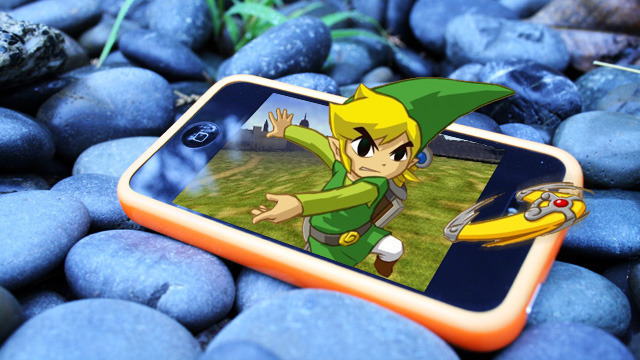
Still just an artist’s conception… and likely to remain one. Credit: Photo illustration by Aurich Lawson

The bulk of Iwata’s presentation, though, dealt with “redefining the concept of a video game platform.” In part, that means acknowledging that Internet-enabled smart devices are “once again chang[ing] our definition of video games to keep up with the times,” Iwata said. But the company president reiterated that this does not mean Nintendo will simply be bringing its stable of games to iOS and Android.

“In order to be absolutely clear, let me emphasize that this does not mean simply supplying Nintendo games on smart devices,” he said. “We feel that simply releasing our games just as they are on smart devices would not provide the best entertainment for smart devices, so we are not going to take any approach of this nature.”

Instead, Iwata said he has devoted a “small, select team of developers” to create software focused on “achieving greater ties with our consumers on smart devices.” The presentation was light on details, but Iwata said he hopes Nintendo’s smartphone apps will be “capable of attracting consumer attention and communicating the value of our entertainment offerings” and let consumers “engage with our offers frequently.”

Those goals sure make it sound like Nintendo’s big, bold move into smartphones is going to be… a social marketing app. Rather than offering smartphone games to compete directly with the myriad gaming experiences already on smartphones, it sounds like Nintendo wants to use mobile apps merely as a way to make people aware of and interested in buying the games the company makes on the Wii U and 3DS. That probably means mobile game trailers, “offers” like regular coupons, and the ability to purchase games when you’re away from your Nintendo console.

There’s nothing wrong with that kind of idea in and of itself, but it sounds more like a token acknowledgment that smartphones are a good place to run ads than a reflection that mobile gaming has revolutionized the market in the last few years. It’s a marketing move that lives on smartphones but doesn’t really address how mobile games, in Iwata’s own words, are “chang[ing] our definition of video games.”

There is a danger of pre-judging this effort, of course, and Iwata said we should all wait and “see how our approach yields results.” Iwata also noted that he has “not given any restrictions to the development team, even not ruling out the possibility of making games or using our game characters” in mobile apps (“However, if you report that we will release Mario on smart devices, it would be a completely misleading statement,” he quickly added).

That suggests Nintendo may be able to surprise us with a mobile app that does more than simply hocking Nintendo’s existing consoles in a new ad medium. Still, the language Iwata used to talk about the company’s mobile foray does not give us high hopes.

Ill-defined platform integration

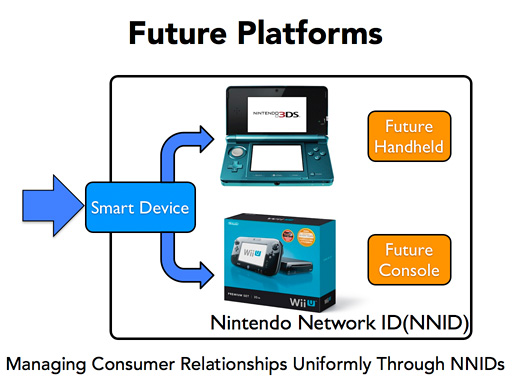
An illustration of how Nintendo sees the future of its unified, platform-agnostic “platform.” Credit: Nintendo

Another part of Nintendo’s “redefinition,” according to Iwata, is removing the link between a “platform” and specific hardware. Instead, Nintendo wants to create a relationship with consumers that carries over across various systems. The Nintendo Network ID is central to this ability, Iwata said, as a way of letting the company “connect with our consumers based on accounts, not devices.”

Iwata pointed out that the company added the ability to link an existing Wii U Nintendo Network ID to a Nintendo 3DS last month, and it’s taking steps to allow people to manage and access their Nintendo accounts through smart devices. But aside from those vague notions of “connection,” the presentation was very light on actual consumer benefits that will spring from this new hardware-agnostic, account-centric approach. The only concrete advantage mentioned, in fact, was the ability to “offer flexible price points to consumers who meet certain conditions.” That is, if you buy more games through your Nintendo account or share those games with friends, you could be offered a discount on future game purchases.

That’s a fine marketing gimmick, we suppose, but it pales in comparison to the kind of cross-hardware integration that’s being championed by the likes of Sony. On the PlayStation platform, it’s not uncommon to buy a game on the PlayStation 3 or 4 and get a free copy of essentially the same game to play on your Vita (or vice versa). In the PlayStation universe, a single subscription to PlayStation Plus gets you an impressive selection of free games every month on every piece of PlayStation hardware you own. Sony’s ecosystem also integrates things like cloud saves, trophies, leaderboards, and even online gameplay and chat (not to mention Remote Play) across its portable and console systems (and often across generations).

Contrast that with Nintendo’s “platform,” where you have to pay twice to buy identical Virtual Console games separately on the 3DS and Wii U, where you have to pay money to “upgrade” your existing Wii Virtual Console purchases to be playable on the Wii U GamePad, and where buying a 3DS XL means transferring all the games you’ve downloaded for your original, smaller 3DS in a way that makes them unplayable on the older system (and don’t get me started on the headache of transferring purchased games from the Wii to the Wii U).

It’s nice that Nintendo is making an effort to increase the natural synergy between its console and portable hardware. The steps it has made in this direction thus far, though, amount to crawling, while companies like Sony are already sprinting. It’s going to take more than an occasional discount for buying in bulk to really sell customers on Nintendo’s newly integrated “platform.”

A pivot to “health”

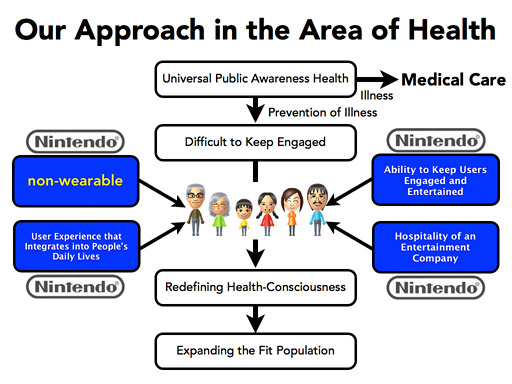
If you can follow this flow chart, you probably understand Nintendo’s bold move into a new market better than us. Credit: Nintendo

The rest of Iwata’s remarks continued the theme of offering few details for sometimes confusing corporate moves. He talked about “actively expand[ing] our character licensing business.” That seems difficult to do effectively, given the company’s already extensive list of existing licensed products ranging from toys and clothes to iPhone cases and duct tape. The suggestion that Nintendo might start to license its characters into “digital fields” was more intriguing, but it is limited by the fact that those products “are not in direct competition and we can form win-win relationships.” In other words, we’re more likely to see a new version of Mario Teaches Typing than a Mario platform game made by Naughty Dog or something.

Iwata also gave over a sizable portion of his presentation to Nintendo’s coming expansion into the world of health. More than toe-dipping efforts like Wii Fit, this expansion into an entirely new field was described as a “blue ocean” move focused on “providing preventive measures which would require us to enable people to monitor their health and offer them appropriate propositions.” There were hints of new portable hardware devoted to this kind of health monitoring (though Iwata stressed that it would be “non-wearable”) and game-like attributes to keep users engaged.

Nintendo’s whole “health” plan as described so far is so amorphous that it’s hard to evaluate in any real way. Still, this kind of radical diversification is a bit unsettling to consumers that want Nintendo to remain focused on what it does best: making great games. It’s easy to see this new health focus as a kind of lifeboat, an effort for Nintendo to grab a foothold in a new market in case its standing in the established video game market continues to deteriorate. At the very least, launching such a massive new undertaking seems likely to take some of Nintendo’s attention away from reviving its core video game business.

In the end, that lack of focus seemed to characterize everything Iwata offered up in his remarks. Throughout his presentation, Iwata mentioned only a single upcoming game, Mario Kart 8, saying its May release might help bring some gamer attention back to the Wii U. Sure, this wasn’t a gamer-focused Nintendo Direct presentation, and the investor-heavy audience was likely looking for bold business ideas and not more just new sequels. Still, it would have been nice to hear some indication that Nintendo is trying to use new software to dig itself out of the hole it’s currently in. Instead, we got a mish mash of vague, confusing, and unfocused ideas that seems ill-equipped to provide the kind of turnaround Nintendo needs.

Listing image: Casey Flesser

Photo of Kyle Orland
Kyle Orland Senior Gaming Editor
Kyle Orland has been the Senior Gaming Editor at Ars Technica since 2012, writing primarily about the business, tech, and culture behind video games. He has journalism and computer science degrees from University of Maryland. He once wrote a whole book about Minesweeper.
170 Comments