Skip to content
Where can I put in an application?

Google loses two execs: one for Messaging and Workspace, another for Payments

Two executives in charge of Google’s most turbulent products are leaving this week.

Ron Amadeo | 151
Story text

Google had a pair of high-ranking executives leave this week. The first was Bill Ready, Google’s “President of Commerce, Payments & Next Billion Users,” who left to become CEO of Pinterest. The second big departure is Javier Soltero, who was vice president and GM of Google Workspace, Google’s paid business app, and was the leader of Google Messaging. Both executives made big changes to Google in their nearly three-year stints at the company. Now that they are leaving, it’s unclear what the future of their respective products holds.

Ready was only at Google for two-and-a-half years, where his highest-profile move was presiding over the disastrous rollout of a significant Google Pay revamp. The new Google Pay app was spearheaded by Ready’s payments team, led by another recently ousted executive, Caesar Sengupta. The Google Pay revamp brought an app originally developed for India to the US, where the requirement for phone number-based identity came with a huge list of downgrades: The Google Pay website had to be stripped of payment functionality, the app no longer supported multiple accounts, and you couldn’t be logged in to multiple devices.

The rollout of the new app was also clumsy. Slowly, over a month or two, users were kicked out of the old Google Pay and had to transition to a new app. The new identity system wasn’t backward compatible with the old Google Pay, though, which meant users still on the old app couldn’t send money to users on the new app.
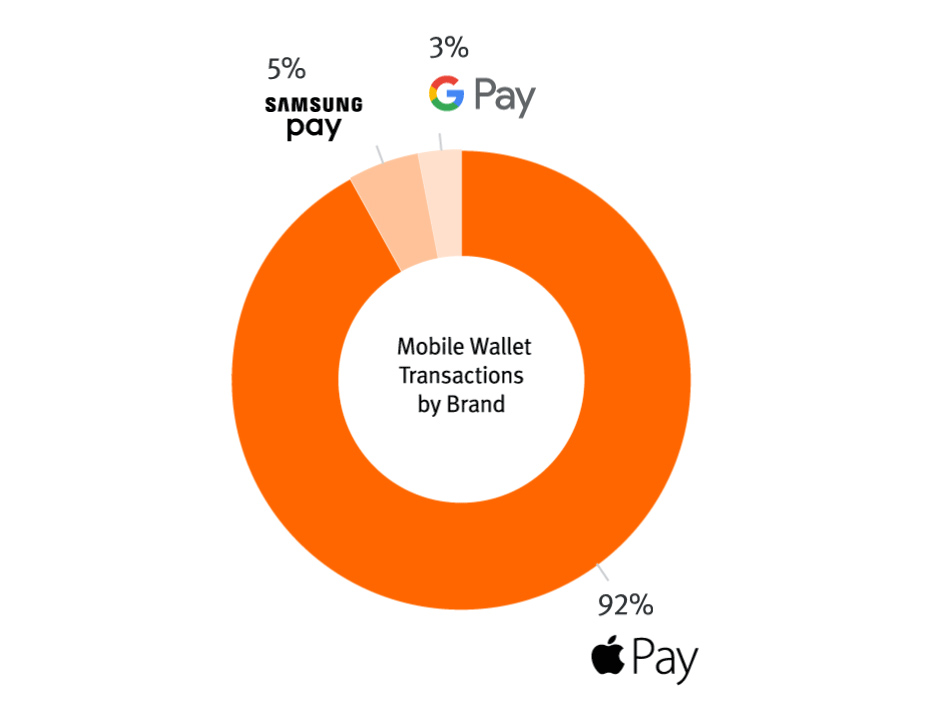
According to Pulse network (a wing of Discover card) Google Pay has 3 percent of the entire US NFC market. Keep in mind Google entered this market years before Apple. Credit: Pulse Network

The new Google Pay was announced one year into Ready’s tenure at Google and launched in March 2021. The app initially came with big plans for expansion, including a wild announcement of Google-branded bank accounts. Sengupta left Google one month after the US launch of the new Google Pay, which triggered an “exodus” of employees, according to Insider. The report said, “Dozens of employees and executives” left the payments team after Sengupta’s departure, with one employee saying there was “frustration” the new Google Pay “wasn’t growing at the rate we wanted it to.”
What happened afterward seems like a complete scrapping of the original “New Google Pay” game plan. Google generally launches a product in the US first and then slowly rolls it out to the rest of the world, but after the initial poor reception, the new Google Pay never saw a wide rollout outside of the US. Google canceled its heavily promoted plans for a Google bank account, even though, according to the Wall Street Journal, the company already had 400,000 curious users sign up for the public waitlist.

Ready appointed a new leader of Payments this January, a move Bloomberg described as a “reset” of Google’s payments strategy. Ready also made headlines at the time by saying, “Crypto is something we pay a lot of attention to,” though no Google product has emerged.

Four months later, at Google I/O 2022, another revamp of Google Pay was announced, re-branding the product to “Google Wallet.” That’s right, after a big revamp of Google’s payment app in 2021, there’s now another new revamp in 2022. Ready is now leaving five months after appointing a new Payments lead and setting these plans in motion, but he won’t be around for the launch of Google Wallet. Between the departure of old Payments lead Sengupta, Sengupta’s boss, Ready, and “dozens” of team members, it sure seems like the payments team ended up cleaning house.

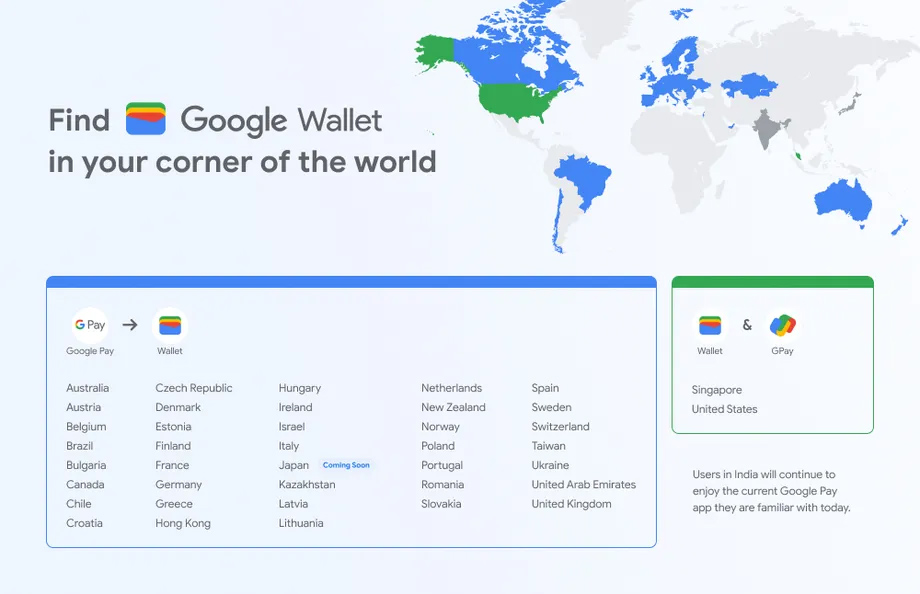
This nightmare of a map has the US with Google Pay and Google Wallet co-existing, while the rest of the world gets a cleaner solution of one payment app: Wallet. Credit: Google

At the heart of Google’s payments turbulence is probably the fact that most estimates put Google Pay at 3-4 percent of the US NFC payments market, which is way behind Apple’s nearly 92 percent market share. It’s an embarrassing loss considering Google was a pioneer in NFC payments and entered the market three years before Apple.

A big part of Google’s payment problems is this kind of instability, with Google’s payment app running through four different brands in 10 years (Google Wallet, then Android Pay, then Google Pay, now Google Wallet again). It still doesn’t seem like the company has arrived at a great solution with the new Google Wallet. The current plan—which could change once Ready’s replacement is hired—is for Google Wallet and Google Pay to co-exist in the US. In the rest of the world, there will be one payment app, Wallet, which sounds like a clean, reasonable offering. In the US and Singapore, though, Google doesn’t want to kill the widely panned new Google Pay app, so Google Wallet and Google Pay will be available. Why? If Wallet is rolling out to the rest of the world, the codebase clearly has the full payment feature set, why not just roll it out everywhere?

Google is still searching for a VP to replace Bill Ready, but the interim Payments president will be longtime Googler Nick Fox. Fox was previously front and center in the Google tech landscape as the head of Google messaging when the company produced Google Allo. Allo was Google’s main messaging app from 2016-2018, lasting about 576 days on the market. Since Allo, Fox has been running Google Search.

Next out the door: Javier Soltero, head of Workspace and Messaging

Speaking of Google’s messaging mess, the other big exec to leave this week is Javier Soltero. Soltero was head of Google Workspace, but he more frequently made headlines as the head of Google’s six communication apps.

Soltero was handed Google’s pile of messaging apps in the wake of Zoom’s meteoric rise during the COVID-19 pandemic, which Google completely missed out on. Google had already mastered group video chat nine years earlier with the 2011 launch of Hangouts video chat, but Google’s absentee leadership and constant need to churn communication products meant no decent video chat product was ready for 2020’s explosive video chat demand. By April 2020, The New York Times was writing about how Google and other rivals had completely lost to Zoom and relayed this incredible anecdote from a Google meeting:

Late last month, Philipp Schindler, Google’s chief business officer, held a videoconference with thousands of the search giant’s employees using Google Meet, three people who attended the call said. During the session, one employee asked why Zoom was reaping the biggest benefits even though Google had long offered Meet.

Mr. Schindler tried placating the engineer’s concerns, the people said. Then his young son stumbled into view of the camera and asked if his father was talking to his co-workers on Zoom. Mr. Schindler tried correcting him, but the boy went on to say how much he and his friends loved using Zoom.

About a month and a half after this meeting, Soltero was named messaging cat herder with the mandate of creating a “more coherent vision.” It was now his job to make sense of Google Hangouts, Chat, Messages, Voice, Meet, and Duo.

Under Soltero’s leadership, the video apps are arriving at what sounds like a solid conclusion. Google announced in June that Google Duo and Google Meet would merge, leaving Google with one true video app to try and recapture the red-hot group video chat market. On the text side of things, before Soltero joined Google, plans were already in motion to shut down Google Hangouts, and now it sounds like that might happen by the end of the year. Google Chat launched for consumers under Soltero’s watch, with the confusing mandate to go after Slack, the world’s leading business messaging app, and support existing Google Hangouts users as a consumer-oriented service. It still is not a viable Slack competitor.

Even when Hangouts shuts down, that leaves Google Chat, Google Voice, and Google Messages as a confusing lineup of three similar messaging apps that only co-exist because they use different back-end protocols. Google Chat is the successor to Hangouts and the most “Googley” chat app: It uses a Google account for authentication and works on almost anything that connects to the Internet: phones, tablets, laptops, desktops, browsers, etc. Google Messages is a more carrier-oriented offering that uses SMS or RCS. It uses your carrier phone number for identity and only sends messages via your primary phone. Google has tried to drag SMS/RCS into the Internet age with hacks like QR code-powered message forwarding website, but that still runs through your phone and isn’t as convenient or flexible as a native Internet service. Google Voice, meanwhile, gives you a phone number from Google and lets you access SMS and phone calls over the Internet.

Screenshot of email interface.
The new Gmail design. You can see a chat pop-up in the bottom left.
The new Gmail design. You can see a chat pop-up in the bottom left. Credit: Ron Amadeo

Running three messaging apps doesn’t seem like a great solution, and Google Hangouts, Google’s best messaging app, once combined Google’s over-the-top messaging service, SMS, and Google voice into a single client. That seems like the best possible solution for a “coherent vision,” but Google messaging doesn’t seem that ambitious anymore.

As for Google Workspace, Soltero presided over the launch of Google Workspace, the fourth re-brand of Google’s business app suite. (By my count, it was “Google Apps for your Domain,” then “Google Apps for Work,” then “G Suite,” then “Google Workspace.”) Soltero previously worked at Microsoft, where he had relevant experience running product strategy for Microsoft Office. For Workspace, Soltero sought to combine Google’s various productivity apps into a more cohesive offering, resulting in the new Gmail design. The redesign launched in February (and is switching to the default soon!) and is a wild productivity turducken combining Gmail, Google Chat, Google Docs, and Google Meet into a single interface.

Soltero’s Workspace tenure seems to have been a success, with a report from Protocol saying, “monthly active users of Google Workspace have grown more than 50 percent over the last three years.” The report cites an internal Google email saying Workspace’s VP of engineering, Aparna Pappu, will take over Workspace. There’s no word on who’s in charge of messaging now.

Photo of Ron Amadeo
Ron Amadeo Reviews Editor
Ron is the Reviews Editor at Ars Technica, where he specializes in Android OS and Google products. He is always on the hunt for a new gadget and loves to rip things apart to see how they work. He loves to tinker and always seems to be working on a new project.
151 Comments