Skip to content
Tech

A review of the $10 Walmart phone—better than nothing, but not by much

We bought an LG Sunrise for the low, low price of $10. We regret it.

Ron Amadeo | 286
We traded the thing on the left for the thing on the right. And yes the display really looks that bad in real life.
Story text
The back has a grid texture, once of the few luxuries on a $10 phone.
The top houses the earpiece and sensor cluster. There’s no front facing camera, though.

The other day we were rather shocked to hear that Walmart was selling a pre-paid smartphone for ten whole dollars. When we saw the device was running Android, we just had to see what it was like. So we walked into our local store, plunked an entire $10 bill down on the table, and walked out with a rough facsimile of a smartphone. Meet the LG Sunrise.

This is not our first trip into the masochistic world of ultra-cheap smartphones. We previously reviewed the Intex Cloud FX, a $35 smartphone that ran Firefox OS. The Cloud FX had a ton of problems, but for us the most limiting thing was FireFox OS. It couldn’t run any benchmarks or our battery tests, making the device a $35 slab of uselessness that could occasionally render a webpage without crashing. The Sunrise is packing something much more familiar though: Android. It’s only running Android 4.4 KitKat, but that’s a lot better than Mozilla’s app-less browser OS.

We should mention that while we walked into a Walmart and spent only $10 on this device, it was on sale. Various carrier models have the MSRP of the Sunrise listed for $40-$60. We should also mention that this $10 deal is for a locked prepaid phone. If you want to have cell service on this device, it has to be with TracFone unless you want to unlock it somehow. You could also just never get service and have a $10 Wi-Fi device.

The specs look like something out of 2007: a 3.8-inch 480×320 display, a dual core, 1.2GHz Snapdragon 200, 512MB of RAM, 4GB of storage, and a 3MP camera. Everything here aims to fits the most basic definition of each component rather than living up to any kind of performance standard. The camera, for instance, technically records some kind of image based on the light that enters the lens, but we wouldn’t call that image “good.” The display is a grid of squares that can change colors to represent text or images. There is even a speaker that can create several different noises.
But hey, it’s $10! You’ve got to lower your standards appropriately. If your other option is nothing, there is actually a lot the Sunrise can offer: It can boot and show the Android desktop. If you tap the screen, something (eventually) happens. You can load up Chrome and browse the Internet. You can run apps—even the Google apps—and have access to the entire Play Store. You’ll get Google Maps, push notifications, voice commands, and everything else you would expect. It’s pretty amazing that for the cost of two Starbucks drinks you can get a mostly-functional, Internet-enabled smartphone that can (more or less) run the same software as a $600 flagship.

Design and Build Quality

SPECS AT A GLANCE: LG Sunrise L15G
SCREEN 480×320 3.8″ (152ppi) LCD
OS Android 4.4 KitKat
CPU 1.2GHz dual-core Qualcomm Snapdragon 200
RAM 512 MB
GPU Adreno 302
STORAGE 4GB plus MicroSD slot (1.15GB usable)
NETWORKING 802.11b/g/n, Bluetooth 4.0, GPS
PORTS MicroUSB 2.0, 3.5mm headphone jack
CAMERA 3MP rear camera
SIZE 113 x 63.5 x 12.44 mm (4.43 x 2.50 x 0.49 inches)
WEIGHT 119 g (4.20 oz.)
BATTERY 1540 mAh (removable)
STARTING PRICE $10
OTHER PERKS  A 4GB MicroSD card!

Is a $10 smartphone really ever “designed?” Sure, it is constructed to meet some kind of specification, but “design” feels like we’re overstating things a bit. The 3.8-inch screen means the Sunrise is tiny by 2015’s standards. It’s like two-thirds the size of a normal smartphone. It’s also pretty fat at over 12mm thick.

The materials here, are, of course, as cheap as possible. The exterior shell is made from a matte plastic, although LG was nice enough to include a grid pattern rather than plain plastic. The touch panel is plastic too, which makes it easy to scratch. The phone also lacks the rigidity we’re used to from Gorilla Glass panels. Push with a bit of force and you can deform the touch panel enough to smoosh the liquid crystal display and distort the image around your finger.

The touchscreen and display aren’t bonded into a single sheet, leaving a noticeable air gap between the two layers of the device. Most modern smartphone displays look like they sit at the top of the device, but this is definitely sunken into the body a good amount. Less light comes out as a result, making the screen dim and washed out.

The display is easily the worst part of the Sunrise, and if we were designing a higher-budget version of this, the display is the first place we would spend more money. The 3.8-inch, 480×320 is very grainy, and with Android and LG’s skin optimized for higher-resolution devices, text can often be difficult and unpleasant to read.

The viewing angles are absolutely awful. At a straight-on 90 degrees the screen looks OK, but tilt a few degrees in any direction and the screen will change to either a hazy white or go completely negative with inverted colors. The viewing angles are so exact that just normally holding the device creates a “shimmering” effect, where the slight changes in angles makes the colors fluctuate.

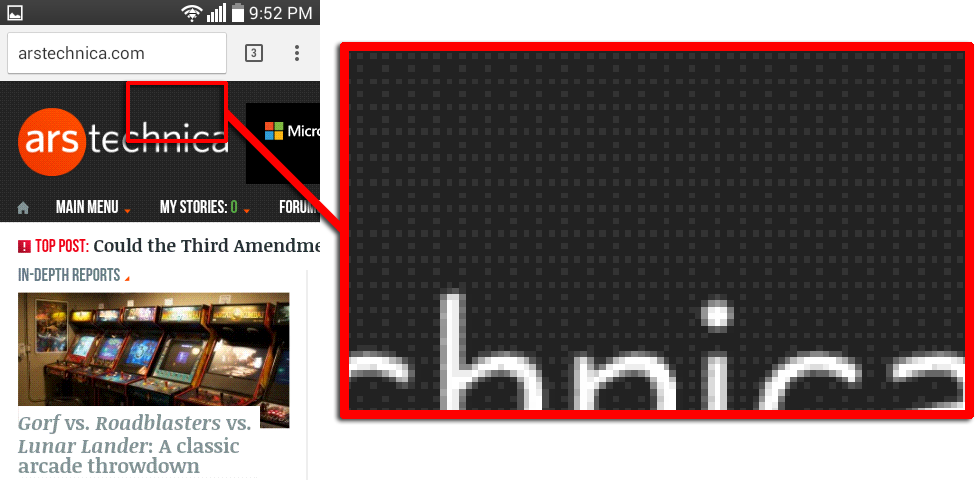
Dithering in action on the LG Sunrise awful display. The dark background should be a solid color, but it isn’t. Credit: Ron Amadeo

Any modern display you use today has 16 million colors, but the Sunrise LCD can only display 65,000 colors. To make up for the missing 15.9 million colors, the display uses “dithering” where instead of a solid color, it tries to “mix” colors together by displaying a pattern of the closest two colors it can show. For instance the background of the dark meincmagazine.com site isn’t pure black—it’s something the Sunrise can’t quite display—so it makes the background grey and overlays a grid of black dots onto it. This happens on most colors and makes the already grainy display look even grainier.

The display hurts every single activity you can do on this device. It can load webpages, but reading text on the grainy screen is unpleasant. It can play YouTube videos, but they’re often hard to see unless you nail the viewing angle. The small size makes the typing on the tiny keyboard a challenge. You can’t even sit it on a table and glance at your notifications, because the angle is too strong, so the screen will go white.

The back of the Sunrise pops off, revealing the 1540mAh removable battery and MicroSD card slot. The Sunrise actually comes with a 4GB card pre-installed, which is pretty shocking given that is purely a luxury item that you don’t need. It’s possible live off the 4GB of internal space and never use the SD card.

$10 means you’ll have to cut some of the standard suite of smartphone features, so the Sunrise is missing a few things. There is no front facing camera, no rear flash, no NFC, and only a single microphone (modern phones use a second mic for noise cancelling). There are capacitive buttons at the bottom ofthe screen, but they aren’t backlit—just painted on with reflective paint. It’s interesting that these dirt cheap devices aren’t using on-screen navigation keys. We imagine that would be cheaper, since you don’t have to worry about the extra step involved in making the buttons, but none of these cheap devices ever seem to embrace on-screen buttons.

Overall, the device doesn’t only like a cheap smartphone, it feels like a toy version of a normal smartphone—just replace the LCD with a big sticker and you’d complete the look. It’s light, tiny, fat, and the 3:2 aspect ratio just makes something seem “off” about the whole device.

Software

The lock screen, app drawer, and settings.
The messaging app with keyboard, the phone app, and the calendar.

It feels weird saying this about a device that runs an OEM-skinned version of Android 4.4 KitKat in 2015; but the software is the highlight of the LG Sunrise. It runs a real version of Android, complete with all the apps and features you would expect from any other smartphone. You’ve got the Play Store and access to over a million apps, along with all the Google apps and access to just about every Google service. Running on Android 4.4 doesn’t really slow the Sunrise down when it comes to Google apps. You get up-to-date versions of everything, thanks to Google Play Services filling in most of the functionality gaps.  

The skin is basically the same thing that LG shipped on the LG G3, which also shipped with KitKat. LG just took that KitKat build and dumped it onto the Sunrise, minus some of the fancier effects. The problem is the G3 had a 2560×1440 display, and this device is running at 480×320, so everything feels like it’s too thin and lacks definition and clarity. Fonts need to be beefier, outlines need to be thicker, and the UI needs to be simpler, but none of that happened during the transition to the low-res screen. Our favorite resolution-challenged interface piece is LG’s Clock app icon, which tries to render 60 tick marks around the perimeter of an analog clock but in a 48×48 icon.

The result is a UI that is kind of an ugly mess. The chosen font weights and the overall font rendering makes reading anything rather unpleasant. Android’s font anti-aliasing just doesn’t work on a 480×320 display, where most letter strokes are only the width of one or two pixels. LG’s defaults don’t help matters either. The default home screen background—a photograph of a beach—too busy to too lightly colored, which makes reading the icon text and status bar icons difficult.

Camera

Of course the 3MP camera in a $10 phone is going to be bad, but it’s not the worst camera we’ve ever tried. That distinction still belongs to the $35 Cloud FX phone that runs Firefox OS. It’s hard to say how good a $10 phone camera should be really.

For the competitors, we’ve got the $100 MicroMax A1, one of the first Android One phones; the $35 Intex Cloud FX, which has one of the worst cameras ever created by mankind; and the $380 Nexus 5X, as a show of what a good camera would do.

Sure, this is a bad picture from the Sunrise, but what qualifies as a “good effort” from something this cheap?
Here’s the $100 Android One phone. It’s not as washed out, but not much better.
And the Sunrise is WAY better than the awful Cloud Fx camera. This is the best picture out of multiple shots.
Here’s the Nexus 5X, showing how it’s done.


The weather is not cooperating, so here’s a rainy photo from the Sunrise. It’s not bad compared to the other cheap phones.
Here, the Android One phone turns our scene pink.
And the Cloud FX is again, shockingly, hilariously awful.
The Nexus 5X does brilliantly.


A picture in moderate low light. The Sunrise doesn’t do very well.
It can’t compete with the Android One phone.
We’re always impressed with how bad the Cloud FX camera is.
The Nexus 5X makes it look like someone turned on the lights, but we swear we didn’t.

Performance

Overall performance is awful. You’re often waiting multiple seconds for apps to launch, and some things like the home or recent apps button will result in a few seconds of a black screen while everything unloads and loads into memory. When you spend such a small amount of money on a phone, you’re giving up any aspirations of speed and just focusing on “can it eventually do this task, or not?”

The last ultra-cheap phone we tested, the $35 Cloud FX phone, couldn’t run a single benchmark. Part of that was due to it running FireFox OS and having no real benchmark apps, but we also couldn’t complete a single browser benchmark. We’re happy to report we got most of our usual benchmark software to actually run on the Sunrise, save for the Google Octane browser test and most of the GFXBench GPU tests.

GFXBench gave us the most trouble, with only the older “T-Rex” test able to run on the Sunrise. Usually the GFXBench tests come in two versions: “Onscreen,” which runs at the native resolution of the display (320p in the case of the Sunrise) and an “Offscreen” version which runs at a normalized resolution of 1080p. The Sunrise couldn’t handle the harder 1080p test, leaving only the 320p native resolution test.

The Sunrise has 512MB of memory, which is another limiting factor for GFXBench—the app warns you about memory limits even when you run it on a 1GB phone, and halving the RAM means that most of the tests won’t work. This will also affect 3D games and apps, one chunk of the Google Play Store’s app selection the Sunrise can’t handle. The Sunrise ran every 2D app we threw at it, including games like Angry Birds, but 3D apps follow a similar pattern to GFXBench: anything difficult will fail to run. The Sunrise can run the barest of 3D games, but anything more complicated than Temple Run probably won’t work on this phone.

If you were wondering what the difference is between $10 and $600, it’s about a 10x improvement in benchmark scores.

If only the screen were better…

The Sunrise is slow, it’s small, it feels like a toy, it’s shipping two-year-old software, and the camera is bad. We could forgive it all though if the screen just worked. The low quality screen hurts just about every activity you can do on the Sunrise. You really can’t use it at a table because the slight angle makes the screen unreadable. The graininess and constant “shimmering” effect makes reading unpleasant and video difficult to discern.

Other than the screen issues, and it being very slow, it’s a surprisingly functional little device. While it looks and feels like a toy replica of a phone, it can run just about any 2D app that serious phones can run. If you can snag one for $10, it’s better than nothing. Maybe you could gut it or install some software and turn it into some kind of little project phone. And if you desperately need to get up and running with some Android software, it’s hard to beat a price like this.

Good

  • It’s TEN DOLLARS. We’ve spent more than that on a USB cable just to charge a smartphone.
  • It can run all the 2D apps your big $600 phone can run.

Bad

  • It’s really slow.
  • The camera is awful.
  • It’s shipping Android 4.4 KitKat and it’s almost 2016.
  • LG’s skin was designed for a 1440p display and downscaled to a 320p device.

Ugly

  • The low-quality screen ruins most of the activities you would want to do on a phone.
Photo of Ron Amadeo
Ron Amadeo Reviews Editor
Ron is the Reviews Editor at Ars Technica, where he specializes in Android OS and Google products. He is always on the hunt for a new gadget and loves to rip things apart to see how they work. He loves to tinker and always seems to be working on a new project.
286 Comments