Skip to content
Tech

“Oprah” for indie bands: Apple once loved unknown acts—what changed?

Why you’ve heard of Feist instead of Willy Moon, and why it’s unlikely to change.

Nathan Mattise | 78
Silhouette of a man using an iPod
Apple has always been a company that takes its audio fairly seriously. Credit: Aurich Lawson
Story text

In April 2007, only diehard Broken Social Scene fans salivated when band member Leslie Feist released a solo album titled The Reminder. Sales were moderate for the first five months, reaching an average of 6,000 per week.

But that September, Apple released its most impactful ad since it unveiled the Macintosh. The spot had a simple concept: a pudgy iPod Nano laid flat against a white table, with a hand repeatedly removing it to reveal another Nano in another color. Each Nano showed the same music video—the song “1234” from Feist.

A little video for everyone.

Within five weeks of the commercial’s launch, Feist’s total album sales reached nearly 300,000 units. Roughly 100,000 of those sales came after the ad campaign started, according to USA Today. Fast forward six more months and The Reminder had moved more than 730,000 copies, according to Spin.

The undeniably catchy “1234” may have experienced an even greater individual bump. Reuters reported that in the first month after the ad appeared on television, the song went from 2,000 downloads per week to more than 70,000. It eventually leapt into the Top 30 of the Billboard Top 100 chart.

Feist was by no means new. Besides her continued role in Broken Social Scene, she began releasing solo albums in 1999, with 2004’s Let It Die a Juno Award-winning favorite back in her native Canada. But following the iPod Nano spot, Feist was everywhere—performing on shows from Sesame Street to the Grammys, where she received four nominations including “Best New Artist.” Feist even guested on SNL and The Colbert Report, where, naturally, Stephen Colbert summed up her situation perfectly: “I discovered her in a little out-of-the-way club I call an iPod commercial.”

Feist wasn’t the first musician to launch off the strength of an Apple commercial; the trend had gained enough attention that The New York Times asked “Is Apple the Oprah for indie bands?” But in the years after “1234,” Apple commercials became a less reliable way for bands to make it big. Lightning didn’t strike in the same way for The Submarines, Chairlift, or the Ting Tings, for instance—and that trio is likely the most notable bunch of the post-2007 Apple ad soundtracks.

Today, the multi-year streak when lesser-to-unknown acts caught their break via iDevice ads seems to have ended. When Apple used an unknown Willy Moon for its bouncy iPod reboot spot in 2012, the song (“Yeah Yeah”) only sold 155,000 copies in six months, according to Billboard. (Feist’s single sold 180,000 copies within a single month.) So sorry, Julie Doiron, you may be a few years too late.

What changed?

Not the ad, but the user-created video that spawned it.

Before (and immediately after) Feist

To interpret the present, it’s important to understand that Apple’s support of musicians went deeper than a few iPod spots. To start, Apple began winning over musicians at a tenuous time for the music and technology industries.

“It’s a very cool thing for musicians and music,” U2 frontman Bono famously said at the 2003 launch event for iTunes. “That’s why I’m here to kiss the corporate ass. I don’t kiss everybody’s.”

The iPod and iTunes prompted an entire decade of Apple defining digital business for the legacy music industry (a mantle that today has been seemingly passed to streaming companies like Spotify and Rdio). This argument has been laid out in plenty of places (there’s even an entire chapter called “The Music Man” in Walter Isaacson’s Steve Jobs biography), but the gist is this: the iPod changed how we consume music, iTunes and the iTunes store changed how the industry operates, and the iPhone brought all these changes to the mobile phone, which has achieved near ubiquity.

But being music’s suit-and-tie management consultant isn’t exactly exciting. Initially, Apple consciously positioned itself as a young, hip tech company, a move that was vital for Cupertino to reach its current heights. Musical taste was as much a part of that branding as product design.

“I had this crazy idea that we could sell just as many Macs by advertising the iPod,” Jobs said, according to Isaacson. “In addition, the iPod would position Apple as evoking innovation and youth.”

Apple used $75 million of advertising money to pitch the iPod, outspending device competitors by a factor of about a hundred. Early iPod advertisements relied mostly on big, familiar names like Eminem, Bob Dylan, and U2. Only later in the decade—say 2005 to 2008, following a year that saw both U2 and Coldplay in ads—did the tone really shift toward Jobs’ goal of evoking youth.

This mid-decade period is when Apple truly embraced the notion of launching bands like the Fratellis, Caesars, Yael Naim, et al. (All those links lead to nostalgic advertisements; two have the famed dancing silhouettes, and the third is the first Macbook Air spot).

The power of the company’s brand around this time might be best exemplified by the group which came right after Feist. One month after the “1234” spot, Apple garnered headlines for empowering a now-famous, user-created iPod Touch ad: “My music is where I’d like you to touch…” The song in the ad was from an unknown Brazilian group called Cansei de ser Sexy (CSS). According to the San Francisco Chronicle, CSS’ 2006 debut album was selling under 350 copies per week pre-commercial. After the October 2007 launch of the ad, that figure moved above 1,000, and the song—“Music is my Hot, Hot Sex”—snuck into the Billboard Top 100.

“This is one of the rare instances where we can point to a single event and say, ‘This is for sure what’s driving all of our record sales,’” Tony Kiewel, CSS’ agent at Sub Pop records at the time, told the paper. “The band is completely absent from this country and has been for ages. And the record is over a year old.”

Sound familiar? This came before the more famous Apple spot.

What made CSS’ success even more astounding was that the very same song was in a similar US ad just months before—but it was unable to make a real blip on the cultural radar. In 2006, Microsoft’s Zune used “Music is my Hot, Hot Sex” to soundtrack an ad about an animated lion and gazelle duo. CSS band manager Joel Mark told Ars last year that this kind of double-dipping is pretty typical for a band. There wasn’t any intent to pair up specifically with tech companies pushing digital music players—rather, the goal was to get the music in front of the public in as many ways as one could.

“Anything you’re doing—when you agree to put a song in a movie that the band likes—you think ‘Hey this is great.’ So many people are going to see this movie, it’ll live online forever, and this will be a good way to promote the music,” he said. “In a way they’re all marketing impressions, and you don’t know what impression will convert someone to like the artist. But the Apple ad was a tangible boost, absolutely. I don’t know if the Zune ad was; I don’t feel like it was. With the Apple thing, it was a big change. You felt things shifting around the band, and that might be the single biggest thing that they’ve done.”

An intrepid reporter filed this after hearing a band via iTunes sessions. Credit: Nathan Mattise and Aaron Freeder for The Newshouse.com

Monetizing sessions

People mostly remember the commercials, but Apple could launch bands in other ways, too. When iTunes 1.0 appeared in 2001, live sessions for iTunes quickly followed (yes, before the iTunes Store launched two years later). Today you can find exclusive live recordings of hits like Train’s “Drops of Jupiter” and Kelly Clarkson’s “Since U Been Gone” among those early iTunes sessions.

The concept of live sessions wasn’t new, but it had largely been limited to radio stations. For example, KCRW’s Morning Becomes Eclectic has been at this since the late 1970s; WBEZ’s Sound Opinions since the late 1990s. But making these exclusive live performances instantly downloadable commodities became a big differentiator. A live session for Apple can bring bands a coveted spot on the iTunes front page, arguably the most desirable place for a band to showcase their music to this day.

“Even now—and forever more but especially then—when Apple says jump you say ‘how high?’” Graham Wright, keyboardist and songwriter for the band Tokyo Police Club, told Ars. “From our perspective, it wasn’t so common then to do sessions that were recorded of any kind. We had some recorded in Canada from the CBC, but this was the first time that some gargantuan force in the music world like Apple indicated any interest in us. And it worked out that we were in New York anyhow—not that we wouldn’t have traveled just to do it.”

Wright and Tokyo Police Club performed two live iTunes sessions during the peak of Apple’s role as musical tastemaker in 2007 and 2008. Wright said that the band’s 2007 Live at SoHo session (by his estimation, the lesser of the band’s two performances) even stayed among the top or most promoted things on iTunes for longer than the band might prefer, given that the band had an EP available and the session was a precursor to the band’s 2008 debut LP. Though it can be difficult to pinpoint one particular “big break” when bands are doing so many things simultaneously, Wright does recognize the enormity of that iTunes opportunity.

“As far as I’m aware, you can pay Amazon or iTunes or anyone to get nice, big, front page placement when you log into an online store. But if you’re TPC, especially TPC in 2006, you don’t have the cash on hand to do that,” he said. “But in this way Apple has evened the playing field. By providing content that’s exclusive to them, that all of a sudden pops up on the main page, and it doesn’t cost a cent to the band. This is great because independent bands are chronically short of funds, but their supply of music is virtually inexhaustible.”

iTunes had other band-boosting mechanisms, too. iTunes offered a “Single of the Week” for free download, and bands like The Alabama Shakes have received that honor and a Grammy nomination within the same calendar year. That initiative soon expanded to Starbucks offering free download codes for iTunes singles, pushing dumb Norah Jones’ duets IRL, too.

Dave Grohl—of Foo Fighters, Nirvana and Them Crooked Vultures—basks in the glory of Apple.
“I once got kicked off SNL for playing an anti-industry tune, can you show me how this new iPhone works?”

Live music

Since the early days of its Macworld conference appearances, Apple has made musical performances part of its events—bands like The Foo Fighters and Elvis Costello have played at recent product unveilings. The company eventually spun this fondness for live music into its own music festival starting in 2007, and the iTunes Festival expanded from the UK to the US last year. Like Apple’s overall approach to music, the lineup has shifted from lesser-knowns to true headliners over time: Mika headlined the first festival, while Paul Simon, Lady Gaga, and Usher took turns in recent years.

With the iTunes festival, Apple apparently wanted to identify itself with one of the few areas of the music industry that was growing: live music. In 2013, there was at least one multiday, outdoor music festival per week from June 1 through September 1. In fact, there were more notable festivals during that time period (at least 96) than there were days (precisely 93). According to LA Weekly, concert revenues as a whole reached $4.3 billion in 2013, compared to only $7 billion for all music sales. The paper reported that the lowest-rung act at a festival like Coachella can earn $15,000+, while headliners can command seven figures.

If anyone needed an Apple-bump, surely it was legend David Bowie releasing his first album in 10 years. O_O

“When you can stream on iTunes, you do it”

Quietly, in 2011 with the Red Hot Chili Peppers’ I’m With You album ready to launch, Apple rolled out a pre-release album stream platform. Accessed only through the iTunes store (and today through an iTunes Radio channel), Apple allowed fans to preview an album in its entirety—with the ability to pre-order just a click away on the same screen.

Again, this wasn’t a new concept. Bands previously allowed their albums to be previewed for free through media outlets like AOL’s Spinner and NPR Music. But unlike most other pre-release opportunities, Apple provided a direct link to tangible pre-orders within the largest music outlet on the Internet.

Local Natives’ second album, Hummingbird, streamed on iTunes before its release in January 2013. Apple identified a band ready to break, according to Paul Hanly, who helped market the album for Frenchkiss Records. Here’s how Hanly describes the deal:

So this was a band poised to be in the same conversation as Grizzly Bear or Beach House, and we began playing the record for iTunes very early on. They loved it. They hadn’t really attached themselves to an indie artist for a stream, but we were given this great opportunity to do this. They were giving us, a smaller band in the grand scheme, huge placement. We knew they were supporters in the past, but this only solidified their support.

The stream helped us get a 360 ad campaign with them, and as a result we had an amazing first week sales—debuted at No. 12 on the Billboard and a lot of that was the iTunes sales from our ad placement and the stream. We were also going to do a stream with NPR, but we ended up working out a radio session with them instead. iTunes had the exclusive on the album version…

Not to take away anything from campaigns we did with Amazon or other online retailers, but when you can stream the album a week earlier on iTunes, you do it.

In the three years since Apple started pre-release streams, Local Natives may have been the smallest act to participate. The list of bands showcased is varied—Kanye West, David Bowie, La Roux, Carrie Underwood, Justin Timberlake—but, frankly, they’re all A-listers.

And the power of that positioning is real. More than a quarter of album sales today comes from pre-release transactions. And while it may not have been the only factor, just last year the iTunes pre-album stream setup had a string of releases that went from iTunes immediately to No. 1 on the Billboard charts: Daft Punk’s Random Access Memories, Queens of the Stone Age’s …Like Clockwork, and Vampire Weekend’s Modern Vampires in the City. At the time, the Daft Punk album had the second highest first week sales of any LP in 2013, according to Billboard. (The first was a Justin Timberlake album that also premiered on iTunes.)

Are you a 2014 buzzband? Chances are your music can be found elsewhere.

The shifting scene

Apple uses its clout in different ways today. For instance, it still produces new iTunes sessions, but song downloads themselves have become less valuable to a band. Recent Nielsen industry reports show on-demand streaming up 42 percent year-over-year, exceeding 70 billion plays. By contrast, digital song sales dropped 13 percent to 593.6 million. While iTunes still generates record sales (Apple attributed $4.5 billion in income from “iTunes/software/services” in Q3, its fourth highest earning product), the company acknowledges this is largely due to app store sales and not to music.

Thanks to these industry shifts, smaller buzz bands today—say, 2014’s potential end-of-the-year list darlings, Future Islands—might want to make their exclusive performance recordings a Spotify session rather than an iTunes one. (In fact, Future Islands did exactly this.)

So downloads need to be more enticing now. Today, most iTunes sessions are no longer from bands the size of Tokyo Police Club. Bigger acts like OneRepublic (a pop/rock act big enough to collaborate with Timbaland) or Florida Georgia Line (of the inescapable, in some parts, “Cruise”) now sit atop any recent “iTunes Session” Google searches.

Part of this is beyond Apple’s control. More and more entities are asking bands for this kind of exclusive content. Albums may be recorded specifically for Rdio or Spotify, for the Google Play Store, or for numerous online music site series that range from the established (La Blogotheque or Daytrotter) to the obscure (performances on a big yellow couch or in the back of a Volkswagen).

For bands, the temptation is to churn out some “exclusive” for every outlet that asks for one, but that’s not always the best strategy.

“The Takeaway shows from La Blogotheque, I remember when I discovered that, it was the coolest thing ever,” Wright said. “But now when we’re on tour, it’s not an exaggeration, half of the cities we go to we get an e-mail from someone with a T3i, [saying,] ‘This is a thing, a site called Fountain Songs, come play unplugged versions of your songs—but by a fountain!’

“Bands have an inexhaustible supply of musical trinkets. If I could pay my rent with half-baked musical ideas, I could pay my rent forever. But you start to realize maybe quantity isn’t the best idea, you don’t want to put your name on mediocre shit. You might not even realize it, it comes one e-mail at a time, but you can end up diluting what you put into the world with all these half-ass bonus tracks. I fear it’ll become a weird zero sum game going forward, since people seem to consume music like I read reddit—which is to say, I’ll read it for three hours, and I won’t remember a single thing about it.”

Apple’s famed advertising has undergone a similarly subtle shift. In its recent health-themed iPhone 5S commercial, Apple dug out a bit of exercise propaganda from the Kennedy era. In the visually minded iPad Air spot, there’s no music at all, merely a Walt Whitman verse. The first iPhone 6 ads opt for star power, with Jimmy Fallon and Justin Timberlake recreating the theme from 2001: A Space Odyssey. Even a music-centric 5S commercial opted for A) a cover from B) an older group (The Pixies) when turning “Gigantic” into a spring earworm.

“When the Apple ads came on TV, they seemed to only expose new music,” said Mark, the CSS manager. “The first was with that group The Caesars. A friend of mine was with their US label, the band was minty fresh, and they were a Swedish import. But it was this interesting thing—that Apple was only using these relatively lesser known bands and songs and really breaking artists.

“It’s changed completely, and I don’t know why. I’ve had a couple meetings down there, but they’re not going to tell me why they’re changing what they’re doing. But that outlet is no longer there for music in general, and it used to be a couple artists per year were broken through being in those ads. And we don’t have that anymore.”

Even if the company won’t say why, the shift away from buzzy music makes sense. Devices being highlighted in today’s ads aren’t typically music-centric and don’t need to cater to a record-store audience. How many songs does a user need on an iPhone if that storage can be better spent on apps, which take up more than 50 percent of digital screen time for the average American? Several of those apps have the potential to provide access to seemingly every song in existence anyway. Newer Apple ads simply make soundtrack choices that reflect this.

The iPhone’s rise in particular has accelerated the company’s de-emphasis on music credibility. Whereas the early iPhones could get away with being a touchscreen iPod with calling, texting, and Web browsing capabilities, today all of those are just individual functions among many. iPhone ads now focus on the visuals (it’s the video and still camera for millions) and its Swiss Army knife-tech experience (Game! Tweet! Facebook! E-mail, and manage work materials!). Since the iPhone debuted in 2007, the iPod is Apple’s only product line with steadily declining sales. Apple’s new core device prioritizes its near-infinite flexibility, and it has ushered in an era of “When will Apple kill the iPod” rumors for the fixed-use music machine since 2011. And while Apple shouted the iPhone 6’s merits from the rooftops last month, it quietly and finally put the ol’ music player out of its misery. The classic iPod has been killed off.

Here’s something for you, too

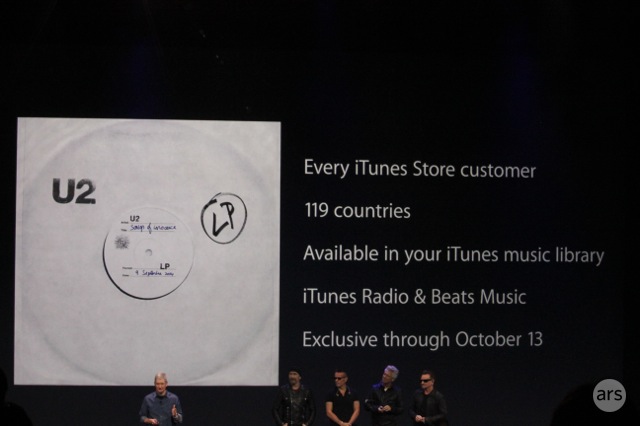
The access Apple can offer a band today, reserved for U2-types. Credit: Megan Geuss

Recently, Apple took the idea of an album stream one step further. The company agreed to release an album outright for free, pushing the music to 119 different countries and half a billion people. A reported 200,000-plus listeners downloaded the album in its first week, a figure that would be good enough to top the charts straight away. Good luck finding that large of an audience through traditional means.

The band to benefit from this was, of course, a little independent act called U2. We’re sure that the rock legend, releasing its first new album in over five years, needed some press, but the deal also involved compensation. The New York Times pegs it at up to $100 million.

The U2 partnership won’t bolster Apple’s hip image nearly as much as if the company released Apple partner Dr. Dre’s long-rumored Detox album, as rock critic David Greenwald suggested. But it’s absolutely in line with the company’s slow progression back toward established acts rather than indies.

Beyond Apple, the current tech landscape doesn’t offer much for upcoming musicians either. Many musicians have spoken out about pennies per stream offered by Spotify, including heavy-hitters like Beck, who said he’d be out of business if he relied on streaming for steady income. Declining and changing sales have led to a lifestyle where it’s touring that pays the bills, and constantly being on the road isn’t as glamorous as a musician might hope.

While by all critical accounts an act like Grizzly Bear is a successful band, an infamous New Yorker profile around the release of its Shields LP shone a light on even an “established” band’s finances. “Obviously we’re surviving,” singer Ed Droste told the magazine. “Some of us have health insurance, some of us don’t, we basically all live in the same places, no one’s renting private jets. Come to your own conclusions.”

The reality is that things have dramatically flipped since Apple first tried to burnish its reputation for music. Apple no longer relies on music-centric devices even as the music industry has shifted away from a digital ownership model (good for iTunes!) to a streaming, vinyl, and digital ownership model (just OK for iTunes). In light of that, why devote any resources to some kind of hipness arms race against the new music tech companies?

As Vulture recently pointed out, the biggest bands in the world today try to attach themselves to Apple for credibility—a complete inversion of the original model. It was Bono asking for help and thanking Tim Cook at the iPhone launch event, not the other way around. And even then, Apple likely only listened because it’s U2.

Musicians and industry types might hope that Apple return to the indie-inflected days of yore. But music fans have more options to consume and discover than ever before, and many of these are better and more convenient than what Apple offered when it helped to revolutionize music for a generation. The company’s focus may be better applied elsewhere (see how quiet things have been on the Beats’ front compared to future wearables), but the music industry is the only one worse off for it.

“With streaming services today, if Apple comes up with something that’s even better I’ll be shocked in a happy way,” Mark said. “I hope they go back to using music to advertise it; you’d think they’d get back to a second era of Apple ads that break new artists.”

For now, it’s clear music is no longer Apple’s hot, hot anything. Instead, the company has apparently found what it’s looking for in big-name bands like U2.

Listing image: Aurich Lawson

Photo of Nathan Mattise
Nathan Mattise Features Editor Emeritus
78 Comments